
Whenever a central bank announces a cut to the reserve requirement ratio or policy interest rates, the most common market commentary proclaims that "the central bank has unleashed hundreds of billions in liquidity" or that "banks are flush with cash that will instantly flow into the real economy." While intuitive, such narratives skip over the most critical operating mechanisms of modern banking.
Commercial banks are not old-fashioned money shops locking physical cash in vaults, nor does modern credit creation work by central banks printing paper notes and handing them over to commercial lenders. When a central bank cuts reserve requirements, total funds in commercial bank accounts may not increase by a single cent. When a central bank injects hundreds of billions in interbank liquidity, loans to the real economy do not automatically expand in equal proportion. Meanwhile, on the other side of the Atlantic, the Federal Reserve reduced its statutory reserve requirement ratio to 0% in 2020, yet commercial banks in the United States currently hold trillions of dollars in reserves—far surpassing historical norms.
Understanding the real efficacy of monetary policy tools requires looking past superficial "easing" and "tightening" rhetoric and mapping the central bank, commercial banks, and the real economy onto an interconnected balance sheet network. Do specific tools alter reserve constraints, reserve quantities, or the price of liquidity? Why does an injection of reserves fail to automatically generate broad money? And what distinct policy implementation frameworks are currently adopted by major central banks across China, the United States, the euro area, and the United Kingdom?
I. Starting with an RRR Cut: What Does the Central Bank Actually Release?
To trace the transmission of monetary policy, consider the most familiar instrument: a cut to the Required Reserve Ratio (RRR).
The statutory reserve requirement mandates that commercial banks, upon taking in customer deposits, must hold a specified percentage of central bank money in their reserve accounts at the central bank, sequestered from arbitrary deployment.
What happens on bank balance sheets at the exact moment an RRR cut takes effect? Consider a simplified commercial bank balance sheet model.
Suppose a commercial bank currently exhibits the following balance sheet structure:
| Asset | Amount | Liability | Amount |
|---|---|---|---|
| Reserves | 10 | Customer Deposits | 100 |
| Loans | 90 | ||
| Total Assets | 100 | Total Liabilities | 100 |
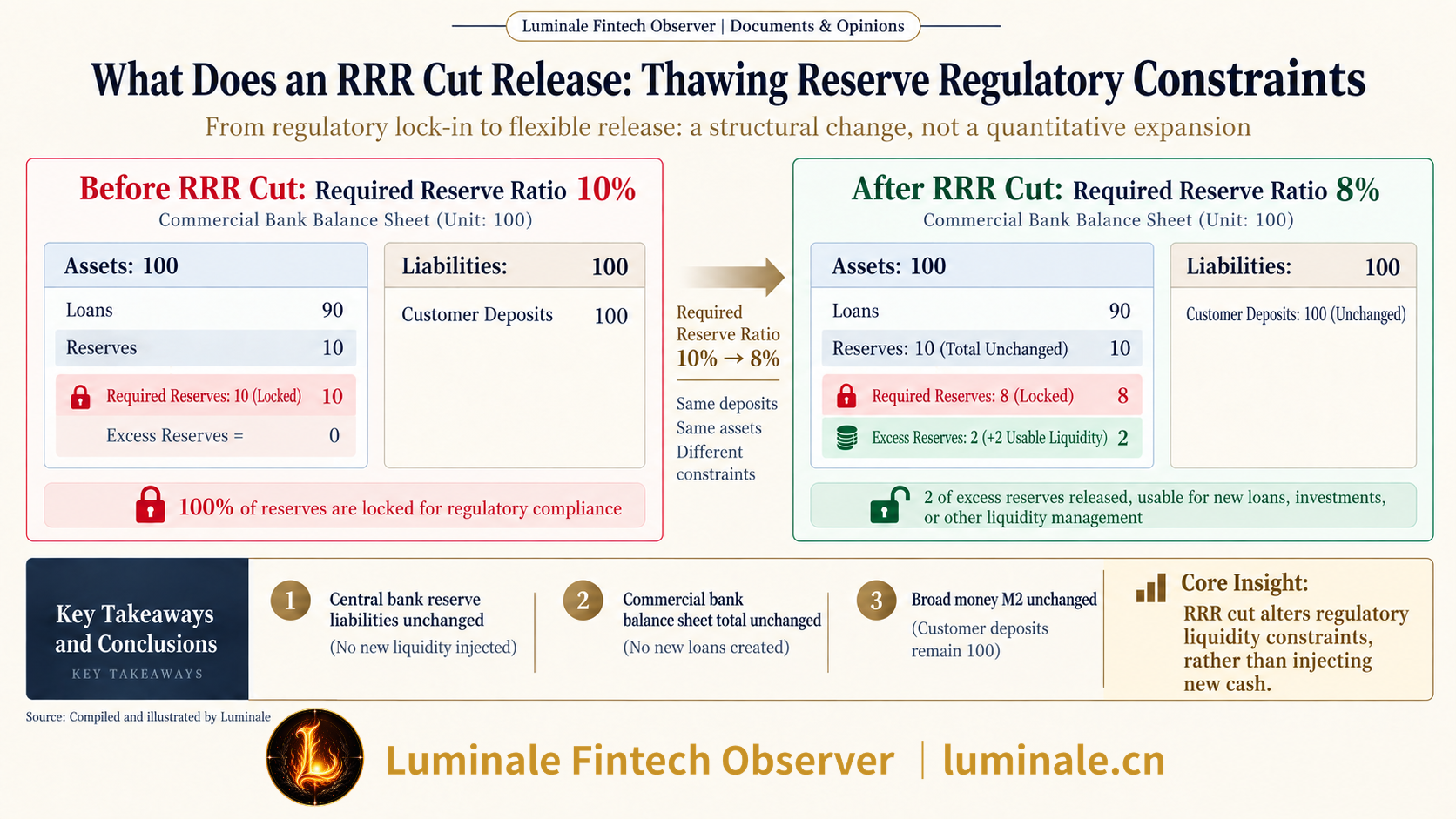
Assume an initial statutory reserve requirement ratio of 10%. At this stage, all 10 units of reserves held by the bank represent Required Reserves pledged to meet regulatory compliance, leaving 0 units of freely usable Excess Reserves.
Now, the central bank announces a reduction in the reserve requirement ratio from 10% to 8%.
At the precise moment the RRR cut takes effect, the bank's reserve structure shifts as follows:
| Reserve Item | Before RRR Cut (RRR = 10%) | Moment of RRR Cut (RRR = 8%) | Change |
|---|---|---|---|
| Required Reserves (Regulatory Locked) | 10 | 8 | -2 |
| Excess Reserves (Freely Available) | 0 | 2 | +2 |
| Total Reserves (Central Bank Liability) | 10 | 10 | 0 |
| Customer Deposits (Commercial Bank Liability) | 100 | 100 | 0 |
Three foundational realities emerge immediately upon implementation:
- The central bank balance sheet size is unchanged: Total reserve liabilities on the central bank balance sheet remain exactly 10 units.
- The commercial bank balance sheet size is unchanged: Total assets and liabilities of the bank remain exactly 100 units; the central bank has injected no fresh base money.
- Broad money (M2) does not increase: Deposit balances owned by corporate and retail depositors remain exactly 100 units.
An RRR cut primarily alters the regulatory liquidity constraints under which commercial banks hold central bank money, rather than the aggregate volume of reserves. The 2 units of central bank money previously frozen by compliance mandates are "thawed" into freely usable excess reserves.
This explains why the People's Bank of China (PBOC) consistently characterizes RRR cuts as "releasing long-term liquidity"[1]. Freeing up locked institutional liquidity reduces daily liquidity management frictions for commercial lenders while lowering the marginal opportunity cost of freezing reserves against future deposit growth.
If banks take these 2 units of unburdened liquidity and redeem maturing Medium-term Lending Facility (MLF) borrowings from the central bank, or absorb seasonal tax remittance cash drains, the central bank balance sheet may subsequently contract during settlement. Liquidity released through reserve requirement reductions cannot be translated into credit growth through naive formulas. Under a modern two-tier fractional banking system, loans are not created by "taking cash out of a vault to hand to a borrower." Instead, loan disbursement and customer deposit crediting occur simultaneously, while reserves serve primarily to settle interbank transfers, support interbank clearing, and satisfy regulatory liquidity metrics. Treating the reciprocal of the statutory reserve ratio as a mechanical "money multiplier" disregards balance sheet choices and regulatory realities.
II. Mapping Tools onto Balance Sheets: Volume, Price, and Orientation
If RRR cuts modify reserve "constraints," how do other central bank instruments take effect across central bank and commercial bank balance sheets?
Modern monetary policy instruments can be unified under four balance sheet mechanisms: altering constraints, altering prices, altering reserve supply, and providing directional asset allocation incentives.
1. Altering Reserve Constraints: Statutory Reserve Ratios
As demonstrated above, an RRR cut initially neither expands central bank balance sheet size nor increases aggregate reserves. Instead, it reclassifies required reserves as excess reserves, easing institutional compliance constraints.
2. Altering the Price of Reserves and Funding: Rate Cuts
Relative to quantitative adjustments, interest rate management generally operates through "price first, quantity second."
Lowering policy interest rates does not require the central bank to execute balance sheet expansion on the announcement date. Instead, the central bank adjusts the opportunity cost for financial institutions to borrow liquidity from the central bank or deposit surplus balances with it. This price signal propagates across the interbank repo market, short-term money markets, sovereign yield curves, and commercial bank funding costs, eventually reaching the Loan Prime Rate (LPR) and corporate borrowing rates[2].
3. Expanding Reserve Supply Directly: Reverse Repos, Outright Repos, and Secondary Bond Purchases
When a central bank conducts a RMB 10 billion reverse repo operation with primary dealers via Open Market Operations (OMO), both balance sheets expand concurrently:
| Institution | Asset | Liability |
|---|---|---|
| Central Bank | Claims on Financial Institutions (Reverse Repo Underlying) +RMB 10B | Bank Reserves +RMB 10B |
| Commercial Banks | Reserves at Central Bank +RMB 10B | Borrowing from Central Bank (Repo Liability) +RMB 10B |
This operation represents direct base money injection. Commercial banks gain central bank reserves while incurring a corresponding short-term liability to the central bank, requiring repayment and collateral unwinding at maturity.
When the central bank purchases government bonds in the secondary market, settlement relies on Delivery versus Payment (DvP) mechanisms operated by financial market infrastructures. The accounting outcome depends heavily on the trading counterparty in the secondary market.
If the central bank purchases RMB 10 billion of government bonds directly from commercial banks:
- The total size of commercial bank balance sheets remains unchanged, undergoing an asset swap: "Government Bond Assets" decrease by RMB 10 billion, while "Central Bank Reserves" increase by RMB 10 billion.
- On the central bank balance sheet, asset-side "Treasury Bonds" increase by RMB 10 billion, matched by an asset-side increase of RMB 10 billion in "Commercial Bank Reserves" on the liability side.
If the central bank buys bonds held by non-bank financial institutions (such as mutual funds or insurers), settled through commercial bank custodian accounts, the accounting entries trigger an entirely different transmission channel:
- Non-Bank Financial Institutions: Asset-side "Treasury Bonds" decrease by RMB 10 billion, while "Commercial Bank Deposits" increase by RMB 10 billion.
- Commercial Banks: Asset-side "Central Bank Reserves" increase by RMB 10 billion, while liability-side "Customer Deposits (Non-Bank Institutions)" increase by RMB 10 billion.
- Under this structure, broad money (M2) expands directly upon trade settlement alongside the expansion of bank reserves.
4. Directing Liquidity Allocation: Relending, Rediscounting, and Targeted Policy Facilities
Standard relending and rediscounting facilities appear on central bank balance sheets as simultaneous expansions of claims on financial institutions and reserve liabilities. Their distinguishing trait lies in eligibility criteria and concessionary pricing:
- Structural Relending Facilities: Such as targeted facilities for sci-tech innovation, green development, and inclusive eldercare. Commercial banks first issue eligible loans to designated sectors and then apply for concessionary low-cost refinancing funds from the central bank.
- Capital Market Stabilization Tools: Such as the Securities, Funds and Insurance Companies Swap Facility (SFISF) and the stock repurchase/cash-out relending facility introduced by the PBOC in 2024[3]. The swap facility provides non-monetary asset-for-asset collateral swaps, boosting high-grade liquid asset access for institutional investors without expanding base money, while targeted repurchase facilities establish segregated loan custody loops to support market stabilization.
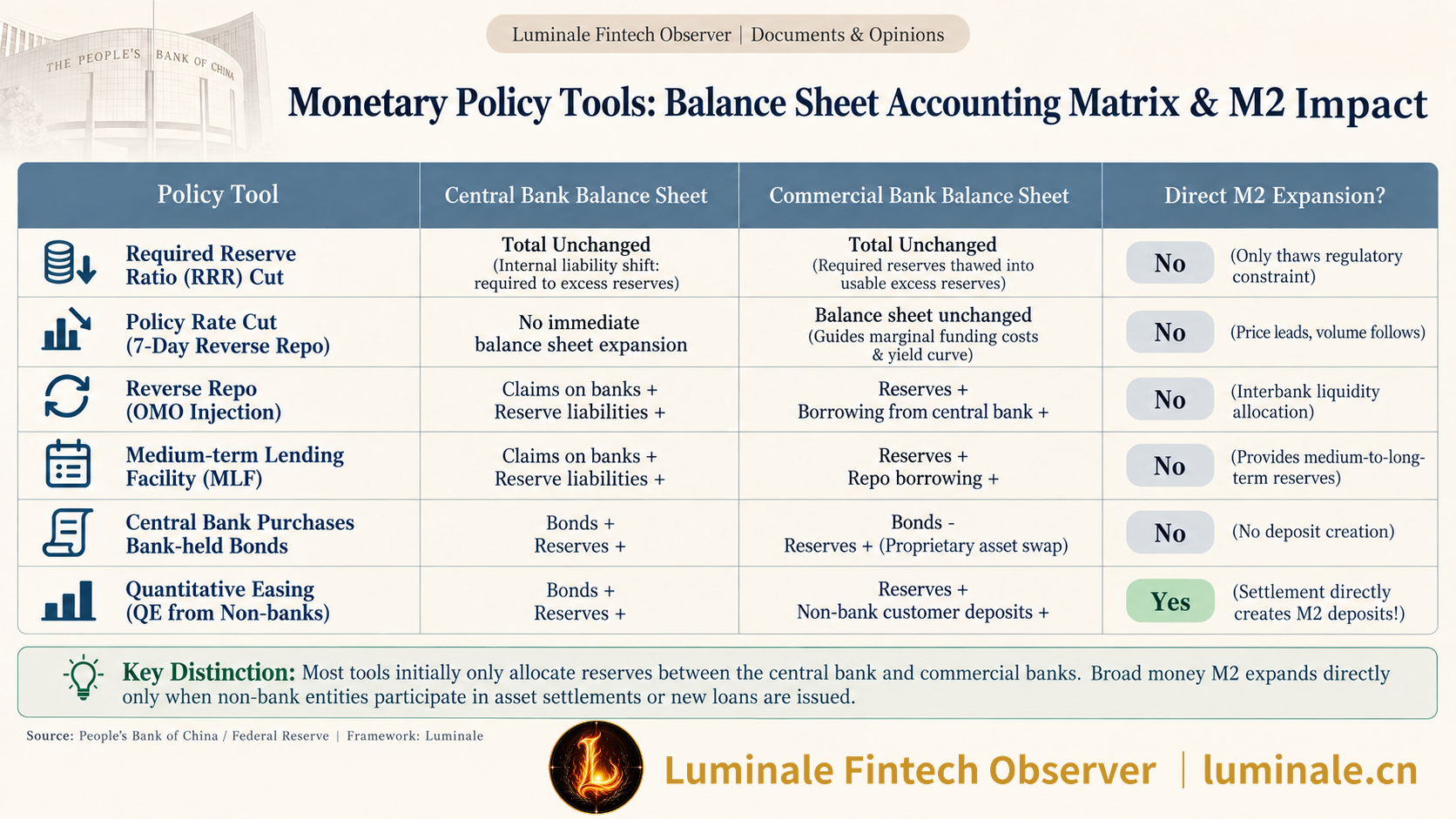
To summarize balance sheet effects across policy instruments, the following matrix compares seven typical operational scenarios:
| Policy Tool | Central Bank Asset Change | Central Bank Liability Change | Commercial Bank Asset Change | Commercial Bank Liability Change | Immediate Broad Money (M2) Expansion? |
|---|---|---|---|---|---|
| RRR Cut (Reserve Requirement Cut) | Unchanged | Internal shift: Required reserves decrease, excess reserves increase | Internal shift: Required reserves decrease, excess reserves increase | Unchanged | No (Only thaws regulatory constraint) |
| Policy Rate Cut (Rate Cut) | Unchanged | Unchanged | Unchanged | Unchanged | No (Alters marginal cost of funding) |
| Reverse Repo (OMO Injection) | Claims on financial institutions increase | Bank reserves increase | Reserves increase | Borrowing from central bank increases | No (Reserves increase without deposit creation) |
| Medium-term Lending Facility (MLF Injection) | Claims on financial institutions increase | Bank reserves increase | Reserves increase | Borrowing from central bank increases | No (Adds medium-to-long-term reserve liquidity) |
| Rediscounting | Discounted bill assets increase | Bank reserves increase | Reserves increase, bill assets decrease (Asset swap) | Unchanged | No (Commercial bank asset restructuring) |
| Central Bank Purchases Bank-held Treasury Bonds | Securities investment increases | Bank reserves increase | Reserves increase, bond assets decrease (Asset swap) | Unchanged | No (Interbank settlement only) |
| QE (Purchasing Treasury Bonds from Non-banks) | Securities investment increases | Bank reserves increase | Reserves increase | Customer deposits (Non-bank deposits) increase | Yes (Settlement directly creates broad money M2) |
III. Central Banks Provide Liquidity: Why Might Lending Still Fail to Materialize?
As shown above, except in specific cases where the central bank buys assets from non-bank institutions, most policy operations initially circulate purely within central bank and commercial bank accounts. Moving from reserve injection to real credit extension and broad money expansion requires clearing multiple balance sheet hurdles.
Within Luminale's payments and central bank balance sheet analysis framework, the transmission path comprises three interconnected layers:
Tier 1: Central Bank Balance Sheet (Adjusting reserve quantity, price, and regulatory lock ratio)
   │
   ▼
Tier 2: Commercial Bank Balance Sheet (Facing capital constraints, liquidity ratios, risk pricing, NIM considerations)
   │
   ▼
Tier 3: Real Economy Balance Sheet (Corporate expected returns, household leverage headroom, effective credit demand)
Transmission can stall at each successive boundary.
1. Capital Adequacy Constraints: The Hard Ceiling of Risk-Weighted Assets
Reserves on commercial bank balance sheets carry a 0% risk weight (under sovereign domestic currency claims). However, once a bank converts reserves into commercial loans, the asset must be weighted at 100% or another designated risk weighting under Risk-Weighted Assets (RWA).
Commercial credit expansion is constrained by regulatory capital mandates, including Common Equity Tier 1 (CET1) ratios. If a bank's capital buffers are exhausted, zero-cost central bank reserves will not enable compliant loan issuance.
2. Regulatory Liquidity Metrics: Looking Beyond Raw Reserve Totals
Basel III introduced the Liquidity Coverage Ratio (LCR) and Net Stable Funding Ratio (NSFR), imposing rigorous standards on liquid asset composition and liability duration. Long-term loans on the asset side require stable, matching term liabilities. If the central bank supplies liquidity exclusively via short-term 7-day reverse repos, banks confront asset-liability duration mismatches that prevent financing multi-year corporate capital expenditures.
3. Credit Risk and Net Interest Margin Considerations: Commercial Banks Must Absorb Losses
Commercial banks operate as commercial entities responsible for their own balance sheet performance. During economic downturns, counterparty default probabilities climb, requiring provisions for loan losses that directly erode equity capital. When Net Interest Margins (NIM) contract excessively, expected lending returns fail to compensate for credit risk and overhead, leading to risk aversion and credit contraction.
4. Effective Credit Demand in the Real Economy: Pushing on a String
Monetary policy can be pulled taut like a string during tightening, but frequently encounters friction when pushing credit into the economy. If businesses forecast excess capacity and consumers curtail borrowing to repair personal balance sheets, rock-bottom nominal interest rates cannot coax reluctant economic actors into taking on additional leverage.
A commercial bank's capacity and willingness to create deposit money is constrained by capital adequacy ratios, liquidity requirements, credit risk assessments, and real-economy balance sheet health. Reserves are vital settlement liquidity, but they are never the sole determinant of credit expansion.
IV. From China to the US, Euro Area, and UK: Four Distinct Operating Frameworks
While major global central banks pursue macroeconomic mandates of price stability and sustainable growth, their underlying reserve management systems and routine policy implementation frameworks have evolved along divergent paths.
1. China: A Tripartite Framework of Quantity, Price, and Structural Tools
The PBOC's monetary policy toolkit exhibits comprehensive structural characteristics:
- Active Statutory Reserve Ratio Management: Despite multiple RRR cuts, China's banking system retains an active, tiered statutory reserve requirement framework. Reserve ratio cuts serve as a primary instrument to release durable liquidity and reduce bank liability costs.
- Clear Policy Benchmark Anchors: The open market 7-day reverse repo rate serves as the primary policy interest rate anchor, guiding interbank market rates within a defined interest rate corridor.
- Diversified Medium-to-Long-Term Liquidity Injections: Through MLF facilities, outright reverse repos, and secondary market treasury bond operations, the PBOC supplies short, medium, and long-term liquidity.
- Targeted Relending Facilities: Providing concessionary refinancing funds to subsidize credit allocations toward green finance, small and micro-enterprises, and technology sectors, combining macroeconomic stabilization with targeted credit allocation.
2. United States: From Scarce Reserves to the Ample-Reserves Framework
The Federal Reserve reduced its statutory reserve requirement ratio to 0% in 2020:
- Prior to the 2008 global financial crisis, the Fed operated a Scarce-Reserves Framework. Total bank reserves were limited to tens of billions of dollars. The Fed conducted fine-tuned daily open market operations to steer reserve supply against demand, nudging the Effective Federal Funds Rate (EFFR) toward its target.
- Following the 2008 crisis, the Fed initiated multiple rounds of Quantitative Easing (QE), flooding the banking system with trillions of dollars in reserves. Reserves expanded far beyond statutory minimums, shifting the reserve supply curve into an elastic, flat horizontal region.
- In 2019, the Federal Open Market Committee (FOMC) formally affirmed its long-term commitment to the Ample-Reserves Framework. In an ample-reserves environment, marginal fluctuations in reserve supply no longer trigger sharp interest rate volatility.
- With reserves persistently abundant, statutory reserve requirements ceased to perform an active policy implementation function. On March 15, 2020, the Federal Reserve reduced statutory reserve requirement ratios across all depository institutions to 0%, effective March 26, 2020[4][5].
How does the Fed manage policy interest rates without statutory reserve requirements? It administers interest rates directly on reserves:
- Upper Corridor Anchor: Interest on Reserve Balances (IORB). The Fed pays interest directly on all reserve balances maintained by banks at Federal Reserve Banks. No commercial bank has an economic incentive to lend reserves in the interbank market below IORB, establishing an effective rate floor.
- Supplementary Sub-Floor Facility: Overnight Reverse Repo Facility (ON RRP)[6]. Because non-bank financial institutions such as Government-Sponsored Enterprises (GSEs) and Money Market Funds (MMFs) cannot hold reserve accounts at the Fed to earn IORB, the ON RRP allows them to place cash overnight with the Fed at an administered rate slightly below IORB, closing arbitrage loopholes beneath the target band.
The Fed no longer mandates minimum reserve holdings; it sets IORB and ON RRP rates to manage interest rate levels directly across a vast reservoir of reserves.
3. Euro Area: Retaining Minimum Reserves with the Deposit Facility Rate as Anchor
The European Central Bank (ECB) maintains a 1% Minimum Reserve Requirement (MRR) to stabilize money market rates and foster structural demand for central bank reserves[7].
In operational practice, however, the Eurosystem has moved past active RRR adjustments as a cyclical policy lever. The ECB's operational framework relies on an interest rate corridor where the Deposit Facility Rate (DFR) serves as the primary policy rate anchor. Surplus bank balances beyond minimum requirements earn the DFR, while Main Refinancing Operations (MRO) and Longer-Term Refinancing Operations (LTRO) fulfill banking system liquidity borrowing demands.
4. United Kingdom: No Statutory Minimum Reserve Ratios with Demand-Driven Repo Supply
The Bank of England (BoE) has historically operated without statutory minimum reserve ratios[8].
The BoE pays its official policy rate (Bank Rate) on all eligible reserve balances held by commercial banks. As Quantitative Tightening (QT) unwinds crisis-era asset purchases, the Bank of England is transitioning to a demand-driven, repo-led framework using the Short-Term Repo (STR) and Indexed Long-Term Repo (ILTR). Commercial banks exchange eligible collateral for BoE reserves on demand to satisfy settlement needs, proving that a sophisticated financial system can maintain financial stability without statutory reserve minimums.
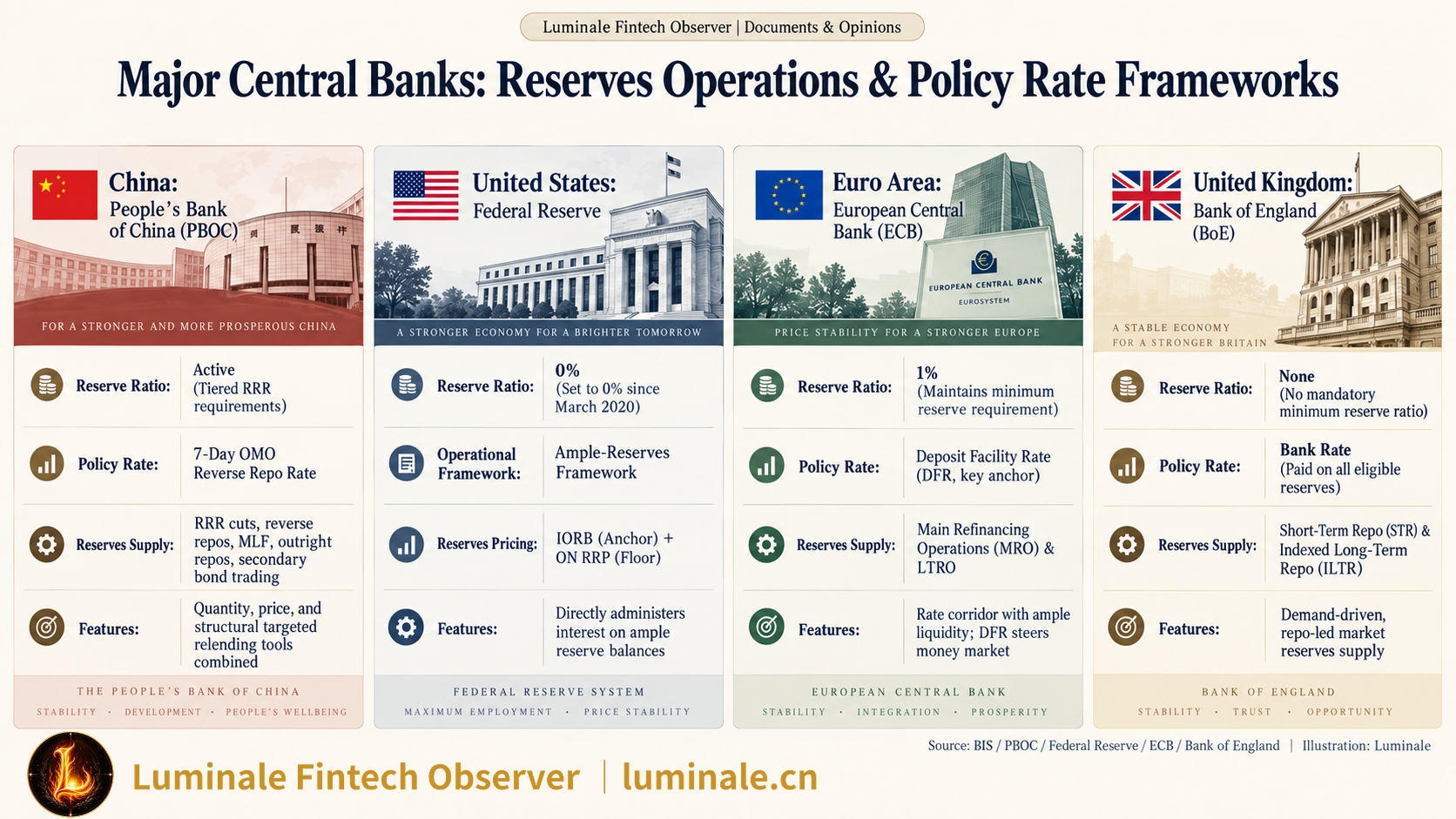
The following matrix synthesizes the reserve frameworks of these four major central banks:
| Jurisdiction / Central Bank | Mandatory Reserve Ratio? | Current Reserves Operational Framework | Core Benchmark Policy Rate | Routine Reserves Injection & Management Tools | Structural Policy Tools Characteristics |
|---|---|---|---|---|---|
| China (People's Bank of China - PBOC) | Yes (Tiered mandatory reserve requirement ratios) | Hybrid framework (Balancing quantity, price, and structural objectives) | 7-Day Open Market Reverse Repo Rate | RRR cuts, reverse repos, outright reverse repos, MLF, secondary treasury bond trading | Extensively Used (Targeted relending for micro/agri, tech innovation, carbon reduction, capital market stabilization) |
| United States (Federal Reserve) | No (Reduced to 0% across all institutions in March 2020) | Ample-Reserves Framework | Federal Funds Target Range (FFR Target Range) | Interest on Reserve Balances (IORB), Overnight Reverse Repo Facility (ON RRP), Standing Repo Facility (SRF) | Rarely Used (Primarily universal liquidity facilities or emergency lender-of-last-resort mechanisms) |
| Euro Area (European Central Bank - ECB) | Yes (Maintains 1% minimum reserve requirement) | Ample liquidity framework with interest rate corridor | Deposit Facility Rate (DFR) | Main Refinancing Operations (MRO), Longer-Term Refinancing Operations (LTRO), asset purchase roll-off | Periodically Used (e.g., Targeted Longer-Term Refinancing Operations - TLTRO) |
| United Kingdom (Bank of England - BoE) | No (No mandatory minimum reserve requirement) | Demand-driven, repo-led supply framework | Official Bank Rate (Bank Rate) | Short-Term Repo Facility (STR), Indexed Long-Term Repo (ILTR), reserve remuneration | Rarely Used (Relies primarily on market-based collateral auctions) |
V. How the US Dollar's Reserve Currency Status Shapes Monetary Policy
Recognizing institutional differences provides a clearer view of global monetary dynamics.
While reducing the US reserve requirement to 0% rests on ample-reserves mechanics, the dollar's dominant role in global payments and trade channels amplifies the international transmission of Federal Reserve policy decisions[9][10].
Adjustments by the Fed to policy rates or balance sheet size reverberate well beyond American borders.
First, Global Dollar Balance Sheet Linkages: The offshore Eurodollar system hosts a multi-trillion-dollar web of syndicated loans and derivatives. Multinational corporations issue dollar-denominated debt, cross-border commodities settle in dollars, and global commercial banks manage foreign exchange risk via FX swaps. When the Fed raises the IORB or reverse repo rates, it contracts offshore dollar liquidity, driving up debt servicing burdens and refinancing hurdles for international borrowers.
Second, The Dual Nature of US Treasuries: US Treasury securities serve not only as instruments to finance federal deficits, but also as the primary safe asset and collateral benchmark for global wholesale finance. Quantitative Easing or Tightening directly shifts the supply of pristine collateral circulating through shadow banking channels and cross-border repo markets.
Third, The Central Bank of Central Banks in Crises: During systemic dollar liquidity shocks, foreign financial institutions lack direct access to the Fed's discount window. To prevent overseas dollar shortages from causing fire sales that destabilize US markets, the Fed operates international safety valves:
- Standing Central Bank Liquidity Swap Lines: The Fed provides dollar reserves directly to major partner central banks (including the ECB, Bank of Japan, Bank of England, Swiss National Bank, and Bank of Canada), which re-lend dollars to domestic banks, extending central bank liquidity across international networks.
- Foreign and International Monetary Authorities (FIMA) Repo Facility: Allowing foreign central banks and monetary authorities to pledge US Treasuries to the Fed for overnight dollar cash, preventing forced asset liquidations in secondary markets during liquidity crunches.
By contrast, in formulating and implementing monetary policy, the People's Bank of China balances domestic macroeconomic equilibrium, employment, and financial stability with interest rate differentials, exchange rate expectations, and cross-border capital flows.
Differences between the Federal Reserve and the PBOC stem from the varying jurisdictional reach of their respective financial networks. Fed policy decisions ripple across international balance sheet networks, conferring global monetary reach while imposing the burden of safeguarding offshore dollar liquidity during times of crisis.
VI. Conclusion: Policy Tools Shape Conditions but Cannot Dictate Outcomes
From the vantage point of financial market infrastructures and bank balance sheets, monetary policy is a systematic engineering process rather than financial alchemy:
- RRR cuts adjust regulatory liquidity lockups on reserves;
- Rate cuts adjust the opportunity cost of central bank credit and interbank funds;
- Reverse repos, outright repos, and open market lending alter the aggregate supply and distribution of reserves;
- Structural relending provides targeted pricing incentives for priority assets; and
- Quantitative easing and bond operations alter the duration, safe asset supply, and reserve composition of the wider financial system.
Yet each tool operates within the boundary of the central bank's own balance sheet. Once liquidity departs central bank ledgers, credit creation and deposit expansion depend on commercial bank capital buffers, liquidity compliance, risk tolerance, and the borrowing decisions of millions of enterprises and households across the real economy.
Monetary policy tools establish the institutional preconditions for credit creation, but they cannot replace the decisions of commercial banks and the real economy to absorb risk and expand debt.
References
[1]: People's Bank of China. Implementation of RRR Cuts and Central Bank Monetary Policy Instruments Overview. 2026-01-05. https://www.pbc.gov.cn/zhengcehuobisi/125207/125213/5727710/2026010517563068096/index.html ↩
[2]: Monetary Policy Department, People's Bank of China. Advancing Interest Rate Liberalization and Perfecting Market-Based Rate Formation and Regulation Mechanisms. 2025-08-12. https://camlmac.pbc.gov.cn/zhengcehuobisi/125207/125227/125957/5347949/2025100917195573922/2025081217013923839.pdf ↩
[3]: People's Bank of China. China Monetary Policy Report (Q4 2024) and Recent Developments in the Monetary Policy Operational Framework. 2025-02-26. https://www.pbc.gov.cn/goutongjiaoliu/113456/113469/5587716/2025022618190099812.pdf ↩
[4]: Federal Reserve Board. Reserve Requirements: Final Rule and Policy Statement. 2020-03-15. https://www.federalreserve.gov/monetarypolicy/reservereq.htm ↩
[5]: Federal Reserve Board. Federal Reserve Actions to Support the Flow of Credit to Households and Businesses. 2020-03-15. https://www.federalreserve.gov/newsevents/pressreleases/monetary20200315b.htm ↩
[6]: Federal Reserve Board. Decisions Regarding Monetary Policy Implementation: IORB and ON RRP Rates. 2026-06-17. https://www.federalreserve.gov/newsevents/pressreleases/monetary20260617a1.htm ↩
[7]: European Central Bank. Statement on the Operational Framework for Implementing Monetary Policy. 2024-03-13. https://www.ecb.europa.eu/press/pr/date/2024/html/ecb.pr240313~807e240020.en.html ↩
[8]: Andrew Bailey (Bank of England). The Bank of England's Balance Sheet for the Future: Charles Goodhart Lecture at the LSE. 2024-05-21. https://www.bankofengland.co.uk/speech/2024/may/andrew-bailey-lecture-london-school-of-economics-charles-goodhart ↩
[9]: Federal Reserve Board. The International Role of the U.S. Dollar (2025 Edition). FEDS Notes. 2025-07-18. https://www.federalreserve.gov/econres/notes/feds-notes/the-international-role-of-the-u-s-dollar-2025-edition-20250718.html ↩
[10]: Federal Reserve Board. Fifth Conference on the International Roles of the U.S. Dollar: Stablecoins, Digital Payments, and the International Role of the USD. 2026-07-16. https://www.federalreserve.gov/econres/notes/feds-notes/fifth-conference-on-the-international-roles-of-the-u-s-dollar-stablecoins-digital-payments-and-the-ir-of-the-usd-20260716.html ↩
Originally published by Luminale Fintech Observer: https://luminale.cn/articles/monetary-policy-tools-balance-sheet-logic-reserves-quantity-price-constraints-en