In financial news, banks are frequently portrayed as institutions with boundless liquidity. However, on September 6, 2026, Agricultural Bank of China (ABC) and Industrial and Commercial Bank of China (ICBC) separately unveiled A-share private placement proposals of up to RMB 160 billion and RMB 100 billion, respectively, with all proceeds—net of issuance expenses—dedicated entirely to replenishing Common Equity Tier 1 (CET1) capital[1]. Official disclosures indicate that the total capital replenishment across eight central financial enterprises in this round reached approximately RMB 360 billion, with the core equity injections for these two mega commercial banks totaling RMB 260 billion.
The immediate reaction of many observers is intuitive: as colossal institutions handling trillions of yuan in daily fund turnover, why do these banks still need to raise capital via targeted equity offerings? Does this capital injection imply that the central bank is pumping an equivalent volume of fresh loan liquidity into the real economy?
Answering these questions requires looking past the surface flow of funds to examine the fundamental, most critical bulwark on a modern bank's balance sheet: Common Equity Tier 1 (CET1) capital.
I. Why Banks Need to Replenish Common Equity Tier 1 Capital
Understanding this capital injection requires distinguishing between two fundamentally different types of funds on a bank's balance sheet: money entrusted by clients that can be withdrawn at any time, and the bank's own equity cushion designated to absorb operational and credit risks.
Banking is inherently a high-leverage, debt-funded enterprise. When depositors place funds in a bank, those funds constitute liabilities on the bank's balance sheet. As the bank deploys these funds into loans and bond investments, it takes on the underlying risk of borrower default or asset depreciation. If loans sour and write-offs occur, the bank cannot directly deduct losses from client deposits; instead, those losses must be absorbed first by shareholders'equity.
Capital is therefore not a pool of cash that a bank uses for daily customer payouts. Rather, it represents the equity at the bottom-right of the balance sheet, determining the institution's shock-absorbing capacity when its assets suffer impairment.
In this private placement, when subscription funds enter the bank, the asset side receives unencumbered cash (typically reflected as central bank reserves or high-liquidity clearing funds), while the liability and equity side records an equivalent increase in paid-in capital and capital reserves under shareholders'equity.
This mechanism differs fundamentally from a central bank injecting base money into the financial system:
- Fiscal and Shareholder Capital Injections: Represent equity funding that alters the commercial bank's standalone capital strength and equity structure without expanding the aggregate monetary base issued by the central bank across the banking system;
- Central Bank Liquidity Operations: Provide reserves to the interbank market via open market operations, reserve requirement ratio (RRR) cuts, or relending facilities, resolving short-term interbank liquidity positions without directly boosting commercial banks'CET1 equity capital.
Furthermore, this RMB 260 billion in CET1 capital cannot be equated with an equivalent sum of new loans. Capital serves as the statutory load-bearing structure for balance sheet expansion, defining the maximum volume of risk-weighted assets a bank can legally support. Whether this credit headroom translates into actual lending depends on real-economy credit demand, borrower creditworthiness, internal risk appetite, and asset-liability maturity matching.
II. The Essence of CET1 Capital: Who Bears Bank Losses First?
To understand how CET1 capital functions, consider a simplified commercial bank balance sheet.
A modern commercial bank's balance sheet strictly adheres to the core accounting identity:
| Assets (Uses of Funds) | Amount (RMB Billion) | Liabilities & Equity (Sources of Funds) | Amount (RMB Billion) |
|---|---|---|---|
| Cash & Central Bank Reserves | 1,500 | Customer Deposits | 8,000 |
| Customer Loans | 7,000 | Interbank Liabilities & Debt Issued | 1,200 |
| Bond Investments & Other Assets | 1,500 | Shareholders'Equity (CET1 Capital, etc.) | 800 |
| Total Assets | 10,000 | Total Liabilities & Equity | 10,000 |
This structure clarifies the balance sheet classification of key balance sheet items:
- Customer Deposits: Constitute rigid liabilities owed to external depositors that must be redeemed at par and cannot serve as loss-absorbing capital;
- Central Bank Reserves: Represent liquid assets held at the central bank to facilitate interbank clearing and depositor withdrawals, not equity capital;
- Common Equity Tier 1 (CET1) Capital: Comprises ordinary share capital, capital reserves, surplus reserves, retained earnings, and general risk reserves, representing the highest-quality tier of equity.
Throughout this process, the presence of the equity cushion ensures that after absorbing the net loss, total assets (RMB 9,800 billion) still exceed total external liabilities (RMB 9,200 billion), leaving depositors completely protected.
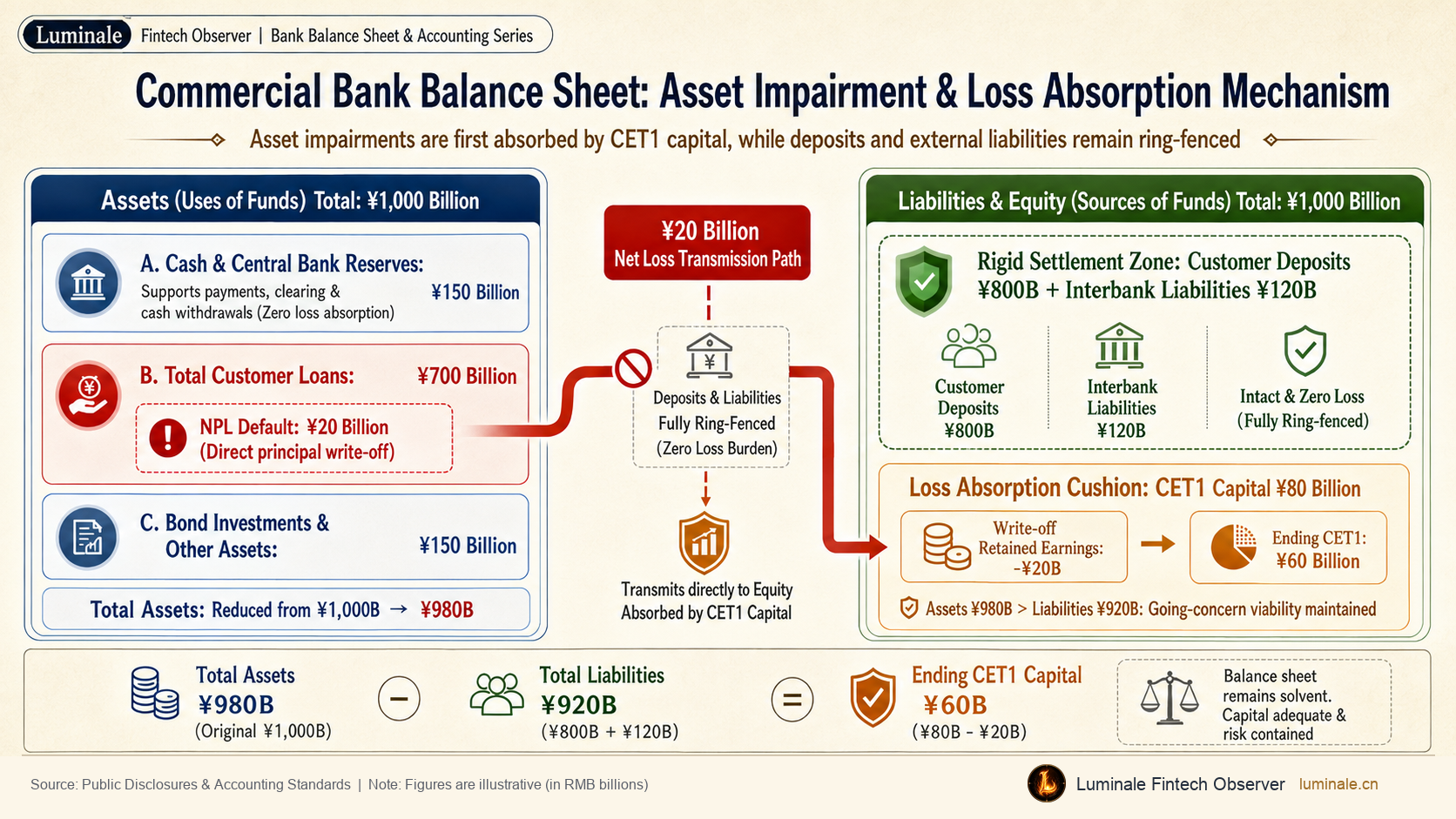
If a bank's equity is exhausted and total assets fall below external liabilities, the institution enters technical insolvency. Prudential regulators impose strict criteria on capital instruments because they care not merely about nominal accounting figures, but about whether those funds can absorb losses on a going-concern basis without restriction.
CET1 capital carries no mandatory coupon servicing obligations, ranks lowest in liquidation seniority, and requires no principal repayment during normal operations, making it the most reliable loss-absorbing buffer in the financial system.
III. Why Basel III Placed CET1 Capital at the Center of Regulation
Elevating this balance-sheet logic to the international level brings us to the core framework of global prudential supervision: the Basel III Accord (Basel III), established by the Basel Committee on Banking Supervision (BCBS)[2].
During the evolution of the Basel Framework, regulators faced a fundamental question: if the goal is to prevent insolvency, why not enforce a single aggregate capital adequacy ratio rather than imposing a strict, standalone minimum specifically for CET1?
The 2008 global financial crisis provided the answer. Leading up to the crisis, many international banks appeared adequately capitalized under aggregate headline metrics. Yet their capital base was heavily diluted with hybrid debt instruments, subordinated debt, and redeemable preferred shares. When liquidity froze and asset prices plummeted, these secondary instruments failed to absorb losses on a going-concern basis, accelerating institutions'slide toward insolvency.
This lesson drove Basel III to reshape regulatory capital: the focus shifted from headline capital quantity to the loss-absorbing quality of capital.
Under Basel III, regulatory capital is organized into three distinct tiers:
┌─────────────────────────────────────────────────────────────────────────────┐
│                    Basel III Capital Hierarchy & Loss Absorption             │
├─────────────────────────────────────────────────────────────────────────────┤
│ Tier 3: Total Capital (≥ 8.0%)                                              │
│ Includes: Tier 2 (T2, e.g., qualifying subordinated debt), absorbs losses    │
│ primarily on a gone-concern (liquidation) basis                             │
├─────────────────────────────────────────────────────────────────────────────┤
│ Tier 2: Tier 1 Capital (≥ 6.0%)                                             │
│ Includes: Additional Tier 1 (AT1, e.g., perpetual bonds), absorbs losses    │
│ on a going-concern basis under contractual trigger terms                    │
├─────────────────────────────────────────────────────────────────────────────┤
│ Tier 1: Common Equity Tier 1 (CET1 ≥ 4.5%)                                  │
│ Includes: Common stock, capital surplus, and retained earnings; absorbs      │
│ losses first on a going-concern basis with highest loss-absorbing capacity  │
└─────────────────────────────────────────────────────────────────────────────┘
The core minimum baseline ratios mandated by Basel III are:
- Common Equity Tier 1 Capital Adequacy Ratio (CET1 Ratio): Minimum 4.5% of risk-weighted assets (RWA);
- Tier 1 Capital Adequacy Ratio: Minimum 6.0% of RWA;
- Total Capital Adequacy Ratio: Minimum 8.0% of RWA.
Above these hard baselines, Basel III introduced a mandatory 2.5% Capital Conservation Buffer (CCB), which must be met entirely with CET1 capital[2].
Combining the 4.5% minimum requirement with the 2.5% conservation buffer establishes a baseline CET1 requirement of 7.0%. However, the regulatory consequences of crossing 4.5% versus 7.0% differ substantially:
- 4.5% is the statutory survival floor: Breaching 4.5% indicates that the institution has violated minimum prudential solvency standards, triggering immediate regulatory intervention, potential restructuring, or resolution;
- 7.0% is the prudential conservation threshold: Dipping into the 4.5%–7.0% buffer zone does not mean the bank is insolvent, but it automatically triggers progressive, mandatory distribution constraints. The bank must restrict common stock dividends, discretionary staff bonuses, and executive compensation, forcing earnings retention to rebuild capital.
Furthermore, Basel III introduced two additional macroprudential buffers, both requiring CET1 capital:
- Countercyclical Capital Buffer (CCyB): Ranging from 0% to 2.5%, activated by national authorities during periods of excessive credit growth to build up capital that can be released during downturns;
- Global Systemically Important Bank (G-SIB) Capital Surcharge: Ranging from 1.0% to 2.5% (with an empty top bucket of 3.5%) based on size, interconnectedness, substitutability, global cross-jurisdictional activity, and complexity, mitigating systemic negative externalities[3].
Within the commercial bank capital and balance-sheet framework synthesized by Luminale, this evolution reflects a clear regulatory logic: Basel III does not impose abstract numerical rules for their own sake, but ensures that balance-sheet risk expansion is anchored by tangible, going-concern loss-absorption capacity.
IV. From Basel to China: Current Capital Requirements for Commercial Banks
Basel standards are international prudential benchmarks agreed upon by BCBS member jurisdictions; they do not automatically hold legal force across borders. Each sovereign jurisdiction transposes these standards into domestic regulations and may apply more stringent requirements.
In China, the governing regulatory framework is the Rules on Capital Management of Commercial Banks, issued by the National Financial Regulatory Administration (NFRA)[4].
China's regulatory framework closely aligns with Basel III while applying higher prudential baselines in core metrics:
| Regulatory Capital Metric | Basel III Minimum Baseline | China Current Regulatory Standard | Comparative Analysis |
|---|---|---|---|
| CET1 Minimum Requirement | 4.5% | 5.0% | China standard is 0.5 percentage points higher |
| Tier 1 Minimum Requirement | 6.0% | 6.0% | Aligned with international benchmark |
| Total Capital Minimum Requirement | 8.0% | 8.0% | Aligned with international benchmark |
| Capital Conservation / Reserve Buffer | 2.5% (100% CET1) | 2.5% (100% CET1) | Consistent rule, met entirely with CET1 |
| Standard Baseline CET1 Requirement | 7.0% | 7.5% | Minimum baseline plus conservation/reserve buffer |
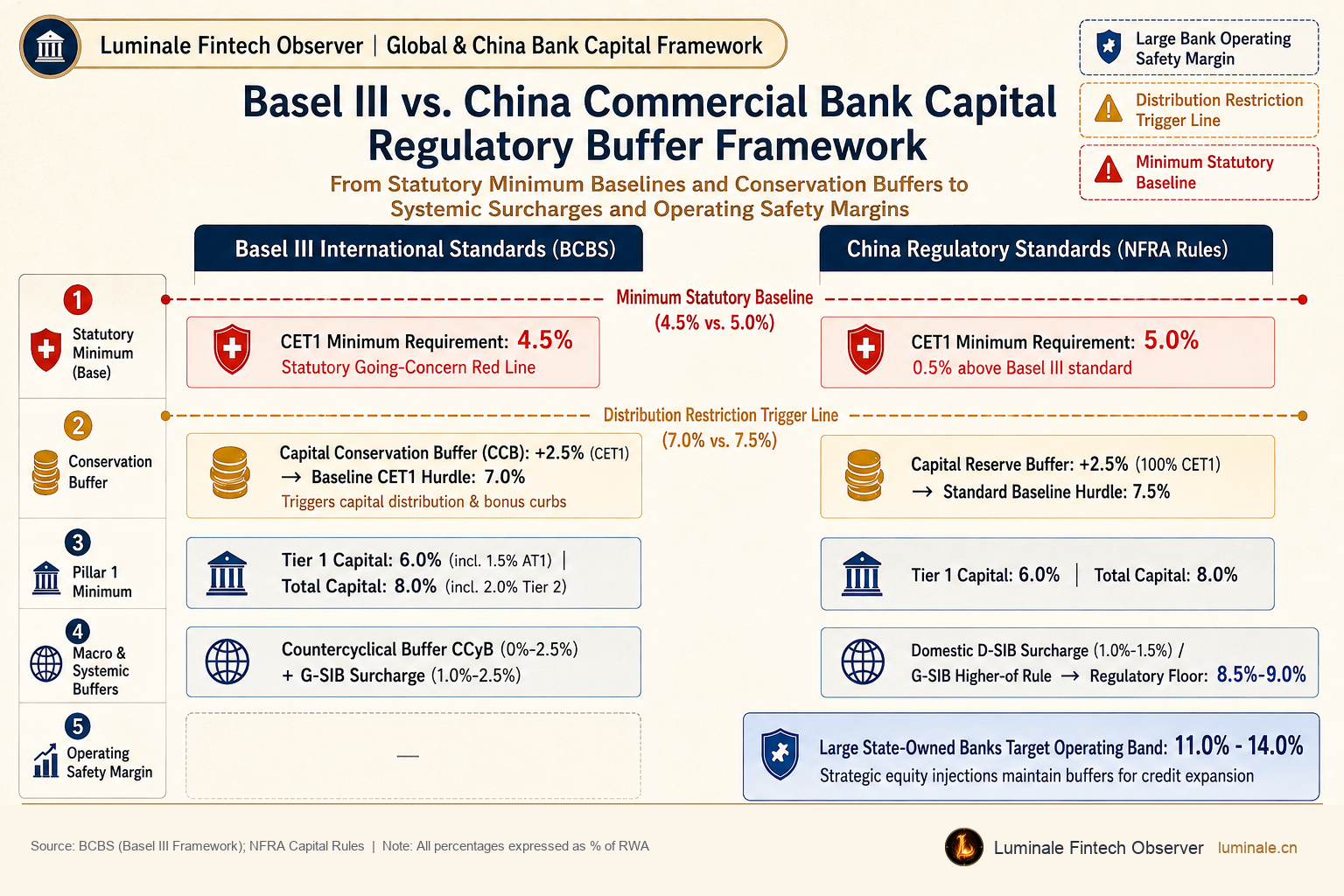
This comparison highlights that Chinese commercial banks face a baseline CET1 hurdle of 7.5% (5.0% statutory minimum + 2.5% capital reserve buffer), setting a higher baseline equity threshold across the industry.
However, 7.5% represents only the industry-wide baseline. For major state-owned banks such as ICBC and ABC, additional regulatory layers apply:
- Domestic Systemically Important Bank (D-SIB) Surcharges: China classifies D-SIBs into five buckets, imposing additional CET1 capital requirements of 0.25%, 0.5%, 0.75%, 1.0%, and 1.5%, respectively. ICBC and ABC consistently rank in the higher buckets, requiring a 1.0% to 1.5% additional buffer;
- Global Systemically Important Bank (G-SIB) Surcharges: In the annual G-SIB list published by the Financial Stability Board (FSB) and the BCBS, ICBC is in Bucket 2 (1.5% surcharge) and ABC in Bucket 1 or 2 (1.0%–1.5% surcharge). Under regulatory coordination rules, domestic and global surcharges generally follow a higher-of principle;
- Pillar 2 Requirements and Internal Capital Targets: Regulators may impose institution-specific capital requirements based on tailored asset-portfolio risk assessments. In day-to-day operations, large banks maintain an internal management buffer of 1.0% to 2.0% above all statutory minimums to satisfy credit rating agencies, interbank counterparties, and stress tests.
This explains why ICBC and ABC maintain reported CET1 ratios between 11% and 14%, well above the 5.0% statutory floor and the 7.5% standard hurdle.
Large banks undertake capital replenishments not because they are breaching regulatory minimums, but to sustain comfortable operational buffers above regulatory floors and create capacity for ongoing loan growth.
V. How Capital Adequacy Ratios Truly Constrain Bank Lending
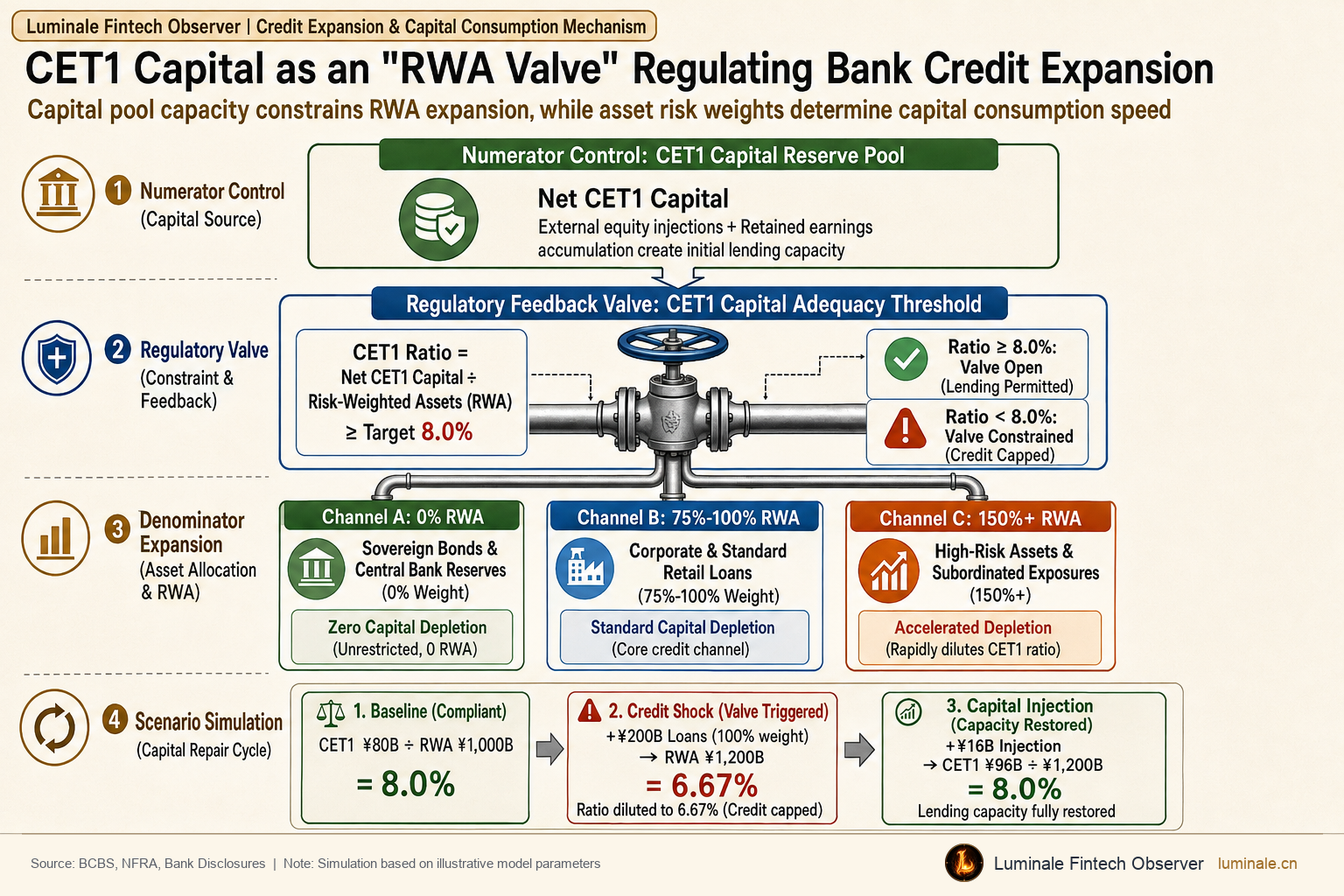
In modern credit creation, capital adequacy ratios serve as a structural governor on balance-sheet expansion. The governing formula is:
This formula reveals the mechanism of capital constraint: the denominator is not nominal total assets, but assets weighted by their underlying risk profile.
Under the Basel Framework and China's capital management rules, RWA aggregates three risk categories:
- Credit Risk-Weighted Assets (Credit Risk RWA): Measures potential losses from counterparty or borrower defaults;
- Market Risk-Weighted Assets (Market Risk RWA): Measures losses arising from adverse movements in interest rates, exchange rates, equity prices, and commodities;
- Operational Risk-Weighted Assets (Operational Risk RWA): Measures losses resulting from internal process failures, human error, system breakdowns, or external disruptions.
Deploying RMB 100 billion into different asset classes produces vastly different RWA volumes and capital consumption:
- Sovereign bonds or claims on the central bank carry a 0% risk weight, generating zero RWA and consuming no CET1 capital;
- Standard corporate loans typically carry risk weights between 75% and 100%, converting RMB 100 billion of credit into RMB 75 billion to RMB 100 billion in RWA;
- Higher-risk exposures or subordinated instruments can carry risk weights of 150% or higher, accelerating capital depletion.
To execute this RMB 200 billion credit expansion while maintaining an 8.0% CET1 ratio, the bank must expand its CET1 capital base through retained earnings or external equity injections to:
This demonstrates how capital constrains credit expansion: without expanding the numerator (Net CET1 Capital), a bank cannot support a growing denominator (RWA). Balance-sheet management is fundamentally an exercise in optimizing the efficiency of risk-weighted assets per unit of core equity.
VI. Capital Is Not the Only Constraint: Leverage and Liquidity
While capital adequacy is a pillar of bank regulation, it does not cover every dimension of banking risk. Comprehensive prudential supervision rests on three complementary lines of defense:
┌─────────────────────────────────────────────────────────────────────────────┐
│                 Three-Dimensional Bank Balance Sheet Constraints             │
├───────────────────┬─────────────────────────────────────────────────────────┤
│ Capital Regulation│ Core Question: If severe credit defaults occur, does the│
│ (CAR / CET1)      │ bank have enough equity to absorb the losses?           │
├───────────────────┼─────────────────────────────────────────────────────────┤
│ Leverage Ratio    │ Core Question: Independent of risk weights, has the     │
│ (LR)              │ total balance sheet expanded too aggressively?          │
├───────────────────┼─────────────────────────────────────────────────────────┤
│ Liquidity Rules   │ Core Question: Under depositor runs or interbank stress, │
│ (LCR / NSFR)      │ can the bank meet immediate cash outflow obligations?   │
└───────────────────┴─────────────────────────────────────────────────────────┘
1. Leverage Ratio Regulation: An Unweighted Balance Sheet Anchor
Risk-weighted asset calculations rely on internal rating models (Internal Ratings-Based Approach, IRB) or standardized supervisory weights. If banks optimize models to underestimate default probabilities or accumulate outsized volumes of low-weight assets, reported capital adequacy ratios can overstate financial resilience.
To prevent model arbitrage, Basel III introduced the Leverage Ratio (LR) as a non-risk-weighted backstop.
The calculation is straightforward:
The leverage ratio disregards risk weights, treating all assets and exposures equally. Basel III sets a minimum leverage ratio requirement of 3.0%, while China's Rules on Capital Management of Commercial Banks mandates a higher standard of not less than 4.0% on both consolidated and solo bases[4].
2. Liquidity Regulation: Guarding Against Bank Runs and Maturity Mismatches
Capital measures balance-sheet solvency, whereas liquidity measures immediate cash-settlement capability.
A well-capitalized bank can still fail rapidly if it runs out of liquidity. If an institution's assets are locked in high-quality 10-year infrastructure loans while its liabilities consist of short-term demand deposits, a sudden run can render it unable to settle interbank clearing obligations, regardless of accounting solvency. The 2023 banking stresses in the United States and Europe demonstrated how rapid liquidity outflows can overwhelm an institution before capital cushions can be deployed.
To mitigate run risks and structural maturity mismatches, Basel III established two key liquidity metrics:
- Liquidity Coverage Ratio (LCR): Requires banks to hold sufficient High-Quality Liquid Assets (HQLA) to withstand a 30-day severe liquidity stress scenario, with a minimum requirement of 100%;
- Net Stable Funding Ratio (NSFR): Requires banks to maintain a stable funding profile across a one-year horizon relative to the liquidity characteristics of their assets, also set at a minimum of 100%.
A resilient commercial bank must operate within the boundaries of capital adequacy, leverage limits, and liquidity standards. Capital ensures solvency against unexpected losses, the leverage ratio prevents unconstrained balance-sheet expansion, and liquidity buffers maintain ongoing settlement viability.
Conclusion: Understanding Capital Is Understanding the Boundaries of Credit Creation
The capital injections announced by Agricultural Bank of China and Industrial and Commercial Bank of China represent a substantial equity financing program that reflects a foundational principle of modern banking: banks possess the unique franchise to create credit and deposits, but this expansion cannot occur unconstrained.
From Basel III's emphasis on capital quality to China's tailored regulatory framework, the underlying supervisory objective is consistent:
Prudential regulation does not aim to prevent banks from taking calculated credit risks, but requires that before taking on risk to support the real economy, banks must first secure adequate, high-quality equity capital capable of absorbing losses on a going-concern basis.
Understanding Common Equity Tier 1 capital clarifies how modern commercial banks operate safely with substantial financial leverage while remaining anchored within strict capital boundaries.
References
[1]: Xinhua News Agency. (2026-09-06). ABC and ICBC announce A-share private placement plans to actively replenish core tier 1 capital. Xinhua Net. https://english.news.cn/20260906/25863ee3d7cc4bf4985150b112391c54/c.html ↩
[2]: Bank for International Settlements. (2020-11-26). Basel Framework: RBC20 - Minimum capital requirements. Basel Committee on Banking Supervision. https://www.bis.org/committees/bcbs/basel-framework/standard/rbc/20/inforce/2023-01-01/published/2020-11-26 ↩
[3]: Bank for International Settlements. (2019-12-15). Basel Framework: RBC40 - Global systemically important banks. Basel Committee on Banking Supervision. https://www.bis.org/committees/bcbs/basel-framework/standard/rbc/40/inforce/2019-12-15/published/2019-12-15 ↩
[4]: National Financial Regulatory Administration. (2023-11-01). Rules on Capital Management of Commercial Banks (NFRA Decree [2023] No. 4). Policy and Regulation Department. https://www.nfra.gov.cn/cn/view/pages/rulesDetail.html?docId=1134197&itemId=4214 ↩
Originally published by Luminale Fintech Observer: https://luminale.cn/articles/what-is-common-equity-tier-1-capital-bank-capital-basel-iii-en