A Chinese tourist pays at a convenience store in Tokyo: the cashier taps the card on the contactless POS terminal, the screen prompts that the transaction is approved, and a receipt prints out. The entire process takes barely two seconds.
On the surface, this appears to be nothing more than a piece of plastic executing an instant checkout. Behind the scenes, however, this single transaction involves the Tokyo merchant, a local Japanese acquiring bank, a cross-border bank card clearing network, and the cardholder's issuing bank located in mainland China. The issuing bank maintains no dedicated private telecommunication lines with tens of millions of merchants across the globe. The reason a single bank card can be seamlessly accepted across merchant networks spanning over two hundred countries and territories rests entirely upon the cross-institutional rulebooks and multilateral clearing mechanisms established by bank card clearing institutions.
Many people commonly conflate bank card clearing institutions (commonly known as card schemes or card networks, such as Visa, Mastercard, and China UnionPay) with commercial banks that issue credit cards, assuming that Visa and Mastercard are themselves massive transnational lending institutions. In reality, modern payment card networks neither issue plastic cards to consumers nor extend a single penny of credit to cardholders, nor do they operate retail POS terminals in merchant stores.
Their core economic function is to operate as an impartial, multilateral financial infrastructure: establishing unified global technical standards and operating regulations, routing encrypted transaction messages in real time, executing end-of-day multilateral netting, and governing financial dispute resolutions and loss allocations among member institutions.
This article unpacks the underlying institutional architecture and financial engineering of bank card clearing networks:
- How does the "Four-Party Scheme" maintain operational balance among issuing banks, acquiring banks, merchants, and cardholders?
- In a "Dual-Message System," how does the system execute real-time online authorization in two seconds while deferring clearing and settlement to end-of-day batch processing?
- How does the multilateral netting algorithm compress millions of interbank debt obligations into a single net transfer via central bank reserve accounts?
- How do the chargeback lifecycle, arbitration rules, and EMV liability shift distribute financial losses during merchant disputes and counterfeit card fraud?
- Facing the global expansion of Account-to-Account (A2A) fast payment systems, why are card networks transforming from physical card switches into global digital wallet interoperability infrastructures?
I. Neither Issuing Cards nor Lending: Functional Boundaries and the Four-Party Scheme
To understand modern card clearing networks, one must first dismantle a widespread misconception: the logo emblazoned on the corner of a bank card does not indicate the lender of the underlying funds.
1.1 Core Concepts and Legal Positioning
A Bank Card Clearing Institution (commonly termed a card network, card scheme, or card association) refers to an institutional entity that operates specialized technical networks, formulates unified clearing rules and message standards, and provides transaction authorization routing, clearing, and multilateral settlement services for interbank transactions initiated via payment cards.
In legal and business operations, the functional boundaries of a card network adhere to strict negative constraints:
- It does not operate retail consumer deposit or credit ledgers: When a consumer applies for a credit card, the credit limit evaluation, background risk screening, and monthly debt billing are handled exclusively by the issuing bank (such as ICBC, Chase, or HSBC). The card network never extends credit, assumes consumer default risk, or maintains individual consumer deposit accounts;
- It does not deploy merchant POS terminals: The POS machines, QR code scanners, and payment soundboxes seen at merchant cash registers are provided by commercial merchant acquirers or third-party acquiring service providers, rather than deployed directly by Visa or UnionPay;
- It does not hold retail merchant funds: Card networks do not maintain direct custodial accounts for retail merchants. Transaction payouts and fund remittances are completed by acquiring banks through local interbank payment rails.
What a card network truly owns and operates is a specialized, global, and highly standardized interbank clearing rulebook and message routing telecommunication grid. It provides an institutional coordination infrastructure: enabling any two financial institutions across the globe—even if they share no prior commercial relationship, bilateral credit line, or mutual trust—to conclude a transaction authorization and complete ultimate multi-party fund settlement within two seconds, strictly adhering to automated pre-established contractual covenants.
1.2 Division of Labor and Obligations in the Four-Party Scheme
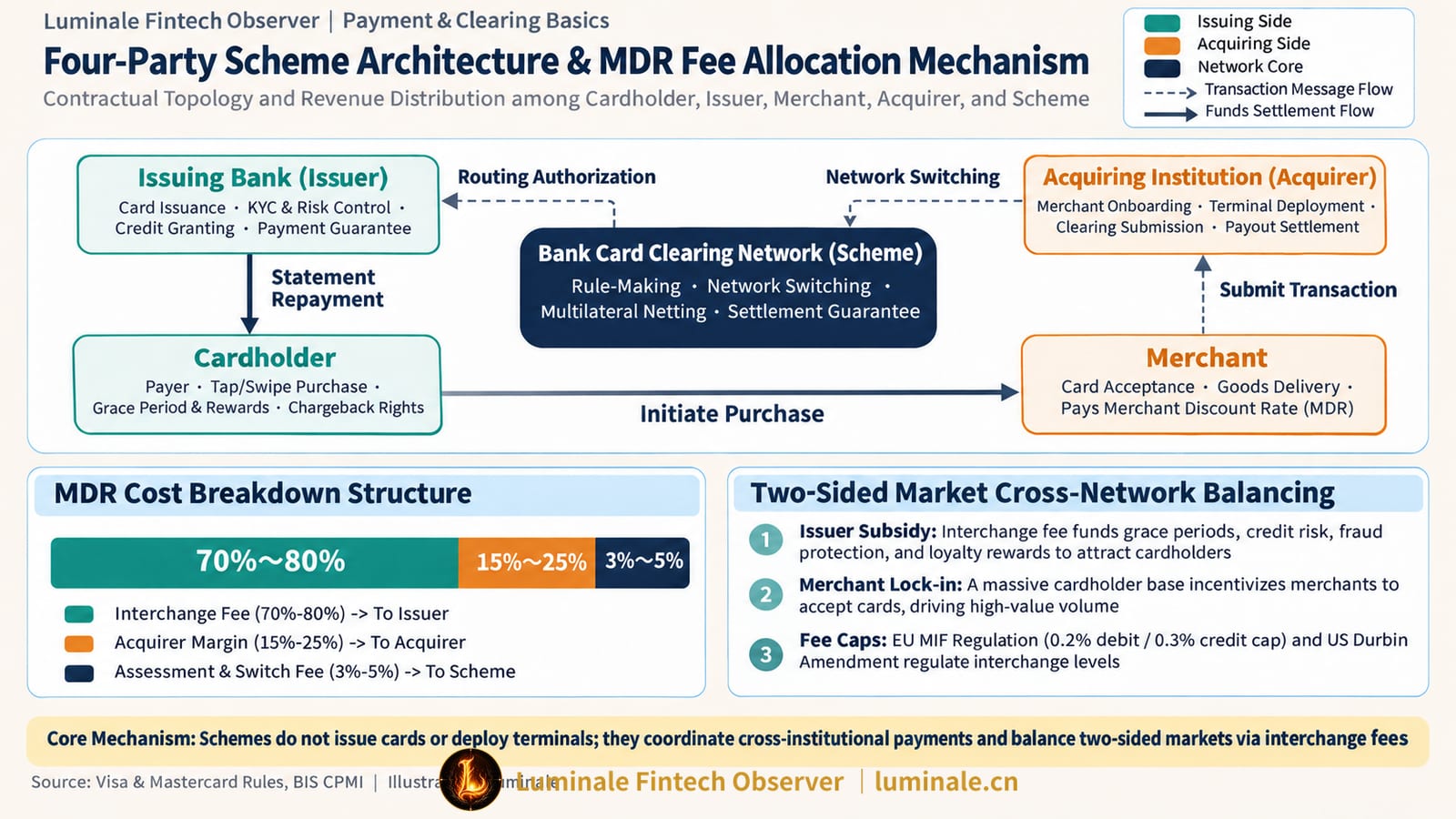
To facilitate multi-party interactions across disparate entities, modern payment card networks universally adopt the Four-Party Scheme (open-loop model). The four primary pillars of this scheme comprise:
- Cardholder: The consumer who holds a valid payment card and initiates purchasing transactions;
- Issuer (Issuing Bank): The financial institution that manages the cardholder's deposit or credit account, issues the physical or virtual payment card, extends purchasing credit lines (for credit cards) or holds demand deposits (for debit cards), undertakes the first-line credit risk of the consumer, and makes definitive payment authorization commitments during transactions;
- Merchant: The business entity that accepts payment cards for goods or services and complies with network acceptance rules;
- Acquirer (Acquiring Bank / Institution): The financial institution or licensed payment entity that contracts directly with merchants, deploys POS acceptance terminals, captures and formats payment data, advances settlement funds to merchants, and assumes merchant underwriting and chargeback exposure.
In practical business execution, two critical auxiliary intermediaries operate within this ecosystem:
- Independent Sales Organization (ISO) / Merchant Service Provider (MSP): Third-party agency teams that contract with licensed acquirers to assist in offline merchant onboarding, POS installation, and technical terminal maintenance;
- Payment Gateway: Data channel providers specializing in online e-commerce environments, responsible for securely capturing, encrypting, and converting frontend web checkout information into standard financial transaction messages before transmission to acquirer host systems.
The card network sits squarely at the center of this multi-party architecture. Operating as an impartial central coordinator, it links tens of thousands of independent commercial banks and acquiring entities worldwide—none of which maintain direct bilateral correspondent accounts with one another—into a cohesive, globally interoperable network.
In merchant discount processing, the gross fee paid by the merchant—known as the Merchant Discount Rate (MDR)—is split among the issuing bank, the acquiring institution, and the card network according to established contractual schedules. As we detailed with quantitative calculations in "When You Swipe $100 , Who Does It Pass Through? A Guide to Issuers, Acquirers, Card Networks, and Merchants", the MDR distribution reflects distinct economic compensation for each participant's underlying operational and financial commitments.
Contrasting with the open Four-Party Scheme is the closed Three-Party Scheme (such as the historical operating models of American Express, Diners Club, and early JCB). Under a pure three-party arrangement, the network operator functions simultaneously as both issuer and acquirer: it directly issues cards to individuals, directly signs contracts with merchants, and deploys its own proprietary terminals. Because issuing and acquiring functions are internalized within a single balance sheet, there is no interbank transaction routing, thereby obviating the need for complex multilateral interchange fee negotiations.
However, the expansion of a closed three-party loop is inherently bounded by the operator's own balance sheet capacity and sales headcount. To achieve widespread global retail acceptance across tens of millions of small and medium merchants, modern three-party networks have increasingly opened their networks, partnering with external commercial banks as network issuers or merchant acquiring partners, progressively converging toward the operational dynamics of the multi-party model.
| Comparison Dimension | Four-Party Scheme | Three-Party Scheme |
|---|---|---|
| Typical Examples | Visa, Mastercard, China UnionPay | Early American Express, Diners Club, Early JCB |
| Issuing Entities | Thousands of independent commercial banks and depository institutions | The network itself (or licensed co-issuing partner banks) |
| Acquiring Entities | Independent acquiring banks and licensed payment institutions | The network itself (proprietary merchant sales force) |
| Clearing Mechanism | Cross-institutional multilateral clearing and net settlement | Internalized intra-firm book-entry transfers (no interbank debt) |
| Core Pricing | Centrally scheduled Interchange Fee to balance two-sided demand | Proprietary Merchant Discount Fee, with no external interchange fee |
| Network Effects | Open network, scaling rapidly by leveraging global banking rails | Closed loop, with higher merchant onboarding costs but total client data control |
1.3 Core Technical Foundations: BIN Numbers, Routing Tables, and Messaging Standards
The capability of the Four-Party Scheme to coordinate multi-party transactions globally within two seconds rests upon three standardized technical pillars:
1. Bank Identification Number (BIN / IIN)
Pursuant to the ISO/IEC 7812 international standard, the primary account number (PAN) embossed on any payment card adheres to a rigorous numeric taxonomy:
- Major Industry Identifier (MII): The initial digit of the card number, designating the primary business sector of the issuing institution (for instance, 1 and 2 designate airlines, 3 designates travel and entertainment such as Amex/Diners, 4 denotes Visa, 5 denotes Mastercard, and 6 denotes China UnionPay and Discover);
- Bank Identification Number (BIN / Issuer Identification Number, IIN): The initial 6 to 8 digits of the PAN. (To accommodate surging global card volumes, ISO/IEC 7812 revised its standard in 2017 to expand standard BIN lengths from 6 digits to 8 digits). BIN ranges are officially allocated to licensed issuers by designated international registration authorities. Upon reading the leading digits of a card, a point-of-sale terminal instantly references its local routing cache to determine the governing card network, legal issuing entity, card product tier (Classic, Gold, Platinum), and base account currency;
- Individual Account Number: Digits running from position 7 (or 9) through the penultimate digit, assigned by the issuing bank to uniquely identify the cardholder's internal customer ledger;
- Check Digit: The final digit of the card number, computed algorithmically via the Luhn Algorithm (Mod 10) against all preceding digits, allowing terminals to immediately detect manual input typos or optical scan read errors.
2. Dynamic Global Routing Tables
Card networks maintain dynamic addressing directories across their core communication backbones. Every business day, card networks broadcast full-scale BIN routing updates to the Front-End Processors (FEPs) of all member institutions. When a card beginning with "62" (UnionPay) or "5" (Mastercard) is tapped at a Japanese convenience store terminal, the acquirer host executes prefix indexing within ten milliseconds, instantly dispatching the payload to the appropriate global network switching interface.
3. Financial Transaction Message Standards (ISO 8583 and ISO 20022)
The universal dialect of bank card online transaction processing is the ISO 8583 standard (Financial transaction card originated messages). It specifies a compact binary and hexadecimal data structure:
- Message Type Identifier (MTI): A four-digit numeric code defining the core business purpose of the transmission. Typical examples include:
0100: Authorization Request;0110: Authorization Response;0200: Financial Transaction Request (frequently deployed in single-message debit transactions);0210: Financial Transaction Response;0420/0400: Reversal Notification (dispatched to reverse ledger freezes when network timeouts or terminal printer jams occur);- Bitmaps: ISO 8583 utilizes primary and secondary bitmaps, using binary flags (0s and 1s) to indicate which of the subsequent 128 data fields are present in the payload. This compact architecture minimized byte payloads, enabling sub-second transmissions over early low-bandwidth dial-up telecommunications;
- Key Data Fields: The specification formally governs data element semantics and formats. Representative examples include Field 3 (Processing Code), Field 4 (Transaction Amount), Field 11 (Systems Trace Audit Number, STAN), Field 14 (Card Expiration Date), Field 22 (Point of Service Entry Mode, distinguishing magnetic stripe, chip contact, or NFC contactless), Field 39 (Response Code, such as
00for approval,51for insufficient funds, or54for expired card), and Field 55 (Integrated Circuit Card / EMV Data, transporting dynamic chip cryptograms).
Presently, global payment infrastructures are progressively transitioning toward the ISO 20022 messaging standard, built upon XML and JSON syntaxes. Compared with the flat field schema of ISO 8583, ISO 20022 accommodates richer end-to-end business contexts, supports extended character encodings, and carries structured remittance metadata, markedly enhancing automated anti-money laundering (AML) sanctions screening and reconciliations.
1.4 Two-Sided Markets and the Interchange Fee Mechanism
The stability of the Four-Party Scheme relies fundamentally on economic incentive alignment. A payment card network represents a classic Two-Sided Market: one side comprises cardholders, while the opposite side comprises merchants.
A powerful Cross-side Network Effect operates between these two sides: the utility of holding a card to a consumer depends on the breadth of global merchants willing to accept it; conversely, a merchant's willingness to deploy POS terminals and absorb transaction fees depends on the volume of consumers carrying cards bearing that brand mark.
In this two-sided environment, elasticity of demand is distinctly asymmetric:
- Cardholders exhibit extreme fee sensitivity: if consumers are charged a surcharge for card usage, they rapidly retreat to cash or alternative zero-fee instruments;
- Merchants exhibit high sensitivity toward lost sales opportunities: to secure high-ticket sales and capture affluent consumer spend, merchants are willing to bear a reasonable acceptance fee.
To overcome the chicken-and-egg coordination problem, card networks established the Interchange Fee system:
In a Four-Party transaction, the acquiring institution pays a standardized interchange fee to the issuing bank, calculated according to public schedules set by the card network. The total Merchant Discount Rate (MDR) paid by the merchant is decomposed into three distinct components:
Within this split, the card network retains only the network assessment fee (typically a modest toll of several basis points); the acquirer retains its markup to cover hardware deployment, terminal maintenance, and merchant risk management; while the dominant share of the MDR (frequently 60% to 80%) flows directly to the issuing bank as interchange revenue.
This revenue stream furnishes commercial banks with the necessary financial margin to absorb interest expenses during the cardholder's interest-free grace period, buffer unsecured credit default exposures, invest in real-time anti-fraud engines, and fund cardholder acquisition perks—such as waived annual fees, travel rewards, airline miles, and cash rebates. These subsidies entice a vast consumer base to carry and swipe cards, which in turn compels merchants to maintain broad acceptance of the card brand.
Nonetheless, elevated interchange levels have historically triggered pushback from merchant coalitions and antitrust regulators. Over the past decade, major economic jurisdictions have enacted regulatory caps on interchange fees:
- EU Interchange Fee Regulation (MIF Regulation, EU 2015/751): The European Union imposed statutory caps on domestic card transactions within the European Economic Area, capping debit interchange at 0.2% and credit interchange at 0.3%, compressing issuing margins and fostering low-cost domestic European payment alternatives;
- US Durbin Amendment: Enacted as part of the Dodd-Frank Act, the Federal Reserve capped debit card interchange fees for financial institutions with assets exceeding $10 billion at "21 cents + 0.05% of transaction value", structurally altering retail debit unit economics across the United States.
Within China's payment architecture, a clear statutory demarcation separates bank card clearing institutions from online retail clearing platforms (namely, the NetsUnion Clearing Corporation, NUCC). Bank card clearing institutions process interbank transactions rooted in card account media and payment card business rules; conversely, NUCC primarily routes internet-originated transactions initiated by non-bank payment institutions (such as Alipay and WeChat Pay) directly linking commercial bank demand accounts. In "What Do NUCC and UnionPay Actually 'Clear'? The Middle Layer of Payment Clearing, Explained", we previously examined the distinct functional scopes and division of labor between these two clearing middle layers.
II. Separating Authorization from Settlement: Dual-Message Systems and Multilateral Netting
In retail payment system taxonomy, as we previously analyzed in "Which Rail Should a Payment Take? Classifying Payment Systems: Wholesale, Retail and Cross-Border", retail payment rails diverge significantly between Real-Time Gross Settlement (RTGS), bulk electronic funds transfer (ACH), and card networks. The defining structural hallmark of payment card transactions is the widespread deployment of the Dual-Message System (DMS), which bifurcates transaction processing in time and space into two separate stages: real-time online authorization, followed by deferred batch clearing and settlement[5].
2.1 Single-Message System (SMS) vs. Dual-Message System (DMS)
Global card networks operate across two distinct messaging architectures:
- Single-Message System (SMS):
- Also known as the PIN-Debit mode (widely utilized in ATM cash withdrawals and domestic debit card point-of-sale networks such as the US STAR, NYCE networks, and China UnionPay's domestic debit transactions);
- Financial authorization and fund clearing are compressed into a single real-time transmission (
0200financial request message). The moment the terminal receives approval (0210), the issuing bank has executed a binding final debit against the cardholder's demand deposit account, simultaneously generating an irrevocable interbank clearing obligation;
- Dual-Message System (DMS):
- Universally deployed in global credit card transactions and cross-border Visa and Mastercard retail transactions;
- In Stage One (real-time swipe), the system transmits an authorization message (
0100/0110), checking solely whether the card is authentic, whether the account has sufficient available credit, and placing a temporary authorization hold (funds reservation) on the credit limit. No funds are debited, no interbank settlement occurs, and no legal discharge of debt is effected at this moment; - In Stage Two (end-of-day batch processing), the merchant batches its approved transaction records and submits a clearing presentment via its acquirer. The clearing house matches the presentment against the prior authorization, computes multilateral net positions, and initiates interbank central bank reserve transfers on the following business day.
Why do credit cards and cross-border retail payments overwhelmingly adopt the dual-message architecture?
- Gratuities and Amount Adjustments: In overseas hospitality and dining, a consumer signs the initial bill upon checkout, but the final tip amount is written manually onto the slip afterward. The dual-message system allows the authorization amount to float by an established margin (typically 15% to 20%), permitting the merchant to capture the adjusted final sum during end-of-day batch submission without forcing the cardholder to re-insert the card;
- Pre-Authorizations and Security Deposits: In hotel check-ins and car rentals, merchants cannot determine the ultimate expenditure or rental extensions at the time of check-in. They secure an estimated pre-authorization hold, executing definitive financial capture only upon checkout;
- Foreign Exchange Buffers and Reconciliation Fault Tolerance: In cross-border card transactions, the exchange rate displayed during real-time authorization represents an indicative estimate. The dual-message framework permits the central clearing house to apply uniform daily benchmark settlement exchange rates during end-of-day batch processing, enhancing cross-border reconciliation certainty.
2.2 Stage One: Online Real-Time Authorization
When a cardholder taps a card or mobile wallet at a Tokyo convenience store, it triggers the first phase of the dual-message system—online real-time authorization:
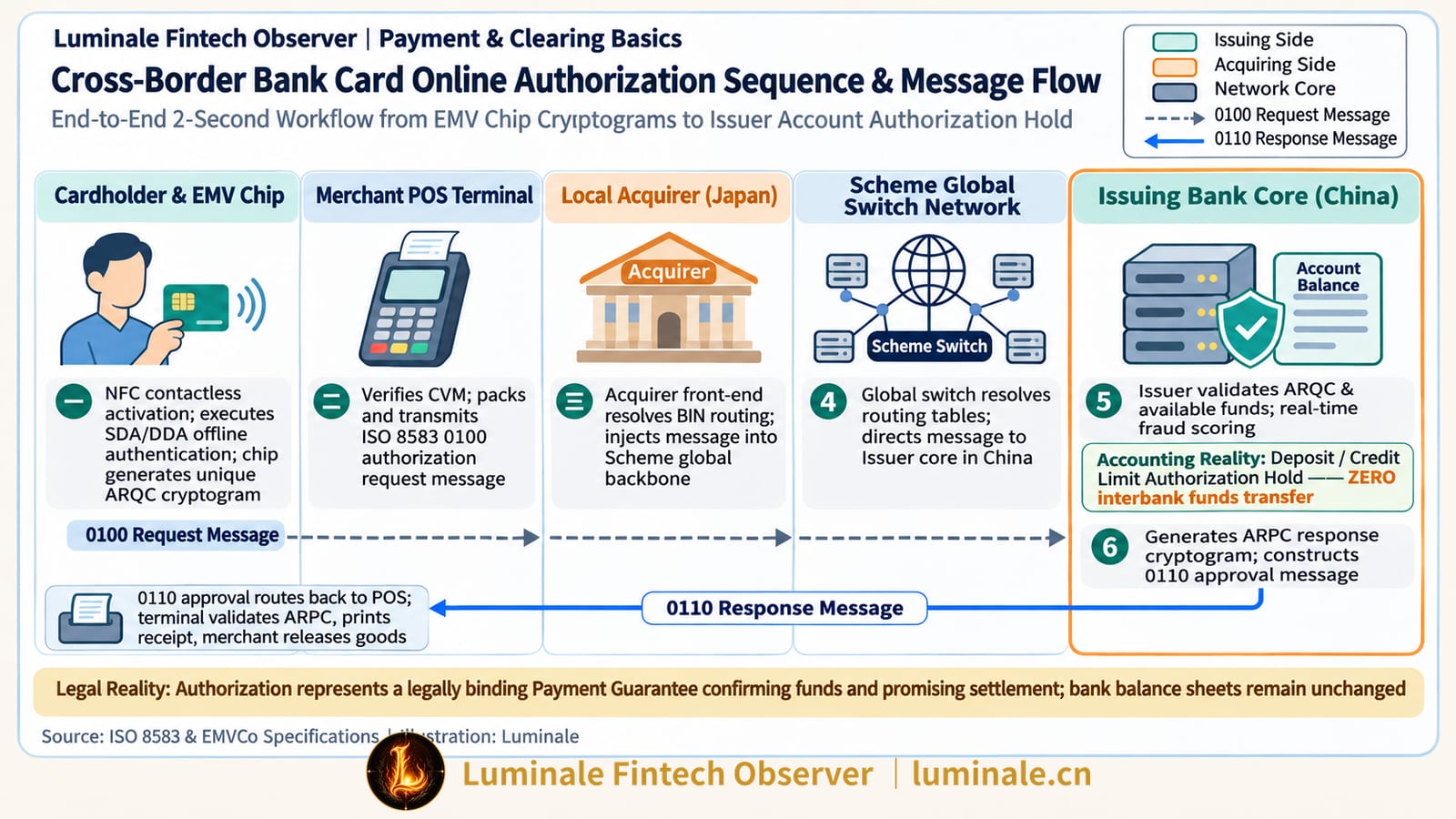
- Terminal-to-Chip Interaction (EMV Specifications):
- The instant the chip enters the electromagnetic field of the POS contactless reader, the terminal powers the chip and initiates application selection;
- The chip transmits offline data authentication parameters to the terminal, which executes Static Data Authentication (SDA), Dynamic Data Authentication (DDA), or Combined Dynamic Data Authentication (CDA), verifying card authenticity via public-key cryptography;
- The terminal validates the Cardholder Verification Method (CVM)—such as contactless no-PIN limits, online PIN entry, or consumer device biometric verification (CDCVM);
- The chip generates an Application Request Cryptogram (ARQC), derived by the card's master key from a terminal-generated unpredictable number and transaction amount, ensuring the cryptogram is uniquely valid for that single transaction.
- Cross-Border Message Routing:
- The POS terminal packages the transaction into an ISO 8583
0100authorization request payload, forwarding it to the Japanese acquirer host; - The acquirer front-end processor reads the card's leading BIN digits, directing the payload into the global backbone of the card network;
- The central processing facility of the card network consults its global routing tables, routing the payload to the cardholder's issuing bank in China.
- Issuer Risk Control and Ledger Hold (Core Ledger Operation):
- Upon receipt of the
0100message, the issuing bank's authorization engine verifies the ARQC cryptogram, cardholder verification results, and Card Verification Number (CVN/CVV); - The issuer's real-time fraud scoring engine evaluates the geographic location, merchant category code (MCC), transaction velocity, and spending profile;
- If risk rules are satisfied and available credit is adequate, the issuer's core ledger executes an authorization hold (funds reservation): the cardholder's available credit limit is decremented by the equivalent RMB amount, but no formal accounting debit occurs, and no interbank assets or liabilities shift;
- The issuer returns an ISO 8583
0110authorization response containing authorization code00(Approved); - The response traverses the reverse network path back to the Tokyo POS terminal, which displays an approval confirmation and prints the customer receipt. The entire multi-point transmission concludes within two seconds.
2.3 Stage Two: Batch Clearing and Multilateral Netting
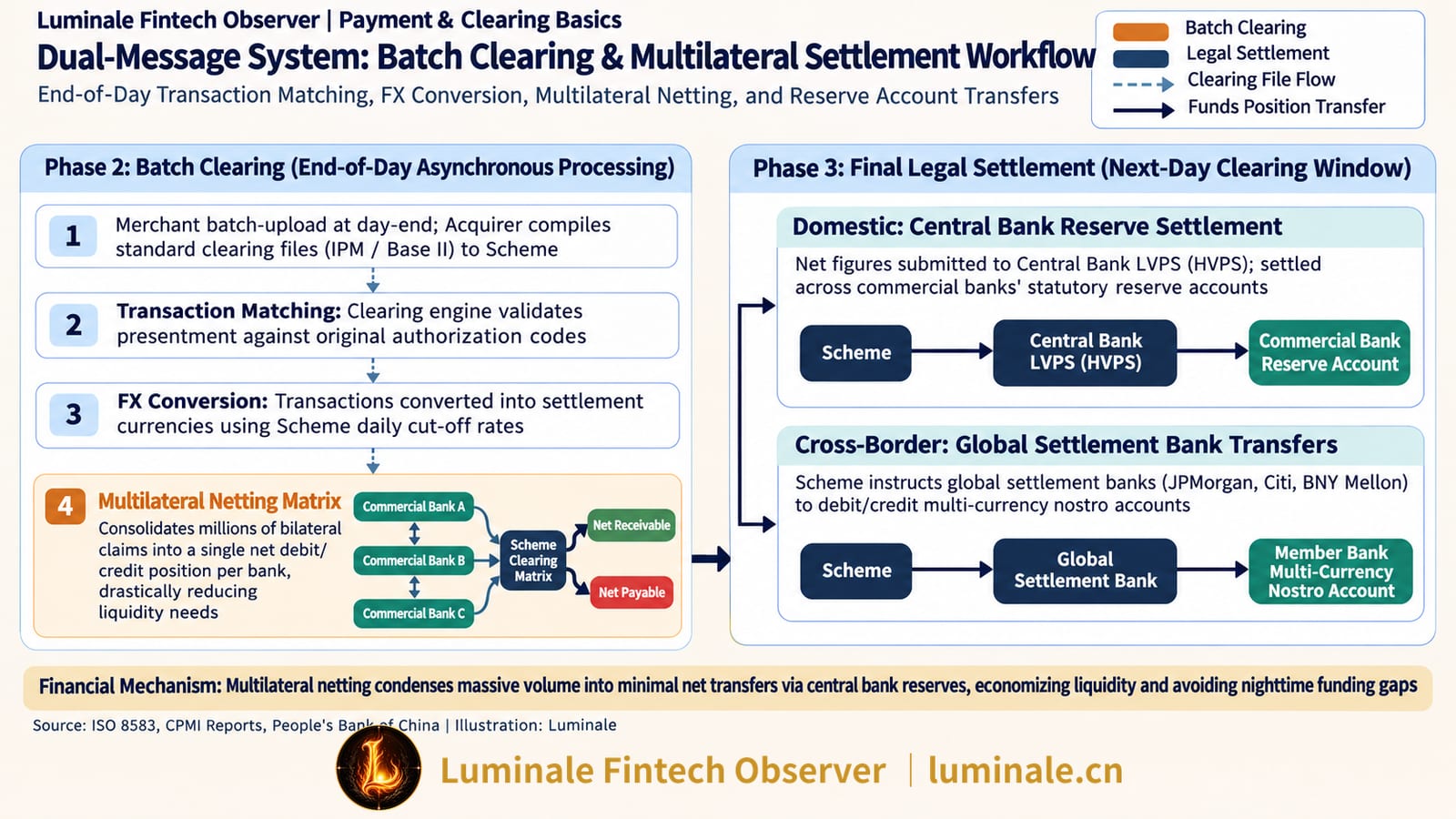
Real-time authorization merely confirms the cardholder's purchasing capacity and captures the merchant's claim. Interbank funds have not moved. The real movement of money occurs during the second stage—end-of-day clearing:
- Clearing File Generation and Upload (Presentment):
- Following the close of the business day, the Tokyo merchant POS terminal performs an end-of-day batch settlement (Batch Settlement), aggregating all authorization transaction records from that day into a batch clearing file, uploaded to its acquirer host;
- The acquirer formats these transaction receipts into an ISO 8583
0200financial presentment file (or clearing files conforming to card network specifications, such as Visa Base II or Mastercard IPM formats) and uploads them to the card network's regional clearing center.
- Multilateral Netting Algorithm and Settlement Obligations:
- The card network's central clearing system matches the submitted presentment records against the prior authorization database, verifying transaction integrity, currency conversions, and interchange fee parameters;
- If Bank A's cardholders swiped $10 million at Bank B's merchants today, while Bank B's cardholders swiped $8 million at Bank A's merchants, executing bilateral wire transfers for every single transaction would generate massive interbank liquidity strain and operational friction.
- The card network executes a Multilateral Netting Algorithm: across all member institutions within a given clearing cycle, it sums every institution's gross claims and gross obligations across all counterparts, canceling out opposing positions to calculate a single consolidated net settlement figure for each bank:
Through multilateral netting, billions of fragmented retail transactions across the banking system are condensed into a single net debit or credit obligation per institution per clearing cycle.
2.4 Stage Three: Final Settlement and Fund Discharge
Following the conclusion of multilateral netting, clearing gives way to the final stage of the lifecycle—ultimate financial settlement:
- Domestic Currency Settlement Mechanism:
Within mainland China, once China UnionPay, NetsUnion, or licensed joint venture card clearing houses calculate the net positions across commercial banks, they generate final settlement manifests dispatched directly to the People's Bank of China's High-Value Payment System (HVPS). Commercial banks settle their net obligations through their statutory reserve deposit accounts maintained at the central bank, achieving definitive legal finality. We previously analyzed the liquidity scheduling mechanisms governing central bank RTGS systems in "How Does Big Money Move Between Banks? Understanding Large-Value Payment Systems". This framework balances transaction processing volumes against commercial bank intraday liquidity exposures.
- Cross-Border Multi-Currency Settlement Mechanism:
In cross-border transactions spanning different sovereign jurisdictions, international card networks cannot directly connect to every central bank's RTGS reserve accounts. Consequently, Visa and Mastercard appoint major global commercial banks (such as JPMorgan Chase, Citibank, and BNY Mellon) as designated Settlement Banks in offshore financial centers.
Member banks worldwide must maintain multi-currency settlement clearing accounts funded with adequate liquidity buffers at these settlement banks. The card network dispatches debit and credit instructions to the settlement banks, transferring balances between the respective settlement accounts of issuing and acquiring institutions, achieving definitive multi-currency settlement.
To illustrate the double-entry bookkeeping across a dual-message system, consider an overseas purchase of 10,000 JPY (assumed equivalent to 500 RMB, subject to a 1.5% MDR fee):
| Business Stage | Participating Entity | Debit | Credit | Economic Substance |
|---|---|---|---|---|
| 1. Online Real-Time Authorization (~2 seconds) | Cardholder | None | None | Credit limit earmarked; no formal ledger entry |
| Issuer | (Off-balance-sheet memo: Credit line or demand deposit hold: 500 RMB) | Authorization hold applied; no balance sheet assets or liabilities shift; issuer extends formal payment commitment | ||
| Acquirer | None | None | Terminal logs STAN audit trail; no debtor-creditor relationship formed | |
| Merchant | None | None | POS prints receipt; merchant delivers 10,000 JPY in merchandise | |
| 2. Batch Clearing (End-of-day batch) | Issuer | Customer Demand Deposit (or Credit Receivable): 500 RMB | Settlement Payable (Card Network): 494 RMB Fee Income (Interchange Fee): 6 RMB | Formal ledger debit posted; hold converted to firm liability; interchange revenue recognized |
| Acquirer | Settlement Receivable (Card Network): 494 RMB | Merchant Settlement Deposit: 485 RMB Fee Income (Acquirer Margin): 9 RMB | Recognizes receivable from card network; credits merchant account net of fee | |
| Card Network | Settlement Receivable (Issuer): 494 RMB | Settlement Payable (Acquirer): 494 RMB | Multilateral netting establishes symmetric claims (excluding network switch fee) | |
| 3. Final Settlement (Next-day window) | Issuer | Settlement Payable (Card Network): 494 RMB | Reserve Deposits (Central Bank / Settlement Bank): 494 RMB | Statutory funds transferred outward; interbank clearing debt extinguished |
| Acquirer | Reserve Deposits (Central Bank / Settlement Bank): 494 RMB | Settlement Receivable (Card Network): 494 RMB | Statutory funds received; interbank claim fully discharged | |
| Central / Settlement Bank | Bank A (Issuer) Reserve Account: 494 RMB | Bank B (Acquirer) Reserve Account: 494 RMB | Ownership of central bank money (or settlement bank commercial balances) formally transfers |
III. Dispute Resolution and Loss Allocation: Chargebacks and Card Network Arbitration Rules
Commerce relies upon credit and certainty. In cross-border retail transactions, buyers and sellers reside in entirely different legal jurisdictions, linguistic environments, and time zones. Why does a cardholder dare to present sensitive payment card credentials to an unfamiliar merchant in a foreign country? And why does a merchant dare to hand over expensive merchandise to an unknown foreign tourist?
The institutional bedrock sustaining this global commerce is the standardized, globally binding dispute resolution and loss allocation rulebook maintained by the card networks.
3.1 Legal and Operational Character of Reverse Transactions
In bank card operations, market observers frequently conflate reversals, refunds, and chargebacks. These three transaction types diverge fundamentally in legal nature and operational drivers:
- Reversal / Void: An immediate transaction cancellation initiated at the merchant terminal shortly after online authorization occurs (typically prior to end-of-day batch submission), caused by terminal paper jams, cashier entry errors, or immediate customer withdrawal. Reversal messages (such as ISO 8583
0400/0420reversals) immediately release the issuing bank's authorization hold on the customer's credit line; the transaction never enters batch clearing; - Refund: A reverse financial transfer initiated voluntarily by the merchant via the POS terminal following agreement with the cardholder (e.g., product return or price adjustment). A refund represents a brand-new financial credit transaction funded by the merchant, where the acquirer remits funds back to the issuer through the clearing network;
- Chargeback: A formal redress mechanism initiated by the cardholder through the issuing bank upon reviewing their monthly statement (due to alleged unauthorized fraud, merchant nondelivery, or billing errors). Acting under the card network's global operating rules, the issuing bank forcibly claws back transaction funds from the acquiring bank through the clearing network.
A chargeback represents a powerful institutional privilege granted to the payer, constituting the defining structural distinction separating payment card networks from wire transfers or cash transfers. In a traditional wire transfer, once funds depart the sender's account, they cannot be recovered absent voluntary beneficiary return or protracted civil litigation; in a card network, the rulebook provides structured, asymmetric consumer protection.
3.2 Reason Codes and Four Core Dispute Categories
A chargeback cannot be lodged arbitrarily. The issuing bank must assign a standardized Reason Code established by the governing card network. Across global card networks, dispute reasons fall into four primary categories:
- Fraud Disputes:
- The cardholder asserts they never authorized or participated in the transaction. Examples include physical counterfeit card cloning, lost or stolen card fraud, or card-not-present (CNP) e-commerce account takeover;
- Representative codes include Visa 10.4 (Other Fraud: Card-Absent Environment) and Mastercard 4837 (No Cardholder Authorization);
- Authorization Disputes:
- The merchant or acquirer failed to obtain valid authorization in accordance with network rules. Examples include processing forced offline transactions without approval, multiple incremental authorizations following an initial decline, or settlement amounts exceeding permitted authorization variance tolerances;
- Representative codes include Visa 11.3 (No Authorization) and Mastercard 4808 (Authorization-Related Chargeback);
- Processing Errors:
- Accounting or operational errors at the system, telecommunication, or terminal layer. Examples include duplicate billing where a single purchase was batched twice, settlement amounts conflicting with sales receipts, or presentments submitted past maximum network clearing time limits;
- Representative codes include Visa 12.6 (Duplicate Processing / Paid by Other Means) and Mastercard 4834 (Point of Interaction Error);
- Consumer / Commercial Disputes:
- Contractual fulfillment disputes between the cardholder and the merchant. Examples include merchandise lost in transit or failing to arrive by the agreed delivery date, goods materially defective or differing significantly from merchant descriptions, recurring subscriptions billed following cancellation, or merchant refusal to honor stated return policies;
- Representative codes include Visa 13.1 (Merchandise/Services Not Received) and Mastercard 4853 (Defective/Not as Described).
3.3 Dispute Lifecycle and Final Card Network Arbitration
A chargeback dispute does not rest upon the unilateral discretion of the issuing bank; it follows a rigorous Dispute Lifecycle bounded by evidentiary deadlines and procedural due process:
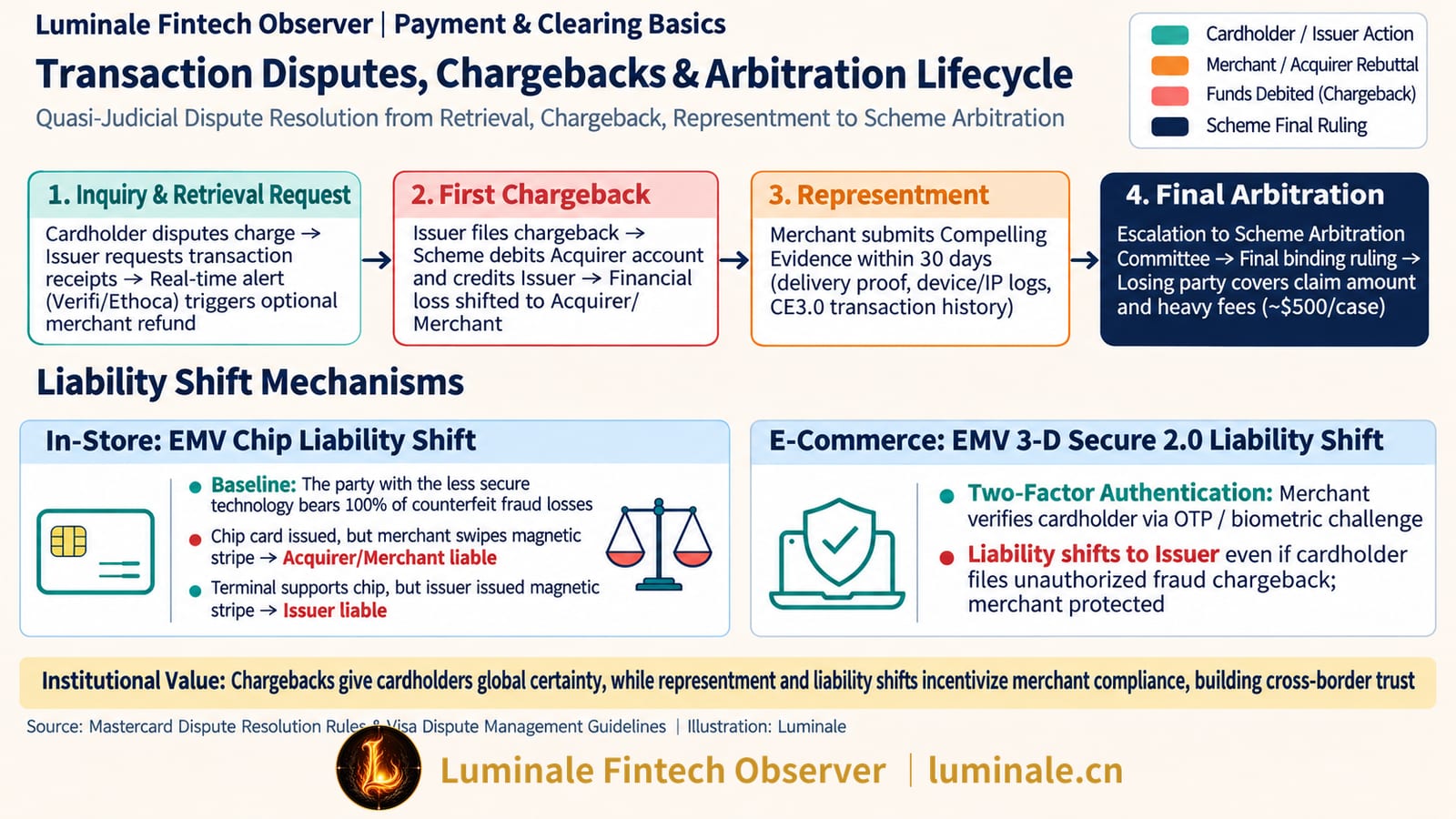
- Retrieval Request and Pre-Dispute Collaboration:
- Prior to lodging a formal chargeback, the issuing bank can request the acquirer to retrieve the merchant's original signed receipt, digital signature log, or proof of delivery (Retrieval Request);
- In recent years, automated collaboration networks—such as Visa's Verifi and Mastercard's Ethoca—enable real-time merchant alerts. When a consumer contacts their bank to dispute a charge, the merchant receives an automated notification, allowing it to issue an immediate voluntary refund within hours, resolving the friction before a formal chargeback registers against merchant operational ratios.
- First Chargeback:
- If the dispute is not resolved and the cardholder maintains their claim, the issuing bank transmits an electronic chargeback record through the network.
- The card network's clearing system automatically debits the disputed sum from the acquiring bank's net settlement balance and credits the issuing bank during the daily multilateral netting cycle. The issuer applies a provisional credit to the cardholder's statement;
- The acquiring bank then debits the merchant's deposit account, passing the dispute notification down to the merchant.
- Representment:
- If the merchant possesses definitive evidence proving the charge was legitimate and fully fulfilled (e.g., signed delivery slips with matching IP/device fingerprints, or flight boarding logs), the merchant may instruct its acquirer to initiate a Representment within a strict window (typically 30 to 45 calendar days);
- The acquirer re-submits the financial transaction along with documented proof. The card network reverses the prior chargeback, debiting the issuer and re-crediting the acquirer's settlement balance.
- Pre-Arbitration:
- If the cardholder and issuer reject the merchant's rebuttal evidence (e.g., claiming the signature was forged or the delivery went to an unverified address), the issuer initiates Pre-Arbitration;
- The parties enter a final formal consultative phase, providing the acquirer and merchant one last opportunity to evaluate the evidentiary strength and settle the claim without incurring heavy arbitration penalties.
- Final Arbitration Committee Ruling:
- If the acquiring bank and merchant refuse to concede, either party may formally escalate the dispute to the Card Network Arbitration Committee;
- Functioning akin to a specialized private international commercial tribunal, the committee reviews all evidentiary submissions against the network rulebook and issues an irrevocable, legally binding final judgment;
- The losing institution must not only pay the disputed principal in full but must also absorb substantial procedural arbitration fees (often ranging from $250 to $500 or more per case). This punitive fee structure discourages frivolous or bad-faith appeals across the banking community.
3.4 EMV Liability Shift and Asymmetric Incentives
Card networks possess no direct administrative police powers. To drive global point-of-sale terminals and merchant systems to upgrade to advanced anti-fraud technologies, card networks engineered an ingenious institutional mechanism—the Liability Shift.
The core premise of the liability shift is elegant: The party that adopts the less secure technical standard bears full financial liability for resulting counterfeit fraud losses.
1. In-Person EMV Countertop Liability Shift
Before the widespread adoption of EMV chip cards, bank cards relied upon traditional magnetic stripes. Magnetic stripe data is static, unencrypted, and exceptionally vulnerable to cloning via skimming devices at gas pumps or ATM card slots, enabling criminal syndicates to manufacture counterfeit cards for unauthorized swipes.
To eliminate counterfeit stripe fraud, EMVCo (founded by Visa, Mastercard, Europay, and later joined by JCB, American Express, and China UnionPay) established the global EMV chip standard. However, replacing billions of cards and hundreds of millions of POS terminals worldwide required billions of dollars in private capital expenditure.
Rather than issuing bureaucratic mandates, card networks established an objective milestone—the EMV Liability Shift (implemented across major markets between 2011 and 2015):
- If an issuing bank issues an advanced EMV chip card, but a merchant continues to use an obsolete magnetic stripe swipe terminal, any counterfeit card fraud that occurs is borne entirely by the merchant and its acquiring bank;
- Conversely, if the merchant has invested in an EMV-compliant chip insertion or contactless terminal, but the issuing bank lazily persisted in issuing legacy magnetic stripe cards to save manufacturing costs, all resulting counterfeit fraud losses are borne entirely by the issuing bank.
Relying entirely upon commercial loss-allocation covenants, this framework compelled tens of millions of merchants and financial institutions worldwide to overhaul their POS hardware and card inventory within a few short years.
2. E-Commerce 3D Secure Liability Shift
In the online card-not-present (CNP) e-commerce sphere, card networks collaborated to engineer the EMV 3-D Secure (3DS) protocol (marketed as Visa Secure, Mastercard Identity Check):
- 3DS introduces two-factor authentication (2FA) beyond static "PAN + Expiry + CVV2" data, prompting cardholders with dynamic one-time passwords (OTP) via SMS or in-app biometric approvals;
- Online Liability Shift Mechanism: If an online merchant implements 3DS and the transaction successfully clears cardholder authentication (or if the issuer failed to support 3DS, forcing a protocol bypass), any subsequent chargeback lodged by the cardholder alleging unauthorized fraud results in an automatic liability shift: financial responsibility transfers from the merchant to the issuing bank. Merchants gained a definitive safe harbor against fraud chargebacks, powerfully catalyzing the worldwide adoption of Strong Customer Authentication (SCA) standards.
IV. Domestic Clearing Networks and Market Access: Global Networks, Geopolitics, and Market Diversification in China
Across the retail clearing landscapes of major global economies, payment card clearing networks exhibit a dual-layered architectural pattern: global transnational networks and sovereign domestic networks intertwining and coexisting.
4.1 The Dual-Layer Landscape: Global Giants and Sovereign Domestic Networks
In cross-border travel and international commerce, Visa, Mastercard, and American Express operate global switching networks spanning more than two hundred countries and territories. These transnational networks possess formidable economies of scale, extensive merchant acceptance, and decades of multi-currency clearing experience.
However, for any sovereign state, entrusting the domestic retail payment clearing of all citizens and commercial enterprises entirely to transnational private card networks entails significant institutional and security considerations:
- Business Continuity and Geopolitical Resilience of Financial Infrastructure:
Payment clearing networks constitute the circulatory lifelines of modern national economies. During geopolitical conflicts or unilateral sanctions, external clearing disruptions can instantly paralyze domestic retail payments.
The most salient historical demonstration occurred following the outbreak of the Russia-Ukraine conflict in 2022: international card networks suspended operations within the Russian Federation, severing all cross-border transaction routing for Russian financial institutions. Yet, Russian citizens using domestic bank-issued Visa or Mastercard cards to buy groceries at domestic stores experienced virtually zero disruption.
The critical mechanism behind this resilience dates back to 2014 following the Crimean crisis, when the Central Bank of Russia established the National Payment Card System (NSPK) and launched the domestic payment brand Mir. Russian law mandated that all domestic transaction routing and clearing initiated by international card networks must be processed through NSPK's domestic processing center. When international card networks cut external communications, NSPK instantly assumed full control over the domestic routing and central bank settlement of all bank card transactions, insulating Russia's internal commerce;
- Financial Data Sovereignty and Privacy:
Every retail transaction record carries sensitive economic intelligence: transaction timestamps, geolocation, merchant identity, purchase value, and spending frequency. Keeping core clearing systems deployed within sovereign jurisdiction is an objective prerequisite for safeguarding critical macroeconomic data;
- Domestic Merchant Acceptance Costs:
The fee schedules of transnational card networks are typically calibrated for developed consumer markets, imposing heavy cost burdens on domestic micro and small retailers. By establishing state-sponsored or non-profit domestic clearing rails, sovereign jurisdictions can maintain public-interest, lower-cost fee schedules tailored to local economic conditions.
Internationally, many major economies maintain robust domestic retail card clearing networks:
- NPCI and RuPay in India: The National Payments Corporation of India (NPCI), established under the guidance of the Reserve Bank of India, launched the domestic debit scheme RuPay. Deeply integrated with government direct benefit transfer (DBT) accounts, RuPay accounts for over half of India's domestic card issuance;
- European Domestic Debit Networks and Co-Badging: Within continental Europe, domestic debit networks such as France's Cartes Bancaires (CB) and Germany's girocard have historically dominated domestic point-of-sale checkout counters. Many European bank cards employ a Co-badging architecture: the physical chip embeds both a domestic network application (e.g., CB) and a transnational network application (e.g., Visa or Mastercard). When a cardholder taps at a French merchant, the POS terminal defaults to the CB local route to benefit from ultra-low clearing interchange; when the cardholder travels abroad, the terminal automatically invokes the Visa or Mastercard application to route the cross-border transaction.
4.2 Institutional Evolution and Market Opening of China's Bank Card Clearing Market
The development of China's bank card clearing market represents an institutional evolution from fragmented municipal paper clearing to nationwide standardized interoperability, culminating in market-oriented opening under statutory oversight.
Prior to the year 2000, Chinese commercial banks issued proprietary cards independently. POS terminals and ATM networks deployed by different banks operated in isolation and could not process cross-bank transactions. To overcome interbank fragmentation, with State Council approval, the People's Bank of China led the joint establishment of China UnionPay Co., Ltd. in March 2002. UnionPay established the national "62" standard for payment cards and technical specifications, achieving full nationwide interoperability across China's banking system.
As China deepened its integration into global commerce, China's bank card clearing market transitioned from single-institution operations toward orderly, rules-based, and prudentially regulated market opening.
This market opening rests upon foundational statutory legislation:
- Establishing Market Access Principles: In April 2015, the State Council promulgated the Decision on Implementing Market Access Management for Bank Card Clearing Institutions (State Council Document [2015] No. 22), mandating that institutions engaging in bank card clearing business within mainland China must apply to the People's Bank of China and obtain a Bank Card Clearing Business License[1];
- Formulating Detailed Implementation Rules: In June 2016, the People's Bank of China and the China Banking Regulatory Commission issued the Administrative Measures for Bank Card Clearing Institutions (PBOC & CBRC Order [2016] No. 2), setting forth clear prudential qualification thresholds[2]:
- An applicant must possess a paid-in registered capital of not less than RMB 1 billion;
- The applicant must operate business processing systems, disaster recovery infrastructures, and cybersecurity architectures that comply with national and industry technical standards;
- Core business processing systems must operate independently within the territory of the People's Republic of China;
- Interbank transaction balances generated domestically must settle in Renminbi through payment systems operated by the People's Bank of China;
- The regulation formally established a structured two-stage licensing procedure: "Preparation Application System Construction and Preparation (at least 1 year) Opening Application Formal License Issuance".
Under this statutory framework, the market entry of bank card clearing institutions has advanced steadily:
- First Sino-Foreign Joint Venture Clearing Institution: In June 2020, the People's Bank of China granted a bank card clearing business license to Express (Hangzhou) Technology Services Company (a joint venture between American Express and LianLian Digital). Express Company formally commenced commercial operations in August of that year, becoming China's first licensed sino-foreign joint venture clearing institution[3];
- Second Sino-Foreign Joint Venture Clearing Institution: In November 2023, the People's Bank of China, in conjunction with the National Financial Regulatory Administration, granted a bank card clearing business license to Mastercard NetsUnion Information Technology (Beijing) Co., Ltd. (a joint venture between Mastercard and NetsUnion Clearing Corporation, NUCC)[4]. In May 2024, Mastercard NetsUnion formally launched commercial operations, issuing brand-new single-logo Mastercard RMB bank cards supporting domestic RMB clearing and global multi-currency spending;
- First Wholly Foreign-Owned Institution Approved for Preparation: On October 13, 2026, the People's Bank of China updated its administrative licensing records, formally approving the application of Visa Information Technology (Beijing) Co., Ltd. (a wholly foreign-owned enterprise established by Visa) to prepare a bank card clearing institution[8]. This marks the third international card network approved to enter China's domestic clearing sector, and the first approved wholly foreign-owned applicant. Under regulatory procedures, the entity must complete core system testing and risk controls within a statutory one-year preparation period before applying for final operational inspection and licensing.
With China UnionPay advancing continuous infrastructure upgrades, Express Company and Mastercard NetsUnion in full commercial operation, and Visa entering formal preparatory buildout, China's bank card clearing market has transitioned into a diversified, multi-entity landscape. Legacy dual-currency, dual-badge cards (bearing both UnionPay and foreign card brand marks) are completing their historical transition, as newly issued single-badge cards seamlessly integrate into a transparent, competitive domestic clearing market.
| Institution | Licensing / Approval Date | Registered Capital | Equity Background | Core Characteristics and Regulatory Status |
|---|---|---|---|---|
| China UnionPay | Founded 2002 (Re-licensed 2019 under new rules) | RMB 9.963 billion | Jointly founded by major Chinese commercial banks | Domestic anchor clearing network; operates the "62" standard BIN range; acceptance network spans over 180 countries and territories |
| Express Company (American Express) | Licensed June 2020 | RMB 5.06 billion | Joint venture between American Express and LianLian Digital | First sino-foreign joint venture; operates "37" card ranges; targets affluent travel and unified global rewards |
| Mastercard NetsUnion | Licensed November 2023 | RMB 10.0 billion | Joint venture between Mastercard and NUCC | Second sino-foreign joint venture; leverages Mastercard global merchant reach and NUCC domestic clearing synergy to issue RMB single-badge cards |
| Visa China (Visa Information Tech) | Approved for Preparation October 2026 | RMB 1.0 billion (subscribed/paid-in ongoing) | Wholly owned by Visa subsidiaries (Visa Worldwide & VIISA) | First wholly foreign-owned preparatory institution; currently in statutory 1-year buildout; will issue single-badge cards upon final inspection and licensing |
V. Navigating A2A and Tokenization: The Evolution of Card Clearing Networks
With the ubiquitous proliferation of smartphones and foundational fintech modernization, modern retail payment architecture is undergoing a profound paradigm shift. Payment card clearing networks, with over a half-century of institutional heritage, face dual structural transformations driven by Account-to-Account (A2A) fast payments and cryptographic tokenization.
5.1 The Global Wave of Account-to-Account (A2A) Fast Payments
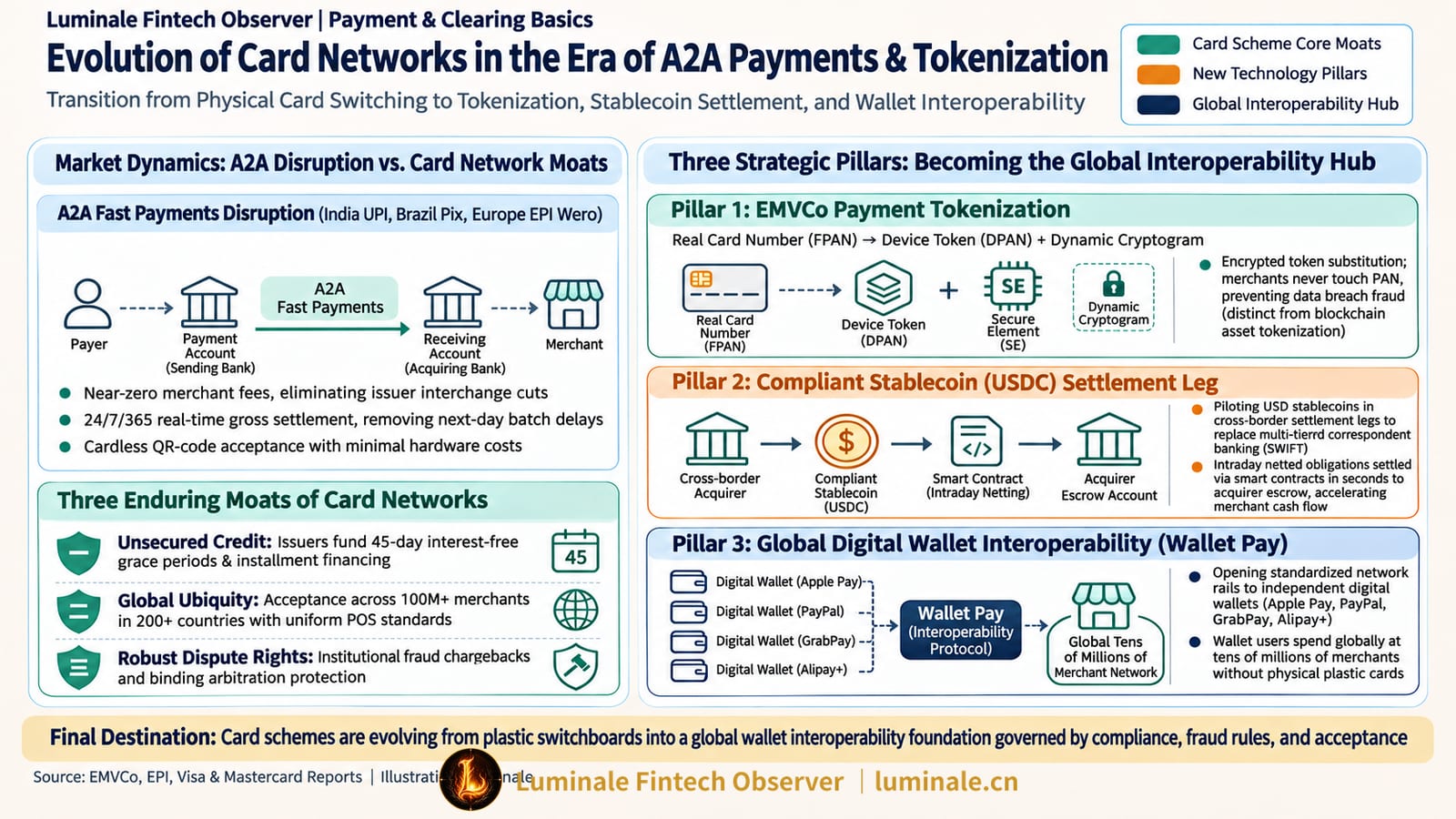
In traditional retail payments, merchant acceptance depended fundamentally on point-of-sale card swipes. In recent years, however, Fast Payment Systems (FPS) operating directly on commercial bank deposit accounts via Account-to-Account (A2A) transfers have experienced exponential global adoption.
In these emerging architectures, fund movements bypass traditional card networks, issuers, and acquirers entirely:
- UPI in India: Operated as a public infrastructure by NPCI, the Unified Payments Interface enables consumers to scan QR codes and execute real-time, account-to-account push payments via smartphones, exceeding tens of billions of monthly transactions and largely displacing domestic debit card usage;
- Pix in Brazil: Developed and operated directly by the Central Bank of Brazil. Launched in 2020, Pix offers fee-free consumer transfers, nominal merchant fees (typically below 0.2%), and 24/7 instant settlement, eclipsing combined domestic credit and debit card transaction volumes within three years;
- Wero Wallet and the TIPS Foundation in Europe: In July 2024, the European Payments Initiative (EPI)—backed by 16 major banks across France, Germany, and Belgium—officially launched the cross-border digital wallet Wero[7]. Wero's core objective is to leverage the European Central Bank's pan-European instant clearing rails (TIPS and RT1) to offer cardless, account-to-account checkout, mitigating continental Europe's structural reliance on Visa and Mastercard while compressing merchant fees;
- Mobile QR Code Payments in China: Within China, WeChat Pay and Alipay deploy barcode technology directly linked to the NetsUnion Clearing Corporation (NUCC) and commercial bank accounts, forming an exceptionally efficient cardless ecosystem for small-value, high-frequency commerce.
Compared with the Four-Party card model, A2A payment rails deliver clear economic advantages:
- Substantially Lower Merchant Costs: Bypassing interchange fees and acquirer margins, merchant acceptance fees represent a fraction of traditional card discount rates;
- Accelerated Cash Flow Cycles: Funds arrive in merchant bank accounts instantaneously on a 24/7 basis, eliminating the multi-day float and settlement lag inherent in card batch clearing;
- Minimal Hardware Barriers: Merchants require only a printed QR code or standard smartphone, avoiding capital-intensive POS hardware deployments.
Faced with the expansion of A2A payments in retail commerce, card networks maintain defensible structural moats across three primary domains:
- Unsecured Consumer Credit Financing: A2A transfers require immediate available cash balances in the payer's demand deposit account. Conversely, credit cards provide revolving credit, 45-day interest-free grace periods, and merchant installment financing, capabilities that deposit-transfer rails cannot replicate natively;
- Global Cross-Border Interoperability: Sovereign A2A systems operate overwhelmingly as domestic clearing silos. Cross-border linking involves complex bilateral treaty negotiations, FX settlement frictions, and capital control boundaries. Conversely, card networks offer mature multi-currency clearing across tens of millions of merchant locations in over 200 countries;
- Structured Buyer Protection and Dispute Redress: A2A transfers represent definitive, irrevocable cash settlement; if a consumer falls victim to online fraud or merchant insolvency, transferred funds are unrecoverable. Conversely, card network chargeback and arbitration mechanisms provide robust consumer trust.
5.2 Payment Tokenization: Digital Credential Restructuring
Confronted with the rise of smartphones and wearable smart devices, card networks did not cling to plastic cards; instead, they pioneered the underlying digitization of payment credentials through EMVCo Payment Tokenization[6].
As we previously deconstructed in "What Happens Behind an Apple Pay Transaction? From Payment Token to Card Clearing", payment tokenization operates through a precise security flow:
- When a consumer provisions a card into Apple Pay or Google Wallet, the mobile wallet acts as a Token Requestor, never storing the underlying 16-digit Funding Primary Account Number (FPAN);
- The card network's Token Service Provider (TSP) ingests the provisioning request, coordinates with the issuing bank for validation, and issues a visually identical surrogate string—the Device Primary Account Number (DPAN);
- The cryptographic mapping between the real FPAN and surrogate DPAN is secured in the card network's encrypted data vault;
- During point-of-sale NFC taps or in-app payments, the mobile device transmits only the DPAN alongside a single-use dynamic cryptogram generated by the device's hardware Secure Element (SE).
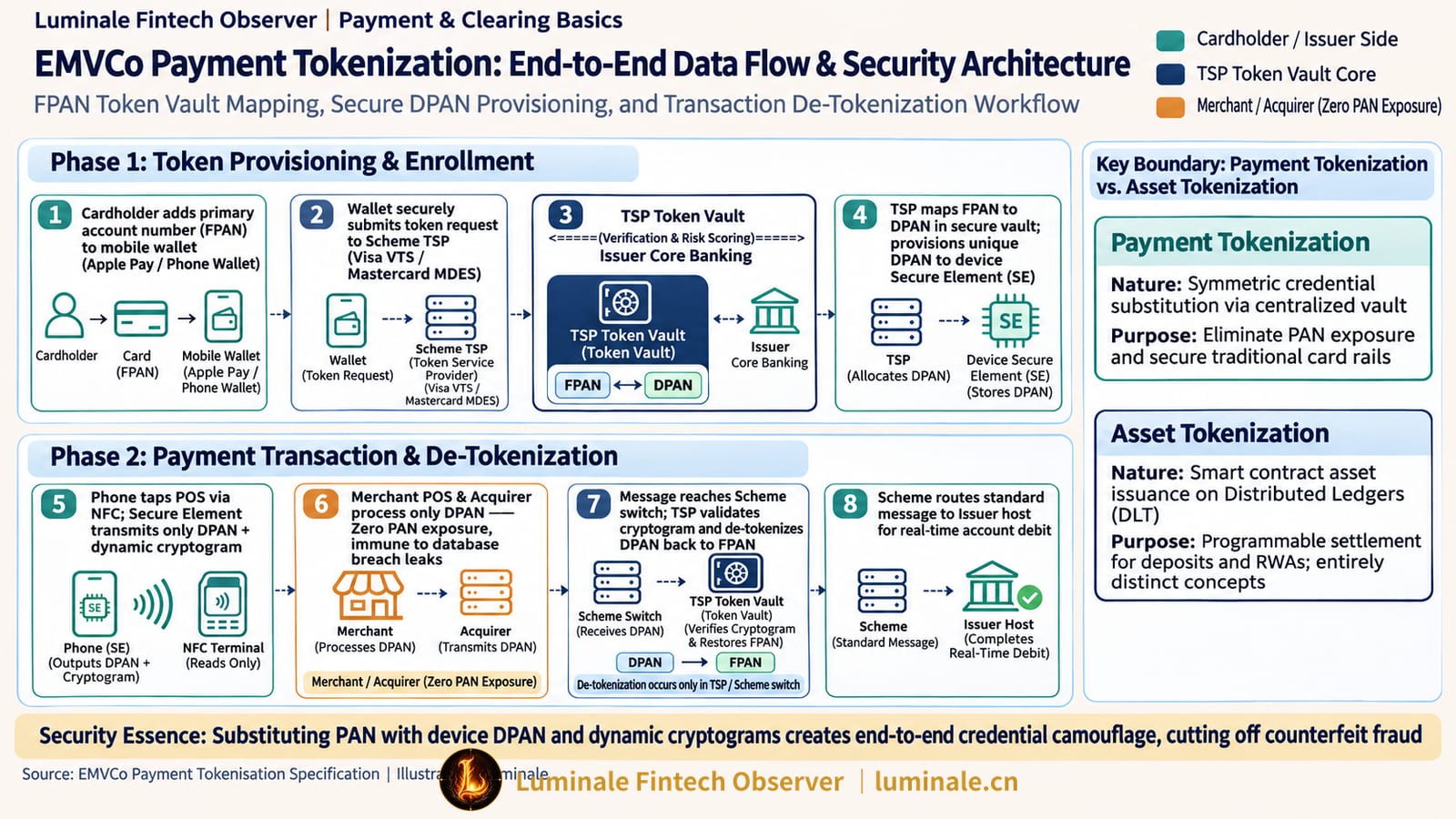
Payment tokenization elevates data security: even if a merchant database suffers a catastrophic breach, compromised records reveal only hardware-bound tokens (DPANs) that cannot be repurposed to clone physical cards or execute unauthorized transactions elsewhere.
Conceptual Clarification:
Payment Tokenization diverges fundamentally from blockchain Asset Tokenization:
- EMVCo Payment Tokenization represents a centralized cryptographic "credential surrogate mechanism". It creates no new digital assets and transfers no value to distributed ledgers; underlying transaction authorization, clearing, and reserve settlement remain 100% anchored in the commercial banking four-party network;
- Asset Tokenization refers to converting commercial bank deposits, bonds, or real-world assets (RWA) into programmable tokens on distributed ledger technology (DLT) or smart contracts.
5.3 Stablecoins and Programmable Settlement Pilots
While frontend consumer checkout operates at millisecond speeds, backend multi-currency Settlement Legs across international card networks still encounter frictions inherent in traditional correspondent banking rails:
- Cross-border fund transfers depend on commercial bank operating windows across disjointed time zones;
- Correspondent wire transfers (SWIFT) pass through multiple intermediary banks, incurring layered fees and multi-day settlement delays;
- Cross-border e-commerce merchants absorb significant FX conversion spreads.
To address these inefficiencies, Visa and Mastercard have conducted operational pilots integrating regulated stablecoins (such as USDC) and public blockchain rails into their backend multi-currency clearing architecture:
- Stablecoin Settlement Rails: In traditional cross-border acquiring settlement, Visa must wait for commercial bank operating windows to wire funds to foreign acquirers, who subsequently pay out to e-commerce merchants. In pilot architectures, Visa maintains treasury reserve wallets on high-performance blockchains (such as Ethereum and Solana). Following end-of-day netting, Visa executes instant, irrevocable on-chain transfers of dollar stablecoins directly into the custodial wallets of cross-border acquiring institutions (such as Worldpay or Nuvei);
- Merchant Liquidity Acceleration: Receiving stablecoins on-chain in seconds, global acquirers can immediately fund cross-border e-commerce sellers worldwide, bypassing correspondent banking delays.
This model does not dismantle the four-party legal rulebook; rather, card networks deploy blockchain smart contracts as an innovative payment rail modernization, optimizing the velocity of interbank multi-currency clearing.
5.4 From Card Networks to Global Digital Wallet Interoperability Protocols
The ultimate trajectory of modern payments detaches payment functionality from plastic cards. In future retail commerce, consumers will increasingly care less whether they carry a plastic rectangle or a mobile digital wallet.
Confronted with fragmented, proprietary digital wallets worldwide (such as PayPal, Apple Wallet, GrabPay, and Alipay+), card networks are executing a business transformation: evolving from physical card routing switches into cross-institutional wallet interoperability infrastructures.
As we previously analyzed in "Mastercard Wallet Pay: Card Networks as Interoperability Infrastructure for Digital Wallets", a card network's enduring asset was never the plastic substrate, but its institutional infrastructure stack:
- Standardized acceptance interfaces across more than 100 million merchant terminals globally;
- Mature anti-fraud scoring and risk models spanning hundreds of currencies;
- Globally accepted, quasi-judicial dispute arbitration and loss allocation covenants.
Emerging digital wallets may enjoy intense regional user adoption, but expanding globally by negotiating bilateral acceptance with millions of overseas merchants is cost-prohibitive. Card networks address this by exposing standardized backend integration suites (such as Mastercard Wallet Pay):
- Digital wallets interface directly with card network tokenization and clearing standards;
- Wallet users receive virtual network credentials dynamically without applying for physical cards;
- Wherever a merchant terminal accepts Visa or Mastercard, the POS processes the digital wallet transaction exactly like a standard payment card, executing authorization and multilateral clearing seamlessly.
This interoperability infrastructure is extending beyond commercial wallets to interface directly with sovereign Fast Payment Systems (A2A / FPS) operated by central monetary authorities.
A prime operational milestone is the systemic linking announced in late 2026 between Hong Kong's Faster Payment System (FPS) and UnionPay International (UPI)[9]:
- Overcoming Bilateral Scaling Bottlenecks: Sovereign retail instant payment systems (such as Hong Kong FPS, Thailand's PromptPay, and Singapore's PayNow) typically operate within closed domestic perimeters. Prior cross-border linkups required central banks to negotiate protracted bilateral treaties, constrained by foreign exchange arrangements and localized clearing agreements;
- Accessing Global Multilateral Merchant Networks: Spearheaded by the Hong Kong Monetary Authority (HKMA), the underlying FPS infrastructure interfaces directly with UnionPay International's global messaging and merchant routing standards. Hong Kong residents can use their existing FPS-enabled mobile banking apps to scan UnionPay standard QR codes at overseas merchant counters globally, without opening third-party accounts or applying for credit cards;
- Synthesizing Real-Time Account Debiting with Multilateral Netting: At the moment of purchase, the Hong Kong commercial bank debits the payer's HKD demand deposit account in milliseconds; in the background, UnionPay's network executes real-time foreign exchange conversion, cross-border message translation, and deferred multilateral net settlement with the acquiring bank.
This milestone demonstrates that in the mobile and instant payment era, the core institutional power of card clearing networks is ascending: it no longer relies on physical plastic cards, but rather packages its global merchant acceptance protocols, real-time risk controls, and multilateral clearing capabilities into a universal interoperability backbone connecting sovereign fast payments, global wallets, and retail merchants.
Conclusion
From the cardboard charge plate introduced by Diners Club in the 1950s, to the nationwide adoption of magnetic stripe cards in the 1970s, through EMV microchips, Apple Pay dynamic tokenization, and on-chain stablecoin settlement, the physical medium of bank card clearing has evolved continuously.
Yet through all technical iterations, its core institutional logic remains unchanged: in a commercial world where trading counterparts lack inherent mutual trust, a card network constructs certainty and economic confidence through rigorous four-party contracts, dual-message accounting split across time and space, and definitive dispute arbitration rules. The resilience and adaptive vitality of this cross-institutional governance framework constitute the true engine powering those two seconds at checkout counters across two hundred countries.
References
[1]: State Council of the People's Republic of China. Decision on Implementing Market Access Management for Bank Card Clearing Institutions (State Council Document [2015] No. 22) [EB/OL]. (2015-04-22). https://www.gov.cn/zhengce/content/2015-04/22/content_9639.htm. ↩
[2]: People's Bank of China, China Banking Regulatory Commission. Administrative Measures for Bank Card Clearing Institutions (PBOC & CBRC Order [2016] No. 2) [EB/OL]. (2016-06-06). http://www.pbc.gov.cn/goutongjiaoliu/113456/113464/3074987/index.html. ↩
[3]: People's Bank of China. PBOC Issues Bank Card Clearing Business License to Express (Hangzhou) Technology Services Company [EB/OL]. (2020-06-13). http://www.pbc.gov.cn/goutongjiaoliu/113456/113464/4038166/index.html. ↩
[4]: People's Bank of China. Mastercard NetsUnion Information Technology (Beijing) Co., Ltd. Formally Obtains Bank Card Clearing Business License [EB/OL]. (2023-11-19). http://www.pbc.gov.cn/goutongjiaoliu/113456/113464/5141976/index.html. ↩
[5]: Mastercard Inc. Mastercard Rules [EB/OL]. (2024-06). https://www.mastercard.us/en-us/business/overview/support/rules.html. ↩
[6]: EMVCo. EMV Payment Tokenisation Specification Technical Framework v2.4 [EB/OL]. (2024-03). https://www.emvco.com/emv-technologies/tokenisation/. ↩
[7]: European Payments Initiative (EPI). EPI announces commercial launch of Wero [EB/OL]. (2024-07-02). https://epicompany.eu/news/wero-launch/. ↩
[8]: People's Bank of China. Public Announcement of Administrative Licensing for Bank Card Clearing Institutions (Decision on Granting Administrative License to Visa Information Technology (Beijing) Co., Ltd.) [EB/OL]. (2026-10-13). http://www.pbc.gov.cn/huobizhengceersi/214481/index.html. ↩
[9]: Hong Kong Monetary Authority. HKMA and UnionPay International Plan Linkage Between Faster Payment System (FPS) and UnionPay [EB/OL]. (2026-11). https://www.hkma.gov.hk/chi/news-and-media/press-releases/. ↩
Originally published by Luminale Fintech Observer: https://luminale.cn/articles/bank-card-clearing-networks-four-party-model-en