When a commercial bank completes a core system upgrade or connects to a new payment messaging channel, internal management inevitably asks the same question: by how much has cross-border transit time shortened, and by how much have transaction fees for corporates and retail customers fallen?
On November 16, 2026, the Financial Stability Board (FSB) published the G20 Roadmap for Enhancing Cross-border Payments: Consolidated progress report for 2026[1]. Spanning 53 pages, this annual report consolidates empirical monitoring data from international standard-setting bodies, central banks, and private-sector participants over the past year, providing a comprehensive assessment of global progress toward the targets set by the Group of Twenty (G20).
For professionals focused on payment clearing, settlement, and bank treasury management, the primary value of reading this report does not lie in tallying how many policy guidance papers were released by various working groups. Rather, it lies in looking beyond policy recommendations and technical standards to determine what current quantitative metrics reveal about tangible improvements, and where significant gaps remain across critical operational links.
1. Establishing the Verification Framework: What Does This Report Actually Check?
Evaluating progress under the cross-border payments roadmap requires a clear coordinate framework. In many cases, regulatory directives or system software deployments do not automatically improve end-user experience.
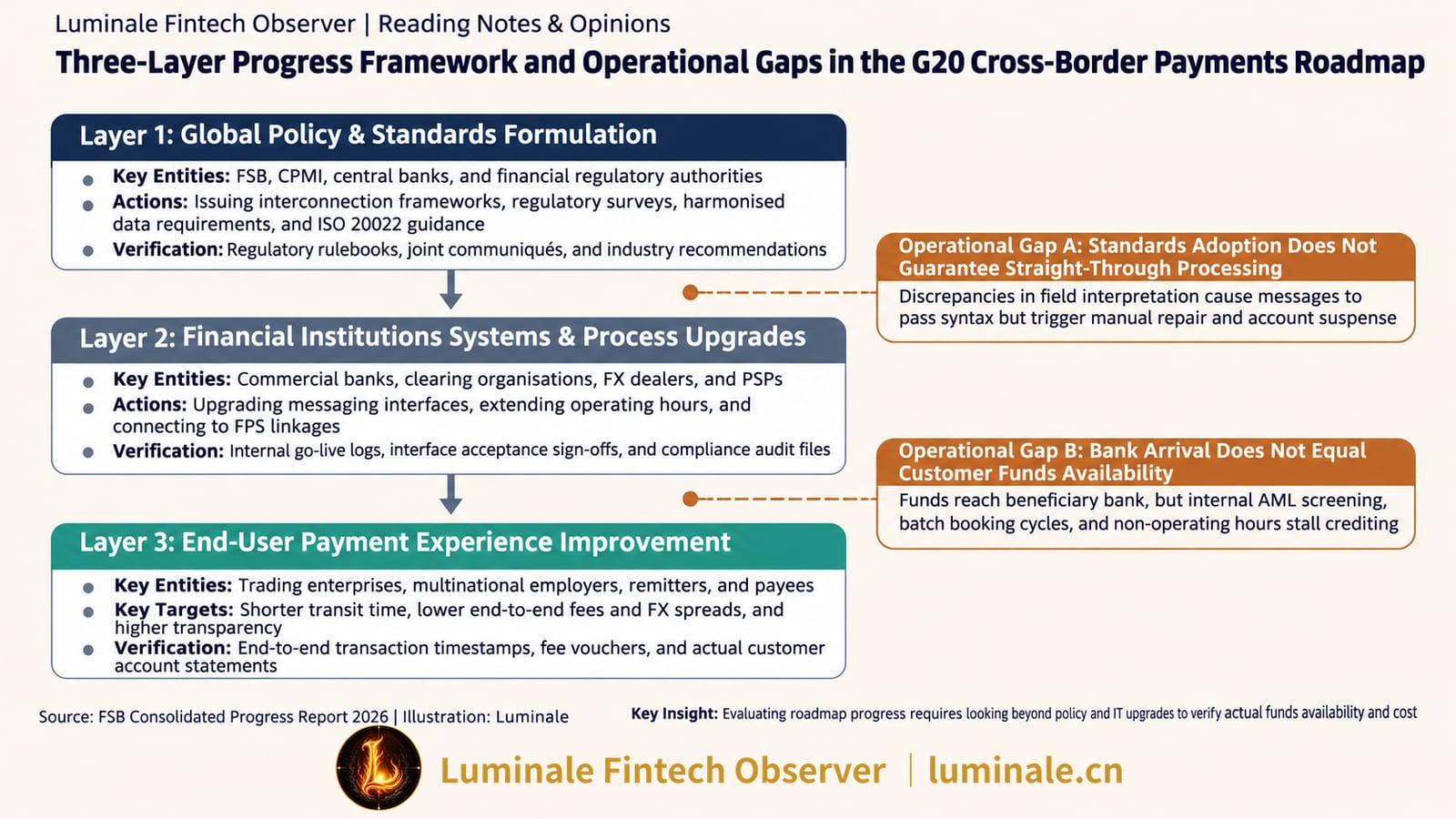
From policy design to customer crediting, cross-border payment optimisation spans three distinct operational layers:
| Operational Layer | Typical Actions | Verification Evidence | Common Decoupling Causes |
|---|---|---|---|
| Policy & Standards Formulation | International bodies issue regulatory guidelines, messaging harmonisation rules, and interconnection frameworks | Published rulebooks, implementation guidelines, and joint communiqués | Recommendations remain non-binding principles; regional legislative timelines and legal interpretations diverge |
| Institutional Process Upgrades | Commercial banks upgrade parsing interfaces, extend operating windows, and integrate with networks | Internal system production deployment logs, interface acceptance reports, and compliance sign-offs | Syntax compatibility does not guarantee straight-through processing; manual repair persists down the pipeline |
| End-User Experience Improvement | Payee receives accessible funds within committed timeframes at lower overall transaction costs | End-to-end per-transaction timestamp logs, debit vouchers, customer statements, and published tariffs | Batch crediting cycles at beneficiary banks, non-operating hour holding queues, and intermediary fee deductions |
The structure of the FSB 2026 Consolidated Progress Report reflects this progression: Chapter 1 reviews implementation across priority actions; Chapter 2 examines operational and legal frictions across jurisdictions; Chapter 3 presents empirical monitoring data for end-user Key Performance Indicators (KPIs); Chapter 4 outlines next steps; and the annexes detail action statuses, regulatory survey findings, and KPI tables[1].
Regarding metric design, the G20 Roadmap divides cross-border payments into wholesale payments, retail payments, and remittances, setting quantitative targets across four key dimensions[2]:
- Speed: End-to-end elapsed time from payment initiation to unconditional funds availability in the payee account;
- Cost: Total comprehensive expenses, including upfront fees, correspondent intermediary deductions, and foreign exchange (FX) spreads;
- Access: The scope of market participants and end users able to access compliant payment services;
- Transparency: The disclosure of pricing breakdowns, expected crediting timelines, and status tracking before initiation and throughout execution.
A critical consideration is the target timeline. The vast majority of G20 roadmap targets are benchmarked for year-end 2027, while the remittance cost target extends to 2030. Consequently, the 2026 Progress Report serves as an interim milestone assessment. Its observed metrics should be used to diagnose operational frictions and technical bottlenecks rather than to render premature judgments on the overall success of the reform program.
2. 2026 Implementation Progress: Tracing Technical Upgrades into Operational Workflows
Chapter 1 of the report examines work across three core pillars: payment system interoperability and extension, legal and regulatory framework alignment, and cross-border data exchange and messaging standards. Mapping these efforts to back-office banking clearing and PSP operations reveals expanding infrastructure capacity, alongside persistent operational thresholds that must be navigated before benefits reach end users.
1. RTGS Operating Windows and Access Criteria
Misaligned settlement windows have long represented a rigid constraint on cross-timezone liquidity flows. According to the FSB survey across major jurisdictions, among 82 surveyed real-time gross settlement (RTGS) systems, 11 operated on a 24/7 continuous basis in 2025, up from 5 systems in 2024[1].
However, lengthening central bank high-value clearing hours merely expands infrastructure availability. In practice, direct participation by non-bank payment service providers (PSPs) in RTGS systems remains subject to stringent prudential oversight. While regulatory frameworks are gradually opening access, central banks maintain rigorous pre-conditions, including minimum capital adequacy, robust anti-money laundering (AML) controls, and prefunded settlement reserve accounts. System connection does not equate to unconditional access; PSPs obtaining direct clearing rails must assume corresponding prudential and settlement risk management responsibilities.
2. ISO 20022 Harmonisation and Data Requirements
Major global payment market infrastructures are executing the transition to the ISO 20022 messaging standard. The standard accommodates rich, structured transaction metadata, including structured counterparty addresses, unique Legal Entity Identifiers (LEIs), and granular payment purpose codes.
Yet, completing interface upgrades only solves syntax interoperability between communicating platforms. If debtor, intermediary, and creditor banks maintain divergent interpretations of specific data fields, or if critical data elements are truncated across borders due to local data privacy restrictions, straight-through processing (STP) fails once the message arrives at the beneficiary bank. Minor spelling variations in account names or non-standard remittance references automatically divert transactions into exception queues, triggering manual review and transit halts.
For a detailed analysis of standard evolution and structured data fields, refer to "What Is ISO 20022? Understanding the Common Language of Next-Generation Payment Infrastructure". The real value of ISO 20022 adoption ultimately depends on whether bilateral counterparties enforce consistent business rules regarding field content and validation logic.
3. Cross-Border Multilateral Linkages of Fast Payment Systems
Connecting domestic fast payment systems (FPS) across borders represents a prominent pathway for accelerating retail transactions and reducing costs. The report documents the development of several bilateral and multilateral linkage initiatives.
Beyond technical connectivity, multilateral FPS linkages face their greatest challenges in governance coordination and settlement finality design. Multilateral arrangements must establish harmonised local-currency clearing mechanisms, competitive FX quotation protocols, and clear dispute-handling procedures for fraud and recall liability. For example, in multilateral payment architecture design, "From Bilateral Linkages to Multilateral Networks: How Nexus Rearchitects Instant Cross-Border Payments" details connection specifications, FX liquidity provider competitive models, and central bank reserve settlement boundaries. Without operational multilateral settlement pacts and liquidity backstops, such networks cannot support sustained commercial traffic.
3. End-User Experience: What Has Empirical Evidence Improved, and Where Do Gaps Remain?
Roadmap progress must ultimately be evaluated against end-user outcomes. Chapter 3 and Annex 3 of the FSB report release empirical monitoring figures. The table below compares latest observed values against established G20 targets:
| Dimension | Segment | Latest Observed Value | G20 Target | Scope & Methodology Notes |
|---|---|---|---|---|
| Speed (within 1 hour) | Wholesale | 57.0% | 75% | Q1 2026; based on Swift actual payment timestamps; excludes corporate front-end approval times[1] |
| Speed (within 1 business day) | Wholesale | 93.9% | Close to 100% | Q1 2026; based on Swift non-future-dated actual crediting data[1] |
| Speed (within 1 hour) | Retail | 32.9% | 75% | As of March 2026; based on service commitment disclosures, not actual per-transaction transit times[1] |
| Speed (within 1 business day) | Retail | 59.8% | Substantial remainder | As of March 2026; based on stated provider delivery commitments[1] |
| Cost (high-cost corridors) | Retail | 15.1% of corridors > 3% | 0% | As of March 2026; FXC Intelligence corridor sample; unweighted corridor count[1] |
| Cost (200 USD remittance) | Remittance | 5.7% (unadjusted 6.2%) | ≤ 3.0% (by 2030) | Q1 2026; World Bank RPW database; influenced by FX benchmark methodological revisions[1] |
| Transparency | Retail | 67.5% | 100% | As of March 2026; conditioned sample (only providers already disclosing pricing)[1] |
| Access | Financial Inclusion | 78.7% account ownership | Universal access | Global Findex 2025/2022 data; no new 2026 data; account ownership does not guarantee cross-border usability[1] |
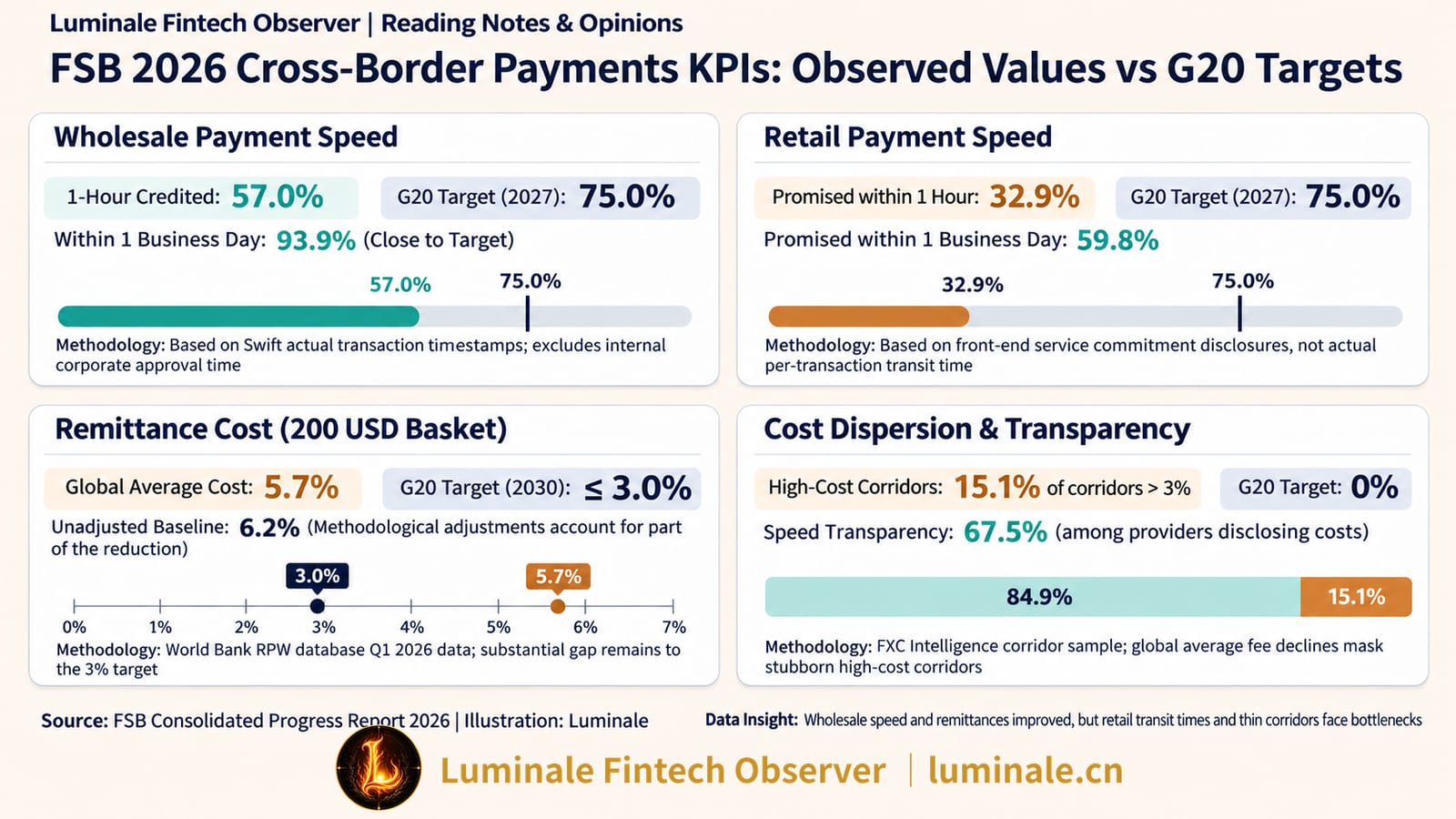
A rigorous examination of these underlying methodologies reveals three critical structural realities:
First, wholesale and retail speed datasets rely on distinct metrics and cannot be directly compared. The 57.0% one-hour wholesale crediting rate is derived from Swift network timestamps tracking actual transaction messages, measuring interbank transit and credit processing at the beneficiary bank. However, it does not incorporate corporate internal workflows, such as voucher origination, multi-tier compliance approvals, and treasury funding. Conversely, the 32.9% retail one-hour metric is collected from published front-end commitments by service providers. Service-level commitments reflect contractual intent, but when payments trigger AML exception screening or encounter settlement batch cut-offs, actual elapsed transit times often exceed advertised disclosures.
Second, the modest decline in remittance costs reflects methodological benchmark revisions. In Q1 2026, the global average cost of a 200 USD remittance fell to 5.7%, remaining well above the 3.0% target for 2030. The report notes that this improvement reflects recent technical revisions by the World Bank Remittance Prices Worldwide (RPW) database regarding baseline reference exchange rates. Calculated using the unadjusted historical baseline, the average cost stands at 6.2%[1]. Methodological updates explain a portion of the recorded reduction, which should not be attributed solely to aggressive fee cutting across corridor service providers. For an analytical breakdown of cross-border cost components across intermediary chains, see "Where Do Cross-Border Remittance Costs Arise? Reading the BIS Working Paper on Banks, Fintechs, and Stablecoins".
Third, the share of high-cost corridors remains persistent. Although global retail average fees have trended downward, 15.1% of surveyed payment corridors still impose fees exceeding 3%[1]. These corridors are heavily concentrated in smaller developing economies characterised by limited transaction volumes, fragile clearing infrastructure, and scarce foreign exchange liquidity. Global averages mask profound geographic dispersion.
4. Translating Policy Frictions into Institutional Checklists
The objective of international policy reporting is to provide market participants with actionable operational checklists. Within Luminale's analytical framework for payment infrastructure, the frictions highlighted by the FSB translate into three concrete verification areas for commercial banks and payment institutions.
1. Operations: Maintaining Corridor-Level End-to-End Timestamp Ledgers
Transit delays in cross-border payments frequently arise not within international trunk messaging networks, but during domestic clearing and account crediting within the destination country. Operations units should maintain dedicated timestamp ledgers across individual corridors, tracking four critical milestones:
- Time of customer instruction debiting at the origin;
- Time of payment message dispatch by the intermediary bank;
- Time of message ingestion and parsing by the beneficiary bank;
- Time of unconditional funds availability in the payee account.
In practice, funds often cross national borders within minutes, but then linger for hours or even an entire business day in beneficiary bank suspense accounts due to internal AML screening lists, account verification routines, or batch booking cycles outside clearing hours. For an examination of this structural friction, see "Why Does It Still Take Hours When Funds Have Reached the Destination Country? The Real Bottleneck Shifts to the Last Mile". Institutions must use reconciliation logs to identify where delays accumulate across core corridors.
2. Compliance and Data: Verifying Legal Authority and Protocols for Cross-Border Sharing
Standardising messaging formats cannot bypass sovereign data compliance mandates. Compliance and legal teams must confirm statutory authority when transmitting sensitive counterparty transaction data across borders.
Consider Verification of Payee (VoP) services: querying beneficiary account and name alignment via network APIs prior to execution prevents misdirected payments and authorized push payment fraud. In cross-border implementations, however, queries require transmitting payee identity attributes back to the foreign debtor institution. Compliance teams must verify: whether destination law requires prior customer consent; whether cross-border disclosure meets data protection thresholds; and whether "partial matches" (such as alternate transliterations or abbreviations) prompt user reconfirmation or enforce automated transaction rejection. While VoP reduces operational error, it does not relieve institutions of statutory AML customer due diligence mandates.
3. Infrastructure Operators and Treasury: Managing Intraday Liquidity and Queue Priority
Expanding clearing windows into night shifts, weekends, or continuous 24/7 cycles involves operational complexity, but the deeper economic friction lies in liquidity provisioning.
During night hours and weekends, foreign exchange and interbank wholesale money markets are closed. If creditor banks must credit incoming funds immediately or settle net obligations within a Deferred Net Settlement (DNS) mechanism, they cannot tap interbank borrowing for intraday position rebalancing. A sudden liquidity outflow overnight risks reserve exhaustion and technical overdraft defaults, forcing institutions to lock substantial excess reserves in central bank clearing accounts and driving up holding costs.
Under DNS risk frameworks, exposures are governed by Net Debit Caps. Cap calculation depends not only on regulatory capital and credit ratings, but strictly on prefunded cash collateral, dedicated clearing margins, and pledged high-quality liquid assets. When a large incoming payment causes an institution's net debit to exceed its cap, clearing systems do not execute blindly; rather, they reject processing citing insufficient debit caps and place the instruction into holding queues.
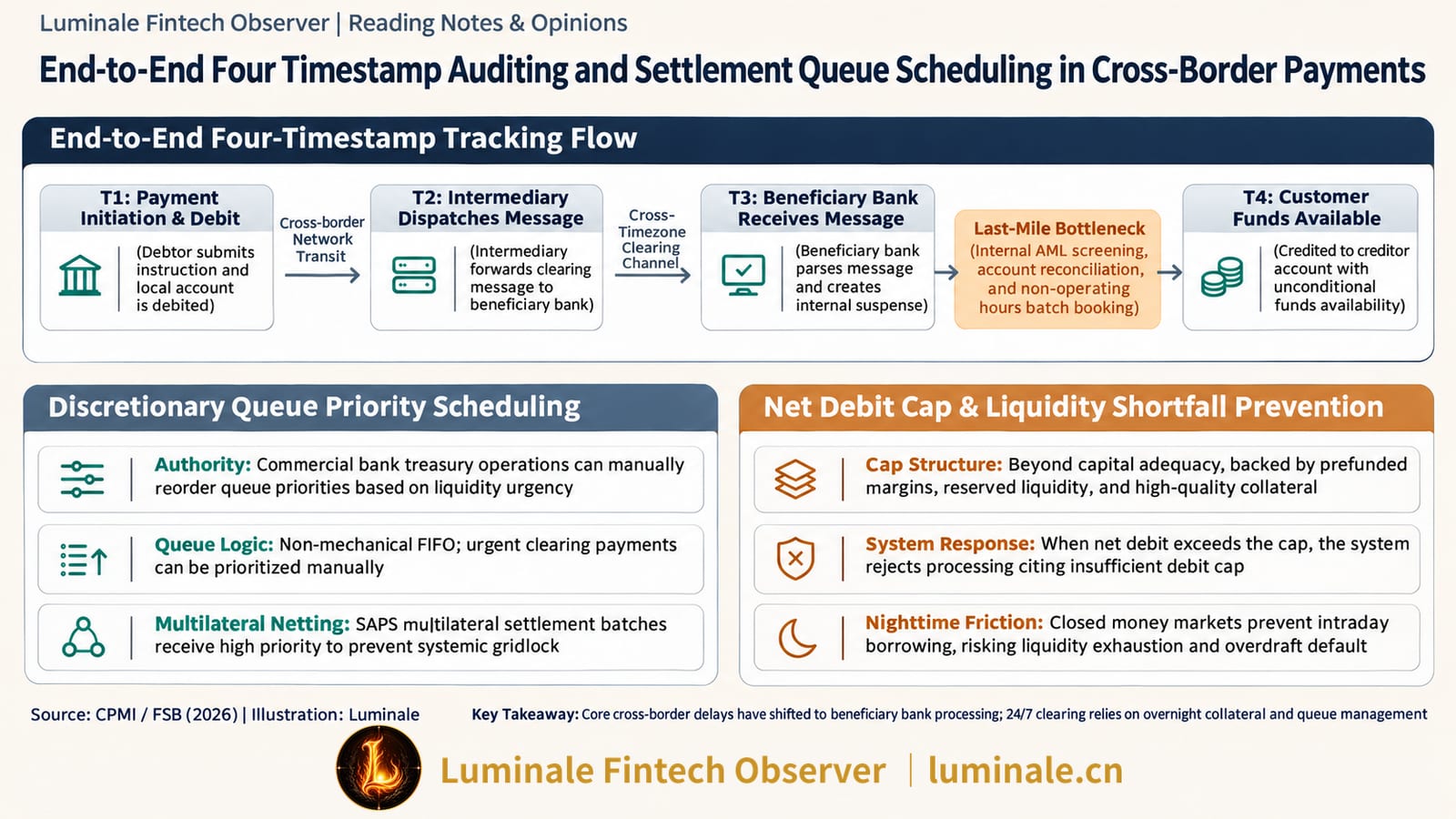
In actual operations, clearing queues do not function as rigid first-in, first-out (FIFO) pipelines. Commercial bank treasury desks possess operational discretion on management consoles to reorder queue priorities manually based on liquidity urgency. When central bank Settlement Account Processing Systems (SAPS) initiate multilateral netting cycles, multilateral net debit instructions receive elevated queue priority to ensure rapid execution and prevent gridlock from spreading across interbank networks.
5. Assessing the Report: Distinguishing Evidence from Extrapolation
Reading annual monitoring reports from international official bodies requires analytical discipline. This involves maintaining clear boundaries between three layers: documented empirical facts, official institutional hypotheses, and unverified causal assumptions.
First, progress within sample corridors cannot be generalised across global corridors. Recorded retail cost reductions and speed accelerations are driven primarily by high-volume corridors tracked by data vendors. In mature corridors with active bilateral commerce and direct clearing channels, competitive forces and connectivity deliver measurable gains. However, in low-volume, peripheral corridors, tiered correspondent banking networks remain largely unaltered.
Second, regulatory survey responses track administrative implementation rather than commercial execution. The annexes summarise self-reported assessments from central banks and supervisory authorities. These questionnaires illustrate commendable momentum in issuing regulatory frameworks and adopting recommended standards, but the lag between publishing an administrative circular and overhauling operational banking pipelines remains considerable.
Finally, pilot experiments must not be equated with scaled commercial deployment. Box 4 of the report highlights Payment versus Payment (PvP) initiatives spearheaded by the BIS Innovation Hub, such as Project Meridian FX[1]. These experiments coordinate atomic settlement across distinct central bank RTGS platforms without intermediary correspondent holding legs. The conceptual mechanics of these models are explored in "From Meridian to the APAC FX Trial: Who Coordinates Synchronised Settlement Across Central Bank Systems?".
Yet, evaluating such innovations requires perspective: regulatory sandbox pilots operate within bounded parameters, pre-positioned liquidity allocations, and statutory exemptions. When these architectures transition to live markets—navigating cross-border insolvency finality conflicts, commercial liquidity costs, and continuous compliance liabilities—their practical capacity to sustain theoretical cost efficiencies and operational resilience remains to be validated.
The ultimate benchmark for cross-border payment reform is reflected in the execution of individual commercial transactions. For financial institutions, the most effective strategy is not to market conceptual promises, but to use the empirical metrics of this report to establish verifiable corridor ledgers tracking end-to-end transit times, fee deductions, and compliance exceptions. Only when improvements are recorded as accessible funds in customer accounts can the G20 Roadmap be considered an accomplished operational reality.
References
[1]: Financial Stability Board (FSB). G20 Roadmap for Enhancing Cross-border Payments: Consolidated progress report for 2026. November 16, 2026. https://www.fsb.org/2026/11/g20-roadmap-for-enhancing-cross-border-payments-consolidated-progress-report-for-2026/ (Official PDF: https://www.fsb.org/uploads/P161126.pdf). ↩
[2]: Financial Stability Board (FSB). G20 Targets for Enhancing Cross-border Payments: Final report. October 13, 2021. https://www.fsb.org/work-of-the-fsb/financial-innovation-and-structural-change/cross-border-payments/g20-targets-for-enhancing-cross-border-payments-2/. ↩
[3]: Financial Stability Board (FSB). G20 Roadmap for Cross-border Payments: Consolidated progress report for 2025. October 9, 2025. https://www.fsb.org/2025/10/g20-roadmap-for-cross-border-payments-consolidated-progress-report-for-2025/. ↩
Originally published by Luminale Fintech Observer: https://luminale.cn/articles/fsb-2026-cross-border-payments-progress-report-en