A Hong Kong trading firm with around twenty employees procures a batch of electronic components from a factory in Dongguan. The goods are transshipped through Hong Kong and sold to an assembly plant in Malaysia. The buyer demands 90-day open account terms—meaning payment is due three months after arrival. Meanwhile, the manufacturing plant insists on full payment before dispatch. To bridge this three-month cash flow gap, the trading firm has no choice but to seek bank financing.
The firm owns no physical plant or real estate, nor does it hold substantial deposits to pledge as collateral. All it can present to the bank is a purchase order, commercial invoice, packing list, and scanned copies of the bill of lading issued by the shipping line. What credit officers see is a stack of papers. They cannot tell which vessel is carrying the cargo right now, whether the customs declarations match the invoice, or whether this very invoice was pledged at another bank last month. Faced with this opacity, the bank demands supplementary documentation, makes verification phone calls, and conducts anti-money laundering (AML) and sanctions screening. Several weeks pass, and the application might still be rejected.
Such scenarios are far from rare in Hong Kong. According to reports by the Hong Kong Monetary Authority (HKMA), trading is Hong Kong's second-largest industry after financial services, contributing roughly 15% of GDP. In 2024, Hong Kong's total merchandise trade value was equivalent to 3.6 times its GDP, ranking third globally. Yet trade finance continues to rely predominantly on paper documents, fragmented data, and manual reconciliation[1].
On 19 January 2026, the HKMA released the Project Cargoᵡ Recommendation Report, putting forward 20 recommendations alongside an implementation roadmap[2]. In May of the same year, the HKMA launched the Project Cargoᵡ Pilot Scheme with 21 participating banks[3]. We previously touched upon this initiative at the conclusion of What Exactly Is a Letter of Credit?. In our Introductory Course on Payment and Clearing article, How Is Money Borrowed? (hereafter referred to as "the financing article"), we also highlighted that the core challenges in trade finance lie in documentation, physical goods, and title information—whereas the funds transfer layer is already relatively mature. This article examines the 61-page report, synthesizing pilot progress and international practices to address three core questions: What problem does Project Cargoᵡ aim to solve? Which layer of trade finance does it actually transform? And how far can it go?
I. Where Trade Finance Falls Short: Hong Kong's Financing Gap and Six Key Pain Points
1. The Global Gap vs. Hong Kong's Gap
The report cites a 2023 survey by the Asian Development Bank (ADB): the global trade finance gap exceeded $2.5 trillion in 2022, representing roughly 10% of global export value. Among rejected trade finance applications, nearly half came from small and medium-sized enterprises (SMEs)[6].
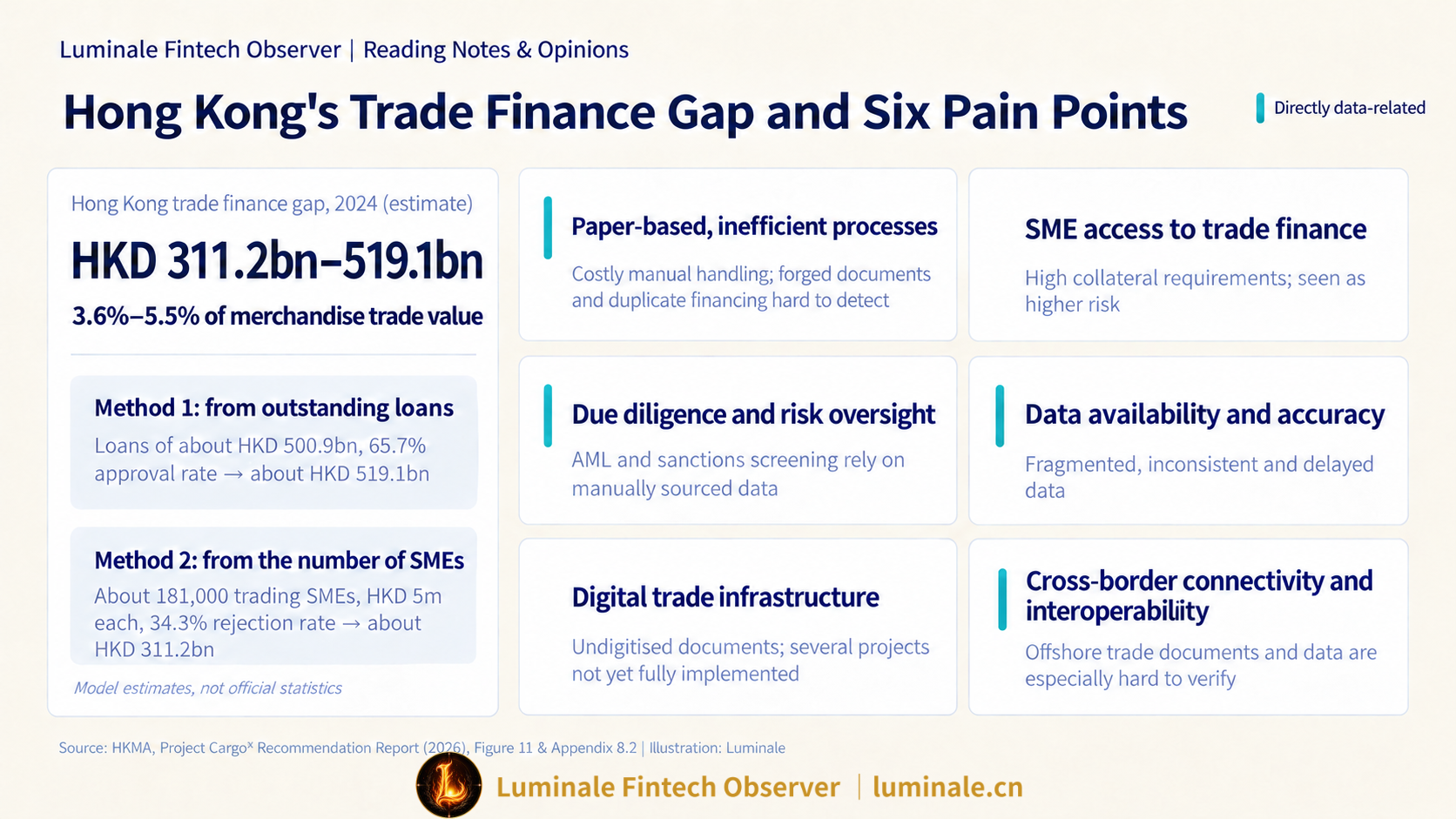
Hong Kong's local gap was estimated by KPMG at approximately HK$311.2 billion to HK$519.1 billion in 2024, equivalent to 3.6% to 5.5% of Hong Kong's total merchandise trade value[1]. The report presents two estimation methodologies:
| Methodology | Starting Point | Key Assumptions | Estimated Result |
|---|---|---|---|
| Method 1 | Hong Kong banks'trade finance loan balance of ~HK$500.9 billion in 2024 | Extrapolating rejected applications from the ADB survey's average approval rate of 65.7%, plus unmet demand that never applied | ~HK$519.1 billion |
| Method 2 | ~353,000 SMEs in Hong Kong, with ~181,000 engaged in trading activities | Average loan demand of HK$5 million per SME, with a rejection rate of 34.3% | ~HK$311.2 billion |
Data source: Project Cargoᵡ Recommendation Report, Appendix 8.2[1].
The report notes that Hong Kong's gap ratio is lower than the global average, attributing this to Hong Kong's advanced economy, robust banking sector, and sound regulatory regime. However, this comparison warrants caution: the global 10% uses export values as the denominator, whereas Hong Kong's 3.6% to 5.5% is measured against total merchandise trade value (imports plus exports). A lower headline percentage does not mean Hong Kong SMEs find financing easy.
The report also highlights a market concentration figure: the top 12 banks by trade finance loan balance in Hong Kong account for 80% of total trade finance lending, while banks willing to serve SMEs represent only a small minority[1].
2. The Rise of Open Account and the Dwindling Paper Trail for Banks
As discussed in our article on letters of credit, the virtue of documentary credits lies in standardized documentation: the issuing bank examines documents against credit terms and pays if they strictly comply; the bank's visibility into the trade derives primarily from this documentary package. The report points out that international trade has increasingly shifted to open account terms, where buyers and sellers agree directly on payment tenors without bank letter of credit issuance or document examination[1].
While open account eliminates LC fees and procedural friction, the trade-off is that banks lose a vetted documentary package when extending financing. To finance receivables or purchase orders under open account terms, banks must find alternative ways to verify whether the underlying trade is genuine, whether the goods have been shipped, and whether the buyer is creditworthy. The report observes that in an environment where traditional paper documents are dwindling, banks must rely more heavily on alternative data to assess risk[1].
3. Six Key Pain Points Identified in the Report
Based on industry interviews conducted by the Expert Group and desk research by KPMG, the report synthesizes six categories of pain points from the perspectives of both SMEs and banks[1]:
| Pain Point | SME Perspective | Bank Perspective |
|---|---|---|
| Paper-based and inefficient processes | Applications and drawdowns rely on manual work, prone to errors | Processing paper documents is costly and time-consuming; difficult to detect forged bills and double financing |
| SME financing accessibility | Stringent underwriting standards and high collateral requirements | SMEs are perceived as higher-risk borrowers |
| Due diligence and risk monitoring | Compliance overhead is ultimately passed on to businesses | AML and sanctions screening require manual data collection, incurring high costs |
| Data accessibility and accuracy | Difficult to provide real-time transaction data | Must aggregate data from multiple fragmented sources, with inconsistent metrics and substantial time lags |
| Digital trade infrastructure and document digitalisation | Documents are not digitalised, leading to prolonged processing times | Several digital trade infrastructure initiatives have begun in Hong Kong but are not yet fully implemented |
| Cross-border connectivity and interoperability | Fragmented systems and processing delays | Lack of end-to-end connectivity; offshore trade documents and data are particularly difficult to verify, raising fraud risks |
Regarding compliance costs, the report notes that while AML and sanctions screening obligations are essential, they consume significant manpower. For some banks, offering a full suite of trade finance products to SMEs simply does not make economic sense[1]. This indicates that SME financing hurdles stem partly from bank cost structures, largely independent of technological sophistication.
Collateral presents another hurdle. Citing a 2022 study, the report notes that collateral requirements are the primary obstacle encountered by Hong Kong SMEs seeking financing[1]. A trading company without factories or real estate can demonstrate repayment ability primarily through its orders, physical inventory in transit, and cash flow records.
4. Why Start with Data?
Among the six pain points, paper-based workflows, due diligence, data accessibility, and cross-border connectivity all relate directly to whether banks can access trusted data. High collateral demands also partly stem from the fact that banks cannot clearly see underlying transactions, forcing them to fall back on tangible assets.
To use an analogy: evaluating a trade finance request is much like inspecting a used car when you are only shown photographs. The photos might be outdated, digitally altered, or already submitted as collateral to multiple dealerships. What Project Cargoᵡ seeks to accomplish is allowing the bank—with the owner's explicit consent—to look up the vehicle's official mileage and maintenance logs directly.
Our financing article discussed double-financing scandals like Singapore's Hin Leong, which will not be repeated here. What these cases had in common was that each lending bank could only see the documents presented by the borrower, without visibility into financing extended by peer banks.
II. Which Part Does Project Cargoᵡ Transform? Consent-Based Data Access Built on CDI
1. The Foundation: Commercial Data Interchange (CDI)
Project Cargoᵡ does not build a brand-new trading platform or settlement system. Instead, it is built on the Commercial Data Interchange (CDI), launched by the HKMA in 2022.
The CDI is a consent-based data-sharing infrastructure. Enterprises are the data owners, banks are the data consumers, and government departments, logistics companies, e-commerce platforms, and utilities serve as data providers. Only upon the enterprise's explicit authorization will data providers transmit designated data to specified banks via the CDI. The report notes participation by 26 banks and 17 data providers[1]. According to the HKMA's September 2025 Quarterly Bulletin, from its official launch through end-June 2025, CDI facilitated over 61,000 loan applications and reviews, with estimated approved credit exceeding HK$50.1 billion[5].
One can think of the CDI as a centralized archival retrieval window that requires customer sign-off. When a bank wants to review a company's shipment records, it must first obtain authorization from the enterprise. The window then queries the port, airport, or other data providers to retrieve the records. This window does not disburse loans, nor does it hold custody of the enterprise's goods or funds.
2. Project Objectives and the Dual-Track Approach
The HKMA frames Project Cargoᵡ as a multi-year public-private partnership centered around three priorities: leveraging cargo and trade data to streamline trade finance processes; developing digital solutions to enhance SME access to trade finance; and exploring cross-border data linkages with external partners[1].
The project proceeds along two parallel tracks. One is the Expert Group established in April 2025. The HKMA invited 24 institutions spanning banks, cargo logistics data providers, credit reference agencies, export credit insurers, government departments, and international bodies—including the BIS Innovation Hub Hong Kong Centre and the ICC Digital Standards Initiative (DSI)[2]. The Expert Group was tasked with analyzing pain points and formulating recommendations, with the report prepared with assistance from KPMG and Quinlan & Associates.
The other track focuses on pilot transactions. In July 2025, HSBC announced that, as an Expert Group member, it had completed a Project Cargoᵡ pilot transaction: accessing shipment and delivery records from the Port Community System (PCS) via CDI to verify the logistical flows of a local freight forwarder, subsequently approving and disbursing a loan on that basis[7].
3. How Data Flows in a Transaction
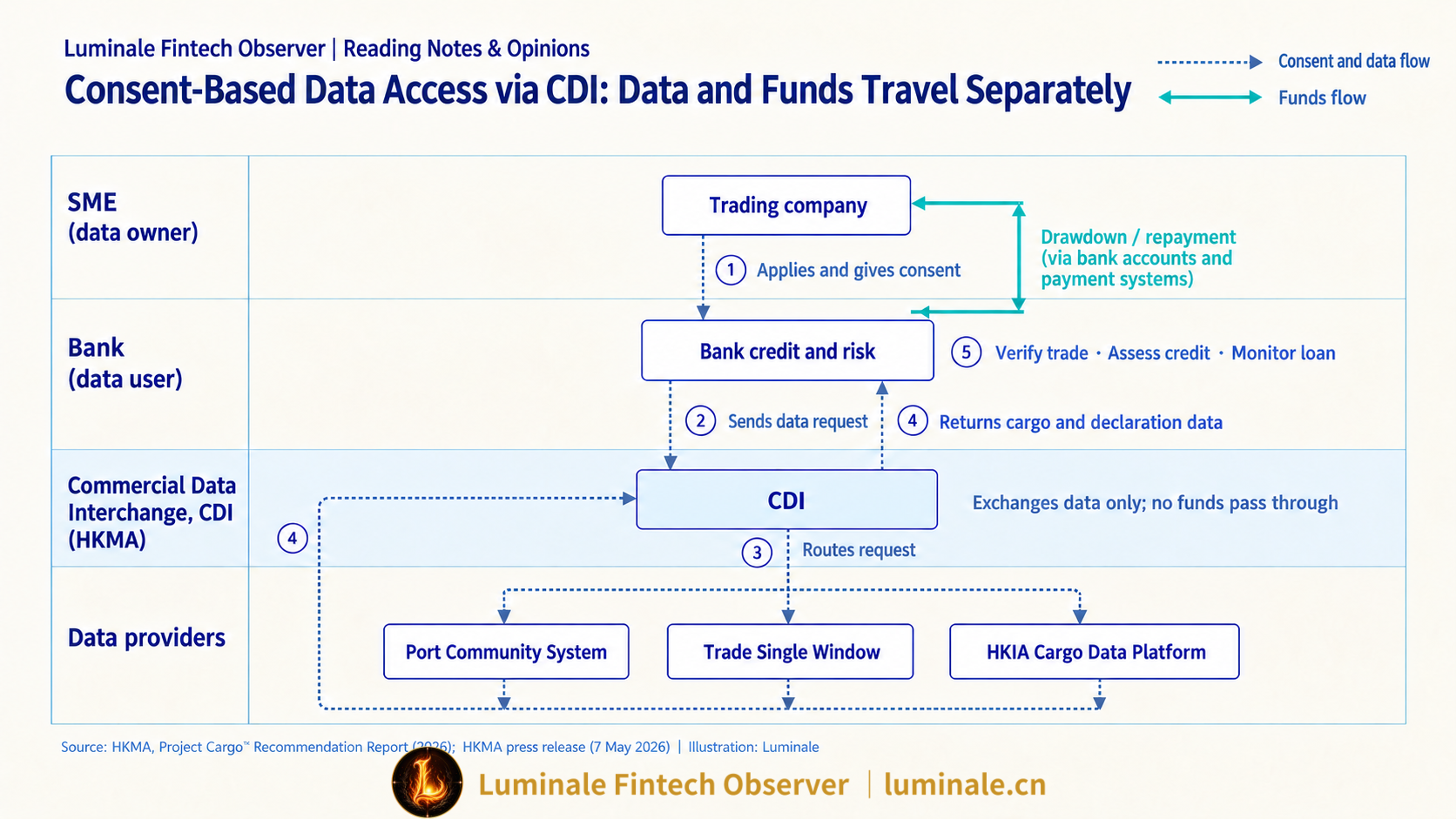
Under the framework outlined in the report and the pilot scheme, data flows during a trade finance application as follows:
- An SME applies for trade financing with a bank and authorizes the bank through banking channels to access designated data, such as transport records for specific shipments or trade declarations over a given period.
- The bank submits a data request through CDI.
- CDI routes the request to the relevant data provider, such as the Transport and Logistics Bureau's Port Community System (PCS), the Commerce and Economic Development Bureau's Trade Single Window (TSW), or the Airport Authority Hong Kong's HKIA Cargo Data Platform.
- The data provider transmits the requested data back to the bank via CDI.
- The bank uses this data to verify transaction authenticity, evaluate corporate creditworthiness, and perform post-lending monitoring.
Throughout this process, CDI strictly handles data interchange. Loan disbursement, trade settlement payments, and loan repayments remain within bank accounts, with interbank transactions cleared through Hong Kong's payment systems as usual.
4. Positioning Project Cargoᵡ across Three Rails
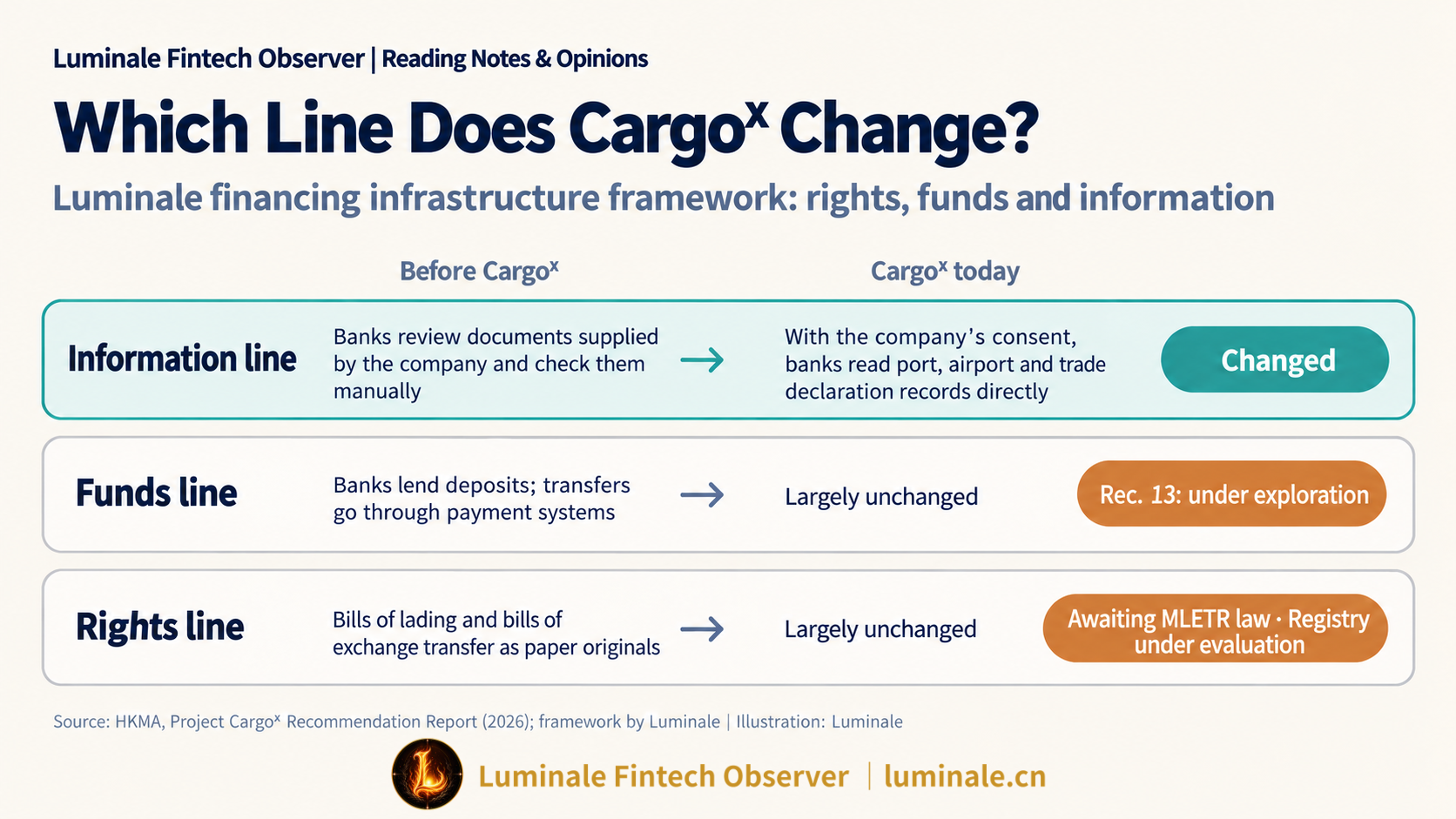
Under Luminale's analytical framework for payment and financial infrastructure, every financing arrangement can be decomposed into three rails: the rights rail (recording who holds what legal entitlements against whom), the funds rail (tracking money movements across accounts), and the information rail (determining where decision-critical data originates). Viewing Project Cargoᵡ through this lens:
| Rail | Prior to Project Cargoᵡ | Current Phase of Cargoᵡ | What Remains Unchanged |
|---|---|---|---|
| Information Rail | Banks primarily reviewed customer-submitted documents manually | With corporate consent, banks directly access third-party port, airport, and trade declaration records | Data coverage depends on which data providers are onboarded |
| Funds Rail | Banks disburse loans in HKD or foreign currency deposits via payment systems | Fundamentally unchanged | Recommendation 13 proposes exploring novel payment mechanisms, but remains exploratory |
| Rights Rail | Title transfers of bills of lading and bills of exchange rely on physical documents | Fundamentally unchanged | Awaiting enactment of HK legislation aligned with MLETR; registry assessment ongoing |
At its current stage, Project Cargoᵡ primarily transforms the information rail. Where banks once relied on paper dossiers submitted by borrowers, they can now query records in third-party systems—with those records moving only after corporate consent. As discussed in After "Transfer Was Successful": Payment Instruction, Account Posting, and Funds Transfer Are Actually Three Different Things, payment instructions, account posting, and funds transfers are distinct operations. Project Cargoᵡ addresses information verification prior to credit decisions; subsequent instructions, postings, and transfers fall entirely outside its scope.
5. Why Enterprise Consent Matters
CDI employs transaction-specific consent for two reasons. First, data protection: an enterprise's operational data belongs to the enterprise, and banks cannot query it at will. Second, it dictates when data moves: data flows to a bank only when an enterprise seeks financing and is willing to share it.
This differs from credit reporting registries, where financial institutions are mandated to report lending data without borrower discretion. While the consent model respects corporate privacy, it introduces a dilemma discussed in Section V.
6. The Pilot Scheme Launched in May 2026
On 7 May 2026, the HKMA announced the launch of the Project Cargoᵡ Pilot Scheme, joined by 21 banks with sizable trade finance franchises, to advance trials across four focus areas over 2026–2027[3]:
| Focus Area | HKMA Formulation | Specific Content |
|---|---|---|
| 1 | Connecting major cargo logistics and trade data platforms | Onboarding PCS, TSW, and HKIA Cargo Data Platform to CDI to verify transactions using cargo tracking, trade declaration, and air freight data |
| 2 | Integrating SME trade and cash flow data | Sharing corporate cash flow data among banks upon enterprise consent to enable multi-dimensional credit assessments |
| 3 | Applying digital corporate identity | Adopting the Digital Corporate Identity (CorpID) launched by the Digital Policy Office for identity authentication and digital signing |
| 4 | Enhancing connectivity with major trade corridors | Collaborating with Mainland data providers and exploring access to ASEAN trade declaration data |
Source: HKMA Press Release (7 May 2026) and CDI Project Cargoᵡ portal[3].
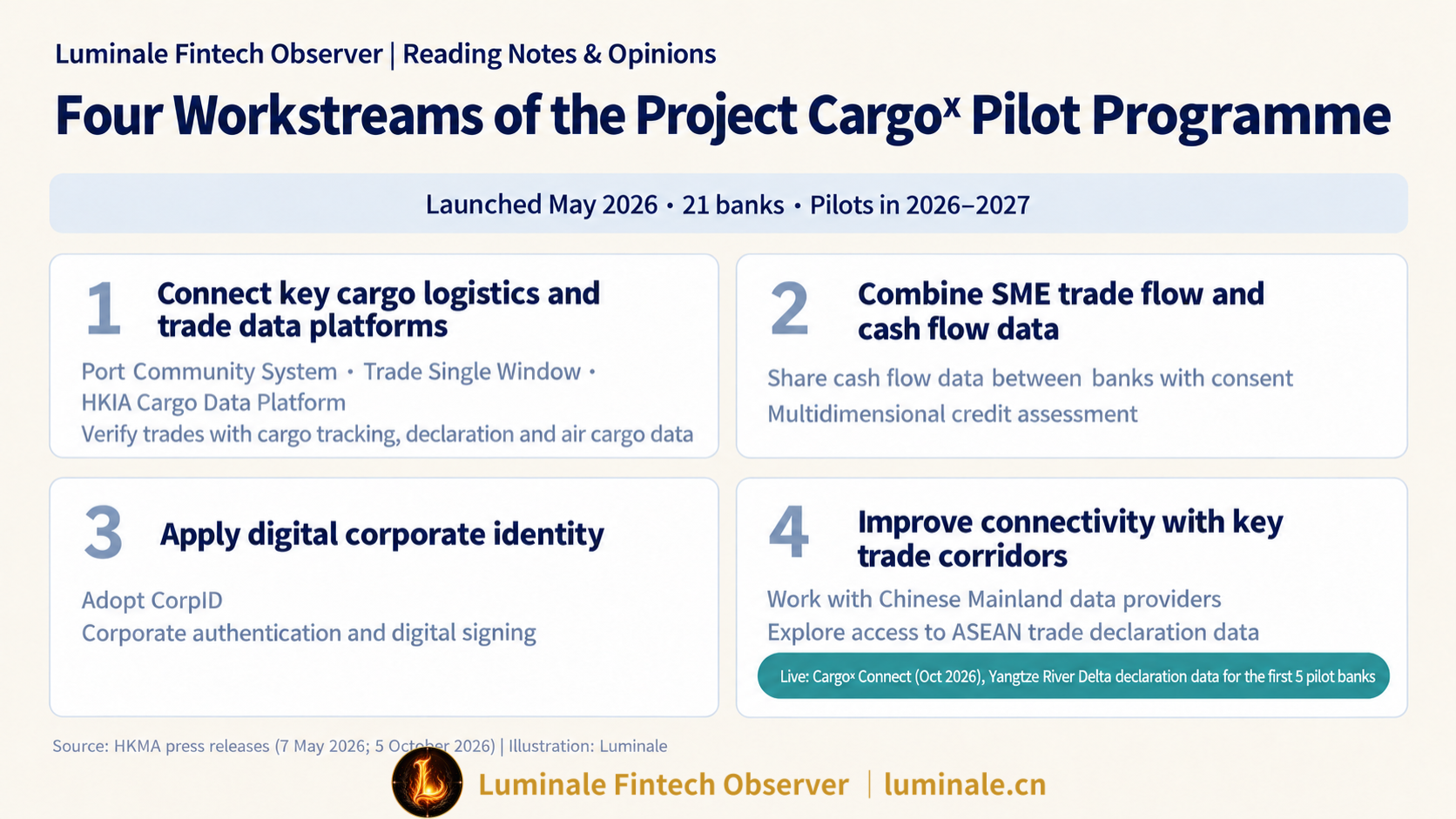
The fourth focus area has already achieved its first tangible deliverable. On 5 October 2026, the HKMA hosted the Cargoᵡ Solutions Day, announcing the linkage between CDI and the digital trade platform developed by the Shanghai Data Bureau—a partnership dubbed "Cargo Trade Connect" (货贸通). The initial batch of five pilot banks (Bank of China (Hong Kong), Hang Seng Bank, HSBC, ICBC (Asia), and Standard Chartered Bank (Hong Kong)) can access and utilize trade customs declaration data from the Yangtze River Delta to verify trade genuineness and perform counterparty due diligence. The HKMA also disclosed that pilot initiatives had facilitated 10 trade finance approvals totaling HK$180 million. On the same day, the HKMA signed a Memorandum of Understanding with the Pan Asian e-Commerce Alliance (PAA) to explore trade data connectivity across its 15 member economies[4].
III. The 20 Recommendations: Three Pillars of Data, Infrastructure, and Connectivity, and the 2030 Roadmap
1. Twenty Recommendations Under Three Pillars
The report envisions establishing Hong Kong as a leading trade finance hub underpinned by resilient, globally connected digital infrastructure. The 20 recommendations are structured across three pillars: data, infrastructure, and connectivity[1]:
| Pillar | Number | Recommendations |
|---|---|---|
| Data | 1–8 | Onboard government cargo and trade data; introduce commercial trade and logistics data; facilitate counterparty due diligence; open historical trade transaction data; utilize e-commerce data for underwriting; integrate trade and cash flows for multi-dimensional credit assessments; enhance SME credit scoring models; develop innovative products |
| Infrastructure | 9–13 | Study comprehensive digitalisation of trade documents and promote paperless trade; align local legislation with MLETR; evaluate costs and benefits of a trade finance documents registry; promote digital identity in trade transactions; explore innovative payment mechanisms |
| Connectivity | 14–20 | Strengthen connectivity with Mainland China; explore connection with ASEAN Single Window; connect with overseas trade corridors; adopt globally interoperable data and document standards; enhance Hong Kong's supply chain and financial ecosystem; strengthen accounts receivable financing; improve trade credit insurance availability |
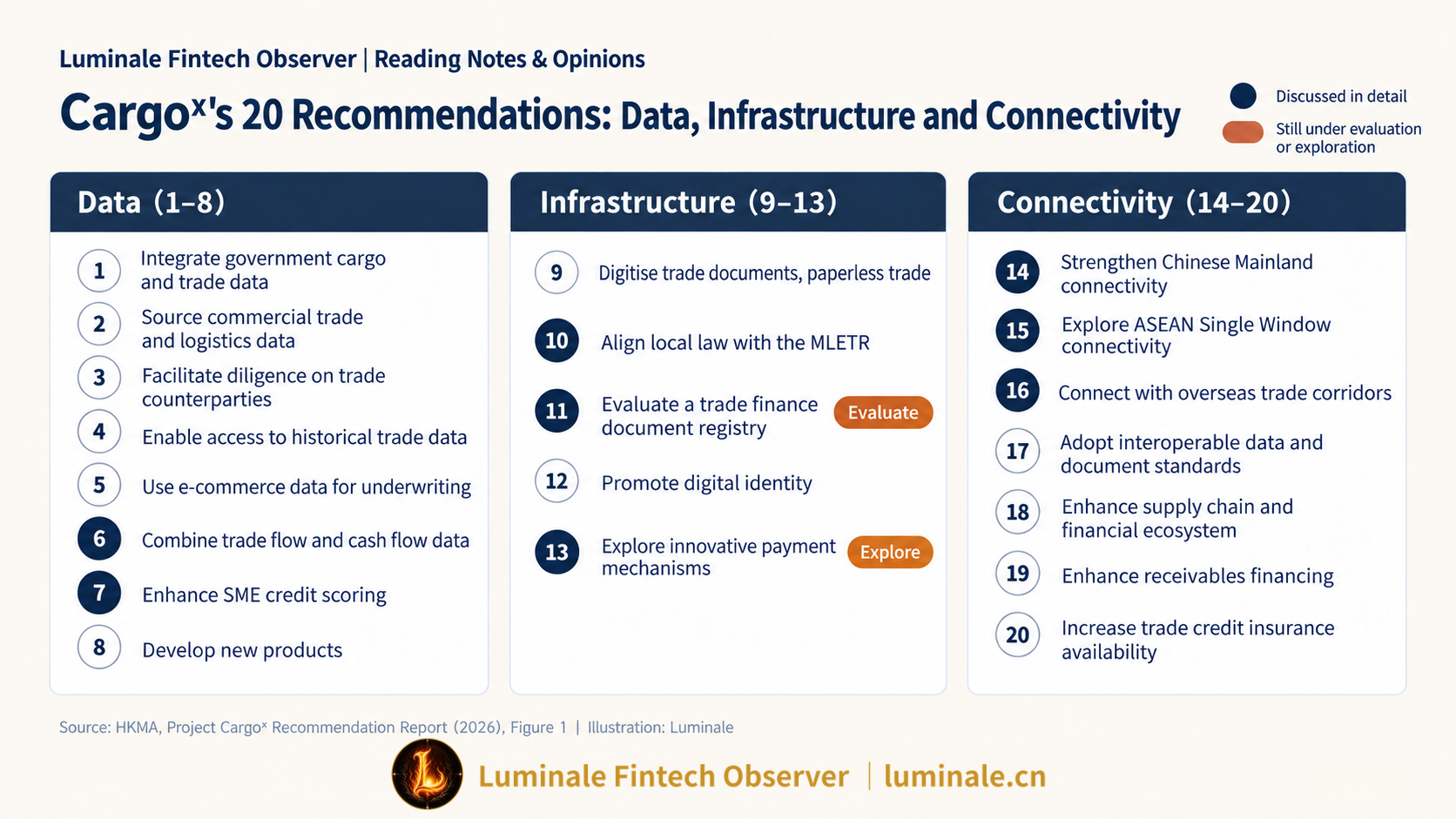
Among these 20 recommendations, some can be driven directly by the HKMA (such as data onboarding and scoring model enhancements); others depend on external government bureaus (such as legislation and digital corporate identity); while several are preliminary assessments or exploratory studies. Below, we examine several recommendations of particular significance to financial infrastructure.
2. Recommendations 6 & 7: Shifting from Collateral to Cash Flows
Recommendation 6 proposes integrating trade and cash flow data to evaluate credit, while Recommendation 7 calls for refining credit scoring models tailored for SMEs. The report's rationale is that banks can leverage real-time data alongside intangible assets—such as verified purchase orders and cash flow histories—to evaluate SME debt service capacity, thereby reducing reliance on physical collateral[1].
This directly mirrors the second focus area of the pilot scheme. Trade data confirms to the bank that cargo was indeed dispatched; cash flow data demonstrates whether the borrower's historical receipts and payments are steady. Taken together, banks obtain a coherent basis for underwriting a trading company that lacks bricks-and-mortar assets.
3. Recommendation 10: Legal Status of Electronic Documents
Adopted by UNCITRAL in 2017, the Model Law on Electronic Transferable Records (MLETR) grants electronic bills of lading and electronic bills of exchange the same legal validity as paper documents. Under common law traditions, transferring a negotiable instrument hinges on possessing the physical original. Without legislative reform, an electronic bill of lading cannot be legally endorsed and transferred in the same manner as paper.
On 29 December 2025, the Hong Kong SAR Government launched an industry consultation on proposed amendments to the Electronic Transactions Ordinance (Cap. 553), seeking to establish a legal foundation aligned with MLETR for business-to-business transferable trade documents like bills of lading and bills of exchange, running through 27 March 2026[8]. The report anticipates introducing legislative proposals in 2026[1]. As of this writing, the timetable for introducing the amendment bill to the Legislative Council has not been finalized.
Mainland China has moved a step ahead. The newly revised Maritime Code of the People's Republic of China, passed on 28 October 2025 and taking effect on 1 May 2026, introduces provisions on electronic transport records, recognizing them as legally equivalent to paper documents[12]. Singapore amended its Electronic Transactions Act in 2021 to adopt MLETR; the UK passed the Electronic Trade Documents Act 2023.
Recommendation 10 is an indispensable prerequisite for Phase 2 of the roadmap. Without this statutory underpinning, electronic bills of lading in Hong Kong can serve only as information sources, not as transferable, pledgeable documents of title.
4. Recommendation 11: Trade Finance Documents Registry
Recommendation 11 advises evaluating the costs and benefits of establishing a trade finance documents registry in Hong Kong. Under this concept, banks would submit invoices and trade documents to a centralized registry to detect duplicate financing; submitted data could also be utilized to verify transactions and provide market analytics[1].
The report candidly acknowledges the challenges: requiring standardized data formats and robust cybersecurity safeguards; needing public policy and funding support; demanding extensive manual onboarding of historical invoices to establish critical mass; and requiring active participation from a majority of banks alongside broad trader and industry buy-in[1]. In the roadmap, Recommendation 11—alongside Recommendations 8, 19, and 20—is classified as a forward-looking initiative slated for later phases.
This recommendation directly addresses the double-financing problem highlighted in our financing article. CDI helps an individual bank see through a transaction, but it cannot inform that bank whether the same invoice has already been financed elsewhere. Answering the latter requires multiple banks to cross-reference their financing records in a shared registry.
5. Recommendation 13: Exploring Innovative Payment Mechanisms
Recommendation 13 is the sole recommendation among the twenty that directly touches the funds rail. The report recommends exploring the use of central bank digital currencies (CBDCs), tokenised deposits, and licensed stablecoins in trade finance. Through initiatives like the HKMA's Project Ensemble, it encourages their application in trade settlement and cross-border payments, while onboarding on-chain payment data onto CDI to enhance the transparency of trade payment flows[1].
The report notes key dependencies: a sound legal and regulatory framework for licensed stablecoins in Hong Kong, and active support from banks, corporates, and regulators[1]. Notably, the report frames this as exploration and encouragement rather than replacing interbank settlement with stablecoins.
This initiative holds significant long-term potential. If trade data (Cargoᵡ) and tokenised settlement (Ensemble) are linked, banks or buyers could configure programmatic conditions—such as triggering automatic payment or loan repayment once goods are unloaded at port and logged into the system—enabling automated financing and conditional payments. We introduced EnsembleTX's use of tokenised deposits to settle on-chain transactions in What Money Settles On-Chain Assets?, and explored the settlement assets required for conditional payments in Smart Contracts, Programmability, and On-Chain Settlement. The report classifies this solely as an exploratory avenue without a binding timetable.
For discussions on regulatory and structural issues surrounding licensed stablecoins in trade settlement, see Understanding Stablecoins in One Article and our deep dive into the FSB Report on Cross-Border Vulnerabilities of Global Stablecoins. For tokenised deposits and e-HKD pilot findings, see Tokenised Deposits: How Commercial Bank Money Enters the On-Chain World and From Retail CBDC to Tokenised Settlement: What Did the Two-Phase e-HKD Pilots Answer?.
6. Recommendations 14–16: Cross-Border Data Interoperability
Hong Kong is an entrepôt hub with substantial offshore trade: Hong Kong firms execute contracts, issue invoices, and arrange financing, while goods are shipped directly from Mainland ports to third countries without entering Hong Kong. The report notes under its pain points that offshore trade documents and data are the hardest to verify[1].
Connecting solely to local Hong Kong port and airport data cannot cover these trade flows. Recommendations 14 (strengthening Mainland connectivity), 15 (exploring links with the ASEAN Single Window), and 16 (connecting overseas trade corridors) were formulated to bridge this gap. Cargo Trade Connect, which grants pilot banks access to Yangtze River Delta customs declarations, represents an initial delivery under Recommendation 14. For context on cross-border RMB settlement, see RMB Internationalisation: More Than Just "Settling in Renminbi".
7. The 2030 Roadmap: Three Phases and Three External Prerequisites
The report organizes the 20 recommendations into a roadmap through 2030 across three sequential phases[1]:
| Phase | Focus | Commencement Conditions |
|---|---|---|
| Phase 1: Quick Wins | Onboard government logistics and customs data onto CDI, progressively incorporate other trade data, and integrate cash flow data and SME credit scoring models | Already underway |
| Phase 2: Scaling Impact | Promote digital trade documents and strengthen connectivity with major international trade corridors | Full rollout of CorpID, full implementation of TSW, and enactment of MLETR-aligned legislation |
| Phase 3: Expanding Connectivity | Comprehensive data exchange with international partners, establishing a globally connected digital trade hub | Built upon Phase 2 foundation |
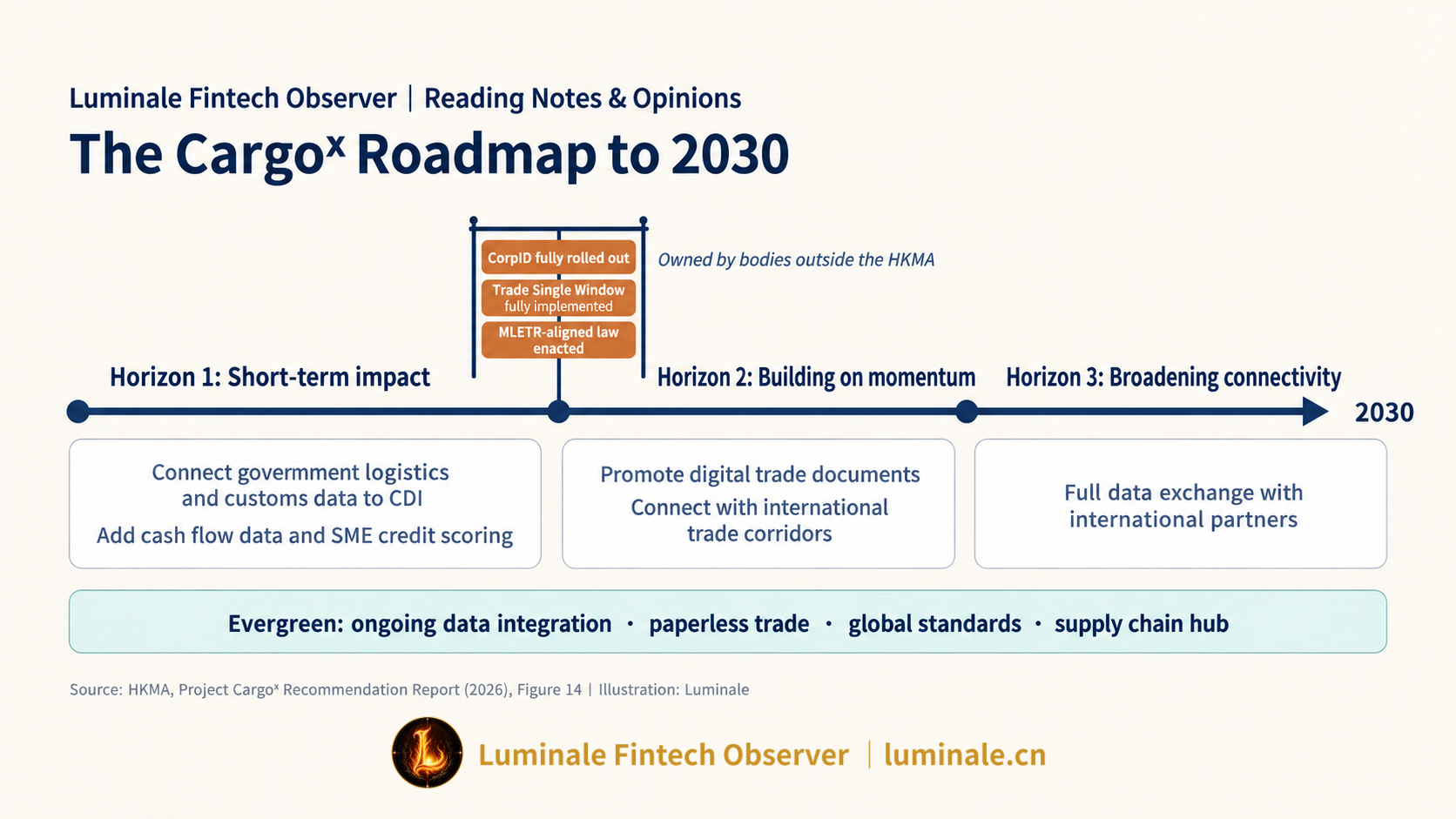
Additionally, ongoing initiatives span across all phases, including continuous data onboarding, promoting paperless trade, adopting global standards, and reinforcing Hong Kong's role as a global supply chain hub.
The roadmap reveals two critical insights. First, the sequencing is deliberate: connect data first, digitize documents second, and expand cross-border connectivity third. Data connectivity can proceed under existing law; document digitalisation must wait for statutory and identity foundations. Second, none of the three Phase 2 prerequisites are within the HKMA's sole control: CorpID is managed by the Digital Policy Office (targeted for 2026); TSW Phase 3 is driven by the Commerce and Economic Development Bureau (targeted for phased rollout starting mid-2026); and MLETR legislation requires approval by the Legislative Council. The pace of Project Cargoᵡ is inherently bound to milestones across other government branches.
Hong Kong's First Five-Year Plan (2026–2030), released in September 2026, also explicitly affirms advancing Project Cargoᵡ and driving electronic trade documentation under its finance-and-trade integration agenda[20].
By analogy: the Data pillar builds access ramps from existing roadways (port, airport, and customs data) to bank doorsteps; the Infrastructure pillar establishes traffic regulations and identity credentials (MLETR, CorpID, registry); and the Connectivity pillar connects these local roads to international highways. Without traffic rules, vehicles cannot travel safely even on well-paved freeways.
IV. How Other Jurisdictions Do It: Singapore, the Netherlands, Mainland China, and Defunct Bank Consortia
Chapter 5 of the report benchmarks four jurisdictions: Singapore, the Netherlands, Germany, and Mainland China[1]. This section builds upon that benchmarking, incorporating supplementary context beyond the report.
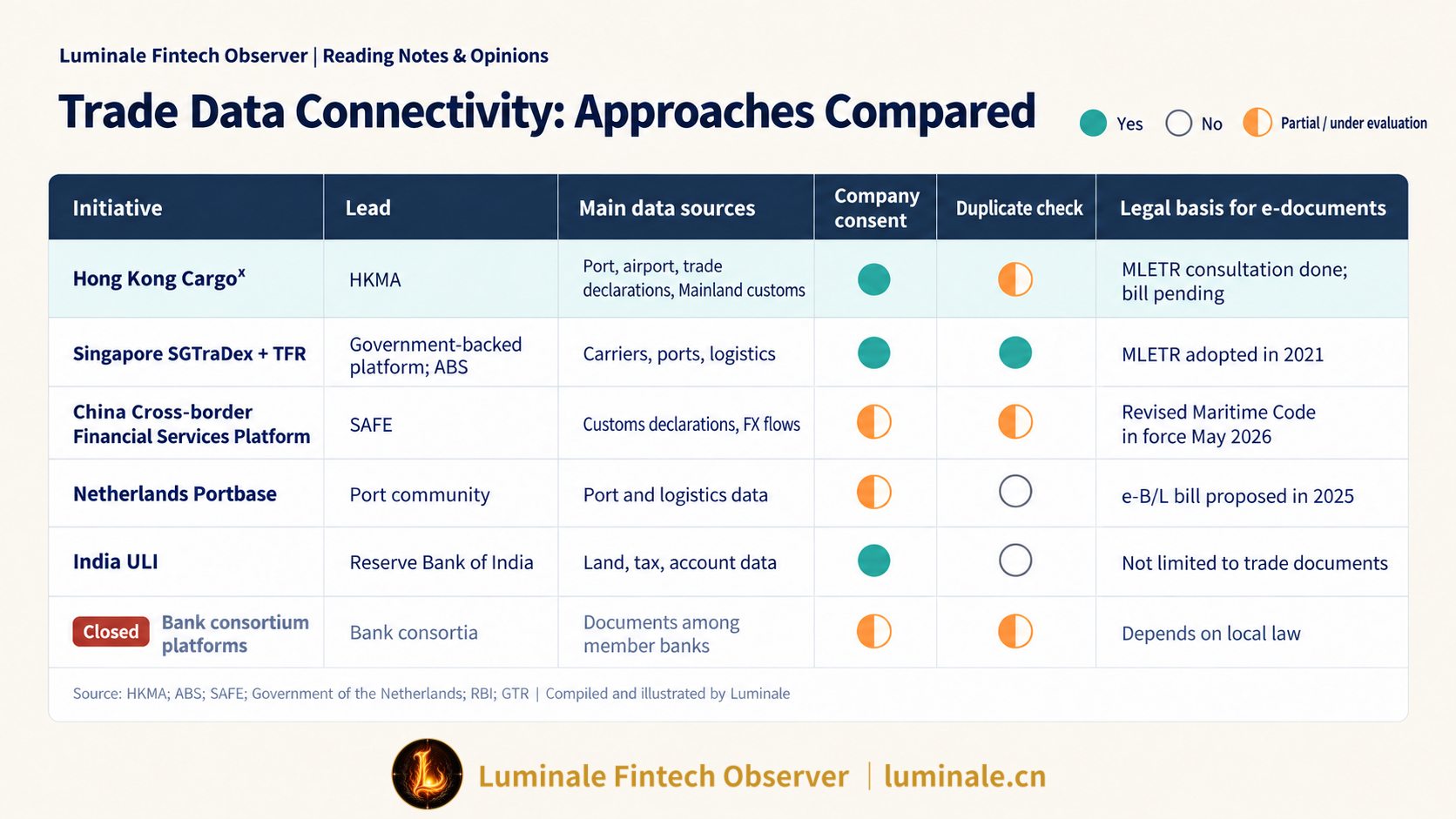
1. Singapore: Advancing Data Exchange, Registry Checks, and Legislation in Parallel
In Singapore, the corporate digital identity platform Corppass boasts over 550,000 registered entities; the e-invoicing network InvoiceNow has approximately 60,000 registered businesses, with phased mandates for GST-registered entities taking effect in 2026; TradeTrust leverages decentralized identifiers (DIDs) and digital signatures to authenticate trade documents; and the Electronic Transactions Act was amended in 2021 to incorporate MLETR[1].
The Singapore Trade Data Exchange (SGTraDex), a government-backed data-sharing infrastructure launched in 2022, connects shipping lines, ports, logistics providers, and financial institutions. It transmits data strictly based on data owner consent without storing underlying data. According to Enterprise Singapore, one of its primary use cases is enabling financial institutions to obtain data directly from trusted sources, verify trade documents, and detect or mitigate double financing[10].
On duplicate financing detection, the Association of Banks in Singapore (ABS) established the Trade Finance Registry (TFR) in 2023. Banks submit hashed metadata of invoices and bills of lading, allowing the system to detect duplicates without exposing raw proprietary data across institutions. In February 2025, TFR and SGTraDex jointly introduced real-time bill of lading genuineness checks: when a bank submits a query, TFR verifies the BL against shipping line data via SGTraDex, returning results almost instantaneously[9].
Compared to Hong Kong, Singapore followed a different sequence. Singapore's banking association established the duplicate-checking registry first, followed by data exchange linkages for BL verification; Hong Kong focused first on data onboarding, while the registry remains under evaluation. Singapore's approach prioritized tackling duplicate financing—the most acute source of credit loss. Hong Kong's approach leveraged the pre-existing CDI to minimize initial setup costs, avoiding the friction of persuading most banks to join a greenfield utility upfront.
Our column explored Singapore's tokenisation and settlement in Where Has Singapore's Digital Finance Reached? From Tokenisation to Payment and Settlement Infrastructure; this section supplements the trade data dimension.
2. The Netherlands and Germany: Port Logistics Data and Legal Certainty
The Netherlands'strength lies in maritime port and logistics data. Portbase connects a vast ecosystem of logistics participants, offering electronic customs declarations and trade document exchange. Built on a federated data-sharing model and API-first architecture, the report highlights Portbase's structure as a key driver of broad industry adoption[1]. In May 2025, the Dutch government tabled legislative proposals granting electronic bills of lading equal legal effect to paper versions[11].
Germany stands out for methodical alignment across legal frameworks and infrastructure. The report highlights Germany's noticeable progress toward MLETR adoption, with electronic customs declarations processed via the ATLAS system, alongside ongoing rollouts of digital enterprise identity and electronic invoicing[1].
3. Mainland China: Centralised Single Window and the SAFE Cross-Border Platform
In Mainland China, fully digitalized electronic invoicing (e-fapiao) has been deployed nationwide; the International Trade Single Window processes roughly 26 million declarations daily; and port and maritime data is aggregated across more than 20 seaports. Furthermore, the newly revised Maritime Code provides statutory recognition for electronic transport documents[1].
Not mentioned in the HKMA report is the Cross-Border Financial Services Platform developed by the State Administration of Foreign Exchange (SAFE) since 2019. In scenarios like export accounts receivable financing and export credit insurance policy financing, the platform enables banks to verify customs declarations online and tag utilized documents to prevent duplicate financing. By early 2026, the platform had launched 15 application scenarios, serving over 160,000 enterprises and facilitating cumulative financing exceeding $450 billion[13].
Both the SAFE platform and Project Cargoᵡ involve the public sector delivering data to commercial banks, but they differ in governance and intent. The SAFE platform was built by foreign exchange authorities, focuses primarily on customs declarations and FX receipts/payments, integrates directly into foreign exchange regulatory workflows, and carries a strong regulatory mandate. Project Cargoᵡ operates strictly on enterprise consent, with banks acting as commercial data consumers under a lighter regulatory posture. For context on foreign exchange controls, see From Current Account to Capital Account: How Cross-Border Capital Flows Are Classified.
4. India: Unified Lending Interface (ULI)
The Unified Lending Interface (ULI), spearheaded by the Reserve Bank of India (RBI), began pilot testing in 2023. Upon borrower consent, lending institutions access standardized APIs to retrieve land records, Goods and Services Tax (GST) filings, and bank account data, primarily serving agricultural and MSME credit[19]. Its philosophy closely mirrors CDI: leveraging consent-based public data access for credit decisions. The distinction is that ULI is not confined to trade finance.
5. Bank Consortium Platforms Around 2018
Around 2018, the banking industry pursued an alternative pathway: consortia of banks collaborating to migrate trade documentation and financing workflows onto distributed shared ledgers.
| Platform | Key Backers | Outcome |
|---|---|---|
| we.trade | Consortium of major European banks | Ceased operations in 2022 |
| Marco Polo | Multi-bank and tech consortium on R3 Corda | Entered liquidation in 2023 |
| Contour | Global bank-backed letter of credit network | Ceased operations in November 2023 |
| TradeLens | IBM and Maersk maritime supply chain platform | Discontinued in 2023 |
| eTradeConnect | Facilitated by HKMA, joined by 12 Hong Kong banks | Launched Oct 2018; limited recent public disclosures |
Public reports indicate that these platforms struggled to survive primarily due to insufficient transaction volumes, lack of cross-platform interoperability, and shareholder banks'reluctance to continue funding operational shortfalls. Marco Polo entered liquidation following failed fundraising rounds[16]; Contour reportedly processed merely 60 to 70 transactions per month before winding down[15]. Hong Kong's eTradeConnect, unveiled by the HKMA during Fintech Week 2018, originally targeted domestic open account trade to digitalize documents and curb fraud[14]; recent operational data remains undisclosed.
The common denominator among these platforms was their bank-centric architecture: they put interbank document transmission onto blockchains without solving where the underlying data originated. Records of physical goods at ports, bonded warehouses, and customs checkpoints remained stubbornly outside the ledger. The approach taken by Project Cargoᵡ and SGTraDex starts instead with government and logistics data, positioning the public sector as infrastructure provider and commercial banks merely as data consumers. This can be viewed as an architectural correction to the previous generation of platforms.
Consortium platforms built a shared highway between banks but neglected to construct feeder ramps connecting factories and container terminals—leaving the highway empty. Project Cargoᵡ and SGTraDex focus first on constructing those public ramps before inviting banks onto the road.
In From Messaging to Execution: Which Layer of Cross-Border Payments Does Swift Shared Ledger Really Change?, we dissected the distinction between information and execution layers. The same analytical lens applies to early trade platforms: they changed how documents were exchanged, but failed to transform how primary data was originated.
6. Global Progress at the Legal Layer
Whether trade data can unlock financing ultimately hinges on whether the legal system recognizes electronic documents. According to tracking by the ICC Digital Standards Initiative, jurisdictions that have enacted, aligned with, or committed to aligning with MLETR represent approximately 62.5% of global exports, up from 34.3% in October 2023[17]. On 15 December 2025, the UN General Assembly adopted the United Nations Convention on Negotiable Cargo Documents, extending negotiable instrument functionality across road, rail, and air transport in either paper or electronic form[18].
7. A Visual Comparison
V. How Far Can Project Cargoᵡ Go? Boundaries of Data Connectivity and Three Critical Variables
The preceding sections synthesized the report and public filings; this section presents my personal perspective.
1. What It Can Improve
Project Cargoᵡ can materially lower the operational cost of verifying transactions and assessing SME credit. Checks that previously required phone calls, emails, and manual cross-referencing can be automated by querying third-party systems. Some loan applications previously declined due to opacity stand a genuine chance of approval. Post-lending monitoring also gains real-time data feeds, allowing lenders to track whether goods arrive at destination ports on schedule and whether corporate cash flows remain healthy.
2. What It Cannot Solve
Data records the movement of cargo. Port loading logs confirm that a specific container was loaded onto a vessel on a given date, but they cannot prove that the contents match purchase order specifications, nor can they guarantee that the overseas buyer will pay. As noted in our article on letters of credit, banks examine documents, not goods—a principle that remains fully valid in the digital data era.
Without enterprise consent, data does not move. Borrowers that warrant the closest scrutiny are often precisely those least willing to be scrutinized. While the consent mechanism safeguards corporate data sovereignty, it introduces adverse selection: firms that readily provide consent are predominantly legitimate operators, whereas bad actors can simply withhold authorization and gravitate toward institutions that do not mandate consent-based verification.
Duplicate financing faces similar limitations. So long as a centralized registry is not built and supported by a majority of banks, an individual bank may obtain perfect clarity on a transaction via CDI yet remain blind to whether the same commercial invoice has already been pledged across town. As the report's design implies, consent-based retrieval and duplicate-checking registries must work in tandem: the former confirms that a trade exists, while the latter confirms that the trade has not been pledged twice.
Finally, legal enforceability depends on statutory reform. Until Hong Kong enacts MLETR-aligned legislation, electronic bills of lading cannot be legally endorsed, transferred, or pledged with the same legal certainty as physical paper.
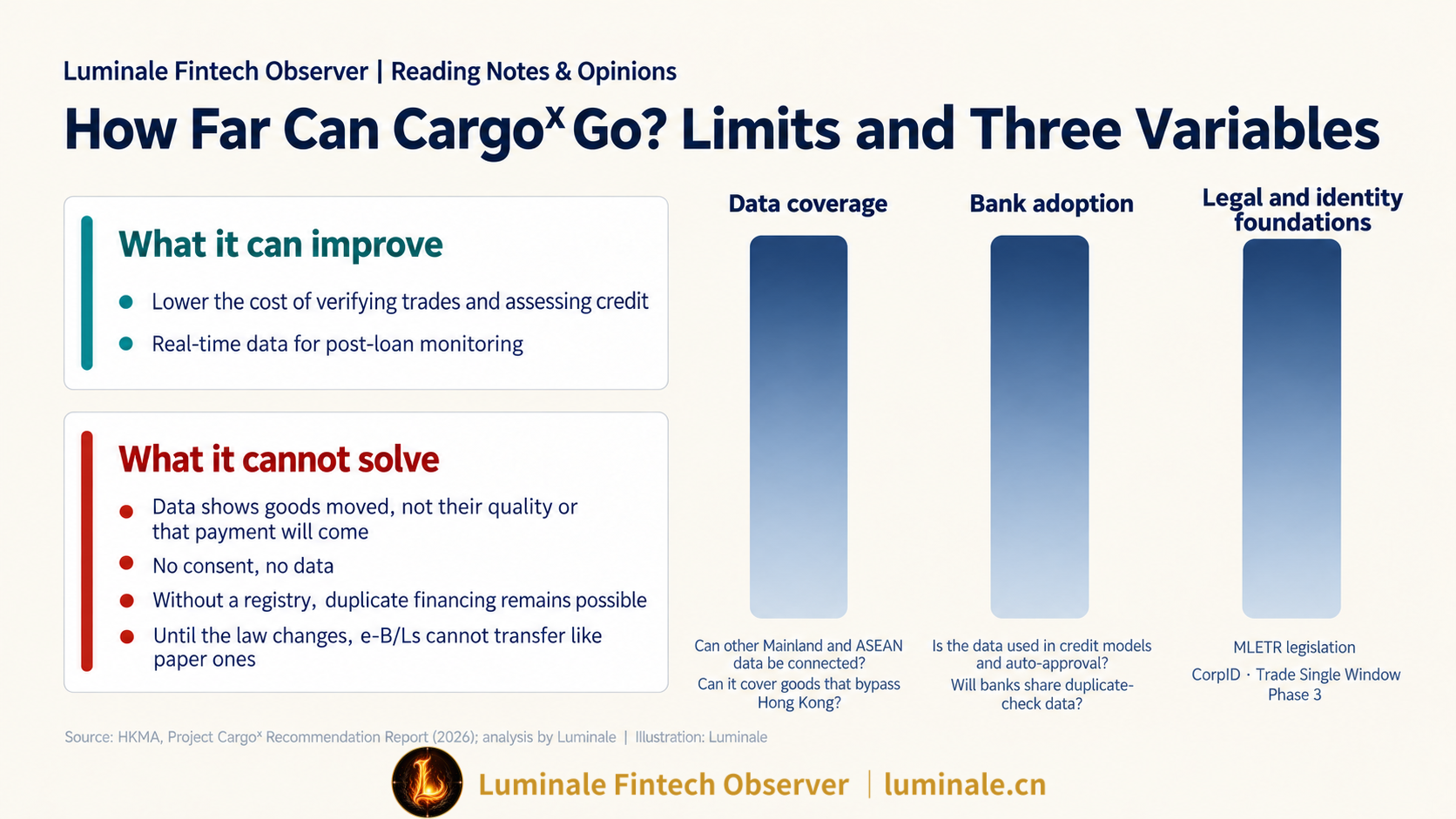
3. Variable 1: How Much Real Trade Can the Data Cover?
Hong Kong's commerce is characterized by immense volumes of re-export and offshore trade. When goods are shipped directly from Shenzhen or Shanghai overseas without transiting through Hong Kong, local port and airport logs offer zero visibility. Cargo Trade Connect, granting pilot banks access to Yangtze River Delta customs declarations, is an encouraging start. The crucial next step is whether data from other Mainland provinces can be integrated, whether ASEAN trade declaration data can be retrieved, and whether cross-border data transfer protocols permit such data to flow systematically and in bulk to Hong Kong lenders. The HKMA indicated during Cargoᵡ Solutions Day that it hopes to expand the Cargo Trade Connect model to additional Mainland provinces in subsequent phases[4].
4. Variable 2: How Deeply Will Banks Integrate It?
Enlisting 21 banks in the pilot scheme provides a solid foundation. The next question to monitor is whether banks truly embed CDI data into automated underwriting models and straight-through processing, or merely treat it as a supplementary reference while continuing to rely on traditional collateral requirements and manual credit committees. If the latter prevails, loan turnaround times and approval ratios will show negligible improvement.
A related hurdle is interbank data sharing. The pilot's second focus area requires sharing SME cash flow data among banks, while Recommendation 11's registry demands that banks actively report financing records. As the report acknowledges, banks may hesitate due to competitive sensitivities[1]. The history of early bank consortia demonstrates that interbank cooperation rarely survives on voluntary goodwill alone. Project Cargoᵡ benefits from being anchored by the HKMA's CDI—offering far greater governance and financial stability than shareholder-funded startups—yet whether banks will share sensitive client data ultimately depends on regulatory stewardship and tangible commercial incentives.
5. Variable 3: Legal and Digital Identity Foundations
The three prerequisites for Phase 2—CorpID, TSW Phase 3, and MLETR legislation—fall entirely outside the HKMA's direct jurisdiction. Among these, the legislative timeline is the most unpredictable. If all three are delivered within the report's expected timeframe, Phase 2 can begin scaling legally transferable electronic trade documents. If they face delays, Project Cargoᵡ will remain constrained to the informational verification layer for the foreseeable future.
The Principles for Financial Market Infrastructures (PFMI) set rigorous standards for governance, operational resilience, and data security, as discussed in A Close Reading of the PFMI. While CDI is currently classified as a data-sharing facility rather than a payment or settlement system, as more banks embed it as an indispensable gatekeeper in credit underwriting, its operational reliability and cybersecurity posture will inevitably face institutional-grade scrutiny.
6. Interfacing with the Payment Rail
If Recommendation 13 advances, connecting trade event data with tokenised deposits and settlement on Project Ensemble, it opens possibilities for cargo-event-driven conditional payments and automated debt service. For instance, the moment a container discharge event at the destination port is registered on-ledger, a buyer's tokenised deposits could be automatically transferred to the seller or swept to extinguish the seller's outstanding trade advance. This step introduces intricate questions regarding settlement currency, when settlement achieves legal finality, how erroneous executions are unwound, and cross-border regulatory harmonization. We explored settlement finality risks in Can a Payment Be Revoked After "Payment Successful"?. Judging from the report's measured tone, this remains a horizon objective rather than an immediate milestone.
7. Returning to the Trading Company
Should Project Cargoᵡ progress smoothly, the trading firm described at the outset could simply click "authorize" within its corporate banking portal when applying for financing. The bank would instantly verify the electronic components'Mainland customs declaration, Hong Kong transshipment logs, and the company's past twelve months of operating cash flows. Approval turnaround could compress from weeks to days.
Conversely, if the cargo sails directly from Shenzhen without entering Hong Kong and Shenzhen data remains unlinked; or if the firm refuses to grant data consent; or if its commercial invoice was already financed at a non-participating lender, the bank's visibility will remain as opaque as it is today.
Conclusion
Project Cargoᵡ issues no new currency, nor does it construct a novel payment or settlement engine. Its core contribution is enabling banks to access trusted third-party data prior to extending credit. Hong Kong chose this path based on a clear strategic judgment: the bottleneck in trade finance lies in the information rail, while the funds rail is already mature.
Where data originates, who is authorized to use it, and whether it holds legal validity—these three factors determine how far trade finance digitalisation can travel. They involve logistics and customs networks, banks and corporates, and the legislature, respectively; no single commercial bank or standalone platform can solve them in isolation. Hong Kong's strategy leverages the HKMA-operated CDI as an infrastructure bedrock, hinges upon enterprise consent, and pursues a phased roadmap: connect data first, digitalize documents second, and expand cross-border interoperability third.
Looking ahead, three milestones will gauge its success: how effectively data links cover re-export and offshore trade; whether a duplicate-checking registry transitions from feasibility study to production; and whether electronic document legislation passes as scheduled. Once these foundations are secured, linking Cargoᵡ to tokenised settlement on Project Ensemble will finally bridge trade finance's information and funds rails into a unified digital continuum.
References
[1]: Hong Kong Monetary Authority, Project Cargoᵡ Recommendation Report, January 2026. https://cdi.hkma.gov.hk/wp-content/uploads/Project_CargoX_Recommendation_Report.pdf ↩
[2]: Hong Kong Monetary Authority, HKMA publishes Project Cargoᵡ Recommendation Report, Press Release, 19 January 2026. https://www.hkma.gov.hk/eng/news-and-media/press-releases/2026/01/20260119-3/ ↩
[3]: Hong Kong Monetary Authority, HKMA launches Project Cargoᵡ Pilot Scheme, Press Release, 7 May 2026. https://www.hkma.gov.hk/eng/news-and-media/press-releases/2026/05/20260507-7/ ; Commercial Data Interchange Project Cargoᵡ Portal. https://cdi.hkma.gov.hk/project-cargox ↩
[4]: Hong Kong Monetary Authority, HKMA hosts Cargoᵡ Solutions Day to drive regional trade data connectivity, Press Release, 5 October 2026. https://www.hkma.gov.hk/eng/news-and-media/press-releases/2026/10/20261005-3/ ↩
[5]: Hong Kong Monetary Authority, HKMA Quarterly Bulletin, September 2025, Feature Article. https://www.hkma.gov.hk/media/chi/publications-and-research/quarterly-bulletin/qb202509/fa1.pdf ↩
[6]: Asian Development Bank, 2023 Trade Finance Gaps, Growth, and Jobs Survey, 2023. https://www.adb.org/publications/2023-trade-finance-gaps-growth-jobs-survey ↩
[7]: HSBC, HSBC completes Cargoᵡ pilot transactions, 28 July 2025. https://www.about.hsbc.com.hk/news-and-media/hsbc-completes-cargox-pilot-transactions ↩
[8]: Hong Kong SAR Government Press Release, Government launches industry consultation on proposed legislative amendments to facilitate digitalisation of business-to-business trade documents, 29 December 2025. https://www.info.gov.hk/gia/general/202512/29/P2025122900233.htm ↩
[9]: The Association of Banks in Singapore, Trade Finance Registry and SGTraDex Further Strengthen Trade Finance Risk Mitigation with Real-Time Bill of Lading Genuineness Check, 12 February 2025. https://abs.org.sg/docs/library/trade-finance-registry-and-sgtradex-further-strengthen-trade-finance-risk-mitigation-with-real-time-bill-of-lading-genuineness-check.pdf ↩
[10]: Enterprise Singapore, Singapore Trade Data Exchange (SGTraDex). https://www.enterprisesg.gov.sg/industries/logistics/guides-and-insights/Singapore-Trade-Data-Exchange ↩
[11]: Government of the Netherlands, Electronic bill of lading to have same effect as paper version, 14 May 2025. https://www.government.nl/latest/news/2025/05/14/electronic-bill-of-lading-to-have-same-effect-as-paper-version ↩
[12]: Maritime Code of the People's Republic of China (Revised at the 18th Session of the Standing Committee of the 14th National People's Congress on 28 October 2025, effective 1 May 2026); Xinhua, China passes its newly revised Maritime Law, 28 October 2025. https://english.news.cn/20251028/13bcc18908d44a1da434901c58eb33fc/c.html ↩
[13]: Xinhua, Report on application achievements of the SAFE Cross-Border Financial Services Platform, 7 January 2026. https://www.news.cn/fortune/20260107/b5e2199499284b16a984258334d7c18d/c.html ↩
[14]: Hong Kong Monetary Authority, The launch of eTradeConnect and the Collaboration with we.trade, 31 October 2018. https://www.hkma.gov.hk/eng/news-and-media/press-releases/2018/10/20181031-4/ ↩
[15]: GTR, Exclusive: Contour to shut down as bank shareholders pull funding, 2023. https://www.gtreview.com/news/fintech/exclusive-contour-to-shut-down-as-bank-shareholders-pull-funding/ ; Trade Finance Global, Contour collapses: what does this mean for digital trade finance? https://www.tradefinanceglobal.com/posts/contour-collapses-what-does-this-mean-for-digital-trade-finance/ ↩
[16]: GTR, Marco Polo brings in liquidators as funds run dry, 2023. https://www.gtreview.com/news/fintech/marco-polo-brings-in-liquidators-as-funds-run-dry/ ↩
[17]: ICC Digital Standards Initiative, MLETR adoption tracker. https://dsi.iccwbo.org/ ↩
[18]: UNCITRAL, General Assembly adopts breakthrough Convention on cargo documents to facilitate global trade, UNIS/L/390, December 2025. https://uncitral.un.org/en/unis390 ↩
[19]: Business Standard, RBI to launch unified lending interface to transform lending space: Das, 26 August 2024. https://www.business-standard.com/finance/news/rbi-to-launch-unified-lending-interface-to-transform-lending-space-das-124082600197_1.html ↩
[20]: Hong Kong SAR Government Press Release, Economic and Social Development of the Hong Kong Special Administrative Region in the Next Five Years (2026–2030), Full Text (Part II), 16 September 2026. https://www.info.gov.hk/gia/general/202609/16/P2026091600140.htm ↩
Originally published by Luminale Fintech Observer: https://luminale.cn/articles/hkma-project-cargox-trade-finance-data-en