On an ordinary weekday morning, the Ministry of Finance issues a book-entry treasury bond through its tender system, and the winning banks must pay the proceeds into the national treasury before the payment date. At the same time, a city commercial bank pledges treasury bonds in the interbank market to borrow overnight funds and cover its position for the day. A manufacturer issues a super short-term commercial paper in the interbank market, applies to its main bank for a working capital loan, and asks the bank to open a letter of credit in favor of an overseas supplier so it can import raw materials. After work, one of the manufacturer's employees signs a mortgage contract, and that evening buys a computer with a credit card.
All of these transactions can be called financing. The borrowers differ, the providers of funds differ, and so do the parties who bear the loss on default. The system in which each claim is registered, and the accounts through which the cash moves, also differ from one transaction to the next.
This column has previously covered bills of exchange and letters of credit. Both touched on discounting, negotiation and forfaiting, but they dealt with individual transactions. This article widens the scope and answers four questions: how to tell direct finance from indirect finance; how governments, financial institutions, firms and households each raise funds; where the claim behind each type of financing is registered and where the cash is settled; and why trade finance still depends so heavily on paper documents and manual checking.
I. Direct and Indirect Finance: The Difference Is Written on the Balance Sheet
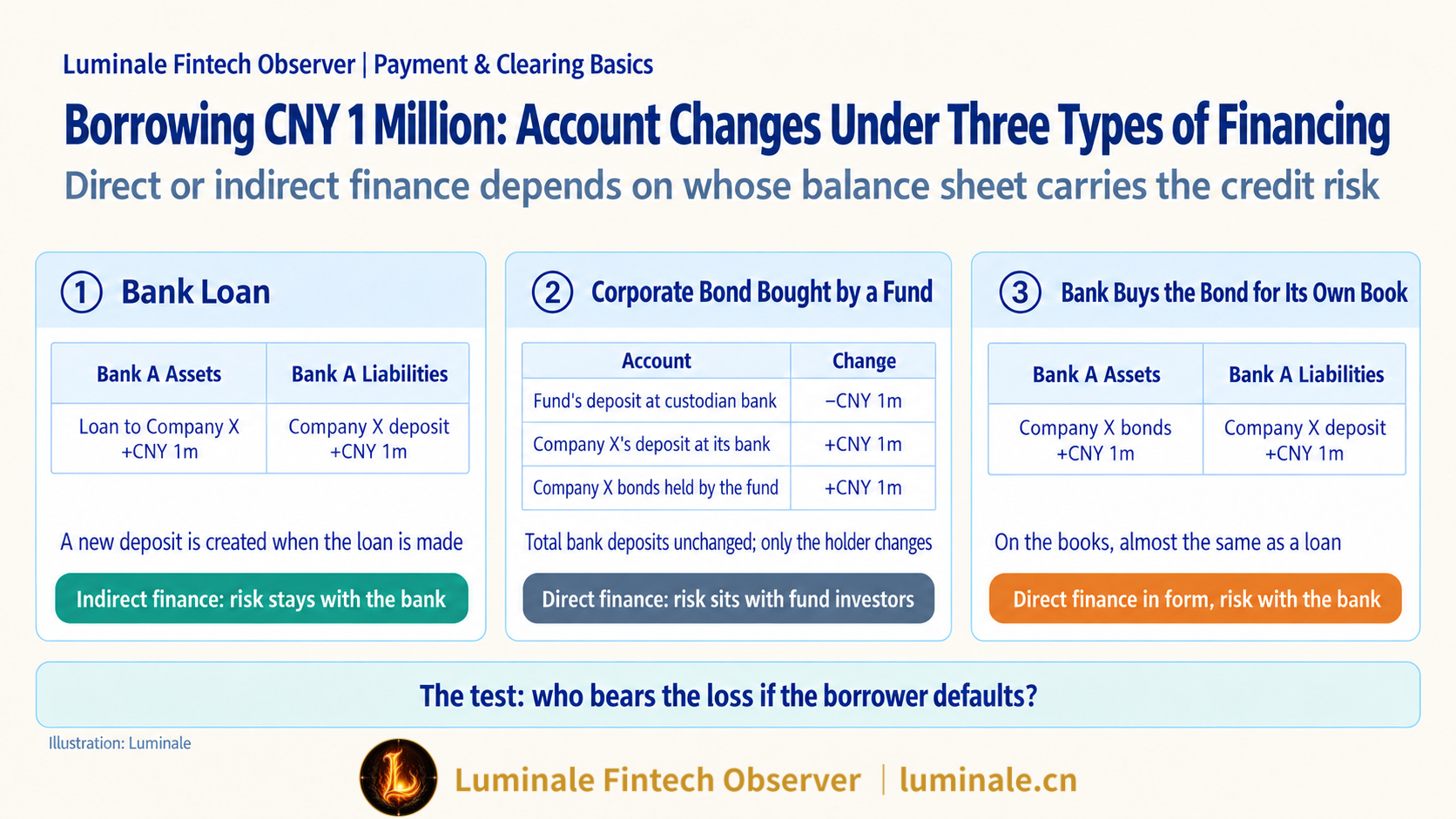
The textbook line is that indirect finance goes through banks and direct finance goes through markets. That is broadly right, but it becomes hard to apply when banks underwrite bonds, banks buy corporate bonds, or wealth management products invest in bonds. A more reliable test is to ask whose balance sheet ends up carrying the credit risk.
1. A bank loan: assets and liabilities rise together
Company A applies to Bank A for a working capital loan of CNY 1 million. Once the loan is approved, Bank A credits CNY 1 million to Company A's deposit account.
| Bank A assets | Change | Bank A liabilities | Change |
|---|---|---|---|
| Loan to Company A | +CNY 1 million | Company A deposit | +CNY 1 million |
This is indirect finance. Depositors have a claim on the bank, and the bank has a claim on the borrower, so the bank's balance sheet sits between the two claims. If Company A cannot repay at maturity, the loss falls on Bank A, and depositors'deposits are not directly affected by the default. The bank absorbs such losses with its own capital and risk management, and maturity mismatch and liquidity risk also stay with the bank.
In M0, M1 and M2 Are Not Three Kinds of Money we explained that deposits held by firms and households at banks belong to broad money. The new deposit created when a bank lends is counted directly in the money supply.
2. A corporate bond: deposits change hands
Now Company A takes a different route. It issues CNY 1 million of bonds in the interbank market, and a public mutual fund subscribes for the whole amount. At payment, the fund pays deposits from its custody account to Company A.
| Account | Change |
|---|---|
| Fund's deposit at its custodian bank | −CNY 1 million |
| Company A's deposit at its bank | +CNY 1 million |
| Company A bonds held by the fund | +CNY 1 million |
If the fund's custodian bank and Company A's bank are different banks, the two banks must also settle the payment through their reserve accounts at the central bank. The total quantity of deposits in the banking system does not change: CNY 1 million of deposits simply moves from the fund's name to Company A's name.
This is direct finance. The fund holds a claim directly on Company A, and if Company A defaults, the loss falls on the fund's investors. The banks involved may have acted as lead underwriter, fund custodian and paying agent, but the claim does not sit among their loan assets.
3. A bank buys the bond: direct finance in form, close to a loan on the books
The third case: the bonds issued by Company A are bought by Bank A with its own funds.
| Bank A assets | Change | Bank A liabilities | Change |
|---|---|---|---|
| Company A bonds | +CNY 1 million | Company A deposit | +CNY 1 million |
In form, Company A is raising money in the bond market. On Bank A's books, however, the asset side gains a claim on Company A and the liability side gains a Company A deposit, which is almost the same as making a loan. The credit risk likewise stays with Bank A. Chinese banks hold large amounts of corporate and government bonds, so to judge the nature of a financing, the balance sheet is a better guide than the name of the instrument.
4. Arrangements between the two
In practice, several arrangements sit between the two forms of financing.
Asset-backed securities (ABS) bundle a batch of loans that a bank has already made and sell them to investors. The loans that were on the bank's balance sheet become securities held by investors, so indirect finance turns into direct finance. When wealth management products and public funds buy bonds, investors hold corporate claims indirectly through an asset management product; the credit risk sits with the holders of the product and not on the bank's balance sheet. In entrusted loans and trust loans, a bank or trust company lends on the principal's instructions, the funds and the risk come from the principal, and the financial institution mainly provides a channel.
5. How much each form of financing weighs in aggregate social financing
The People's Bank of China's aggregate social financing (TSF) statistics list, by method of financing, the funds that the real economy obtains from the financial system. At the end of September 2026, the TSF stock stood at CNY 468.17 trillion. Of this, outstanding RMB loans to the real economy were CNY 279.9 trillion, or 59.8%; outstanding government bonds were CNY 105.23 trillion, or 22.5%; outstanding corporate bonds were CNY 36.62 trillion; and outstanding domestic equity of non-financial firms was CNY 12.73 trillion.[1]
The TSF statistics measure financing of the real economy, and interbank financing such as interbank lending and repos is not included. The figures show that finance in China is still dominated by bank loans, that the share of government bonds is rising, and that corporate bonds and equity together make up less than a tenth of aggregate social financing.
6. Every financing has three lines
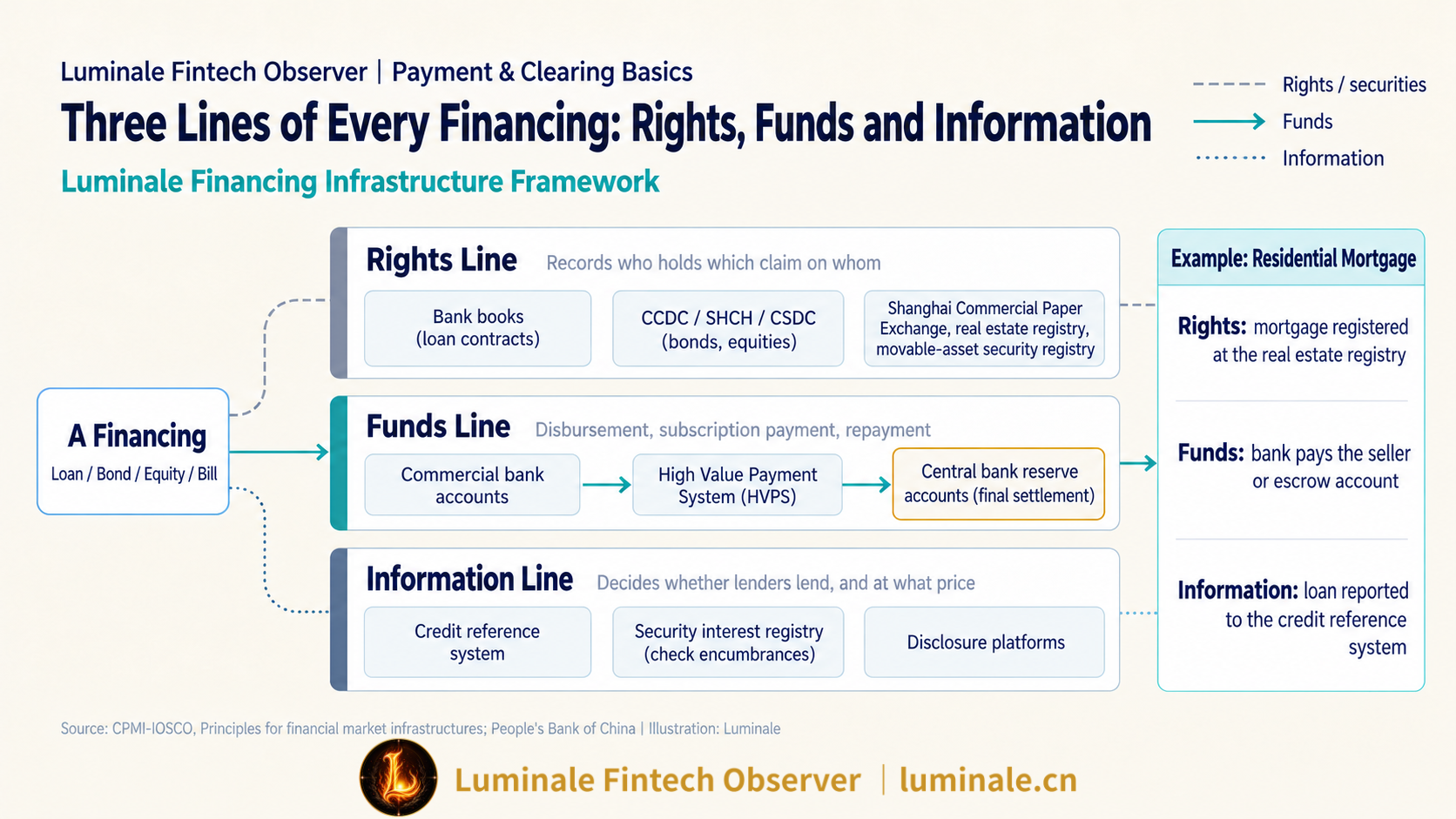
Whatever the type of financing, it leaves records in three places.
The first is the rights line. A loan contract is recorded in the bank's own books; bonds and shares are registered with a central securities depository (CSD); commercial bills are registered with the bill market infrastructure; and a mortgage over a property is registered with the real estate registry. The second is the funds line. Disbursement, subscription payment, and payment of principal and interest are all payments in which money moves from one account to another, and interbank payments are finally settled on reserve accounts at the central bank. The third is the information line: the borrower's credit record, the legal status of the collateral, and the issuer's disclosures. This information determines whether providers of funds are willing to lend and at what price.
Under Luminale's payment infrastructure analysis framework, these three lines map onto different kinds of financial infrastructure. The rights line corresponds to CSDs, securities settlement systems (SSS) and the various registries; the funds line corresponds to payment systems; and the information line corresponds to credit reference systems, registration and publicity systems, and disclosure platforms. We introduced the first two categories in What Does Financial Infrastructure Include? and explained the division of labor among payment instructions, account posting and funds transfer in After "Transfer Successful". Below we follow each type of borrower in turn and see how the three lines operate.
II. How Governments Raise Funds: Treasury Bonds, Local Government Bonds and the Treasury Account
1. Bonds cover the gap beyond taxes
A government's revenue comes mainly from taxes. When revenue falls short of spending, the difference is covered mainly by issuing bonds. The central government issues treasury bonds and local governments issue local government bonds. General bonds fund public-interest projects that generate no revenue, while special bonds correspond to projects with some revenue and are repaid from project income and related government fund income.
Treasury bonds fall into two broad categories. Book-entry treasury bonds are issued and traded in the interbank bond market and the exchange market, and institutional investors are the main holders. Savings bonds are aimed at individuals, sold through the counters and online banking of underwriting banks; they cannot be listed or traded, and individuals may redeem them early under the rules.
Bonds issued by local government financing vehicles (LGFVs) and similar entities are corporate bonds. The issuer is a company, so these must not be lumped together with local government bonds.
2. How one book-entry treasury bond is issued
Book-entry treasury bonds are issued through the treasury bond underwriting syndicate. The Ministry of Finance announces the issuance plan in advance. On the tender day, syndicate members bid through the Ministry of Finance's government bond issuance system, and the Ministry determines the winning rate or price and each member's allotment according to the announced tender method.[2]
After winning, syndicate members must pay the proceeds into the account designated by the Ministry of Finance before the payment date. The account is held at the State Treasury General Account, and the Ministry counts the date on which the funds actually arrive in the account.[2] The claim is then recorded in investors'custody accounts by a registration and custody institution such as the China Central Depository & Clearing Co., Ltd. (CCDC). After the tender there is a distribution period of a few days, during which syndicate members can distribute the bonds they won to other investors, and then the bonds are listed for trading.
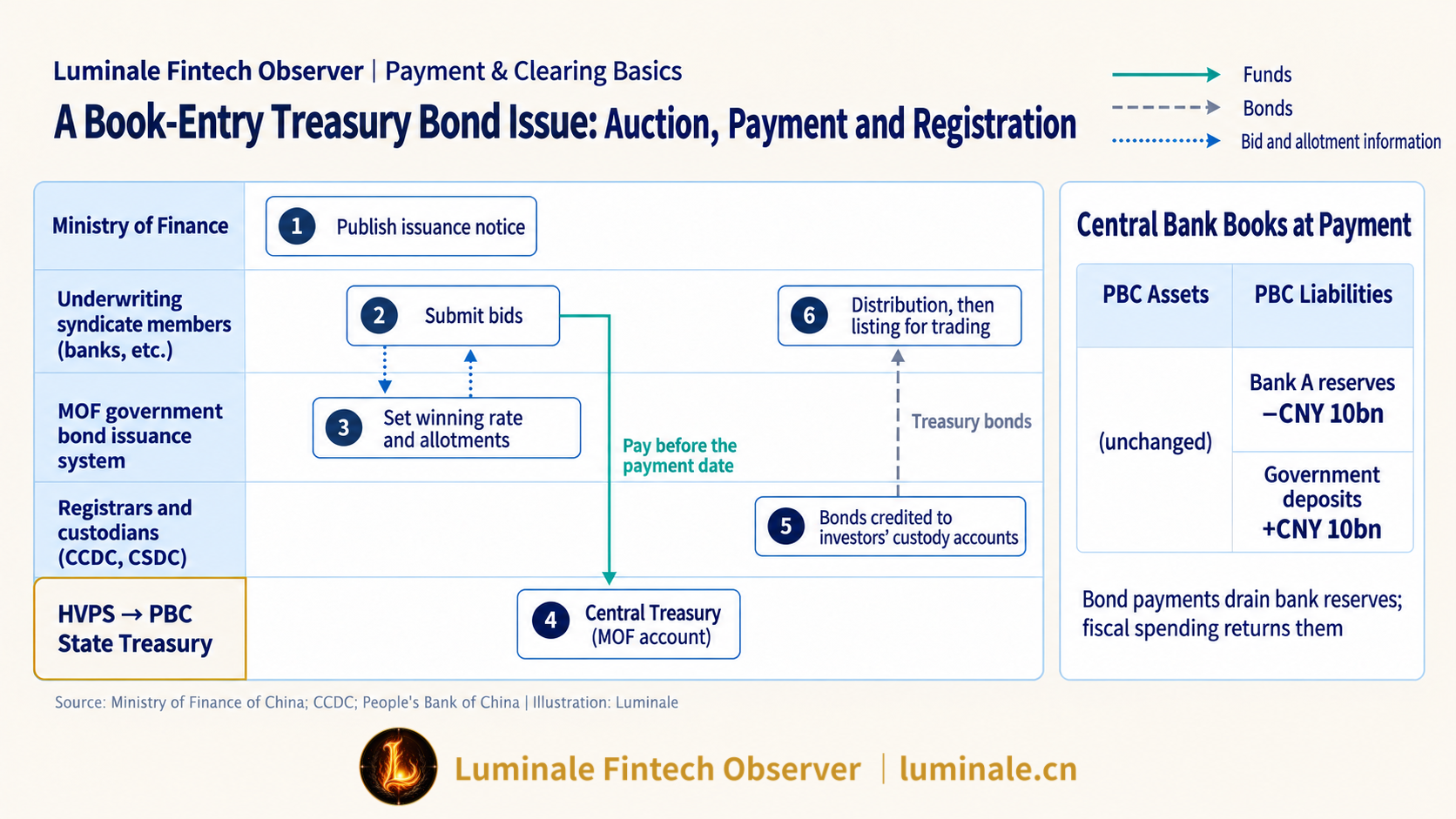
In this process the rights line sits with custodians such as CCDC, and the funds line runs through the High Value Payment System (HVPS) into the Treasury account at the People's Bank of China.
3. Why payment of bond proceeds reduces bank reserves
The Treasury is managed by the People's Bank of China. The Ministry of Finance's deposits are recorded on the central bank's balance sheet and are a liability of the central bank. Suppose Bank A wins CNY 10 billion of treasury bonds with its own funds and completes payment.
| People's Bank of China assets | Change | People's Bank of China liabilities | Change |
|---|---|---|---|
| (unchanged) | Bank A reserve deposits | −CNY 10 billion | |
| Government deposits | +CNY 10 billion |
| Bank A assets | Change | Bank A liabilities | Change |
|---|---|---|---|
| Reserves | −CNY 10 billion | (unchanged) | |
| Treasury bonds | +CNY 10 billion |
If treasury bonds are subscribed by firms or individuals through banks, the payers'bank deposits likewise fall, and the corresponding reserves also flow into the Treasury. We covered these account changes in Central Bank Balance Sheets and Central Bank Reserves Explained. For this reason, the pace of concentrated bond payments, tax periods and government spending affects how tight or loose the interbank market is. Treasury cash management, run by the Ministry of Finance and the People's Bank of China, places part of the Treasury's funds with commercial banks as time deposits, which reduces how much reserve the Treasury balance absorbs.
The Ministry of Finance can open an account at the central bank, and so can commercial banks, but firms and individuals cannot. The account tiers behind this are explained in Who Can Hold an Account at the Central Bank?
4. Why the central bank cannot buy treasury bonds directly
Article 29 of the Law of the People's Republic of China on the People's Bank of China provides that the People's Bank of China shall not overdraw for government finance and shall not directly subscribe for or underwrite treasury bonds and other government bonds.[3] To raise funds, the government can only issue bonds to the market. The central bank may buy and sell treasury bonds in the secondary market for open market operations, but it may not supply funds to the Treasury at the issuance stage.
This provision separates fiscal financing from the issuance of money. What the government borrows by issuing bonds is money that already exists in the banking system, whereas what the central bank adjusts by buying and selling treasury bonds through open market operations is the quantity of reserves, and the two are decided by different bodies. How central bank operations in the secondary market affect reserves is discussed in The Balance Sheet Logic of Monetary Policy Tools.
5. Government bonds are also collateral for the financial system
Government bonds have high credit quality and good liquidity. They are the most commonly used eligible collateral for interbank repos, central bank open market operations, intraday financing in the large-value payment system, and margin at central counterparties. As government bond issuance grows, the supply of high-quality collateral available to the financial system grows with it, which is one link between government financing and financial institution financing.
Foreign institutions can enter the interbank bond market directly to buy Chinese government bonds, or invest through Northbound Bond Connect. The custody and settlement arrangements differ between the two channels, and the details are in What Does Bond Connect Actually Connect?
III. How Financial Institutions Raise Funds: Deposits, Interbank Markets, the Central Bank and Capital Instruments
Financial institutions supply funds to others, and they also need funding themselves. A bank's sources of funds can be read from the liabilities and owners'equity side of its balance sheet.
1. Where a bank's money comes from
| Source of funds | Typical maturity | Features |
|---|---|---|
| Customer deposits | Demand to several years | Largest in size, relatively low cost, fairly stable |
| Interbank placements and borrowings | Overnight to 1 year | From other financial institutions, moves with market rates |
| Repos (funds raised by selling securities under repurchase) | Overnight to several months | Bonds pledged as collateral, cheaper than unsecured borrowing |
| Negotiable certificates of deposit (NCDs) | 1 month to 1 year | Book-entry time deposit certificates, transferable in the secondary market |
| Bonds payable | Over 1 year | Financial bonds, tier 2 capital bonds, perpetual capital bonds and so on |
| Borrowing from the central bank | Overnight to 1 year | Open market reverse repos, medium-term lending facility, relending, rediscounting and so on |
| Owners'equity | No maturity | Capital contributed by shareholders and retained earnings; first to absorb losses |
Customer deposits remain the bank's most important source of funds. Liquidity regulation puts more weight on stable retail deposits and assumes higher outflow rates for short-term interbank funding, so banks cannot rely too heavily on interbank borrowing.
2. Interbank lending: short-term borrowing without collateral
Interbank lending is unsecured short-term borrowing and lending between financial institutions. Deals are concluded on the trading system of the National Interbank Funding Center, with maturities from overnight to one year. After a deal is concluded, the lender sends funds through the large-value payment system to the borrower's reserve account, and at maturity the principal and interest are sent back in the opposite direction.
Lending risk rests entirely on the counterparty's credit, so lending limits are constrained by regulation and by institutions'internal credit limits, and rates also vary with the counterparty's standing.
3. Repo: financing against bonds as collateral
Repo is the largest form of financing by trading volume in the interbank market. The repo seller pledges bonds as collateral and takes in funds from the reverse repo party, agreeing to repay principal and interest at maturity and take back the bonds.
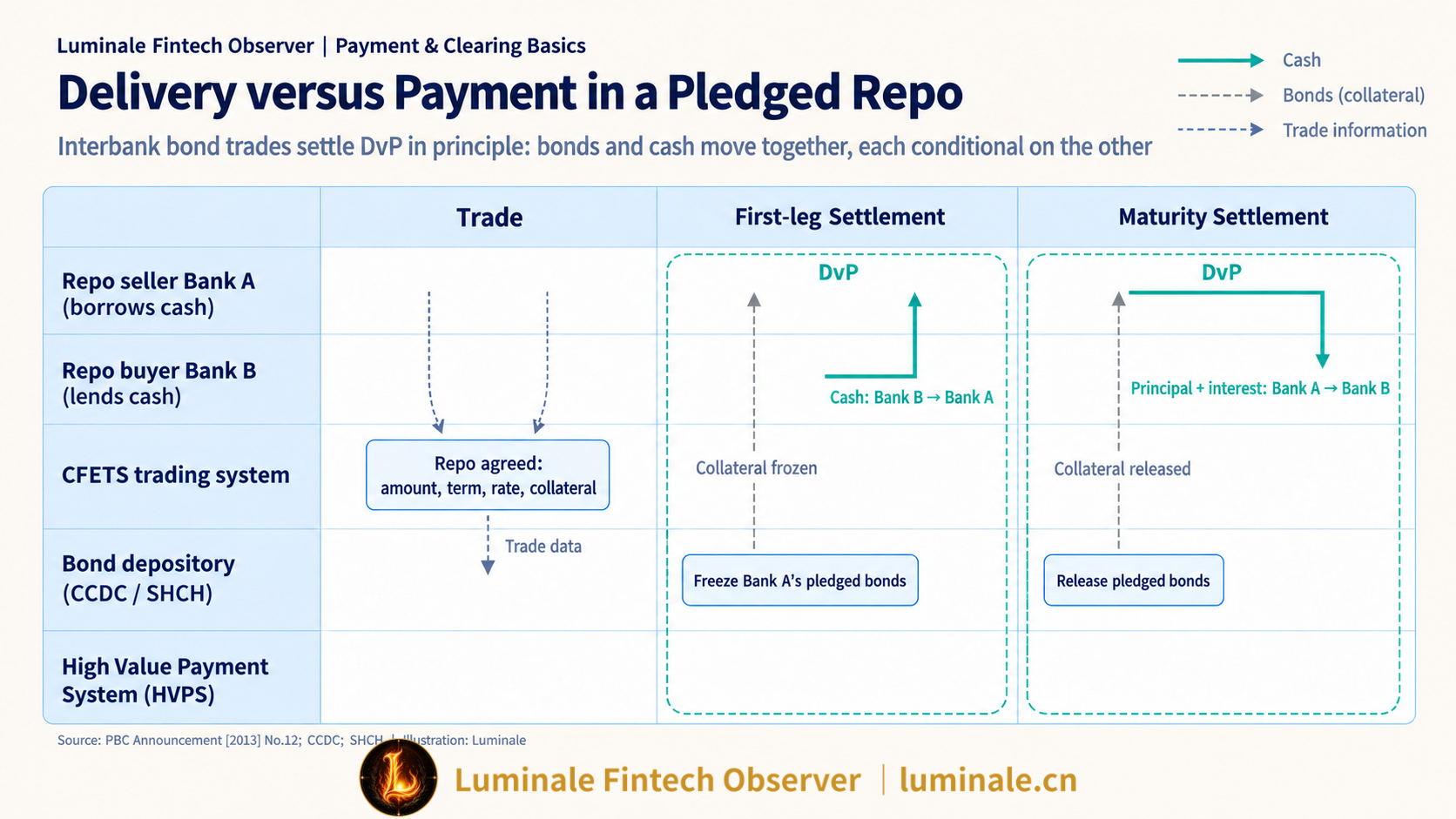
A full cycle of a pledged repo runs roughly as follows:
- The two parties conclude the repo on the trading system of the China Foreign Exchange Trade System (CFETS), agreeing on the amount, term, rate and pledged bonds.
- The trade data is sent to the bond custodian. At first-leg settlement, the custodian freezes the pledged bonds in the repo seller's account and, at the same time, funds move from the reverse repo party to the repo seller through the large-value payment system.
- At maturity settlement, the repo seller repays principal and interest through the large-value payment system, and the custodian releases the pledged bonds.
In 2013, the People's Bank of China issued an announcement requiring that bond trades by participants in the interbank bond market should in principle be settled on a delivery versus payment (DvP) basis, that is, bonds and cash are delivered at the same time on the agreed settlement date, each conditional on the other.[4] Since then, both the first-leg and maturity settlement of repos have been handled on a DvP basis, which prevents one side from delivering the bonds or paying the money while the other side fails to perform. The principal risk that DvP guards against is explained in Delivery Versus Payment: How It Prevents Principal Risk.
A buyout repo differs from a pledged repo in that ownership of the bonds is formally transferred and the bonds must be bought back at maturity, but the economic substance is still financing secured by bonds. Government bonds and policy bank bonds are mainly held in custody at CCDC, while NCDs, short-term commercial paper, medium-term notes and similar instruments are mainly held at the Shanghai Clearing House, formally the Interbank Market Clearing House Co., Ltd. (SHCH). The bond leg of a repo is completed at the relevant custodian.
4. NCDs, financial bonds and capital instruments
NCDs are book-entry time deposit certificates issued by banks. They are registered and held in custody at SHCH and can be transferred in the secondary market and used as collateral. They allow a bank to issue standardized short-term liabilities to the entire interbank market, rather than negotiating interbank deposits with one counterparty at a time.
Longer-term funds come from bond issuance. Ordinary financial bonds supplement medium- and long-term liabilities, while tier 2 capital bonds and perpetual capital bonds supplement capital. The latter two carry write-down or conversion clauses: if the bank runs into difficulty, principal can be written down or converted into equity as agreed, so that these instruments absorb losses ahead of depositors and ordinary creditors. The layers of bank capital are explained in What Is Common Equity Tier 1 Capital?
5. Borrowing from the central bank
Banks borrow from the central bank mainly through open market reverse repos, the medium-term lending facility, relending and rediscounting, and most of these require eligible collateral such as treasury bonds and policy bank bonds. Rediscounting uses commercial bills held by the bank as the underlying asset, and the process is described in the article on bills.
For payment gaps within the business day, banks can also draw on intraday overdrafts and automatic collateralized financing in the large-value payment system, as set out in Where Do Banks Find Funds When an RTGS Account Runs Short?
6. How non-bank financial institutions raise funds
Non-bank institutions such as securities firms, funds and wealth management products raise funds mainly by repoing with banks, and they can also issue short-term commercial paper, corporate bonds and similar instruments. The exchange market also has bond repos, and the China Securities Depository and Clearing Corporation Limited (CSDC) provides centralized clearing for exchange standard-bond repos, acting as central counterparty (CCP) and assuming the performance obligations of both sides. How a CCP manages this kind of risk is discussed in What Does a CCP Solve?
All of this financing between financial institutions is concluded on interbank-market or exchange trading platforms, registered and delivered at CCDC, SHCH or CSDC, and settled between reserve accounts through the large-value payment system. The place of the large-value payment system in China's payment landscape is covered in China's Payment System Map: From Bank Cards to NUCC, UnionPay and the Large-Value Payment System.
IV. How Firms and Individuals Raise Funds: Loans, Bonds, Listing and Consumer Credit
1. Corporate loans: disbursement and payment are two steps
The most common corporate loans are working capital loans and project loans, and large projects with many participating banks use syndicated loans. When a bank disburses a loan, it credits the loan amount to the firm's deposit account, which completes the simultaneous rise in assets and liabilities described in Section I.
The firm then uses the loan to pay for goods, which is the second step. When the paying bank and the receiving bank are different banks, large payments are settled through the large-value payment system, while small payments can be handled by the small-value batch payment system or the internet banking payment clearing system. Under the supervisory rules for working capital loans, loans above a certain amount are generally paid out by entrusted payment: the bank pays the loan funds directly to the counterparty on the firm's payment application, so that the use of funds can be verified.
Acceptance and discounting of commercial bills and the issuance of and financing under letters of credit are also common indirect financing tools for firms. They were covered in the previous two articles and are not repeated here.
2. Firms issuing bonds in the interbank market
Bonds issued by non-financial firms in the interbank market are collectively called debt financing instruments, mainly short-term commercial paper, super short-term commercial paper and medium-term notes, with maturities from a few dozen days to several years. Before issuing, the firm registers with the National Association of Financial Market Institutional Investors (NAFMII); once registration takes effect, it can issue in installments during the validity period.
At issuance, the lead underwriter runs a book-building process in which investors submit subscription rates and amounts. After the issuance rate is set, investors pay the subscription money to the lead underwriter through the large-value payment system, and the lead underwriter deducts the underwriting fee and passes the rest to the issuer. SHCH handles the initial registration and custody of these bonds, and investors'custody accounts are credited with the bonds. At maturity, the issuer pays principal and interest to SHCH, which distributes it to holders according to the register of holders.
3. Firms issuing bonds and listing on the exchange market
Corporate bonds in the exchange market are reviewed by the stock exchange, registered with the China Securities Regulatory Commission (CSRC), and registered and held in custody at CSDC. Enterprise bonds used to be reviewed by the National Development and Reform Commission; in 2023, responsibility was transferred to the CSRC for unified management, and from October 23, 2023, the Shanghai, Shenzhen and Beijing exchanges began accepting enterprise bond projects.[5]
Equity financing includes initial public offerings and refinancing after listing. In an offering, investors subscribe on the exchange, CSDC registers the shares, and the delivery of subscription funds and shares is completed through CSDC and its settlement banks. Once shares are listed, trading in them is secondary market trading, and the company does not receive money directly from it.
4. Individual financing: mortgages, credit cards and consumer loans
Individuals rarely issue securities directly, and nearly all individual financing is indirect finance.
A personal mortgage shows all three lines. After approval, the bank registers a mortgage over the property, so the rights line sits with the real estate registry. The bank disburses the loan, and the funds are paid under the contract into the developer's escrow account or the seller's account, so the funds line runs through the payment system. The loan information is reported to the credit reference system, so the information line is recorded in the borrower's credit report.
A credit card is both a payment tool and a credit tool. When the cardholder pays by card, the issuing bank first pays the acquiring bank on the cardholder's behalf, and the cardholder repays after the statement date. If the cardholder chooses installments or pays only the minimum, it becomes a revolving loan from the issuing bank to an individual. The clearing and settlement path of a card transaction is covered in Card Payment Explained: Issuers, Acquirers, Networks and Merchants.
Personal consumer loans and business loans can be made by commercial banks or consumer finance companies. For online loans where a bank works with an internet platform, the platform may handle customer acquisition, initial risk screening, or co-funding; whose loan it is and whose books carry the risk depend on the cooperation model and the funding share.
5. Two kinds of information infrastructure that serve financing
Beyond issuance platforms, custodians and payment systems, financing by firms and individuals relies on two kinds of dedicated information infrastructure.
The first is the credit reference system. The Financial Credit Information Database operated by the Credit Reference Center of the People's Bank of China collects credit information on firms and individuals, including borrowing and guarantees. Financial institutions query it before lending to judge whether the borrower has repaid on time in the past and how much debt it carries now. The credit reference system provides the collection and querying of credit information, while scoring and approval are done by the lending institution itself.
The second is the security interest registration and publicity system. From January 1, 2021, security interests over movable property and rights have been registered uniformly nationwide. The Unified Registration and Publicity System for Movable Property Financing, run by the Credit Reference Center of the People's Bank of China, handles this registration and covers pledges and transfers of receivables, mortgages of inventory and equipment, financial leasing, factoring and so on.[6] The People's Bank of China then issued the Measures for the Unified Registration of Security Interests in Movable Property and Rights, effective February 1, 2022.[7] Registration is done by the parties themselves, and the system only makes a formal record. Before lending, a provider of funds can check whether the same asset has already been registered to someone else, which helps avoid duplicate financing.
6. The financing infrastructure for four kinds of borrower
Putting the previous sections into one table shows which systems each type of financing passes through on each of the three lines.
| Borrower | Main forms of financing | Issuance or trading | Rights registration | Funds settlement | Information infrastructure |
|---|---|---|---|---|---|
| Government | Treasury bonds, local government bonds | MOF government bond issuance system, underwriting syndicate | CCDC, CSDC | Large-value payment system, PBOC Treasury | Public budget and debt information |
| Financial institutions | Interbank lending, repos, NCDs, financial bonds, capital instruments, central bank borrowing | CFETS trading system, exchanges | CCDC, SHCH, CSDC | Large-value payment system | Disclosure, regulatory reporting |
| Firms | Loans, bills, letters of credit, debt financing instruments, corporate bonds, shares | Bank counters, interbank market, exchanges, bill trading system | Bank ledgers, SHCH, CCDC, CSDC, Shanghai Commercial Paper Exchange, unified registration system | Large-value payment system, on-us transfers | Credit reference system, unified registration system, disclosure |
| Individuals | Mortgages, consumer loans, credit cards, business loans | Banks, consumer finance companies, online channels | Bank ledgers, real estate registry | On-us transfers, interbank payment systems | Credit reference system |
The table is compiled from the rules described in the chapters of this article, and all arrangements are subject to the current business rules of the relevant institutions.
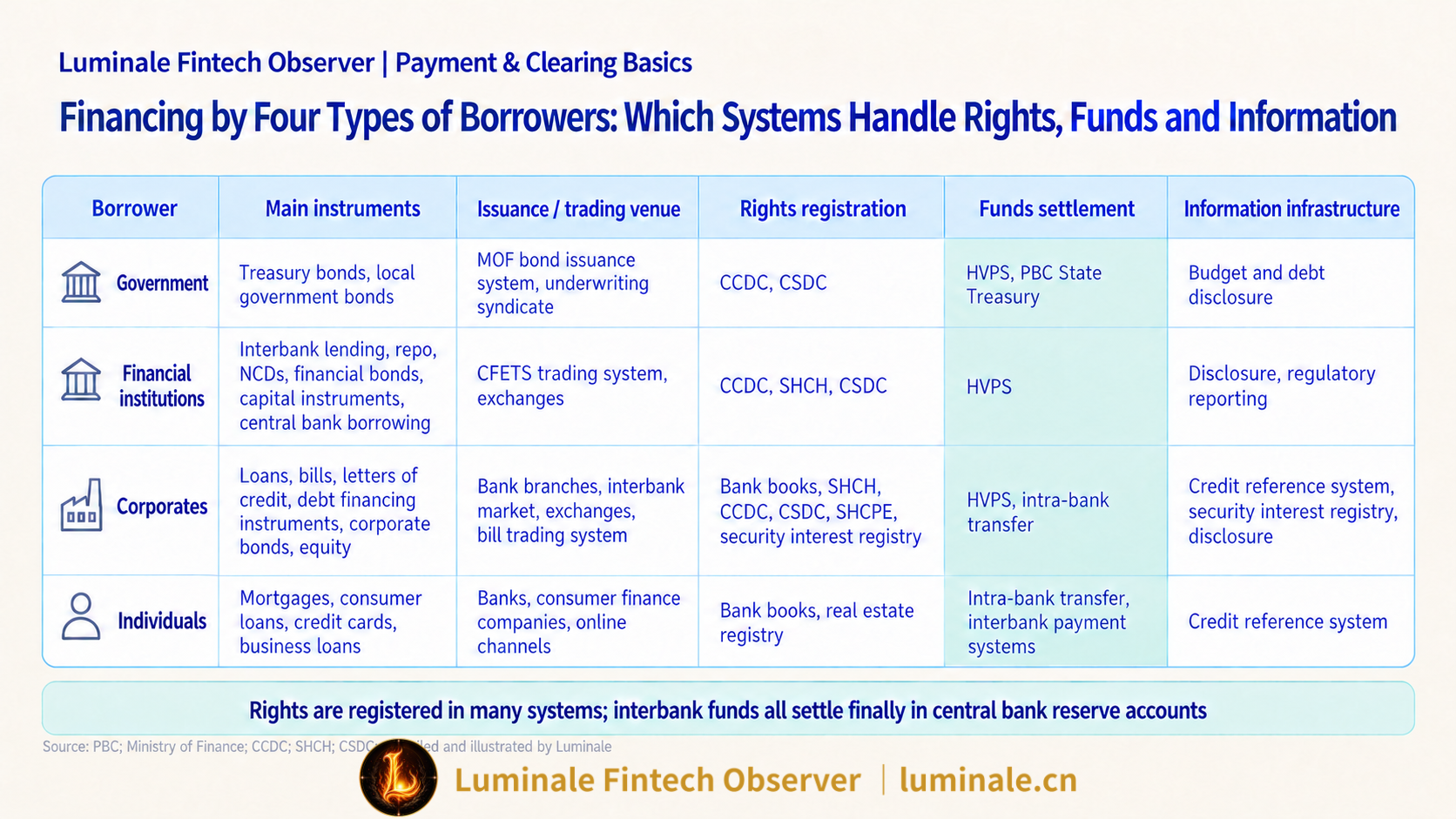
Across borrowers, the rights line is scattered over bank ledgers and several registration and custody institutions, while on the funds line the interbank part almost all converges on the large-value payment system and is finally settled on reserve accounts at the central bank. What it means for a settlement to be irrevocable once completed is explained in Can a "Successful Payment" Be Reversed?
V. Trade Finance: Short-Term Financing That Follows the Goods, with Data and Registration as the Hard Part
1. What is different about trade finance
Trade finance is financing and risk mitigation that banks provide around a specific trade in goods or services. It is a form of indirect finance and differs from an ordinary working capital loan in three ways.
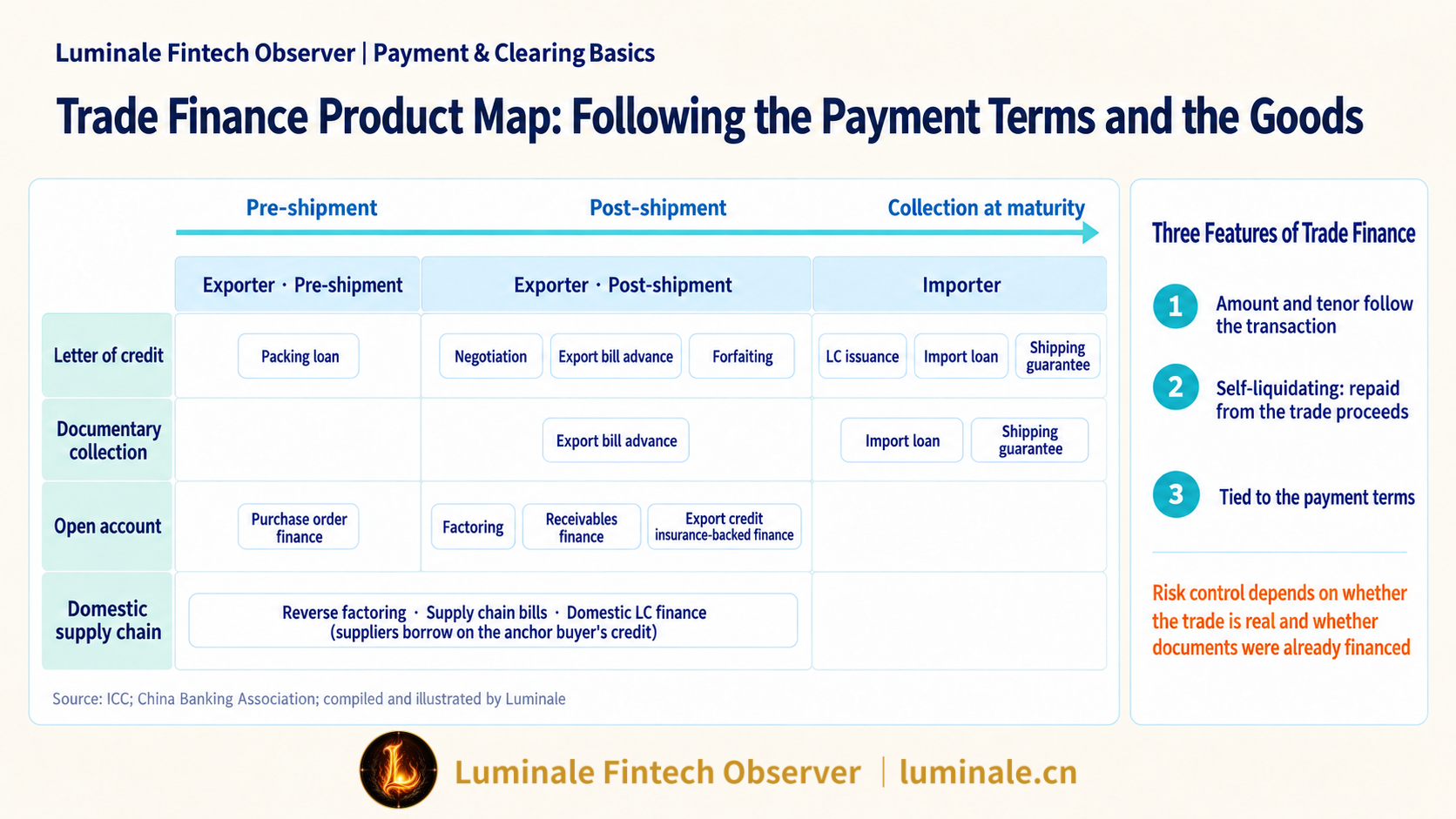
First, amount and term follow the transaction. The financing amount usually does not exceed the invoice or document amount, and the term corresponds to the time from shipment to collection, mostly within a year. Second, it is self-liquidating. The loan is repaid from the proceeds of the trade, and once the importer pays, the issuing bank reimburses, or the insurance pays out, the financing is cleared automatically. Third, it is tied to the payment method. Settlement by letter of credit brings financing under the letter of credit; settlement by collection brings documentary bills under collection; and open account terms rely more on factoring and receivables financing.
Because of this self-liquidating nature, a bank in trade finance cares about whether the transaction is genuine, whether the goods exist, and whether the documents have already been used to raise financing elsewhere, not only about the firm's overall financial condition.
2. Main trade finance products
| Stage | Product | Payment method | Applicant | Source of repayment |
|---|---|---|---|---|
| Pre-shipment | Packing credit, order financing | Letter of credit or open account | Exporter | Subsequent export proceeds |
| Post-shipment | Export bills purchased, negotiation | Letter of credit, collection | Exporter | Reimbursement by the issuing bank or payment by the importer |
| Post-shipment | Forfaiting | Letter of credit, accepted bill | Exporter | Payment at maturity by the issuing or accepting bank |
| Post-shipment | Factoring, receivables financing | Open account | Exporter or supplier | Payment by the buyer at maturity |
| Post-shipment | Financing backed by export credit insurance | Open account, collection | Exporter | Payment by the buyer or insurance payout |
| Import | Issuance of letters of credit, import bills, shipping guarantees | Letter of credit, collection | Importer | Importer's sales proceeds |
| Domestic supply chain | Reverse factoring, supply chain bills, domestic letter of credit financing | Open account, bills, domestic letter of credit | Upstream supplier | Payment at maturity by the core enterprise |
The table lists products according to the general arrangements for each business, and specific terms are subject to each bank's business rules.
Negotiation and forfaiting under letters of credit were covered in the article on letters of credit, and the difference in recourse between forfaiting and bill discounting is compared in the article on bills. Supply chain finance borrows the credit of the core enterprise: upstream small suppliers have insufficient credit of their own, but their receivables from large core enterprises are easier to finance.
3. How the money moves
Disbursement and repayment of domestic trade finance are settled between banks like ordinary loans, with the interbank part going through the large-value payment system. The issuance, advising and presentation of domestic letters of credit are passed between banks over electronic channels.
Cross-border trade finance also goes through the cross-border payment chain. The issuance, advising and reimbursement instructions of letters of credit are passed between banks as messages of the Society for Worldwide Interbank Financial Telecommunication (Swift), funds move through correspondent bank accounts, and foreign exchange is needed when different currencies are involved. This part of the process is covered in What Actually Happens in a Cross-Border Remittance? Receipts and payments for trade in goods belong to the current account, and longer-term trade finance may also touch on external debt management; the classification of cross-border funds is explained in From the Current Account to the Capital Account: How Cross-Border Funds Are Classified. For cross-border trade settled in RMB, funds can be cleared through the Cross-border Interbank Payment System, and the arrangements are described in RMB Internationalization Is More Than "Settling in RMB".
Compared with other forms of financing, trade finance looks similar on the funds line. Its difficulties arise mainly on the information line and the rights line.
4. Pain point one: data is scattered across institutions
A single import or export transaction produces a contract, commercial invoice, packing list, bill of lading, customs declaration, certificate of origin, insurance policy, logistics tracking and payment records. These are kept in the systems of the buyer and seller, the shipping line, the freight forwarder, the port, customs, the insurer and several banks. Formats, numbering and units of measurement all differ, and a good share still exists as paper documents or scans.
When a bank reviews trade finance, it needs to confirm that the documents match each other and that the documents match the actual goods. Where data cannot be connected automatically, the only option is manual comparison, which is costly, slow and poor at catching forged documents. International trade increasingly uses open account terms, so banks cannot rely on the standardized document examination that comes with a letter of credit, and depend more on external data.
5. Pain point two: the same goods financed more than once
Each bank sees only the financing contracts it has signed with the firm. The same batch of goods, the same warehouse receipt, or the same receivable may be financed by several banks at once.
In the 2014 Qingdao Port incident, Dezheng Resources and other firms were alleged to have pledged the same warehouse receipts for alumina and electrolytic copper to different banks to obtain loans by fraud, and many Chinese and foreign banks were involved.[8] In 2020, the Singapore oil trader Hin Leong Trading collapsed with many banks heavily exposed to it; its founder was later convicted by a Singapore court of abetting forgery, cheating and other offenses, and the case involved forged trading contracts.[9] The two incidents occurred in different markets and by different methods, but exposed the same kind of problem: banks cannot see each other's financing records, and they find it hard to verify the goods and the transaction independently.
6. Pain point three: the SME financing gap
The Asian Development Bank (ADB) 2025 Global Trade Finance Gap Survey estimates that the unmet portion of global trade finance demand is about USD 2.5 trillion, roughly 10% of global trade, and that the rejection rate for SME trade finance applications is about 41%.[10]
SMEs lack collateral and long credit histories, and the amount of each transaction is small. The cost of verifying that a trade is genuine is high relative to the return on that financing, so banks tend to decline or tighten their requirements. Part of the gap comes from commercial judgment and part from information cost, and the latter is directly tied to whether data can be obtained and verified cheaply.
7. Pain point four: compliance costs and the legal effect of documents
Trade finance involves cross-border funds and goods, which require customer identification, anti-money-laundering checks and sanctions screening. For small transactions, new customers and high-risk regions, compliance costs can exceed the revenue from the business, so some banks have cut back correspondent banking relationships and trade finance business, and the firms most affected are often SMEs in developing countries.
A paper bill of lading represents rights over the goods, and whoever holds it can take delivery, which makes digitization a challenge. In 2017, the United Nations Commission on International Trade Law (UNCITRAL) adopted the Model Law on Electronic Transferable Records (MLETR), giving electronic bills of lading, electronic bills of exchange and similar records the same legal status as paper documents.[11] In 2023 the United Kingdom passed the Electronic Trade Documents Act 2023.[12] China's newly revised Maritime Law of the People's Republic of China took effect on May 1, 2026, adding a dedicated section on "electronic transport records" and providing that electronic transport records have the same effect as paper transport documents.[13] In December 2025, the United Nations General Assembly adopted the United Nations Convention on Negotiable Cargo Documents, which extends negotiable documents of the bill-of-lading kind to road, rail and air transport and allows both paper and electronic forms.[14] More countries and regions are adopting such laws, but many steps in cross-border trade still need original paper documents. Electronic presentation and electronic bills of lading are covered in the article on letters of credit.
8. Responses so far
The infrastructure being built in response to these problems concentrates on the information line and the rights line.
Unified registration and publicity narrow the room for duplicate financing. The unified registration system for security interests in movable property and rights mentioned earlier makes the rights over receivables, inventory and equipment publicly searchable, and a registrant who registers first can assert priority against later claimants.
Trusted data-sharing platforms are used to verify documents. The State Administration of Foreign Exchange (SAFE) led the building of its Cross-border Financial Services Platform from 2019, connecting data from banks, firms and government departments and supporting scenarios such as export receivables financing and export credit insurance policy financing. On the platform, banks can verify documents such as customs declarations and see whether a document has already been used for financing. By early 2026, the platform had expanded to 15 application scenarios, serving more than 160,000 firms and supporting financing of more than USD 450 billion in total.[15]
Singapore's approach is a duplicate-check facility built jointly by the banking industry. The Association of Banks in Singapore (ABS) set up the Trade Finance Registry in 2023. Banks submit key fields of invoices, bills of lading and other documents after hashing them, the system checks for duplicate financing, and participating banks cannot see each other's original data. In 2025, the Registry worked with the Singapore Trade Data Exchange (SGTraDex) to launch a bill of lading genuineness check, so that banks can verify a bill of lading against data sources on the shipping line's side through the platform; this step used to rely on phone calls and email.[16]
There are also the electronic transferable records legislation mentioned earlier, and the unification of trade data standards promoted by bodies such as the International Chamber of Commerce (ICC). The Hong Kong Monetary Authority's Project Cargoᵡ tries to connect cargo and trade data to trade finance, and this column will cover it separately later.
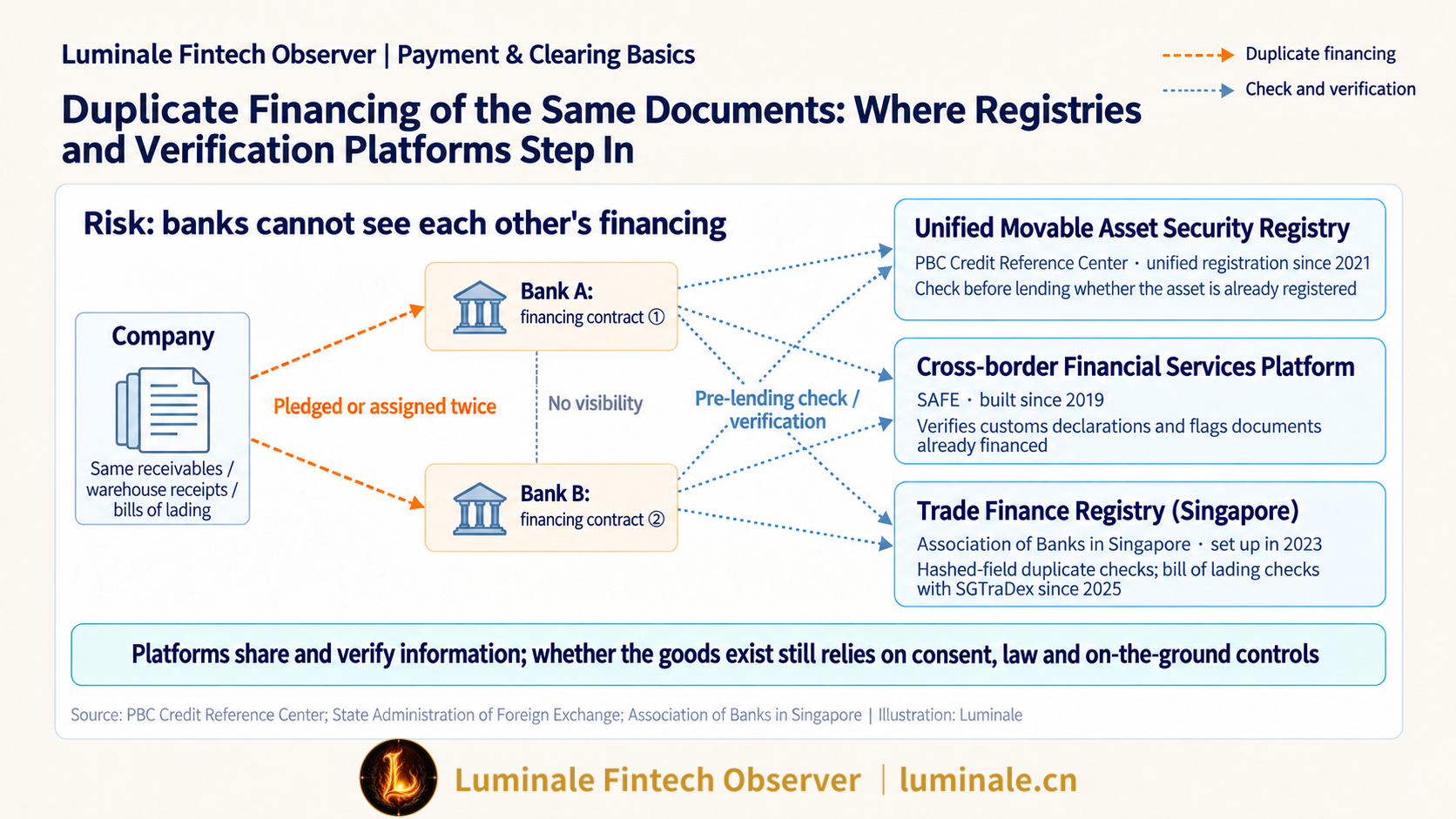
What these platforms can do is make information shareable and verifiable. Whether the goods really exist, whether documents are forged, and whether data can be used lawfully still depend on corporate consent, legal arrangements and controls on the ground.
Conclusion
Back to the financings at the start. The treasury bond is registered at CCDC, the pledged bonds of the repo are frozen at the custodian, the super short-term commercial paper is registered at SHCH, the loan sits in the bank's own ledger, the letter of credit is the issuing bank's payment undertaking, and the mortgage is registered with the real estate registry. The rights lines each go their own way, while the funds lines almost all arrive at the same place: the interbank part runs through the large-value payment system and is finally settled on reserve accounts at the central bank.
The difference between forms of financing lies mainly in who bears the credit risk and the cost of information. Direct finance relies on registration and custody, disclosure, and the investors'own judgment; indirect finance relies on the bank's balance sheet and credit approval. Trade finance is indirect finance that is also closely tied to the details of each transaction: with small, frequent deals, the cost of verifying information is often higher than the cost of moving the funds.
The movement of funds is already fairly mature. What trade finance needs to improve next is mostly whether documents, goods and rights information can be connected, registered and queried in a trustworthy way, which is the question we will take up when we turn to Project Cargoᵡ.
References
[1]: People's Bank of China, aggregate social financing stock statistics for the first three quarters of 2026, released October 14, 2026; cited from China News Service, "PBOC: Aggregate social financing stock up 7.1% year on year at end-September". https://www.chinanews.com.cn/cj/2026/10-14/10714529.shtml ↩
[2]: General Office of the Ministry of Finance, Notice on the Issuance of the 2026 Book-Entry Coupon Treasury Bonds (Series 8) (Cai Ban Zhai [2026] No. 60), April 2026; other series use the same format. Reproduced by Beijing Daily client. https://news.bjd.com.cn/2026/04/13/11685105.shtml ↩
[3]: Law of the People's Republic of China on the People's Bank of China, Article 29. ↩
[4]: People's Bank of China, Announcement [2013] No. 12, August 2013. Reproduced by China News Service. https://www.chinanews.com.cn/gn/2013/09-05/5251161.shtml ↩
[5]: China Securities Regulatory Commission, Announcement on Arrangements for Enterprise Bonds After the Transition Period, October 20, 2023; CSRC and National Development and Reform Commission, Announcement on Transition Arrangements for Transferring Enterprise Bond Issuance Review Responsibilities, April 21, 2023. ↩
[6]: State Council, Decision on Implementing Unified Registration of Security Interests in Movable Property and Rights (Guo Fa [2020] No. 18), effective January 1, 2021. ↩
[7]: People's Bank of China, Measures for the Unified Registration of Security Interests in Movable Property and Rights, effective February 1, 2022. ↩
[8]: China News Service, report on the repeated pledging of metal warehouse receipts at Qingdao Port, June 19, 2014. https://www.chinanews.com.cn/gn/2014/06-19/6296438.shtml ↩
[9]: Singapore Law Watch, Hin Leong founder O.K. Lim gets 17½ years'jail for cheating, forgery, 18 November 2024. https://singaporelawwatch.sg/Headlines/hin-leong-founder-ok-lim-gets-17189-years-jail-for-cheating-forgery ↩
[10]: Asian Development Bank, ADB Global Trade Finance Gap Survey, 2025. https://www.adb.org/publications/adb-global-trade-finance-gap-survey ↩
[11]: UNCITRAL, Model Law on Electronic Transferable Records (2017). https://uncitral.un.org/en/texts/ecommerce/modellaw/electronic_transferable_records ↩
[12]: UK Parliament, Electronic Trade Documents Act 2023. https://www.legislation.gov.uk/ukpga/2023/38 ↩
[13]: Maritime Law of the People's Republic of China (revised and adopted at the 18th Session of the Standing Committee of the 14th National People's Congress on October 28, 2025, effective May 1, 2026), Chapter IV, provisions on "electronic transport records". ↩
[14]: UNCITRAL, General Assembly adopts breakthrough Convention on cargo documents to facilitate global trade, UNIS/L/390, December 2025. https://uncitral.un.org/en/unis390 ↩
[15]: Xinhua News Agency, report on the application of the State Administration of Foreign Exchange's Cross-border Financial Services Platform, January 7, 2026. https://www.news.cn/fortune/20260107/b5e2199499284b16a984258334d7c18d/c.html ↩
[16]: The Association of Banks in Singapore, Trade Finance Registry and SGTraDex Further Strengthen Trade Finance Risk Mitigation with Real-Time Bill of Lading Genuineness Check, 12 February 2025. https://abs.org.sg/docs/library/trade-finance-registry-and-sgtradex-further-strengthen-trade-finance-risk-mitigation-with-real-time-bill-of-lading-genuineness-check.pdf ↩
Originally published by Luminale Fintech Observer: https://luminale.cn/articles/financing-direct-indirect-trade-finance-infrastructure-en