
A green prompt reading "Transaction Submitted" appears on the screen for a cross-border corporate payment: the debtor bank in Singapore dispatched the payment instruction, the cross-network interface routed the data packet, and the creditor bank in Thailand received the message, registering a confirmation status on its distributed ledger. From a purely technical perspective, the transaction appears complete.
Yet in real-world interbank operations, the treasury and compliance teams on both sides immediately confront a cascade of practical questions: exactly whose liability does that newly registered digital token on the creditor bank's ledger represent? Is this asset a commercial bank deposit liability of the Singaporean bank, or a regulated stablecoin? If the corporate recipient requests Thai baht cash for payroll, can the receiving bank redeem this token at par (1:1) into central bank reserves on demand? If an institution faces insolvency or technical disruption, does this "credited" payment carry irrevocable legal finality?
On October 23, 2026, the Monetary Authority of Singapore (MAS) announced a settlement infrastructure initiative called BLOOM, joined by Bank Negara Malaysia (BNM) and the Bank of Thailand (BOT) as policymaker members[1][2]. BLOOM is officially positioned to explore next-generation multi-currency cross-border wholesale settlement infrastructure, focusing on corporate treasury management, trade finance, and cross-border agent payments.
Official materials published by MAS identify two critical priorities alongside technical interoperability across digital money arrangements and programmable controls: acceptance and settlement across jurisdictions, and the harmonization of commercial and operational arrangements under a common implementation framework[1][2]. This structure highlights that for cross-border, cross-network digital money circulation, establishing technical interface connectivity is merely the starting point. The substantive hurdles lie in whether participating institutions can establish shared institutional rules governing asset acceptance, liquidity allocation, and legal liability.
1. Networks That Can "Speak" Do Not Mean Institutions Can Do Business Together
In discussions of cross-network payments, interoperability is frequently reduced to interface protocols, messaging format compatibility, or cross-chain relays between distributed ledgers. The implicit assumption is that as long as two systems can address each other, parse data packets, and verify cryptographic signatures, the barriers to cross-border payments have been solved.
However, the delivery of data packets is not equivalent to the consummation of an interbank economic transaction. In Luminale's analytical framework for cross-border financial market infrastructures, cross-network interoperability must be evaluated across three distinct tiers:
| Analytical Tier | Core Problem Solved | Key Elements & Operational Instruments | Typical Evaluation Criteria |
|---|---|---|---|
| Technical Tier | How messages are securely transmitted and ledger states verified | APIs, ISO 20022 messaging, cross-chain communication protocols, cryptographic signatures | Correct data parsing, completed handshake, cryptographic proof verification |
| Business Tier | Who has access, which assets are accepted, and at what pricing | Access eligibility, eligible settlement asset lists, bilateral credit limits, foreign exchange rates | Executed business contracts, asset redemption commitments, sufficient credit lines |
| Legal & Governance Tier | When liabilities are discharged and which laws govern default | Statutory settlement finality, insolvency protection, conflict-of-laws and dispute resolution | Irrevocable finality, statutory discharge of claims, exclusion of insolvency clawback |
If digital money networks across different jurisdictions are likened to separate national railway systems, technical interoperability resolves track gauges and signaling protocols to ensure locomotives can enter neighboring rails. Business and legal interoperability, however, must determine whether the freight meets local customs standards, who bears liability for damaged cargo, at what tariffs railway operators clear transit fees, and under which national jurisdiction claims are adjudicated in a derailment.
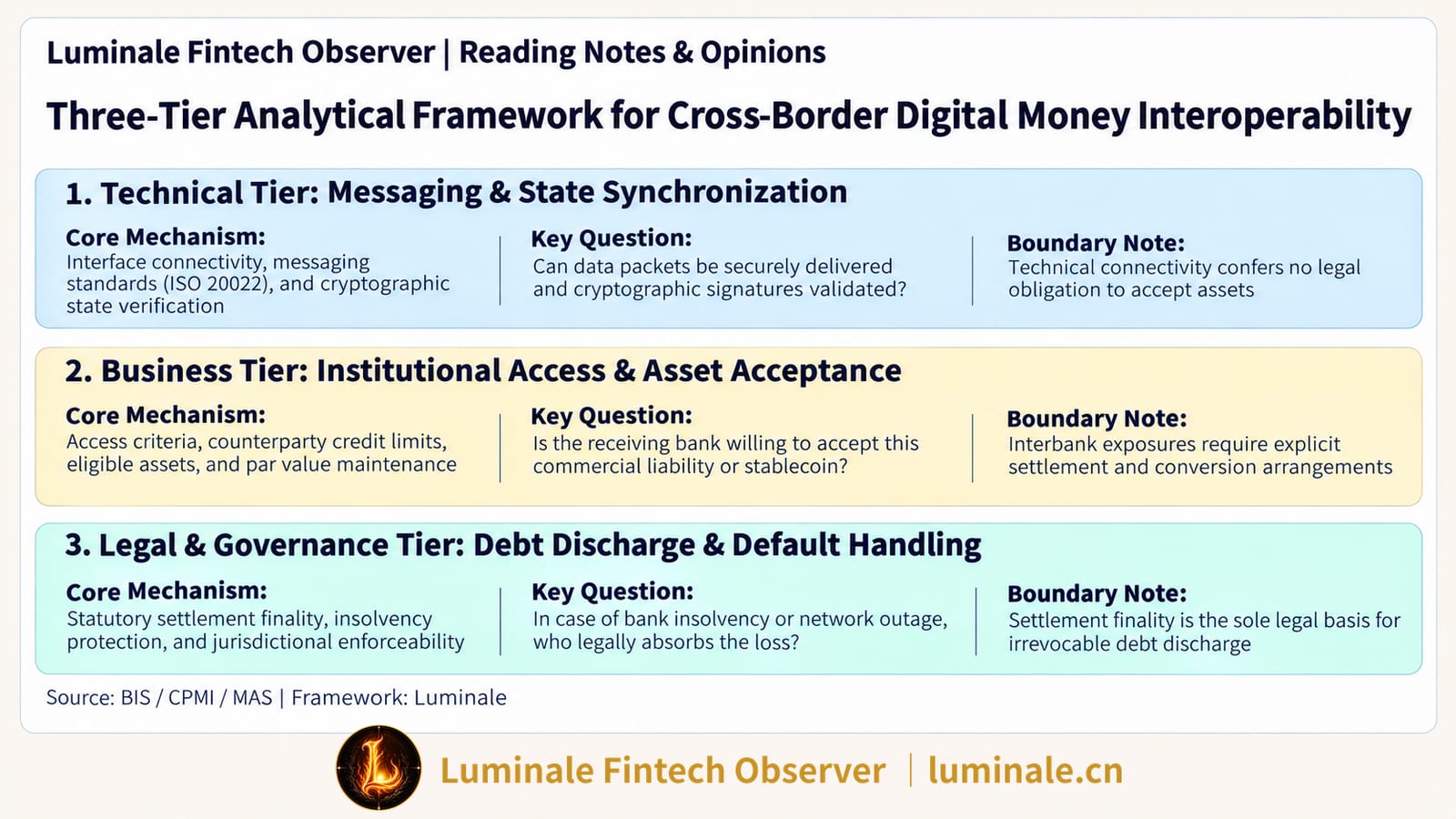
In financial transactions, "message delivery," "ledger state updates," and "debt discharge" have always been distinct stages. A debtor deducting balances on a local ledger and a creditor recording an increment on a remote ledger merely indicates that two systems logged an event. Without pre-established settlement rails, or if the creditor bank does not recognize the token issued by the debtor bank, such ledger adjustments remain unilateral bookkeeping entries that confer no binding financial discharge.
This publication previously examined the underlying legal nature of tokenized assets in "Tokenised Deposits: How Commercial Bank Money Enters the On-Chain World": a token is merely a digital representation of an underlying legal claim. The transfer of tokens across ledgers does not automatically signify that final interbank settlement has occurred. In its BLOOM documentation, MAS explicitly positions cross-jurisdictional "acceptance and settlement" alongside "cross-network interoperability" precisely because technical connectivity confers no legal obligation upon participating institutions to accept a given asset, nor does it eliminate interbank credit exposures[1].
2. Participation Rules Must Come First: Access Eligibility and Currency Acceptance
Operating across networks requires unambiguous eligibility criteria: which institutions are permitted to join, and what forms of digital money participants are required to accept.
In cross-border finance, technical network connectivity and business settlement participation are distinct:
- Technical Access: An institution maintains compatible nodes, cryptographic keys, and API specifications, enabling it to format, transmit, and receive standardized messages.
- Business Participation: An institution must hold relevant financial regulatory licenses, pass Anti-Money Laundering and Countering the Financing of Terrorism (AML/CFT) screening, and secure counterparty credit approvals and credit lines from peer participating banks.
The acceptance criteria for settlement assets present even greater complexity. Digital currencies traversing cross-border networks can take multiple forms: commercial bank-issued tokenised deposits, non-bank regulated stablecoins, or wholesale central bank digital currencies (wCBDC) currently undergoing trials.
These assets exhibit fundamental differences in balance-sheet properties:
| Asset Class | Issuing Entity | Balance-Sheet Liability Nature | Core Interbank Constraint | Basis of Par Value Maintenance |
|---|---|---|---|---|
| Tokenised Deposits | Commercial bank | Commercial deposit liability of the issuing bank | Peer banks are reluctant to hold competitors'credit risk; requires conversion into central bank reserves | Central bank reserve settlement, prudential supervision, deposit insurance |
| Regulated Stablecoins | Licensed non-bank entity or special purpose vehicle | Specific debt obligation of the private issuer | Variable reserve asset quality, uncertain cross-border insolvency ring-fencing, delayed redemptions outside business hours | Full custody of high-quality liquid assets (HQLA) and statutory redemption mandate |
| Wholesale CBDC | Central bank | Sovereign legal tender liability of the central bank | Strictly delimited sovereign boundaries; access restricted for foreign and non-bank entities | Full sovereign backing, zero credit risk, zero liquidity risk |
When two multinational corporations transact via digital currency, what compels the creditor bank to accept tokenized deposits issued by the debtor bank? Commercial banks generally avoid holding bilateral commercial claims against peers over prolonged periods, as doing so converts a commercial trade into uncollateralized interbank credit risk.
This publication explored the Bank for International Settlements (BIS) concept of the "singleness of money" in "Why One Dollar Equals One Dollar Across Different Banks, but Not Necessarily for Stablecoins: Understanding the BIS Concept of 'Singleness of Money'": under a two-tier monetary system, commercial bank deposits exchange at par (1:1) across the economy because central bank reserves serve as the common settlement denominator. Commercial banks extinguish mutual obligations by transferring risk-free reserves held at the central bank.
Without this shared settlement anchor, digital currencies issued by different entities will experience price discounts or liquidity premiums when circulating across networks, driven by divergent credit ratings and varying liquidation capabilities of underlying reserves. Lacking a unified settlement mechanism, receiving banks must impose individual haircuts or credit limits on each token.
According to the joint announcement by MAS, BNM, and BOT, BLOOM's mandate includes collaborating with the industry to establish common approaches for accepting, exchanging, and settling various forms of digital money across institutions, networks, and jurisdictions, while aligning international standards with domestic regulatory requirements[2].
Presently, BLOOM remains in an exploratory phase. Official authorities have not published standardized institutional onboarding lists or formal eligibility criteria for qualified assets. These operational parameters cannot be determined by technical protocols alone; they depend on master legal agreements negotiated among regulators and commercial banks.
3. Beyond Transaction Confirmation: Where Do Funds Actually Settle?
Once messages are exchanged and transactions confirmed across networks, payment processing enters its core stage: where does final settlement actually take place?
Within a single network, transaction confirmation involves only local ledger state transitions. In cross-network, multi-currency wholesale payments, a transaction traverses an extensive processing chain:
- Initiation & Local Verification: The debtor submits payment instructions to the debtor bank, which executes local balance reservations and AML/CFT compliance screening.
- Cross-Network Instruction Routing: The debtor network routes standardized payment instructions to the creditor network via secure messaging channels.
- Creditor Pre-Validation: The creditor network validates instruction formatting, cryptographic signatures, and payee account status, returning a processing receipt.
- Interbank Settlement Execution: Both banks transfer interbank balances across agreed settlement rails using eligible settlement assets.
- Creditor Account Crediting & Notification: The creditor bank credits the payee's account, granting unconditional funds availability.
In this processing chain, technical confirmation and legal settlement finality diverge across distinct operational horizons:
| Processing Stage | Technical State Characteristics | Financial & Legal Reality | Potential Risk Exposure |
|---|---|---|---|
| Instruction Routing & Receipt | Message delivered; both systems log "received" | Pure communication exchange; transfers no balance-sheet assets | Transmission timeouts, message loss |
| Distributed Ledger Confirmation | Block committed via consensus with timestamp | Updates technical ledger state; achieves no statutory debt discharge | Chain reorganizations, provisional state rollbacks |
| Interbank Settlement Execution | Unconditional, irrevocable transfer of central bank reserves or agreed assets | Extinguishes interbank debt obligation; achieves legal finality | Insufficient debtor liquidity, settlement queue gridlock |
If the creditor bank permits customer withdrawals before stage four is concluded, it effectively extends uncollateralized intraday credit to the debtor bank. Should the debtor bank fail during the operating day, the creditor bank absorbs the principal loss.
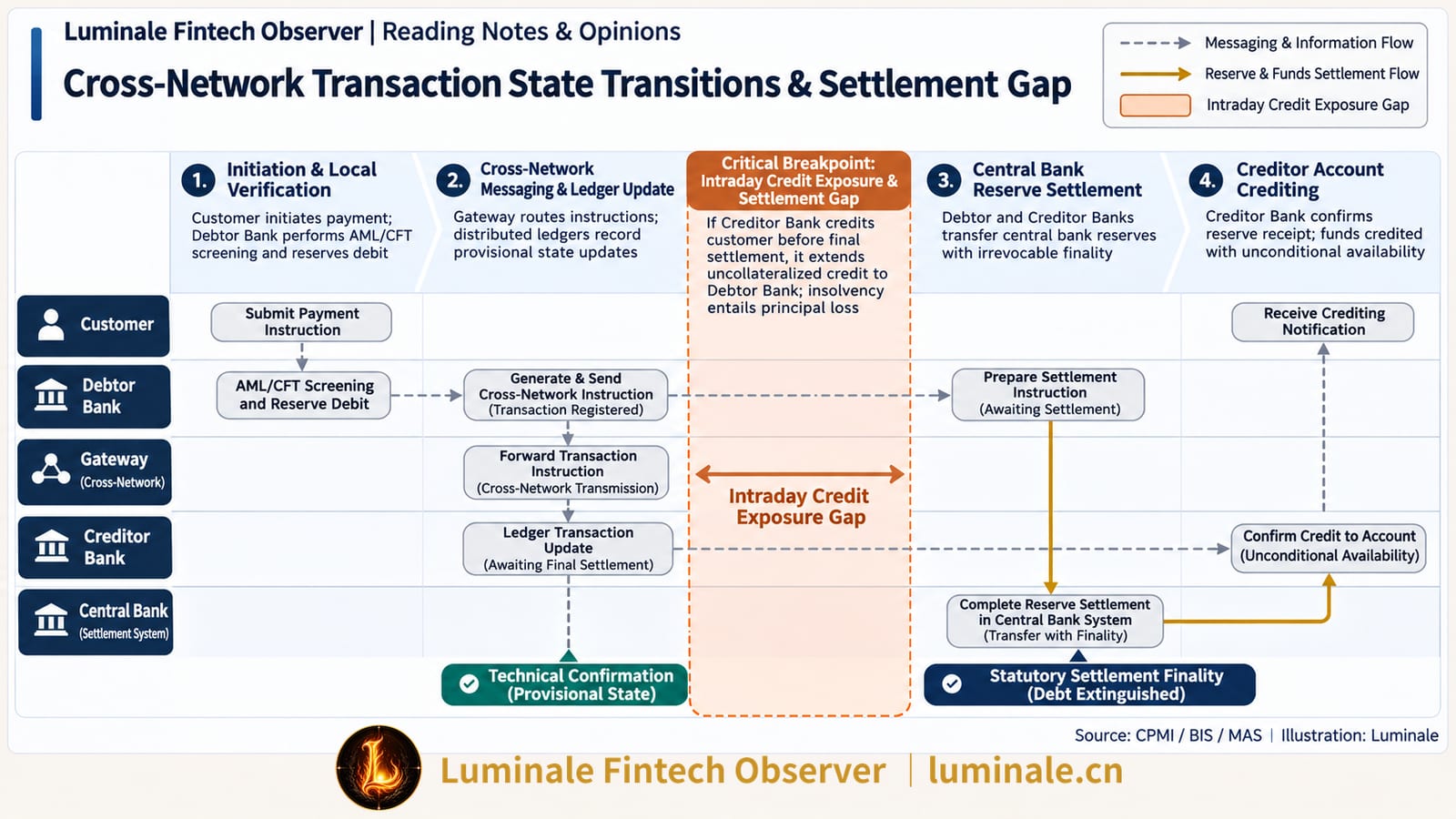
This publication examined the Committee on Payments and Market Infrastructures (CPMI) perspective in "As Payment Instruments Multiply, Why Must Settlement Return to Central Bank Money? A Close Reading of CPMI's 'The Roles of Central Bank and Central Bank Money in an Evolving Payments System'": regardless of how front-end payment instruments evolve, eliminating interbank credit and liquidity risks ultimately requires settling interbank liabilities in central bank money.
Furthermore, cross-network transactions face ledger synchronization challenges. Distributed environments can experience exceptional states: for example, a debtor network locks tokens and generates a cryptographic proof, but the gateway experiences a timeout, preventing the creditor network from decrypting and crediting the funds within the specified window. Without unified state-machine coordination rules, assets can become locked on one side while failing to disburse on the other.
This publication analyzed authoritative state and ledger handoffs in "How Is Digital Money Accounted For? From Accounts and Tokens to CBDC Ledger Design": across coexisting ledgers, rules must explicitly designate which ledger's state changes carry statutory authority, alongside automated compensating transactions to prevent double-spending.
In eliminating cross-currency principal risk, Payment versus Payment (PvP) represents the globally established mechanism. This publication detailed the two payment legs and principal risk (Herstatt Risk) in foreign exchange settlement in "What Is the Most Dangerous Moment in Foreign Exchange? Why PvP Is FX Market's 'Cash Against Delivery'": PvP mandates that the settlement of one currency leg is contingent upon the final settlement of the other, ensuring that both legs either settle simultaneously or neither occurs, thus eliminating principal loss arising from time-zone disparities.
However, while MAS identifies final settlement as a primary exploration area, official documentation has not announced a specific settlement architecture or the deployment of a PvP mechanism within BLOOM[1][2]. Until explicit settlement workflows and asset rules are established, technical connectivity cannot be assumed to provide risk-free funds settlement.
4. Fees, Liquidity, and Operational Liabilities: Who Foots the Bill for 24/7 Transfers?
Digital money initiatives frequently cite "reduced transaction costs" and "24/7 real-time settlement" as primary value propositions. MAS similarly notes that developing a common implementation framework and harmonizing commercial and operational arrangements aims to reduce the need for financial institutions to establish bespoke bilateral arrangements for each counterparty or market, thereby lowering costs and accelerating time-to-market[1].
While this describes an architectural objective, it does not represent verified empirical outcomes. Transitioning from bilateral connections to multilateral networks restructures costs while introducing new resource demands and operational liabilities.
1. Cost Shift Rather Than Cost Disappearance
Financial institutions face substantial friction when managing bespoke bilateral access:
- Technical Integration: Developing dedicated APIs and transformation gateways for every counterparty;
- Legal Due Diligence: Negotiating bilateral master agreements and clearing protocols with each entity;
- Compliance & Risk Controls: Auditing internal controls and maintaining individual credit facilities for each partner;
- Liquidity Fragmentation: Pre-funding collateral across disparate accounts, leading to trapped, inefficiently utilized liquidity.
A common clearing framework theoretically condenses an N×(N-1) mesh of bilateral relationships into an N:1 hub-and-spoke model, reducing redundant integration. However, operating a centralized coordination platform or multilateral network incurs tangible costs: infrastructure maintenance, shared compliance systems, 24/7 operational support, clearing platform fee allocation, and dispute resolution. These operational expenses must ultimately be distributed among network operators, participating banks, and corporate end-users. BLOOM has not yet disclosed a fee-sharing model, leaving governance economics to future design iterations.
2. Liquidity Constraints Behind 24/7 Operations
Many technical designs assume continuous (24/7) liquidity as a default benefit, presuming that as long as servers remain online, payments flow uninterrupted.
In commercial bank liquidity management, the operational constraint on 24/7 high-value cross-border settlement is not server uptime, but liquidity dry-ups and involuntary default risks caused by the closure of overnight interbank money markets.
Under standard market operating conventions, central bank Real-Time Gross Settlement (RTGS) systems and interbank funding markets close outside business hours:
| Operating Environment | Money Market Status | Commercial Bank Liquidity Sources | Primary Risk Profile |
|---|---|---|---|
| Business Hours (Daytime) | Interbank lending markets and central bank open market operations active | Banks draw on interbank borrowings, central bank repo facilities, and daylight overdrafts | Dynamic liquidity rebalancing; capital costs anchored to policy rates |
| Non-Business Hours (Nights & Weekends) | Interbank lending markets closed; central bank settlement windows shut | Zero access to external funding markets; entirely reliant on pre-funded liquidity ring-fenced during daytime | Liquidity depletion; large unforeseen net outflows trigger involuntary settlement defaults |
To support large-value cross-network transfers outside business hours, commercial banks must divert liquid assets from standard daytime operations and pre-fund dedicated settlement accounts. This imposes a significant liquidity-locking opportunity cost. Should large net outflows occur overnight or during weekends, an institution whose pre-funded balance is exhausted cannot access market liquidity, leaving it unable to execute transfers or forcing an involuntary settlement failure.
This publication examined reserve management requirements for continuous fund flows in "Tokenised Deposits: How Commercial Bank Money Enters the On-Chain World". Furthermore, in "Close Reading of the IMF Report: Tokenization Accelerates Financial Transactions, but Does Risk Arrive Faster Too?", we reviewed the International Monetary Fund's (IMF) analysis of trade-offs between settlement speed and liquidity demand: while tokenized architectures achieve instantaneous transaction-by-transaction settlement and boost processing speed, they heighten immediate liquidity demands. Without the netting buffers of traditional batch clearing, institutions in a continuous operating environment must maintain substantial gross liquidity buffers, increasing reserve consumption.
Under liquidity stress, payment queue processing does not function as an idealized First-In-First-Out (FIFO) algorithm. In commercial treasury operations, liquidity managers actively prioritize critical obligations and high-priority transactions. When a bank exhausts its available liquidity and breaches its net debit cap, the settlement system rejects incoming instructions on that basis, rather than permitting queues to accumulate indefinitely.
Unless cross-network architectures incorporate daylight overdraft facilities and Liquidity Saving Mechanisms (LSM), continuous 24/7 operations present a substantial liquidity burden for participating commercial banks.
5. Rules Are Truly Tested Under Outages, Defaults, and Regulatory Conflicts
During normal conditions, technical interfaces dictate transaction latency and throughput. It is only when systems experience external shocks, financial insolvencies, or jurisdictional rule conflicts that multilateral arrangements are truly evaluated.
1. Liability Breakpoints in Stress Scenarios
Cross-network digital currency arrangements face several systemic stress scenarios:
- Systemic Outages: A debtor network debits customer funds, but the gateway experiences an outage, preventing delivery to the creditor network within the settlement window. Must funds reverse automatically, or does an intermediary advance credit?
- Counterparty Insolvency: A debtor bank is placed into resolution by domestic supervisors minutes after dispatching an instruction but prior to central bank settlement. Should the receiving bank credit the beneficiary? Are funds tied up as insolvency estate assets or property of the payee?
- Compliance & Sanctions Conflicts: A trade payment deemed compliant under debtor jurisdiction laws enters the receiving network and triggers a newly enacted local sanctions list. Are funds frozen locally or returned to the sender, and who absorbs the resulting commercial default liabilities?
- Asset De-Pegging & Runs: If transactions rely on a regulated stablecoin or a specific bank's tokenized deposit as an intermediary settlement asset, and that asset suffers a liquidity crisis impairing par redemption, who absorbs corporate customer losses?
Without binding legal contracts, automated smart contracts cannot resolve these conflicts; rigid programmatic execution risks amplifying single-point failures across networks.
2. Tiered Rights and Responsibilities: South Korea's Project Hangang
The Bank of Korea's (BOK) digital currency pilot, Project Hangang, provides an instructive institutional model for tiered rights and responsibilities[3].
BOK's architecture establishes a two-tier division: "Deposit Tokens" accessible to retail and commercial entities, and "Wholesale CBDC" restricted exclusively to licensed financial institutions.
For interbank transfers, Project Hangang enforces a "burn-settle-reissue" workflow:
| Operational Phase | Transacting Entities | Action & Balance-Sheet Movement | Legal & Settlement Boundary |
|---|---|---|---|
| Step 1: Local Debit & Burn | Debtor Customer A Debtor Bank A | Customer A's deposit debited; Bank A burns corresponding Deposit Token A on its local ledger | Liability extinguished internally within Debtor Bank A |
| Step 2: Wholesale Reserve Settlement | Debtor Bank A Creditor Bank B | Bank A transfers equivalent Wholesale CBDC to Bank B on the central bank ledger | Interbank liability extinguished via risk-free central bank money with statutory finality |
| Step 3: Creditor Issuance | Creditor Bank B Payee Customer B | Bank B confirms reserve receipt and mints new Deposit Token B issued against its own balance sheet | Bank B establishes a new deposit liability to Payee Customer B |
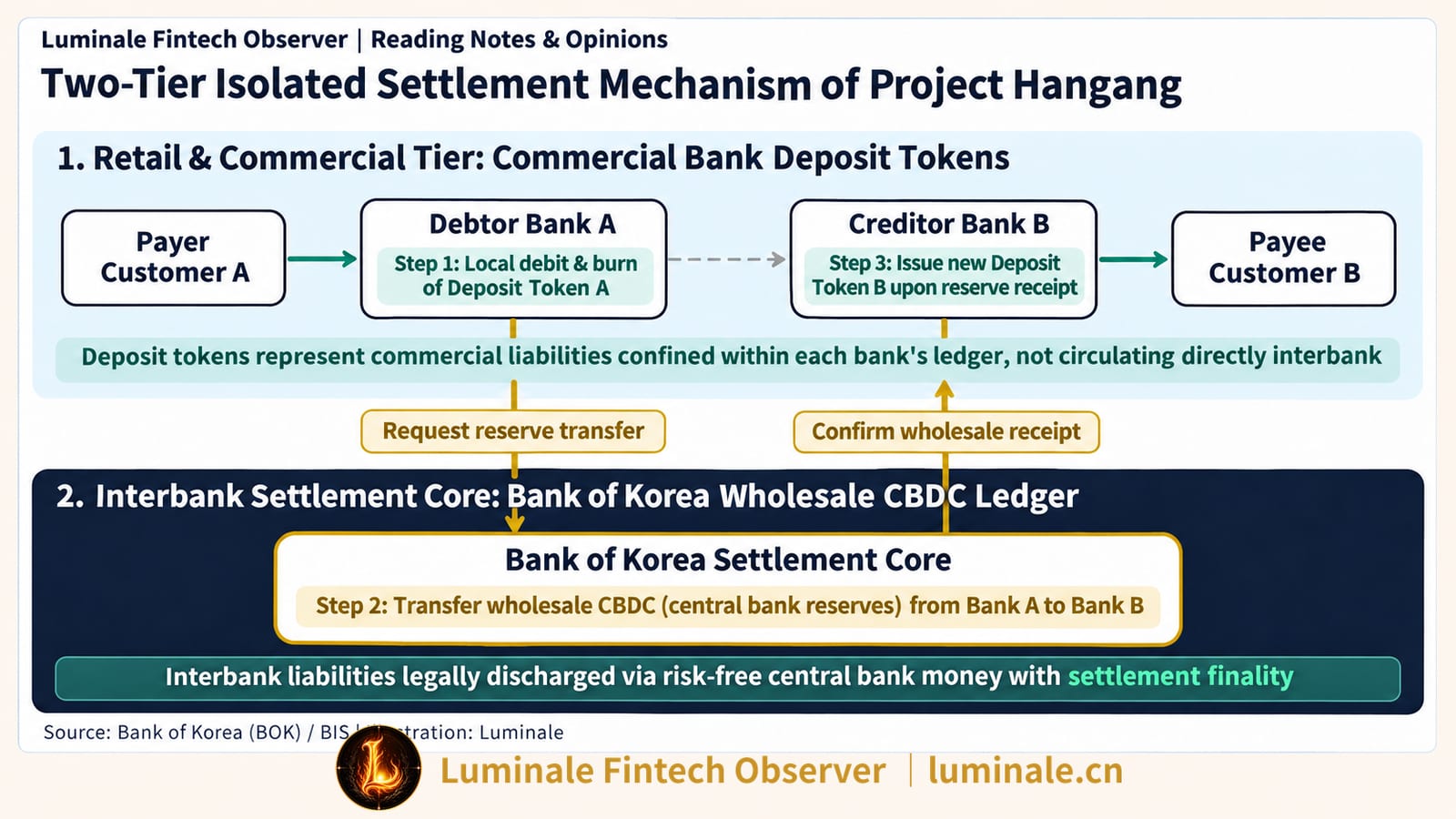
This publication examined the institutional mechanics of this structure in "How Far Has South Korea's Digital Currency Experiment Come? Understanding Project Hangang": commercial bank deposit liabilities remain confined to each issuing bank's ledger. Interbank transfers must penetrate down to the central bank ledger for statutory settlement. Should a sending bank fail, the fallout is restricted to its own depositors, preventing balance-sheet contamination across the banking system.
While Project Hangang operates within a single domestic jurisdiction, its structural isolation illustrates the necessity of clear settlement boundaries. Across borders, the absence of a supranational central bank makes jurisdictional risk ring-fencing substantially more complex.
3. Institutional Hurdle of Cross-Jurisdictional Coordination
The joint announcement by MAS, BNM, and BOT emphasizes that BLOOM seeks to align international standards—such as the CPSS-IOSCO Principles for Financial Market Infrastructures (PFMI)—with regional regulatory expectations, while respecting local legal divergences[2][4].
This prudent posture reflects underlying legal complexities in cross-border finance:
- Territorial Bankruptcy Jurisdiction: Insolvency statutes vary regarding the "zero-hour rule" and fraudulent conveyance clawbacks. A transaction deemed technically irreversible on-chain can still be overturned by a territorial bankruptcy court;
- Enforceability of Netting Arrangements: Where cross-border netting is utilized, whether local bankruptcy codes uphold close-out netting against liquidators determines whether systemic contagion risks persist;
- Data Sovereignty & Cross-Border Flows: Cross-border transactions carrying customer identities, account details, and AML/CFT declarations remain bound by stringent national data privacy and cybersecurity laws, constraining uninhibited data transit across public networks.
The maturity of a cross-network digital money architecture is not measured by the quantity of connected nodes or peak transaction throughput (TPS), but by its capacity to govern asset acceptance, settlement finality, and loss allocation under severe systemic stress through enforceable multilateral rules.
Conclusion
Moving from technical interface integration to substantive cross-network, multi-currency settlement is not merely a communication upgrade; it demands a comprehensive institutional architecture spanning asset properties, settlement finality, liquidity costs, and legal liabilities.
Reflecting on the analysis, any initiative seeking to connect disparate digital currency networks must navigate four fundamental institutional hurdles:
- Asset Acceptance: The balance-sheet liability structure of a token dictates its counterparty credit risk. Without unified reserve settlement and conversion facilities, digital tokens issued by disparate entities cannot maintain par value, leaving interbank credit exposures unhedged.
- Settlement Location & Finality: Technical confirmations across distributed ledgers do not constitute statutory settlement finality. Mitigating interbank credit risk and cross-currency principal risk requires settling liabilities in central bank money through synchronized mechanisms such as Payment versus Payment (PvP).
- Liquidity & Cost Allocation: Continuous 24/7 real-time settlement incurs substantial economic trade-offs. Gross real-time settlement elevates immediate liquidity demands, while overnight money market closures necessitate costly pre-funding, requiring robust liquidity-saving and priority-queuing mechanisms.
- Loss Allocation & Enforceability: During system disruptions, institutional insolvencies, or cross-border regulatory conflicts, automated code cannot adjudicate claims. Risk resolution depends on multilateral master agreements, insolvency protections, and dispute arbitration recognized across jurisdictions.
The significance of the BLOOM initiative launched by the Monetary Authority of Singapore (MAS) alongside Bank Negara Malaysia (BNM) and the Bank of Thailand (BOT) lies in refocusing the cross-border digital money agenda from technical reachability toward multilateral harmonization across implementation frameworks, commercial arrangements, and operational procedures.
Ultimately, the viability of cross-border digital money networks will depend on whether institutions can govern asset acceptance, settlement finality, and default management under enforceable shared rules. Until detailed institutional onboarding criteria, eligible asset taxonomies, and binding legal frameworks are formally established, maintaining disciplined, objective scrutiny remains far more valuable than premature declarations of success.
References
[1]: Monetary Authority of Singapore (MAS). BLOOM: Advancing Cross-Border Settlement in Digital Money [EB/OL]. (2026-10-23) [2026-11-12]. https://www.mas.gov.sg/schemes-and-initiatives/BLOOM ↩
[2]: Monetary Authority of Singapore (MAS). MAS, Bank Negara Malaysia and Bank of Thailand Partner with Industry to Advance Cross-Border Settlement in Digital Money through BLOOM [EB/OL]. (2026-10-23) [2026-11-12]. https://www.mas.gov.sg/news/media-releases/2026/mas-bnm-and-bot-partner-with-industry-to-advance-cross-border-settlement-in-digital-money ↩
[3]: Bank of Korea (BOK). The Bank of Korea, the Financial Services Commission, and the Financial Supervisory Service Jointly Announce the CBDC Pilot Project [EB/OL]. (2023-10-04) [2026-11-12]. https://www.bok.or.kr/eng/bbs/E0000634/view.do?nttId=10080649&menuNo=400069 ↩
[4]: Committee on Payments and Market Infrastructures (CPMI), International Organization of Securities Commissions (IOSCO). Principles for Financial Market Infrastructures (PFMI) [R/OL]. (2012-04-16) [2026-11-12]. https://www.bis.org/cpmi/publ/d101a.pdf ↩
Originally published by Luminale Fintech Observer: https://luminale.cn/articles/digital-money-interoperability-beyond-technical-connectivity-en