In the official project repository of the Bank for International Settlements (BIS), both Project Meridian and its successor Meridian FX are marked as "Concluded." In November 2026, the Bank of England (BoE), the Monetary Authority of Singapore (MAS), and the Bank of Thailand (BoT) jointly published the experimental findings of Meridian FX APAC. Why did three central banks across the Asia-Pacific and Europe choose to advance a research project that had already concluded at the BIS? Who actually coordinates cross-system synchronised settlement? And where are the funds truly recorded?
I. After the BIS Projects Concluded, What Research Continued?
The original use case of the Project Meridian series was an ordinary domestic property transaction in the United Kingdom, rather than a foreign exchange trade. In April 2023, the BIS Innovation Hub London Centre, together with the Bank of England, published the Project Meridian report, addressing the challenge of synchronising funds transfer with property deed exchange in high-value asset settlements[1]. In a typical property purchase, funds move from the buyer's commercial bank deposit account to conveyancing solicitors'accounts, followed by reserve transfers across the central bank's Real-Time Gross Settlement (RTGS) system, while HM Land Registry updates the digital deed of title. Our previous article, How Large-Value Payments Move Between Banks: Understanding RTGS Systems, examined the underlying mechanics of interbank reserve settlement. The original Meridian design introduced a synchronisation network based on Distributed Ledger Technology (DLT) linking commercial banks and HM Land Registry, establishing a Synchronisation Operator (SO) role to coordinate funds reservation and deed exchange. This phase validated the baseline operating model of the SO: the SO merely monitors states, matches bilateral instructions, and transmits orchestration triggers, while never holding customer deposits or central bank reserve assets on its own balance sheet.
In April 2025, the research shifted from single-jurisdiction asset purchases to cross-border foreign exchange settlement. The BIS London and Eurosystem Centres, together with the central banks of England, France, Germany, and Italy, along with the European Central Bank (ECB), published the Meridian FX report[2]. The trial linked a simulated BoE RTGS system to the Eurosystem's exploratory wholesale settlement solutions. On the euro leg, three distinct settlement models were integrated: Deutsche Bundesbank's Trigger Solution connecting to the conventional RTGS system T2, Banca d'Italia's TIPS Hash-Link connecting to the instant payment system TIPS, and Banque de France's DL3S issuing wholesale tokenised central bank money directly on a DLT ledger. As explored in From Pontes to Appia: How Europe Is Rebuilding the Cash Leg for Tokenised Securities, the Eurosystem has conducted extensive exploratory work to settle the cash legs of tokenised transactions. All assets in Meridian FX were simulated; the project's core achievement was proving that a common synchronisation protocol could interface with central bank settlement infrastructures of differing technical designs. With the publication of this report, both projects on the official BIS repository were formally marked as concluded[3].
| Stage & Publication Date | Participating Entities | Scenario & Assets Involved | Core Technology & Account Structure | Nature of Trial & Current Status |
|---|---|---|---|---|
| Original Meridian (2023-04-19) | BIS Innovation Hub London Centre, Bank of England, HM Land Registry, Coadjute | Property transaction: Coordinating commercial bank deposits, RTGS reserves, and digital deeds | DLT synchronisation network; baseline SO model (no assets on SO balance sheet) | Proof-of-concept; marked as Concluded on BIS project portal[1][3] |
| Meridian FX (2025-04-24) | BIS London & Eurosystem Centres; central banks of UK, FR, DE, IT; ECB | Simulated FX PvP: Bilateral GBP/EUR settlement | Simulated BoE RTGS linked to three Eurosystem models (Trigger / TIPS / DL3S) | Cross-border simulation; marked as Concluded on BIS project portal[2][3] |
| Meridian FX APAC (2026-11-13) | Bank of England, Monetary Authority of Singapore (MAS), Bank of Thailand (BoT) | Heterogeneous cross-border FX PvP and multilateral netting (GBP, SGD, THB) | Centralised SO prototype (delivered by Partior); three heterogeneous account and wallet models | Non-production cross-central bank trial; technical and policy reports published[5][6][7] |
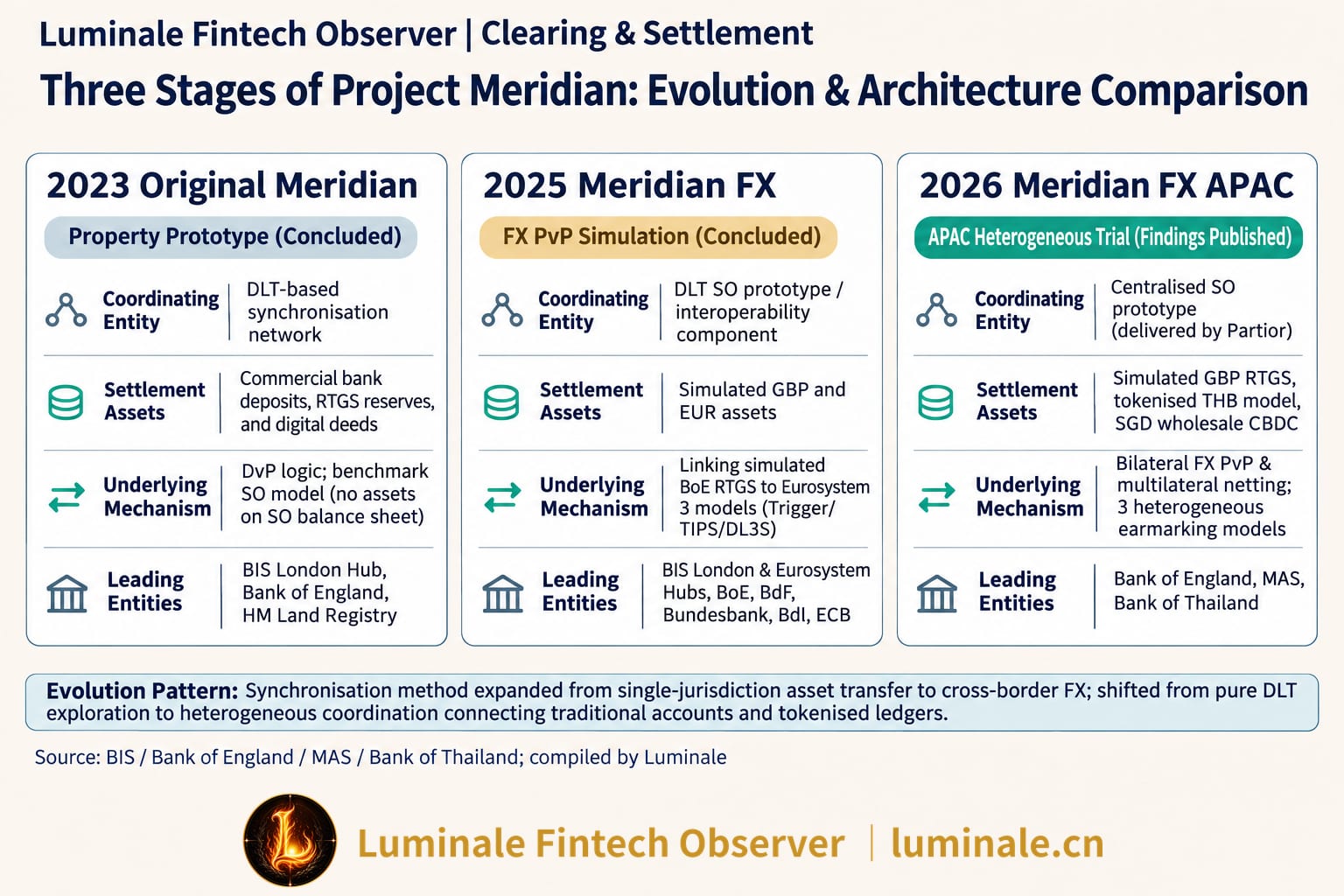
In November 2025, the Bank of England, MAS, and the Bank of Thailand announced an Asia-Pacific trial building upon the foundations of Meridian FX, publishing their findings in November 2026[4][5]. Partior was selected to develop, integrate, and test the SO prototype, with the Reserve Bank of Australia and Bangko Sentral ng Pilipinas participating as policy observers. The three central banks pursued an independent multilateral collaboration based on previously published research methodologies, with the Bank of England participating continuously as a core founding partner.
In November 2025, the Bank of England also published a Project Meridian Securities report examining the synchronised settlement of tokenised securities against central bank money, with the BIS London Centre providing technical advice[8]. This represented an exploratory offshoot applying synchronisation principles to the securities domain, rather than an alternative to the foreign exchange track.
II. The Synchronisation Operator Coordinates Instructions While Settlement Remains on Respective Ledgers
Understanding synchronised foreign exchange settlement requires revisiting the foundational nature of FX settlement risk. In traditional FX settlement, cross-time-zone and cross-system discrepancies often result in a temporal gap where one currency has been paid out before the counterparty currency is received. This principal risk—starkly exposed during the 1974 failure of Bankhaus Herstatt—was examined in detail in What Is the Most Dangerous Moment in FX? Why PvP Eliminates Principal Risk. Payment versus Payment (PvP) requires that the two individual currency payments be conditionally bound: either both legs achieve final settlement simultaneously, or neither leg transfers funds.
The original Project Meridian coordinated cash and title deeds, mirroring the Delivery versus Payment (DvP) mechanism in securities settlement, the institutional boundaries of which are discussed in Delivery versus Payment: What Risk Does DvP Actually Eliminate in Securities Settlement?. In an FX context, however, both legs involve sovereign fiat currencies recorded on the respective settlement ledgers of sovereign central banks. In this environment, the Synchronisation Operator (SO) functions strictly as an instruction coordinator and state orchestrator.
The operational workflow of the SO comprises three sequential steps:
- Instruction Ingestion and Matching: The two FX counterparties (Commercial Bank A and Commercial Bank B) each submit a synchronisation request to the SO through their respective internal systems. The SO validates currencies, amounts, beneficiary account details, and settlement cut-offs, matching the bilateral instructions;
- Coordinating Funds Earmarking: The SO does not debit or credit funds directly. Instead, it dispatches parallel earmarking requests to the GBP and SGD settlement systems, requesting both systems to lock the corresponding payment amounts on their respective ledgers and prevent those liquidity balances from being used elsewhere;
- Condition Verification and Settlement Execution: Upon receiving "earmarking successful" confirmations from both domestic systems, the SO verifies that the condition of irrevocable execution has been satisfied. It then transmits simultaneous settlement execution instructions to both central bank systems. Each central bank system executes the book-entry funds transfer on its own ledger and returns a final settlement confirmation to the SO.
Suppose Commercial Bank A pays Commercial Bank B an amount of GBP (), while Commercial Bank B pays Commercial Bank A an amount of SGD (). The corresponding accounting entries and state transitions across both domestic systems proceed as follows:
| Settlement Phase | BoE Simulated RTGS System (GBP Leg) | MAS SGD Testnet (SGD Leg) |
|---|---|---|
| Initial State | Bank A reserve account normal; Bank B reserve account normal | Bank B dedicated wallet normal; Bank A dedicated wallet normal |
| Funds Earmarking Phase | Bank A available reserve balance reduced by amount (liquidity ring-fenced and locked; not debited); Bank B reserve account unchanged | Bank B dedicated wallet available balance reduced by amount (tokens technically locked; not debited); Bank A dedicated wallet unchanged |
| Final Settlement Phase | Bank A reserve account debited by , Bank B reserve account credited by ; GBP leg achieves final settlement | Bank B dedicated wallet debited by , Bank A dedicated wallet credited by ; SGD leg achieves final settlement |
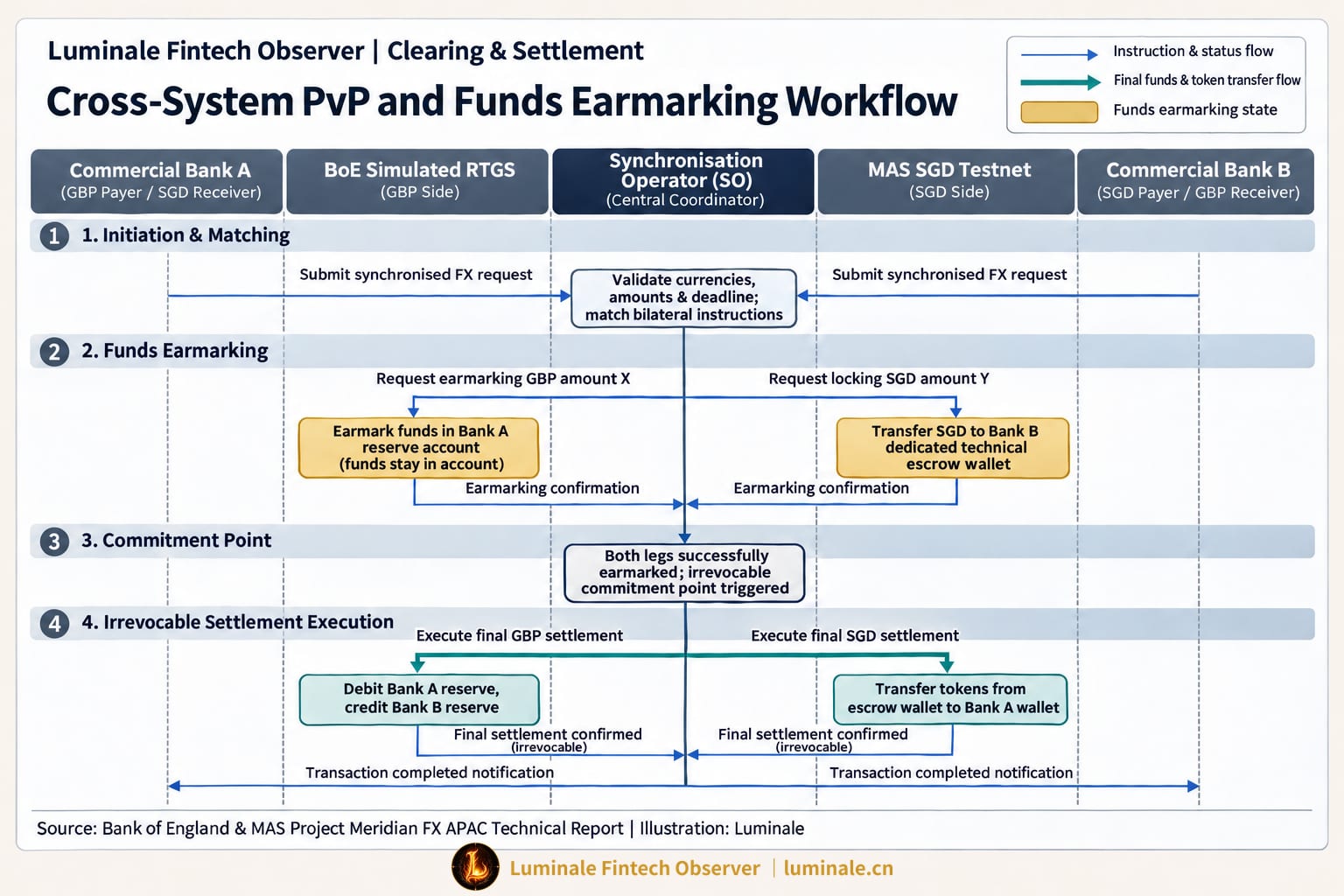
Throughout this entire workflow, the SO does not maintain accounts for commercial banks on its own books, nor does it act as a central counterparty (CCP) for the FX transaction. It maintains the state transitions of a coordination state machine; the actual transfer of legal ownership of both funds occurs entirely within the independent settlement systems governed by each respective central bank. Synchronised settlement does not require sovereign currencies to be migrated onto a single supranational shared ledger, nor does it purport to displace the Continuous Linked Settlement (CLS) system. Instead, it links payments via standardized messaging protocols and controlled interfaces while preserving the operational independence of domestic infrastructures. In their daily treasury scheduling and clearing queues, commercial banks continue to operate under their domestic liquidity management rules, as detailed in When Liquidity Runs Short: Understanding Queuing and Liquidity-Saving Mechanisms in RTGS.
III. Why Earmarking and Authorization Across Three Systems Cannot Be Described Uniformly
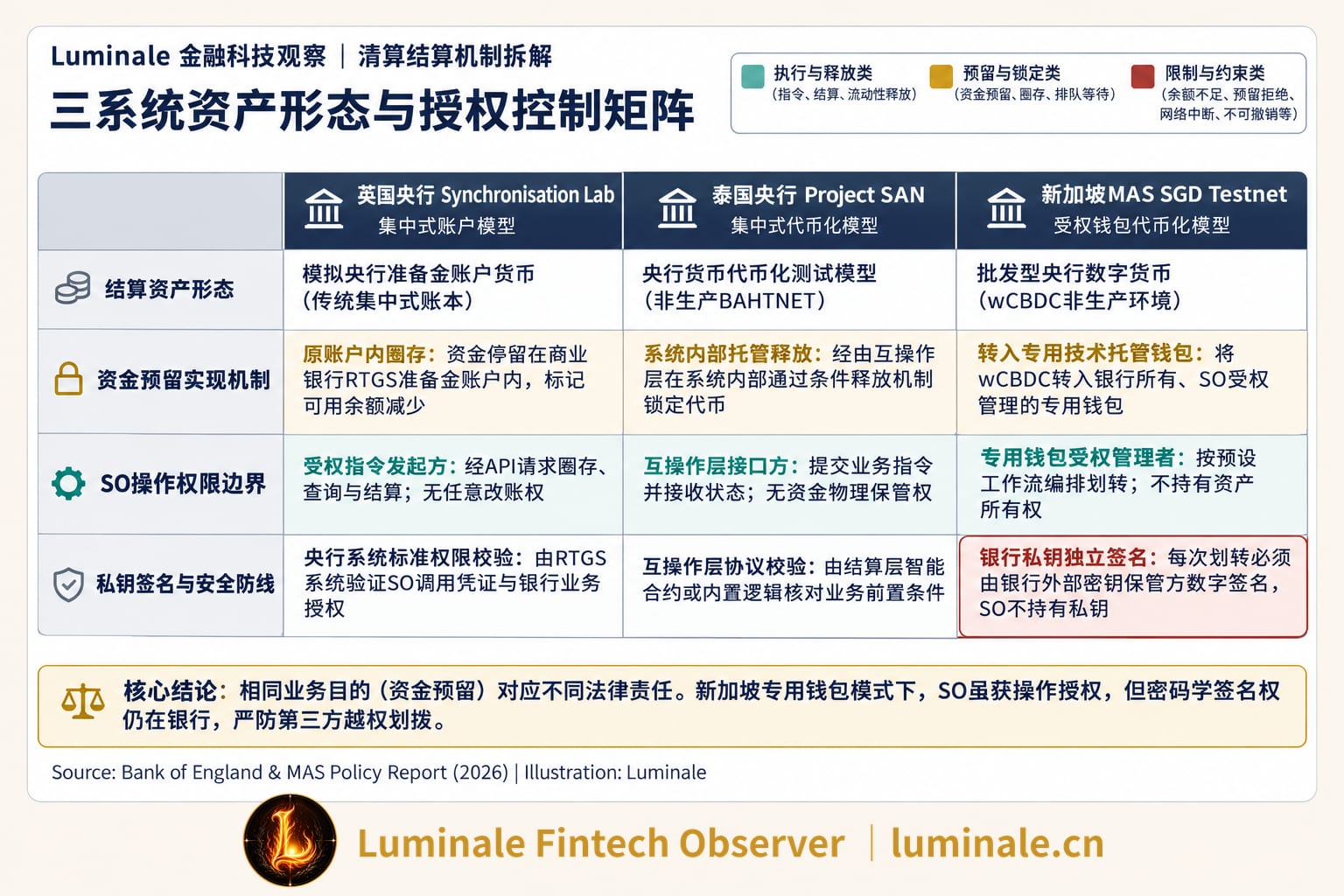
Within the Luminale analytical framework for payment infrastructures, the fundamental obstacle to cross-system synchronised settlement lies not in technical communication protocols, but in how heterogeneous systems define asset forms, funds earmarking mechanisms, and authorization boundaries for the Synchronisation Operator. As noted in Why Digital Money Interoperability Cannot Rely on Technical Connectivity Alone, cross-system asset flows are governed by deep legal account attributes and control rights allocations. In Meridian FX APAC, the three central banks integrated three architecturally distinct test environments, resulting in pronounced differences across the legal relationships governing funds earmarking and operational mandates.
| Test Environment & Lead Central Bank | Settlement Asset Form & Nature of Environment | Specific Funds Earmarking Mechanism | SO Authorization Boundary & Digital Signature Mechanics |
|---|---|---|---|
| BoE Synchronisation Lab (Bank of England) | Simulated RTGS central bank money; centralised account architecture; non-live environment | In-account earmarking: Ring-fences liquidity within commercial bank's own RTGS reserve account; funds do not leave the account | System API recognizes SO as an authorized instruction agent to request earmarking, query, and debit; SO has no authority to alter ledger balances arbitrarily |
| Project SAN (Bank of Thailand) | Tokenised central bank money test model; centralised tokenised architecture; non-live environment | Internal escrow release: Earmarks funds internally via conditional release mechanisms orchestrated through an interoperability layer | SO submits instructions and receives states via interoperability layer; SO assumes no physical custody of funds and holds no direct debit powers |
| SGD Testnet (Monetary Authority of Singapore) | Wholesale central bank digital currency (wCBDC); centralised tokenised ledger; non-live environment | Transfer to dedicated technical escrow wallet: Funds transferred from bank's primary wallet to a dedicated technical escrow wallet owned by the bank | Dedicated wallet operated under mandate by SO; any asset movement requires the commercial bank's digital signature; SO never holds private keys |
These three implementation models reflect the differing technical compromises and architectural choices made by each system in fulfilling the functional requirement of "funds earmarking":
In the Bank of England's Synchronisation Lab, the system utilizes a traditional centralised account architecture. Reserves are recorded directly on the RTGS accounts of the central bank—the bedrock of ultimate settlement finality, as articulated in Why Settlement Anchors in Central Bank Money: Reading CPMI's Report on Central Bank Money in Evolving Payment Systems. The BoE system natively supports an in-account "earmarking" function. When Commercial Bank A initiates a payment, amount remains inside Bank A's reserve account; only its available balance decreases while its earmarked balance increases, preventing the bank's treasury desk from mobilizing those funds for other RTGS transactions. The SO holds API invocation credentials only, with the central bank system validating instruction authenticity before updating ledger states internally.
The Bank of Thailand's Project SAN is a centralised test model of tokenised central bank money, interfacing with the underlying settlement environment via a specialized Interoperability Layer. Funds earmarking is not executed through an external third-party escrow account, but rather leverages system-native conditional release rules to lock tokens at the ledger layer. It must be emphasized that Project SAN functioned purely as an experimental prototype in this trial and must not be conflated with Thailand's live BAHTNET system; nor did the project reports confer any production legal status upon the test tokens.
The MAS SGD Testnet illustrates an alternative logic for handling tokenised assets. MAS simulated wholesale Central Bank Digital Currency (wCBDC) circulation in a non-production testnet, extending an evolutionary lineage discussed in Where Is Singapore's Digital Finance Headed? From Tokenisation to Payment and Clearing Infrastructure. Because this test ledger did not natively support in-account earmarking like the BoE RTGS, the project team implemented an engineering workaround: establishing a "dedicated technical escrow wallet" for each participating bank—owned by the bank, but operated under mandate by the SO. To earmark liquidity, the system transfers wCBDC tokens from the bank's primary wallet into this dedicated escrow wallet, simulating a ring-fenced lock.
This arrangement establishes a nuanced division of rights and responsibilities from a policy and legal standpoint:
- Asset Ownership: Legal title to tokens residing within the dedicated escrow wallet remains strictly with the commercial bank rather than the SO; the SO does not recognize these tokens on its own balance sheet;
- Operational Control: The instruction trigger interface for the dedicated wallet is exposed to the SO, enabling it to orchestrate transfer requests in accordance with the transaction workflow;
- Non-Delegable Cryptographic Signing Authority: This forms the foundational security safeguard—any movement of assets out of the dedicated escrow wallet requires a digital signature from the participating commercial bank. Upon receiving an execution request from the SO, the MAS adapter layer forwards the payload to the commercial bank's External Key Custody facility for cryptographic signing. The SO never accesses, holds, or manages the commercial bank's private keys.
In the Singapore trial, while the SO was granted operational management over the dedicated technical wallet, any token transfer instruction remains cryptographically and procedurally invalid without the commercial bank's local private key signature. Consequently, the operational mandate granted to the SO over the dedicated technical wallet remains strictly bounded and contained.
Furthermore, although the SO prototype developed and delivered by Partior for this trial was a centralised software application, it was engineered to interface seamlessly with both traditional centralised RTGS systems and blockchain-based central bank digital currency platforms.
IV. When One Leg Fails, What Happens to Earmarked Funds on the Other?
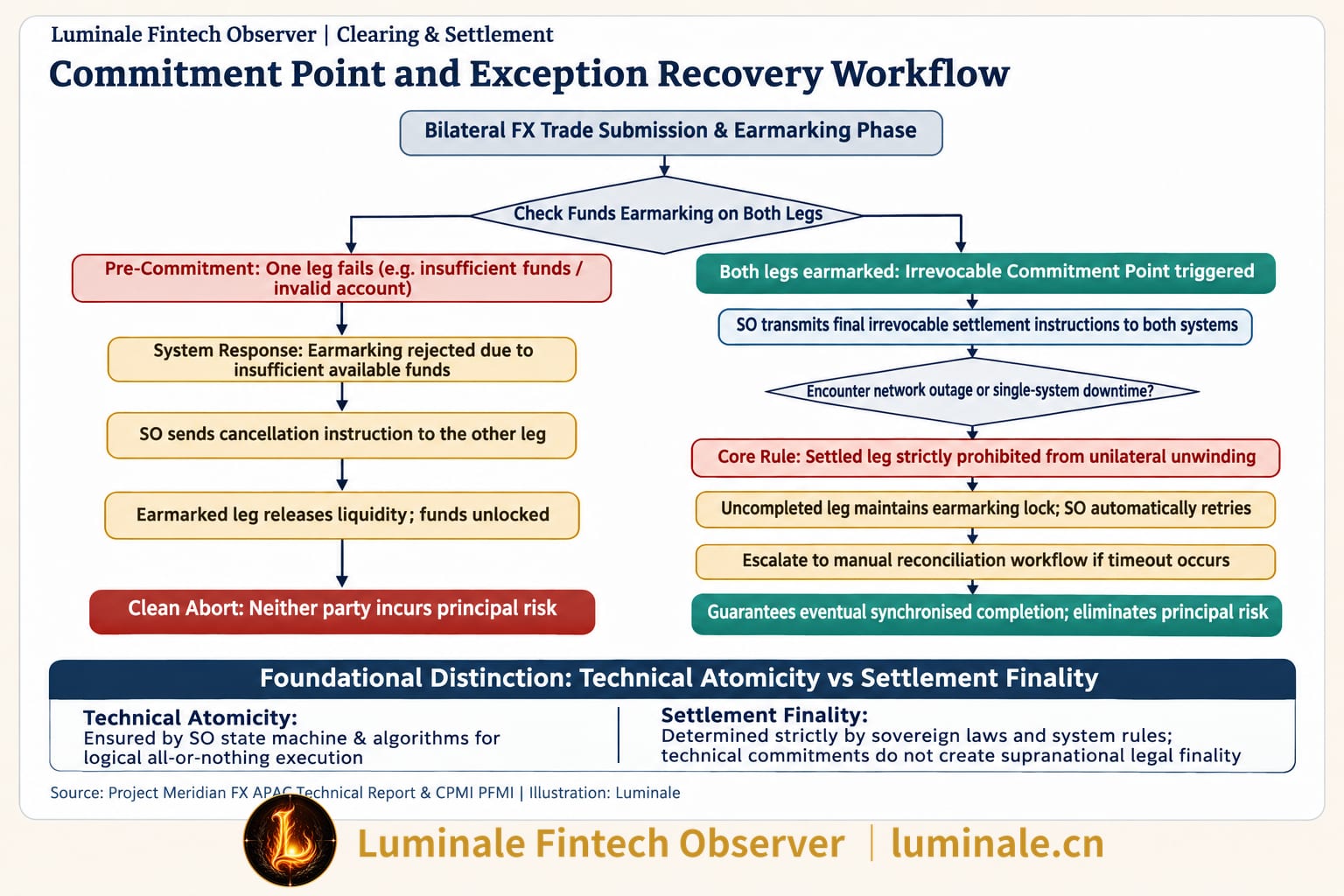
The objective of synchronised foreign exchange settlement is to eliminate counterparty risk even under severe network disruptions and infrastructure outages. If a cross-border transaction spanning multiple sovereign systems suffers an interruption, how should the systems handle funds that have already been earmarked? In the design of Meridian FX APAC, exception handling is strictly demarcated by the "Commitment Point" into two distinct operational regimes.
| Phase & Trigger Condition | Scenario | Remediation Logic & Liquidity Treatment | Resulting State |
|---|---|---|---|
| Pre-Commitment (Earmarking Phase) | One leg suffers insufficient funds or invalid account details | Reject earmarking on that leg; transmit cancellation instruction to the other leg to release earmarked liquidity | Clean abort; neither party incurs principal exposure |
| Post-Commitment (Irrevocable Execution Phase) | Single-system communication outage or temporary downtime | Settled leg strictly prohibited from unilateral unwinding; uncompleted leg maintains earmarking lock and retries automatically | Await network restoration to complete posting; escalate to manual reconciliation upon timeout |
The first regime occurs Pre-Commitment. During the funds earmarking phase, the SO issues parallel earmarking requests to the GBP and SGD legs. If the GBP leg is rejected by the RTGS system due to insufficient available liquidity, the commercial bank's treasury desk receives a standard reason code (e.g., instruction rejected due to insufficient available balance or credit limit). Because the execution preconditions have not been met, the transaction has not crossed into an irrevocable state. The SO immediately aborts the transaction workflow and transmits a cancellation instruction to the SGD leg. The funds previously locked in the dedicated escrow wallet on the Singapore leg are released back to the bank's primary wallet. Both parties'assets remain entirely intact within their original reserve accounts or primary wallets, resulting in a clean abort with zero outstanding credit exposure.
The second regime occurs Post-Commitment. Once liquidity has been successfully earmarked across both the GBP and SGD legs, the SO completes bilateral validation and transmits irrevocable settlement execution orders to both domestic systems. If a network outage suddenly severs communication with one system at this juncture, preventing the timely receipt of a settlement confirmation message, how must the funds on both legs be handled?
At this irrevocable stage, the leg that has completed settlement is strictly prohibited from executing a unilateral unwinding. Permitting the GBP leg to reverse or erase debited and credited ledger entries would trigger cascading reconciliation chaos and unhedged credit exposures. Both technical rules and legal frameworks mandate that the uncompleted leg maintain its funds earmarking lock while the SO continuously retries settlement execution. If an extended outage causes automated retries to time out, the transaction transitions into an explicit suspended state, escalating to manual operational workflows where both commercial banks and the respective central banks settle remaining entries pursuant to pre-agreed scheme protocols.
Here, a fundamental distinction must be drawn between Technical Atomicity and Settlement Finality:
- Technical atomicity refers to the computational "all-or-nothing" execution state maintained by distributed algorithms and coordinator state machines;
- Settlement finality, by contrast, is the statutory protection conferred by sovereign law upon settlement entries—once finalized, even if the paying institution enters insolvency proceedings immediately thereafter, the transfer remains legally irrevocable and cannot be unwound or clawed back by insolvency administrators. The statutory protections governing finality are analyzed in Can a Payment Be Revoked After Success? What Risk Settlement Finality Truly Resolves.
The policy report of Meridian FX APAC explicitly delineates this boundary: while the SO state machine can designate a specific technical milestone as a "Point of No Return," this does not equate to the creation of a harmonized, supranational "statutory finality moment" across the jurisdictions of the UK, Singapore, and Thailand[7]. The precise legal moment at which funds transfers attain statutory finality continues to be governed strictly by domestic legislation—such as the UK Financial Markets and Insolvency Regulations, the Singapore Payment Services Act, and respective domestic system rules. A technical orchestrator cannot unilaterally conjure cross-border statutory effects out of software logic.
V. How Far Did the Trial Validate, and What Is Still Missing for Production?
Progressing from a Proof-of-Concept (PoC) to a live production service in wholesale financial markets represents a formidable leap. Based on the joint findings published by the three central banks, a clear line must be drawn between "validated technical capabilities," "untested operational realities," and "independent central bank roadmaps."
| Evaluation Dimension | Capabilities Validated in Trial | Prerequisites Missing in Production | Underlying Institutional & Technical Constraints |
|---|---|---|---|
| Transaction Models | Bilateral FX PvP synchronised settlement; batch non-urgent multilateral netting | Complex interactions with live commercial bank balance sheets across full FX lifecycle | Participant account balances configured as test parameters; credit limits, intraday exposure limits, and liquidity metrics untested |
| Clearing & Settlement Roles | SO centrally computes multilateral net obligations and validates common trade sets across three systems | Regulatory classification and licensing status of cross-border clearing institutions | Multilateral netting calculation moves beyond pure messaging into the regulatory domain of clearing houses or central counterparties |
| Operating Hours & Liquidity | Assumed perfectly overlapping operating windows across all three systems | Non-overlapping cross-time-zone operating windows; earmarking timeouts and lapse handling | Liquidity scarcity and involuntary overdraft risks during overnight interbank market closures; high opportunity costs of locking 24/7 reserves |
| Resilience & Default Protection | Manual exception workflows tested for selected communication outages and earmarking failures | Enforceable legal recourse during extended infrastructure failures or counterparty insolvency | Absence of multilateral, legally binding Scheme Rules and formalized default fund mechanisms |
| Infrastructure Deployment | Successful API integration and testnet connectivity in sandbox environments | Production-grade synchronisation APIs and formal access criteria in live central bank RTGS systems | Bank of England targets production-grade synchronisation interfaces by 2028; no joint tripartite production timeline exists |
In multilateral netting, the trial successfully verified the SO's ability to batch-process a collection of non-urgent FX trades and calculate net obligations. However, the operational viability of this mechanism hinges on a critical prerequisite: all three central bank systems must simultaneously validate and accept the exact same transaction set, and every participating bank in a net debtor position must successfully earmark its required funds. While multilateral netting dramatically reduces gross liquidity requirements, multilateral offsetting cannot conjure liquidity out of thin air. If a single bank fails to earmark its net debit obligation due to insufficient funds, the entire batch must be recalculated after excising the failed transactions, demanding exceptional consistency and recalculation resilience from the orchestrator.
Far more decisive than technical mechanics is the legal and regulatory classification of the operating entity. If the SO acts solely as a technical routing and state orchestration agent for bilateral instructions, its functional status approximates that of a technology service provider. However, the moment the SO undertakes multilateral netting calculations—or operates participant banks'dedicated technical escrow wallets under mandate, as demonstrated in the Singapore experiment—its operational profile converges substantially with that of a clearing house or asset custodian[7]. Under domestic statutory regimes, would such an entity require formal clearing and settlement licensing? In the event of a participating bank's insolvency, how would assets ring-fenced within dedicated escrow wallets achieve bankruptcy remoteness? These policy and legal questions cannot be resolved through technical interface testing alone.
Operating hour constraints present an equally formidable operational hurdle. The APAC trial assumed perfectly overlapping operating hours across all three systems. In live cross-border commerce, however, business hours in London, Singapore, and Bangkok span disparate time zones. Establishing continuous synchronised settlement would necessitate substantially expanded operating windows. Yet the true bottleneck to 24/7 wholesale settlement lies not in server maintenance or operational shift scheduling, but in the acute liquidity scarcity and involuntary overdraft risks that arise when overnight interbank money markets are closed. Commercial banks cannot access low-cost interbank funding during off-hours; requiring them to pre-fund and lock massive excess reserve buffers around the clock to support PvP settlement imposes prohibitive capital opportunity costs.
In retail cross-border payments, networks such as Project Nexus link domestic fast payment systems by introducing specialized FX providers and a multilateral routing hub, as explored in From Bilateral Links to a Multilateral Network: How Nexus Rearchitects Instant Cross-Border Payments. In wholesale foreign exchange markets, the Project Meridian series illustrates an alternative evolutionary vector: rather than surrendering jurisdiction over domestic currency ledgers, central banks can deploy an external Synchronisation Operator (SO) to coordinate cross-system funds earmarking and execution triggers, offering an architecturally viable engineering pathway to eliminate cross-border FX principal risk.
VI. Conclusion
From synchronising property deeds in the UK domestic market, to simulating interconnections across heterogeneous wholesale models between the UK and the Eurosystem, and finally to trialling cross-border arrangements across three central banks in the Asia-Pacific, the trajectory of the Project Meridian series outlines a distinct middle path beyond pure distributed ledgers: preserving the sovereign, independent native infrastructures of national central banks, while relying on an external Synchronisation Operator for cross-system instruction orchestration and state locking.
The core insights delivered by this series of experiments for cross-border clearing and settlement can be distilled into three principles:
- Strict Decoupling of Orchestration and Bookkeeping: Synchronised settlement does not require sovereign currencies to migrate onto a single supranational "unified ledger," nor does it seek to displace established central counterparties or the CLS system. Funds remain anchored on the reserve ledgers or sovereign token infrastructures governed by individual central banks; the SO acts purely as a workflow state orchestrator rather than a credit intermediary;
- Earmarking Must Adapt to Heterogeneous Architectures: In conventional account-based systems, native in-account earmarking successfully locks liquidity. In tokenised environments lacking native locking capabilities, transferring assets into an authorized dedicated technical escrow wallet provides a pragmatic engineering workaround. However, the rigorous decoupling of cryptographic signing authority from asset ownership constitutes the institutional baseline preventing unauthorized third-party disposition;
- Technical Confirmation Cannot Substitute for Legal Finality: While algorithmic rules guarantee technical atomicity for logical all-or-nothing execution across networks, cross-border settlement finality remains contingent upon statutory protections and insolvency safe harbors within respective sovereign jurisdictions. A technical orchestrator cannot unilaterally create a harmonized supranational finality timestamp.
Looking ahead, the evolution of financial market infrastructures is progressing from conceptual exploration into the deeper waters of institutional design and production engineering. For central banks and infrastructure operators worldwide, the primary challenge is no longer merely whether APIs can communicate or messaging standards can align. The true test lies in preventing liquidity exhaustion across non-overlapping operating windows, clarifying clearing licenses and default obligations in multilateral netting, and establishing enforceable, harmonized legal rulebooks across heterogeneous asset paradigms.
The global payment architecture of the future will not be a singular monolithic skyscraper built upon the ruins of legacy infrastructures. Instead, it is far more likely to evolve into a multi-tiered interchange—one that preserves the robust sovereign pillars of domestic central bank systems while interconnecting them through standardized synchronisation protocols and trusted orchestration services. Grasping this institutional evolution requires evaluating the fundamental constraints and trade-offs underpinning each architectural design. The specific operational algorithms governing cross-time-zone liquidity management and multilateral batch exception recovery will be examined in subsequent analyses.
References
[1]: Bank for International Settlements. Project Meridian: Innovating transactions with synchronisation [EB/OL]. (2023-04-19). https://www.bis.org/publications/project-meridian-innovating-transactions-synchronisation.pdf. ↩
[2]: Bank for International Settlements. Project Meridian FX: Exploring synchronised settlement in foreign exchange [EB/OL]. (2025-04-24). https://www.bis.org/publications/project-meridian-fx-exploring-synchronised-settlement-fx.pdf. ↩
[3]: Bank for International Settlements. Project Meridian / Meridian FX Project Overview [EB/OL]. (2025-04-24). https://www.bis.org/project/meridian-fx. ↩
[4]: Monetary Authority of Singapore. Bank of England, Monetary Authority of Singapore and Bank of Thailand to explore synchronised FX settlement across borders [EB/OL]. (2025-11-13). https://www.mas.gov.sg/news/media-releases/2025/boe-mas-and-bot-to-explore-synchronised-fx-settlement-across-borders. ↩
[5]: Bank of England. The Bank of England, Monetary Authority of Singapore and Bank of Thailand media release on Project Meridian FX APAC [EB/OL]. (2026-11-13). https://www.bankofengland.co.uk/news/2026/november/the-boe-monetary-authority-of-singapore-and-bank-of-thailand-media-release. ↩
[6]: Bank of England. Project Meridian FX APAC: Technical Report [EB/OL]. (2026-11-13). https://www.bankofengland.co.uk/payments/payments-innovation/wholesale-experiments-programme/project-meridian-fx-apac-technical-report. ↩
[7]: Bank of England. Project Meridian FX APAC: Policy Report [EB/OL]. (2026-11-13). https://www.bankofengland.co.uk/payments/payments-innovation/wholesale-experiments-programme/project-meridian-fx-apac-policy-report. ↩
[8]: Bank of England. Project Meridian Securities: Exploring wholesale settlement using distributed ledger technology [EB/OL]. (2025-11-28). https://www.bankofengland.co.uk/payments/rtgs-future-roadmap/project-meridian-securities. ↩
[9]: European Central Bank. Outcome of the Eurosystem's exploratory work on wholesale settlement using new technologies [EB/OL]. (2025-06). https://www.ecb.europa.eu/press/pubbydate/2025/html/ecb.exploratoryworknewtechnologies202506.en.html. ↩
Originally published by Luminale Fintech Observer: https://luminale.cn/articles/meridian-fx-apac-synchronised-settlement-central-bank-systems-en