
In mid-October 2026, a number of Chinese commercial banks published a notice on a change to system operating hours. From 19 October, the time at which the People's Bank of China (PBOC) High Value Payment System (HVPS) starts accepting business for each working day would move from 20:30 on the previous day to 19:00 on the previous day, while end-of-day processing would remain at 17:30 on the day itself. The service hours of the HVPS were thereby extended from "5×21 + 12 hours" to "5×22.5 + 13.5 hours". Many commercial banks subsequently adjusted the acceptance windows for interbank transfers above CNY 1 million in their mobile banking and corporate online banking channels.
For ordinary individual users, the change may show up only as a notice on a transfer screen. For bank treasury departments, clearing departments at securities and fund companies, money brokers and FX trading desks, it means an extra hour and a half each day in which funds can be scheduled. Extending HVPS hours by an hour and a half lengthens the window in which commercial banks can directly mobilise central bank money for transaction-by-transaction settlement.
Compared with the Bulk Electronic Payment System (BEPS) and the Internet Banking Payment System (IBPS), which run 7×24, the HVPS handles a seemingly small number of transactions, but the value it carries is very large. According to the PBOC's 2025 Payment System Overview, the HVPS processed 404 million transactions worth CNY 8,964.68 trillion during the year. Of the combined business of the systems operated by the China National Clearing Center (CNCC), it accounted for less than 2% of volume but more than 94% of value[1].
Whose money does this system, rarely noticed by individual users, actually handle? Why do funds from commercial banks, securities firms, the FX market and the various retail payment platforms all ultimately converge here for settlement? Who sets its operating rules, and which institutions can connect to it directly? How is an interbank payment, often worth hundreds of millions, transferred on the central bank's books? Looking globally, how do the large-value systems of the Federal Reserve, the European Central Bank, the Bank of England and other major central banks compare with China's? And as financial assets are tokenised, are central banks upgrading their existing settlement systems or building new ledgers?
This article is the second in Luminale's series on classifying payment systems. Building on the previous article, Which Rail Should a Payment Take? Classifying Payment Systems: Wholesale, Retail and Cross-Border, which set out the overall landscape of the payment system, and on What Exactly Is a Payment System? From the BIS Definition to the Global Financial Market Infrastructure Landscape, which established the dimensions for analysing infrastructure, this article examines the large-value payment system that underpins a national payment system.
I. What Is a Large-Value Payment System: The Last Stop of a National Payment System
1. Positioning and Boundaries: Final Discharge in Central Bank Money
To understand the position of large-value payment systems, we need to go back to the core asset that carries payments: the hierarchy of money.
In a modern two-tier banking system, money exists in two main forms: commercial bank deposit money issued by commercial banks (a claim on a commercial bank), and central bank money issued by the central bank (a liability of the central bank). Most of what businesses and individuals use in everyday economic activity is commercial bank deposits. When the payer and payee hold accounts at the same commercial bank, a transfer involves only an adjustment on that bank's internal books: the payer's deposit decreases, the payee's deposit increases, and the bank's total liabilities are unchanged.
When funds move between two different commercial banks, however, things become more complicated. The receiving bank cannot accept IOUs from the paying bank indefinitely and unconditionally, and commercial banks cannot issue legal tender to each other as permanent settlement. Net obligations between two banks must be settled in an asset that both trust and that carries no default risk or liquidity discount. That asset is central bank money, specifically the balances that commercial banks hold in reserve accounts at the central bank.
The core function of a large-value payment system (LVPS) is to provide the financial system with a central channel that uses central bank money as the clearing and settlement asset. According to the definition of the Committee on Payments and Market Infrastructures (CPMI) of the Bank for International Settlements, a large-value payment system generally refers to a funds transfer system that handles large-value, high-priority payment instructions between financial institutions, or between businesses and financial institutions[2].
The system is called the last stop of a national payment system because its settlement results carry legal settlement finality. At the moment settlement is completed, the debit and credit entries on commercial banks'reserve accounts at the central bank take effect simultaneously, ownership of the funds is established, and the transfer is legally irrevocable and unalterable. For why settlement must be legally protected from insolvency avoidance powers and the retroactive effect of zero-hour rules, see Can a "Successful Payment" Be Reversed? What Risks Does Settlement Finality Solve?.
Whether it is a bank card transaction from everyday household spending or a QR code payment by a business on an online shopping platform, the interbank net obligations that result from multiple rounds of front-end netting must ultimately return to the large-value payment system and be settled through transfers between reserve accounts at the central bank. For this reason, when the BIS and IOSCO drew up the principles for financial market infrastructures, they treated the soundness of large-value payment systems as a core baseline for preventing systemic risk. For the specific requirements, see Reading the PFMI: The Lines Financial Market Infrastructures Must Hold Behind the 24 Principles.
2. Large-Value vs Real-Time Gross Settlement: Business Nature vs Technical Mechanism
In discussions of financial markets, the terms "large-value payment system" and "real-time gross settlement (RTGS) system" are often used interchangeably, but they are not conceptually the same:
- Large-value payment system (LVPS): describes the economic nature of the business a system carries. It emphasises that payment amounts are usually large, highly time-sensitive and systemically important. Such systems are defined by systemic-risk considerations: even where individual amounts are small, payments are often included if they involve funds settlement for core financial market infrastructures.
- Real-time gross settlement (RTGS): describes the underlying processing mechanism for clearing and settling funds. Once payment instructions enter the system, they are debited and credited on settlement asset accounts one by one, in real time and in order of receipt, without being aggregated and netted or deferred to the end of the day.
The great majority of large-value payment systems owned and operated by central banks use RTGS, because transaction-by-transaction real-time posting eliminates intraday credit risk in the settlement process. The correspondence between the two is not absolute, however:
First, a large-value payment system does not necessarily use pure RTGS. For example, the Clearing House Interbank Payments System (CHIPS), operated by The Clearing House (TCH) in the United States, is a typical large-value payment system, but during the day it uses a prefunding mechanism and a continuous multilateral real-time netting algorithm rather than pure gross debiting of each transaction. EURO1, the large-value system set up by pan-European financial institutions, has long used multilateral deferred net settlement.
Second, an RTGS settlement engine can also be used for retail or low-value business. For example, the ECB's TARGET Instant Payment Settlement (TIPS) technically provides gross settlement of individual transactions directly in central bank reserve accounts, but it mainly serves low-value instant retail payments by households and merchants.
The distinction shows that the mechanism a large-value system adopts is an institutional trade-off between settlement safety (eliminating credit risk) and liquidity cost (tying up large amounts of reserves). For a detailed analysis of how gross and deferred net settlement differ in liquidity consumption and settlement timing, see Why Don't Payment Systems Settle Every Payment Immediately? Understanding RTGS and DNS.
3. What Kinds of Funds It Handles: The Main Artery of the Financial System
A large-value payment system is far more than a channel through which banks lend to and move funds between each other; it carries the densest flows of funds in a modern economy. Specifically, large-value systems mainly handle the following seven types of flows:
- Interbank money market flows: principal and interest on unsecured interbank lending, pledged repo and outright repo between commercial banks, interbank deposit transfers and so on.
- The cash leg of securities transactions: when government bonds, policy bank bonds, local government bonds, corporate credit bonds and equities are traded in the secondary market, the securities depository and settlement system sends funds transfer instructions to the large-value payment system to achieve delivery versus payment (DvP).
- The domestic currency leg of FX transactions: the transfer and payment of domestic currency in cross-currency FX spot, forward and swap transactions; where payment versus payment (PvP) is applied to FX trades, the system serves as the safe delivery channel for the domestic currency leg.
- Funds settlement for central counterparties (CCPs): initial margin and mark-to-market variation margin collected from members by CCPs in the various financial derivatives markets, and transfers of clearing default funds.
- The central bank's own monetary policy operations and treasury business: open market reverse repos, the Medium-term Lending Facility (MLF), the Standing Lending Facility (SLF), central bank relending and rediscounting conducted by the central bank, as well as central treasury receipts and payments such as tax remittances, government bond principal and interest payments, and fiscal transfers.
- Final net settlement for retail and bulk payment systems: the interbank net receivable and net payable positions generated by BEPS, IBPS, bank card clearing organisations (such as China UnionPay) and online payment clearing platforms (such as NetsUnion Clearing Corporation) through netting in specific sessions or at the end of the day.
- Large-value transfers in the real economy: payments for bulk commodity trade by large enterprises and institutions, interbank supply-chain financing disbursements, interbank funds for large mergers and acquisitions, corporate tax payments, and single large interbank transfers initiated by individual customers through electronic channels or at bank counters.
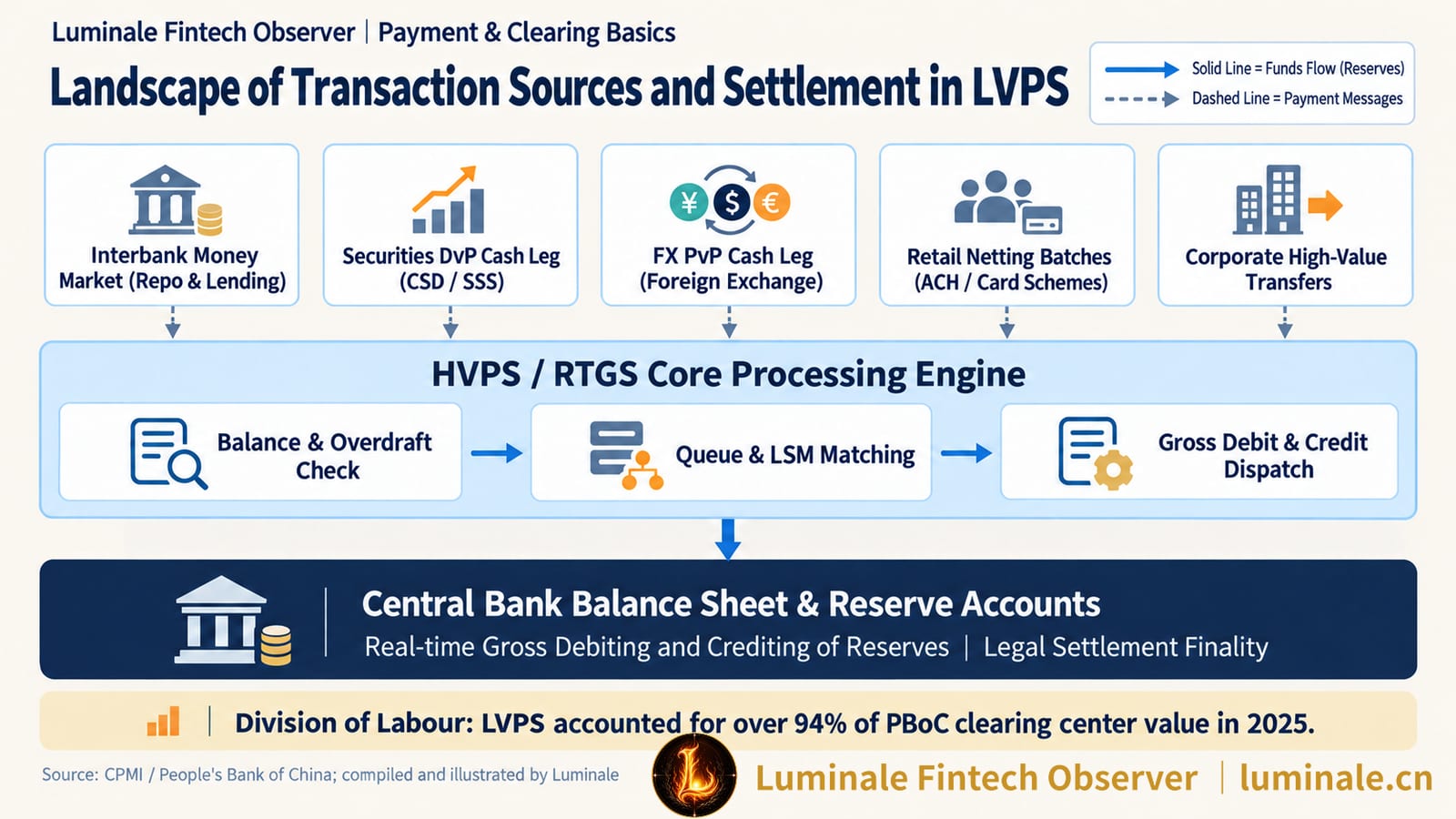
As these scenarios show, although the large-value payment system deals directly with ordinary people only rarely, it is like the trunk main in a city's water supply and drainage network. The branch networks can adjust pressure and pipe size for specific scenarios, but the final load and the convergence of flows depend entirely on the capacity of the trunk main.
4. A Look at the Data: The Extreme Distribution of Volume and Value
To see the division of labour of the large-value system in the flow of funds through the national economy, we can compare the 2025 annual operating data of the core infrastructures operated by the PBOC's China National Clearing Center.
| System | Volume (million transactions) | Share of volume | Value (CNY trillion) | Share of value | Average value per transaction | Operating hours |
|---|---|---|---|---|---|---|
| High Value Payment System (HVPS) | 404 | 1.79% | 8,964.68 | 94.43% | approx. CNY 22.19 million | Working days and special working days |
| Bulk Electronic Payment System (BEPS) | 5,092 | 22.59% | 206.18 | 2.17% | approx. CNY 40,500 | 7×24 continuous operation |
| Internet Banking Payment System (IBPS) | 17,041 | 75.59% | 280.67 | 2.96% | approx. CNY 16,500 | 7×24 continuous operation |
| China Domestic Foreign Currency Payment System (CFXPS) | 7 | 0.03% | 41.84 | 0.44% | approx. CNY 5.95 million | Working days |
| CNCC total | 22,544 | 100.00% | 9,493.36 | 100.00% | approx. CNY 421,100 | -- |
Note: data from the PBOC's 2025 Payment System Overview[1].
The data show a highly asymmetric distribution. IBPS handled more than three quarters of transfer volume but only 2.96% of total value, with an average of just CNY 16,500 per transaction. The HVPS, with less than 2% of volume, carried more than 94% of total interbank value, with an average of more than CNY 22 million per transaction. Over the 248 working days of 2025, the HVPS processed an average of 1.629 million transactions a day, settling an average of CNY 36.15 trillion a day.
This division of labour explains why a country must build several payment systems. To achieve settlement entirely free of credit risk, the large-value system requires participating banks to put up real central bank reserves for every payment. If the billions of daily low-value transactions across society, buying breakfast or ordering takeaway, were all pushed into the large-value system for individual settlement, the banking system would quickly exhaust its intraday liquidity, and queuing and congestion could cripple the settlement efficiency of the entire financial system. Low-value and fast payment systems reduce liquidity consumption through batch netting or deferred settlement, while the large-value system specialises in large-value transfers and final net settlement, providing a stable settlement channel for the whole financial system. For the overall division of labour among the large-value system, retail systems, bank cards and the NetsUnion platform in China's payment system, see From Bank Cards to NUCC, UnionPay & HVPS: A Comprehensive Map of China's Payment System.
II. Who Operates It and Who Can Join: Operators, Participants and Access
1. Diverse Operating Models: Central Bank Operation and Private Charter
Because the settlement asset of a large-value payment system is a liability on the central bank's balance sheet (reserve deposits), the central bank naturally plays a central role in it. In specific institutional design and system operation, however, the major economies have developed several different organisational models:
The first is central bank built and operated. This is the most common model. The central bank not only owns the settlement accounts and has final authority over them, but also directly funds the technical operations centre, builds the dedicated communications network and sets the operating rules. The HVPS operated by the PBOC's China National Clearing Center and the RTGS system operated by the Reserve Bank of India (RBI) both follow this model. The central bank directly controls the whole process, from front-end message exchange to back-office account posting, with the supervisory function and the operating entity coordinated within the central bank.
The second is joint operation within a system of central banks, represented by the euro area's T2 (formerly TARGET2). T2 is jointly owned and managed by the Eurosystem (the ECB and the national central banks of euro area member states). Its underlying technical platform was developed and is jointly operated by four member-state central banks (the Deutsche Bundesbank, the Banque de France, the Banca d'Italia and the Banco de España, together known as the 4CB). Commercial banks in each member state still open central liquidity management accounts at their own national central bank, but technically share a single centralised settlement engine.
The third is central bank control of settlement combined with technical operation by an external entity, as in the Hong Kong dollar Clearing House Automated Transfer System (CHATS) in the Hong Kong SAR. The Hong Kong Monetary Authority (HKMA) is the statutory settlement institution, and all settlement banks open clearing accounts with it; the actual technical development, network operation and day-to-day running are handled by Hong Kong Interbank Clearing Limited (HKICL), a private company owned 50/50 by the HKMA and the Hong Kong Association of Banks.
The fourth is operation by a chartered private institution, represented by CHIPS in the United States and EURO1 in Europe. CHIPS is owned and operated by The Clearing House, a company formed by large commercial banks, and its participants belong to a private multilateral clearing arrangement. Although day-to-day matching and netting are carried out by the private system, CHIPS must still rely on central bank reserve accounts at the Federal Reserve at the start and end of the day to inject funds and settle surpluses.
The historical evolution of operating models is also worth noting. The UK's large-value interbank system, CHAPS, was for a long time operated by a private membership company, CHAPS Clearing Company Limited, with the Bank of England providing only back-end settlement. Against the background of the 2008 global financial crisis and the subsequent tightening of international regulatory standards, and to strengthen the resilience of systemically important financial market infrastructures, the Bank of England formally took over direct operation of CHAPS in November 2017, returning it to central bank operation[3].
2. Participant Categories in China's HVPS
The large-value system does not open direct access to all businesses or institutions. Under the PBOC's Measures for Business Processing of the High Value Payment System and the relevant business rules of the CNCC, participants in the HVPS are strictly divided into three categories:
- Direct participants:
- Have independent legal-person status, have been approved by the PBOC, hold a reserve deposit account (clearing account) at the PBOC, and have an HVPS bank code.
- Have front-end processing capabilities to connect directly to the HVPS, can send and receive payment instructions independently, and are responsible for raising intraday positions and managing liquidity on their own clearing accounts.
- Mainly include policy banks, large state-owned commercial banks, joint-stock commercial banks, city commercial bank legal entities, some locally incorporated foreign banks, and some well-capitalised rural commercial banks. Direct participation is tied directly to holding a settlement account at the central bank. For the access conditions and account tiers for different financial institutions at the central bank, see Who Can Hold an Account at the Central Bank? Decoding the Account Hierarchy and Settlement Infrastructure.
- Indirect participants:
- Are not directly connected to the HVPS but, with PBOC approval, appoint a commercial bank with direct participant status to handle funds transfers and settlement on their behalf.
- Have their own national unified bank code, but their funds must flow through the position pool of their agent clearing bank in the large-value system.
- Mainly include village and township banks, grassroots rural credit cooperatives, and some small and medium-sized non-bank financial institutions.
- Special participants:
- Institutions specially approved by the PBOC that do not take public deposits as their main business but, because they perform important functions in financial market trade matching, securities registration and custody, or clearing intermediation, are permitted to connect directly to the HVPS and open dedicated settlement accounts.
- Special participants are the key links connecting financial market infrastructures. They mainly include China Central Depository & Clearing Co., Ltd. (CCDC), Interbank Market Clearing House Co., Ltd. (Shanghai Clearing House), China Securities Depository and Clearing Corporation Limited (CSDC), China UnionPay Co., Ltd., NetsUnion Clearing Corporation, and Cross-border Interbank Payment and Clearing Co., Ltd. (the CIPS operator).
3. Expanding Access Boundaries and International Practice
For a long time, direct access to large-value payment systems worldwide was almost monopolised by licensed commercial banks subject to prudential supervision. The reason is practical: direct participants have the privilege of drawing intraday liquidity from the central bank or directly touching the central bank's balance sheet, and any operational failure or credit default would be transmitted immediately across the whole interbank network.
Over the past decade, however, the rise of fintech and non-bank payment service providers has challenged this traditional boundary. In many countries, non-bank PSPs handle large volumes of market transactions and merchant settlement, but because they cannot open settlement accounts at the central bank, they must rely on large-value clearing agency services provided by commercial banks. This arrangement creates two problems. First, payment institutions must hold large amounts of customer settlement funds at commercial banks, taking on commercial credit exposure to their agent banks. Second, agent banks charge payment institutions fees for routing and clearing while also competing with them downstream.
To address this, the Bank of England moved relatively early among the major advanced economies. In July 2017, it formally changed its access policy for the RTGS system, allowing non-bank payment service providers that meet specific access criteria and prudential requirements (such as electronic money institutions, EMIs, and payment institutions, PIs) to open settlement accounts directly at the Bank and become direct participants in CHAPS. TransferWise (now Wise) subsequently became, in April 2018, the first non-bank fintech company to connect directly to the Bank of England's RTGS[4].
China has taken a different path on access. Under regulatory requirements, third-party payment institutions do not connect directly to the HVPS. Instead, the PBOC operates a centralised custody regime for customer reserve funds. All customer reserve funds of payment institutions must be held 100% in a dedicated centralised custody account at the PBOC, and payment institutions may not establish direct clearing channels with each other. Interbank transfers initiated by payment institutions are routed and cleared centrally through NetsUnion Clearing Corporation or China UnionPay; NetsUnion and UnionPay connect to the HVPS as special participants, and settlement is ultimately completed between the PBOC's centralised reserve-fund custody accounts and commercial banks'settlement accounts. For how NetsUnion and UnionPay act as the clearing middle layer and settle inter-institution balances on the large-value system, see What Do NUCC and UnionPay Actually "Clear"? The Middle Layer of Payment Clearing, Explained. This model both eliminates the risk of misappropriation or default by commercial banks and isolates the risks of non-bank institutions from the HVPS.
4. Access Communications and Messaging: Moving to ISO 20022
Connecting to a large-value payment system requires not only legal eligibility but also substantial financial and technical investment. Participants usually need to lay dedicated financial communication lines and deploy certified front-end processors (gateways) within the bank. The front-end system connects to the bank's core banking system, treasury trading system and liquidity management system, and handles message packaging, digital signatures, tamper-proof verification and instruction queuing.
At the level of messaging standards, large-value payment systems worldwide are in the process of moving fully to the ISO 20022 messaging standard.
Traditional financial communications widely used SWIFT MT messages or similar fixed-text formats developed by individual countries. Such messages often suffer from limited field lengths, flat structures and a lack of rich metadata. In a traditional MT 103 single customer credit transfer, for example, the addresses and organisation codes of the payer and payee are often mixed together in a few limited text lines, which can easily trigger false anti-money laundering hits because of non-standard formatting and limits the rate of interbank straight-through processing (STP).
ISO 20022 is based on Extensible Markup Language (XML) and uses a fully object-oriented, hierarchical data model. Under ISO 20022, every large-value payment message (such as the pacs.008 customer credit transfer and the pacs.009 financial institution credit transfer) has tightly structured nested tags that can carry the identifier of the ultimate originator (LEI), detailed purpose of payment, tax codes and an end-to-end tracking reference (UETR). For the design logic and message syntax of ISO 20022, see What Is ISO 20022? Understanding the Common Language of Next-Generation Payment Infrastructure.
The major large-value payment systems have all carried out ISO 20022 migration on set timetables in recent years:
- The ECB's T2: completed a full "big bang" cutover to ISO 20022 on 20 March 2023;
- The Bank of England's CHAPS: formally completed its core migration on 19 June 2023;
- The Federal Reserve's Fedwire Funds Service: completed a full single-day cutover to the ISO 20022 format (using a customised extension) on 14 July 2025[5].
A common messaging standard not only improves automated processing within a single system but also removes semantic barriers between large-value systems and external digital ledgers and cross-border settlement networks.
III. How a Large-Value Payment Moves: Business Types, Funds Path and Operating Hours
1. Bank Accounts and Bookkeeping: The Funds Path of a CNY 30 Million Payment
The best way to see the essence of a large-value payment is to follow its accounting entries and the changes on the central bank's balance sheet.
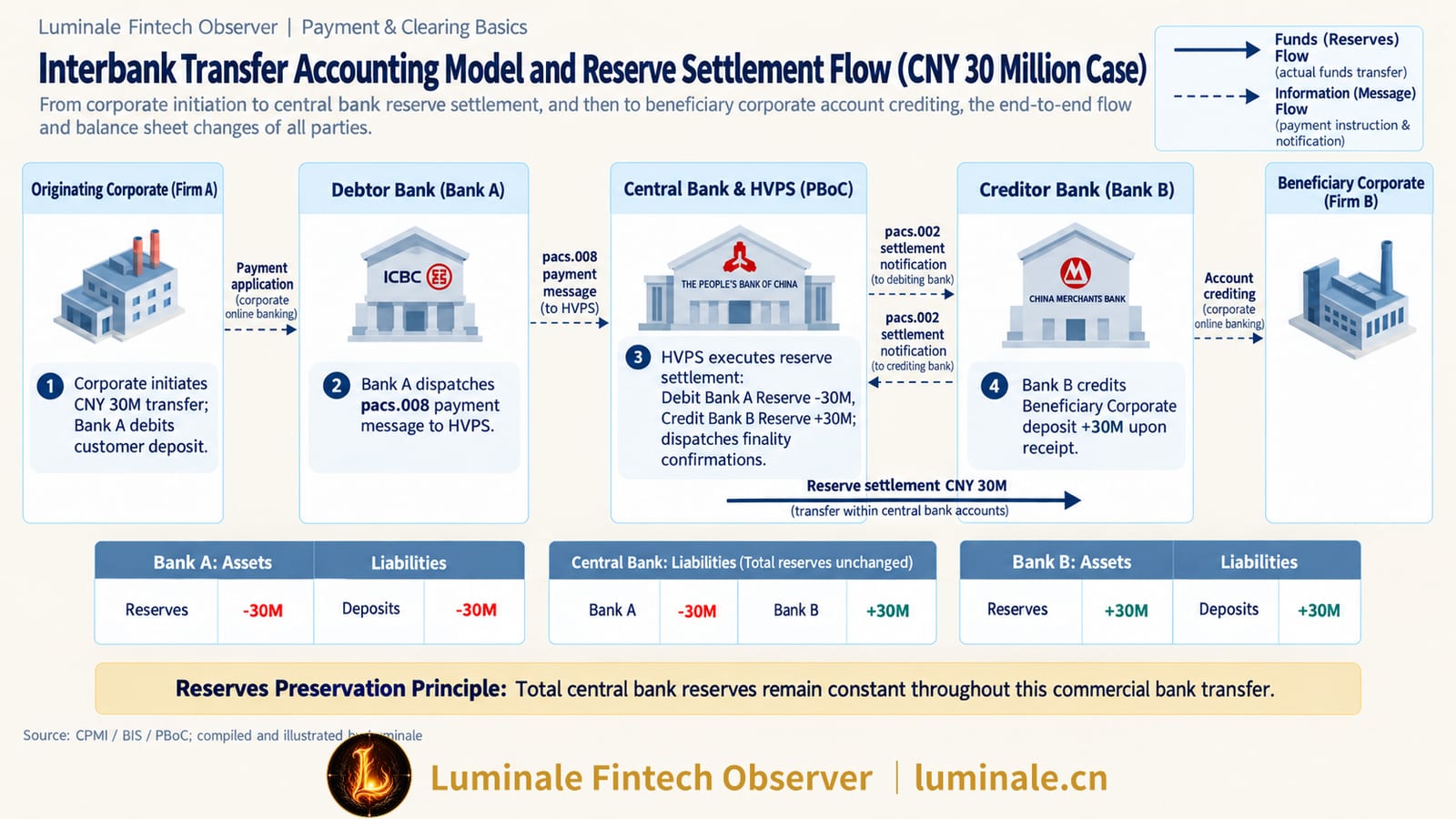
Suppose a manufacturer, "Hongxing Manufacturing", holds its basic deposit account at Industrial and Commercial Bank of China (ICBC). To buy large CNC machine tools, it needs to pay CNY 30 million for equipment to its supplier, "Lanhai Heavy Industries", which banks with China Merchants Bank (CMB). Hongxing's finance manager submits the transfer instruction through ICBC's corporate online banking.
On the commercial banks'balance sheets and the central bank's reserve accounts, the accounting changes unfold step by step:
Stage 1: The paying bank accepts and debits
ICBC's core system receives the payment request, checks the account status, authorisation and AML sanctions lists, confirms that Hongxing's demand deposit balance is sufficient, and freezes and debits CNY 30 million. At this point ICBC's balance sheet changes internally: its deposit liability to Hongxing decreases by CNY 30 million, and an interbank payable pending clearing is created.
Stage 2: A large-value message is generated and enters the HVPS
ICBC's clearing front-end system packages the transaction as a compliant large-value payment instruction in pacs.008 format, with a unique system tracking number, and sends it over the central bank's dedicated financial communications network to the HVPS National Processing Center (NPC).
Stage 3: Central bank account check and real-time gross debit
After receiving the instruction, the HVPS processing centre retrieves ICBC's reserve (settlement) account at the PBOC and performs a position availability check:
- Check formula:
available position = real-time account balance + intraday overdraft limit approved by the central bank - funds queued for debit - ICBC's account has ample funds (available position above CNY 30 million). The system immediately updates the core ledger: it debits ICBC's reserve account by CNY 30 million in real time and simultaneously credits CMB's reserve account by CNY 30 million in real time.
The moment this posting is completed, legally binding settlement finality is established. The central bank sends ICBC a debit confirmation and sends CMB a credit notification message.
Stage 4: The receiving bank credits the payee
CMB's front-end system receives the credit notification from the large-value system, unpacks and verifies it, and credits the funds directly to Lanhai Heavy Industries'demand deposit account. Lanhai's finance staff receive a text message: the funds have arrived.
The whole process can be shown on the balance sheets of the two banks and the central bank as follows:
| Entity | Change on the asset side | Change on the liability side |
|---|---|---|
| Paying company (Hongxing Manufacturing) | Bank deposits −CNY 30 million Equipment payable −CNY 30 million (equivalent to an increase in fixed assets) | (no change) |
| Paying bank (ICBC) | Reserves at the central bank −CNY 30 million | Hongxing's demand deposits −CNY 30 million |
| Central bank (PBOC) | (no change on the asset side) | ICBC reserve deposits −CNY 30 million CMB reserve deposits +CNY 30 million |
| Receiving bank (CMB) | Reserves at the central bank +CNY 30 million | Lanhai's demand deposits +CNY 30 million |
| Receiving company (Lanhai Heavy Industries) | Bank deposits +CNY 30 million Accounts receivable −CNY 30 million | (no change) |
Now consider another typical large financial market transaction: overnight interbank lending. China Construction Bank (CCB), needing funds for a temporary settlement need, borrows CNY 500 million overnight from Agricultural Bank of China (ABC).
| Entity | Change on the asset side | Change on the liability side |
|---|---|---|
| Lending bank (ABC) | Interbank lending +CNY 500 million Reserves at the central bank −CNY 500 million | (no change on the liability side) |
| Central bank (PBOC) | (no change on the asset side) | ABC reserve deposits −CNY 500 million CCB reserve deposits +CNY 500 million |
| Borrowing bank (CCB) | Reserves at the central bank +CNY 500 million | Interbank borrowing +CNY 500 million |
When principal and interest are repaid before the end of the next working day, the process runs as an exact reversal, with the interest accrued over the lending period paid on top of the principal.
2. The Hub Connecting External Financial Infrastructures
In the full picture of the large-value payment system, transfers initiated by individual companies or banks are only the tip of the iceberg. The more important flows come from the system's connections with specialised financial market infrastructures (FMIs). In the FMI analytical framework compiled by Luminale, the large-value payment system plays the role of the final funds settlement engine for the whole market:
The delivery versus payment (DvP) channel
In the interbank bond market, investors buy and sell government bonds and financial bonds. If the buyer pays first, it faces principal risk if the seller fails to deliver; if the seller delivers first, it faces the risk that the buyer defaults on payment. For this reason, the bond book-entry systems of CCDC and Shanghai Clearing House have dedicated direct interfaces with the large-value payment system.
When a bond trade is agreed, the bond system locks the seller's bonds to be delivered on the custody ledger and sends an irrevocable debit and credit instruction to the large-value payment system. After the large-value system debits the buyer's bank's reserves and credits the seller's bank's reserves in real time, it immediately sends a settlement confirmation to the bond system. Only after receiving this message does the bond system transfer the locked bonds to the buyer's custody account. Funds settlement and securities transfer are conditions for each other, achieving delivery versus payment free of principal risk (DvP Model 1)[6]. For a breakdown of how securities settlement eliminates delivery risk, see Securities and Money Must Move "Delivery Versus Payment": What Risk Does DvP Actually Prevent?; for the role of CCDC and Shanghai Clearing House as the underlying back-office book-entry hubs, see Where Are Bonds Really Held? Why CSD and SSS Are the Real Back-Office Ledgers of Securities Markets.
Payment versus payment (PvP) and FX transactions
In FX transactions, principal settlement risk across time zones and currencies (Herstatt risk) has caused turmoil in global financial markets. In China's onshore RMB FX market, the China Foreign Exchange Trade System (CFETS) is closely connected with the large-value payment system. As the final settlement channel for the RMB leg, the large-value system is linked synchronously with the foreign currency payment system, ensuring that the sale of RMB and the purchase of foreign currency are released for settlement simultaneously only when performance on both legs is assured. For how the FX market uses PvP to cut off principal settlement risk, see What Is the Most Dangerous Moment in FX? Why PvP Is the Market's "Payment-versus-Payment".
The funds settlement channel for central counterparties (CCPs)
Derivatives trading and centralised securities clearing depend on the intervention of CCPs. Each day, clearing members must post initial margin and meet mark-to-market variation margin calls with CCPs such as Shanghai Clearing House or CSDC, and complete net funds settlement when contracts mature. The large-value payment system is the final channel for moving these systemically important positions. For how CCPs use multilateral netting to cut off counterparty credit risk, see What Does a CCP Actually Solve? Starting with Counterparty Risk.
Session net settlement from retail and online payment clearing platforms
The hundreds of millions of low-value retail transactions processed by WeChat Pay and Alipay do not hit the large-value payment system in real time. During the day, the NetsUnion platform nets these transactions through a multilateral algorithm in set clearing sessions (for example, a number of fixed clearing batches each day), producing a net receivable or net payable balance for each custodian bank.
After netting, the NetsUnion platform generates a structured multilateral net debit and credit file and pushes it directly to the large-value payment system. The large-value system uses central bank reserve accounts to carry out centralised debiting and crediting for all the direct participant banks involved. Once the large-value system has completed posting, the position obligations between commercial banks are permanently discharged.
3. Queuing and Liquidity Saving: What Happens When Funds Run Short?
The moment that puts a bank treasury on edge in an RTGS system is when a clearing account has "insufficient available position".
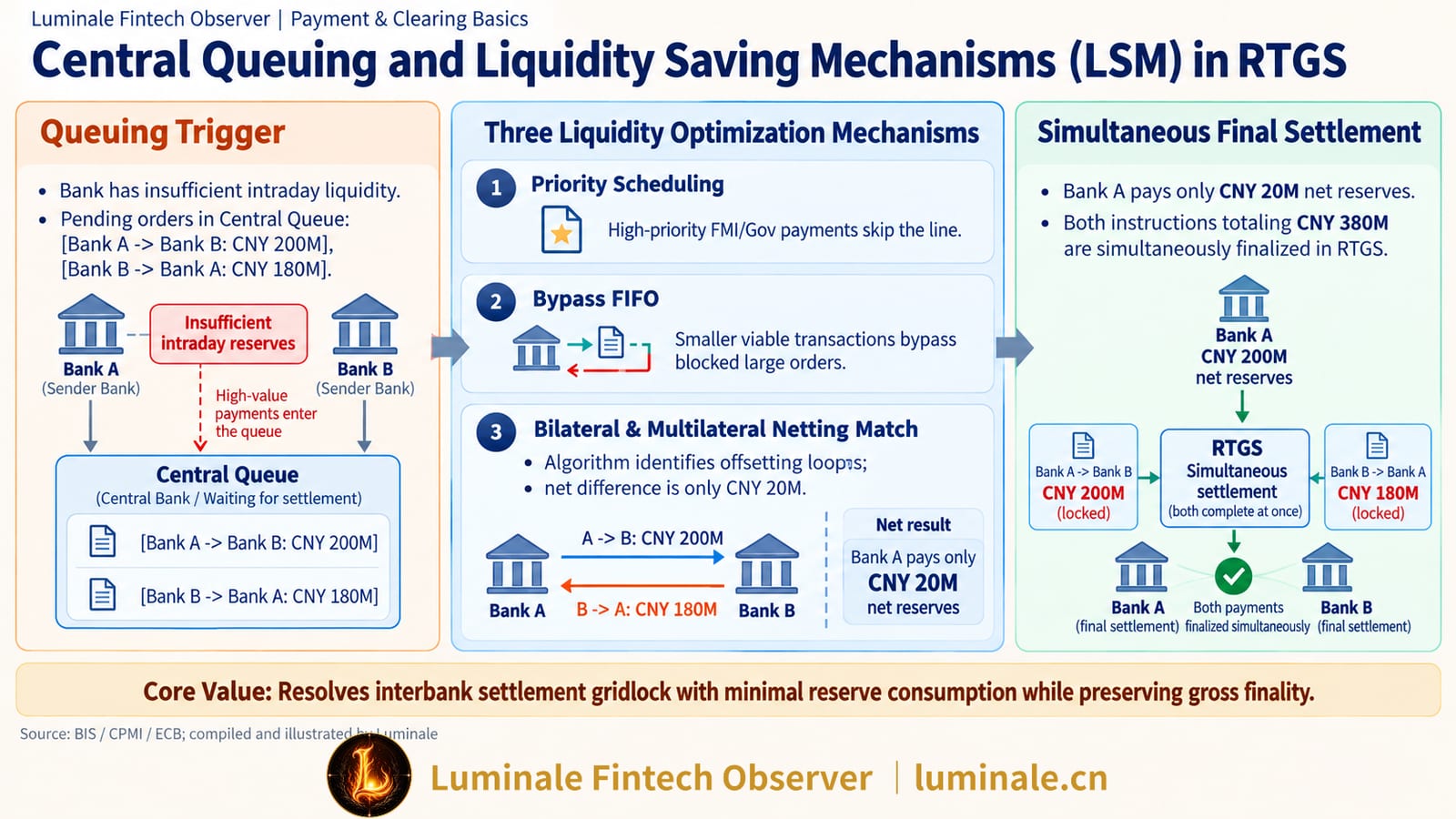
In a pure real-time gross settlement environment, if the balance in the paying bank's reserve account is not enough to cover the instruction just submitted, the system must not debit it directly (unless the central bank provides an unconditional credit overdraft, which is usually tightly constrained by limits and collateral). The payment instruction is not simply rejected and returned; it automatically enters the large-value system's central queue.
Once instructions are queued, liquidity becomes trapped and chain-reaction risk arises. If Bank A cannot pay CNY 400 million to Bank B because it is waiting for CNY 500 million from Bank C, Bank B may in turn be unable to pay CNY 300 million to Bank D because it has not received the CNY 400 million. This network-wide settlement deadlock caused by insufficient liquidity at individual nodes is called "liquidity gridlock".
To ease liquidity pressure while maintaining the principle of gross settlement, modern large-value payment systems generally build in sophisticated queue management rules and liquidity saving mechanisms (LSMs):
- Priority management: payment instructions are usually assigned different priority flags (such as highly urgent, urgent and normal). The system processes high-priority instructions first, so that central bank treasury debits and DvP settlement funds are not delayed behind ordinary commercial payments in the queue.
- First-in, first-out (FIFO) and queue adjustment: by default, the system processes instructions in the order in which they were queued. But if a CNY 1 billion payment at the head of the queue could block smaller payments behind it, the system can apply a bypass mechanism (bypass FIFO) or allow commercial banks to reorder their own queues, letting smaller instructions further back (for example, CNY 5 million) that can be covered by the current position go through first, so that payments are not completely blocked by a single large amount.
- Bilateral and multilateral offsetting: the LSM engine continuously scans the queue in the background. If it finds that Bank A is queuing to pay Bank B CNY 200 million while Bank B also has a queued instruction to pay Bank A CNY 180 million, the algorithm can match the two instructions bilaterally within a very short time. The system then requires Bank A to pay only the CNY 20 million difference in reserves, and both queued instructions, totalling CNY 380 million, are released and settled gross on the books at the same time.
Where three or more institutions are involved (A owes B, B owes C, C owes A), a multilateral cycle algorithm can achieve a similar circular offset within the queue. For a detailed breakdown of queue scheduling and liquidity saving, see Not Enough Funds, So Payments Just Wait? How RTGS Queuing and Liquidity-Saving Mechanisms Work.
In addition, when a bank's own reserve balance and the queuing algorithms still cannot close an intraday position gap, the bank must turn to the central bank for intraday liquidity support. For how banks pledge eligible bonds to obtain intraday overdrafts or standing facilities from the central bank, see When Banks Run Short in RTGS, Where Does the Money Come From? Sources of Intraday Liquidity.
4. Why Operating Hours Are Being Extended
Why can a large-value payment system not be designed from the outset to run 7×24 like an internet platform?
The fundamental reasons lie in the liquidity management model of the commercial banks behind the system and in the central bank's accounting day-end cutover:
- The cost of managing liquidity pools: in a 7×24 environment, bank treasury departments must staff monitoring shifts for as long as the system runs, to provide emergency top-ups of positions for round-the-clock interbank lending and collateralised repo. Global financial markets have their own trading hours, and trading in funding markets is thin at night, so the marginal benefit of commercial banks committing operating and management resources at night is low. And if not all commercial banks operate at night, a bank that does operate at night and runs out of liquidity cannot borrow from the funding market in time, so an individual bank can easily end up in a passive overdraft default overnight.
- Required reserve assessment and accounting day-end cutover: the central bank needs a clear end-of-day point at which to fix all banks'reserve positions, in order to assess compliance with reserve requirements, calculate penalty interest on intraday overdrafts or pay interest on reserve deposits. This cutover requires accounts to be frozen, network-wide reconciliation to be completed and accounting reports to be generated.
This is the background to the wide attention paid to the change in China's HVPS operating hours in October 2026. The specific arrangements are as follows:
- Operating hours on regular working days: on each statutory working day, the time at which the large-value system starts accepting business moves from 20:30 on the previous calendar day to 19:00 on the previous calendar day, while end-of-day processing remains at 17:30 on the business day. This means the system runs continuously for 22.5 hours, from 19:00 on the previous day to 17:30 on the day.
- Special working days and weekend arrangements: on statutory working days created by holiday adjustments, or on special settlement days arranged by the central bank, the system provides a limited service of 8.5 hours (usually a specific window such as 8:30 to 17:00 on the day). Note that the special working day arrangements on weekends and public holidays mainly serve specific settlement needs in the interbank market or major treasury transfers, and do not accept large-value counter or online banking transfers from ordinary businesses, institutions or individuals.
Moving from "5×21 hours" to "5×22.5 hours" brings the start forward by only an hour and a half, but the effect on commercial bank operations is clear:
- Bridging banks'daytime batch processing and overnight front-end operations: banks usually begin end-of-day batch runs on their core systems after 17:30. Previously they could not reconnect to the large-value system until 20:30, so many large overnight payments piled up in queues; starting acceptance at 19:00 lets banks push backlogged instructions into the central bank's payment channel earlier, once their batch runs are largely complete.
- Supporting cross-time-zone flows of funds in and out of China: in cross-border payments and offshore RMB settlement, trading hours in European and American markets differ significantly from Beijing time. A wider overnight window shortens the waiting time between the mainland large-value system and the main European and American markets, and provides more ample final settlement support in domestic currency for onshore foreign currency clearing and for CIPS operations across time zones at night.
IV. Large-Value Payment Systems in Major Economies
The large-value systems of the major economies are highly similar in underlying logic, but each has its own features in institutional design, technical architecture and operator.
1. Comparison of Major Large-Value Payment Systems
| Economy | System | Operator | Main settlement mechanism | Operating hours | Key mechanisms and architecture |
|---|---|---|---|---|---|
| China | High Value Payment System (HVPS) | PBOC China National Clearing Center | RTGS (with central queue and LSM) | "5×22.5 hours" on working days plus special working day arrangements | Nationally centralised National Processing Center architecture; clear tiers of direct, indirect and special participants; supports final settlement of bond DvP, FX PvP, and online payment and bank card net positions. |
| United States | Fedwire Funds Service | Federal Reserve Banks | Pure RTGS | 21.5 hours a day, Sunday to Friday, Eastern Time (21:00 to 18:30 the next day) | Core US wholesale settlement infrastructure; monitors intraday overdrafts on a mixed collateralised/uncollateralised basis; fully migrated to ISO 20022 in July 2025. |
| United States | CHIPS | The Clearing House | Prefunded continuous multilateral balanced netting | Working days, 21:00 to 17:00 the next day, Eastern Time | Patented multilateral real-time matching algorithm; supports trillions of dollars of intraday flows with a small amount of prefunded central bank reserves; public and private systems run in parallel. |
| Euro area | T2 (formerly TARGET2) | Eurosystem (ECB with the 4CB) | RTGS with Central Liquidity Management (CLM) | Monday to Friday, 07:00 to 18:00 CET (with specific overnight batches) | Structurally split into CLM main cash accounts and dedicated RTGS components; connected to T2S securities settlement and TIPS instant retail settlement; migrated to ISO 20022 in March 2023. |
| Euro area | EURO1 | EBA Clearing | Multilateral deferred net settlement (DNS) | Working days; balances settled through T2 at end of day | Private large-value euro clearing system; strict limits on bilateral and multilateral credit exposures; highly liquidity-saving. |
| United Kingdom | RTGS / CHAPS | Bank of England | RTGS | Working days, 06:00 to 18:00 London time (settlement hours) | Taken back under direct central bank operation in 2017; opened direct access to non-bank payment institutions first in 2017; new core settlement engine RT2 launched in April 2025. |
| Japan | BOJ-NET Funds Transfer System | Bank of Japan | Pure RTGS combined with simultaneous same-amount settlement | Working days, usually until 19:00 (extended to 21:00 for some periods) | Core hub of the Japanese financial system; deeply integrated with the JGB settlement system (BOJ-NET JGB); supports synchronised posting for foreign currency transactions. |
| Hong Kong SAR, China | HKD CHATS | HKMA and HKICL | RTGS | Monday to Friday, 08:30 to 18:30 (extendable for special cross-border arrangements) | Multi-currency architecture (USD, EUR and offshore RMB CHATS run alongside); DvP with the equity CCASS and the Central Moneymarkets Unit (CMU) for debt instruments. |
| Singapore | MEPS+ | Monetary Authority of Singapore (MAS) | RTGS with automatic liquidity facility | Working days, 09:00 to 19:00 (with special end-of-day extensions) | Launched at the end of 2006; natively supports central depository and real-time DvP for Singapore Government Securities (SGS). |
| India | RTGS | Reserve Bank of India (RBI) | RTGS | 7×24, all year round | Fully 7×24 since 14 December 2020, one of the first large-value systems among major economies to remove intraday operating limits. |
| Australia | RITS | Reserve Bank of Australia (RBA) | RTGS | Working days, 07:30 to 05:00 the next day (in settlement sessions) | Supports overnight batch settlement; round-the-clock central bank settlement interface with the New Payments Platform (NPP). |
| Canada | Lynx | Payments Canada | Hybrid (gross settlement with liquidity-saving streams) | Working days, covering the eastern and western Canadian time zones | Launched in 2021, replacing the long-serving LVTS; fully compliant with the CPMI-IOSCO PFMI. |
| Switzerland | SIC | Swiss National Bank (SNB) and SIX Group | RTGS | Almost 24-hour continuous operation (only about 1 hour of downtime per working day for reconciliation) | Core Swiss franc hub; very wide operating window; first to connect with the SDX digital asset trading platform for issuing wholesale digital currency on a trial basis. |
Note: the operating status and hours of the systems in the table are based on the CPMI Red Book database and the latest official disclosures of the relevant central banks. The RITS information draws on the RBA's annual report[7]. For a reading of recent developments in Australia's RITS and the RBA's payments system report, see Reading the RBA Payments System Board Annual Report 2026: What Is Changing in Australia's Payment and Settlement Infrastructure?; for an analysis of the Korean large-value system BOK-Wire+, see Reading Bank of Korea's 2025 Payment and Settlement Systems Report: What is Changing in Korea's Payment Infrastructure?.
2. How Four Representative Systems Work
US CHIPS: How a private system uses algorithms to save central bank liquidity
In most countries, the central bank dominates the large-value system. In the United States, the private CHIPS and the Federal Reserve's own Fedwire form a distinctive "dual-track, complementary" structure.
Fedwire is the standard pure RTGS system: for every payment, the paying bank's reserve account at the Fed is debited immediately, which ties up a large amount of real central bank funds. CHIPS takes a different technical route: "continuous multilateral real-time balanced netting supported by prefunding".
Before each business day starts, CHIPS direct participants transfer a preset amount of central bank reserves through Fedwire into a joint account that CHIPS holds at the Federal Reserve Bank of New York (the opening prefunded position). Once business begins, the thousands of large payment instructions entering CHIPS do not directly trigger debits on Federal Reserve accounts. Instead, CHIPS's proprietary matching algorithm scans them on the private ledger at second-level speed:
- If two banks have payments to each other, the system settles them by bilateral netting;
- If several banks form a chain of obligations, the system automatically looks for multilateral offsets;
- If no offset is available for the moment, the system posts the payment gross using the originating bank's prefunded balance.
At the end of the day, CHIPS stops accepting new instructions, applies a final multilateral netting to the residual positions left unsettled during the day, calculates each bank's final net receivable or net payable, and settles them in a single round of transfers on Federal Reserve reserve accounts via Fedwire.
With this design, CHIPS needs only a few billion dollars of opening reserves each day to process trillions of dollars of transactions in the US and cross-border wholesale dollar market, improving liquidity efficiency several dozen times over. This demonstrates that "spending reserves on every payment" is not the only way to run a large-value payment system.
Euro area T2: Decoupling Central Liquidity Management (CLM) from business components
In March 2023, the ECB-led T2 system went live, replacing TARGET2, which had been in service for more than 15 years. One major institutional innovation of T2 is the decoupling of banks'central bank account structure.
In the previous architecture, the reserve account a commercial bank held at the central bank and its account for daily large-value payment settlement were one and the same. When banks needed to take part in cross-border securities settlement on T2S or provide liquidity for TIPS instant retail payments, their positions were often scattered across dedicated accounts in different subsystems, making real-time overall management very difficult.
T2 explicitly splits the architecture into two core layers:
- Central Liquidity Management (CLM): each participating bank has a single Main Cash Account (MCA) at its national central bank. This account does not process ordinary commercial transfers; it is dedicated to direct interaction with the central bank: meeting reserve requirements, taking part in central bank open market refinancing operations and using standing facilities.
- Dedicated business services: including the RTGS component for traditional large-value wholesale payments, the T2S component for securities DvP, and the TIPS component for instant retail payments.
Each business component has its own Dedicated Cash Accounts (DCAs). During the day, commercial banks can move funds from the MCA to the dedicated accounts for RTGS, T2S or TIPS at any time through preset automated instructions; at the end of the day, residual balances in the component accounts can be automatically swept back to the MCA and remunerated together. For how more than 20 European central securities depositories share one settlement engine through T2S and move central bank money, see Twenty-Plus CSDs, One Settlement Engine: How T2S Delivers Euro DvP. This modular design lets a commercial bank manage its liquidity exposure across all financial markets in the system from one central account.
India's RTGS: The technical and institutional basis for early 7×24 operation
On 14 December 2020, the Reserve Bank of India announced that its large-value RTGS system was operating round the clock, 7×24. It was one of the earliest attempts among the world's ten largest economies to run a large-value system around the clock.
India's ability to run 7×24 rested on solving two problems:
- Real-time accounting day-end cutover without interruption: to avoid interrupting daytime business, the RBI developed a "dynamic seamless day-end" algorithm that uses parallel ledger snapshots to freeze the books, calculate the day's interest and reserve requirement compliance within seconds, and then immediately generate the data pointer for the new business day, so that participants barely notice any downtime during posting.
- Round-the-clock automated liquidity facility: during traditional market closures (such as weekends and late at night), the interbank lending market is closed and banks cannot borrow positions in the market. The RBI therefore provides a round-the-clock "Intraday Liquidity Facility (IDL)" against pledged bonds, allowing banks'systems to pledge government securities to the central bank's automated system at night, according to the gap left by queued instructions, to obtain real-time posting positions, with automatic repayment and release the next day.
This experience shows that moving a large-value system to round-the-clock operation is not only a matter of expanding technical capacity; it also requires the central bank's liquidity safety net to extend equally to non-business hours.
UK RT2: A new-generation platform built for synchronised settlement
On 28 April 2025, the Bank of England launched its new-generation RTGS core settlement platform (commonly referred to in the industry as RT2), the result of several years of development[8].
The main purpose of RT2 is not only to complete full adoption of ISO 20022, but more importantly to rebuild the data exchange model and external interface capabilities of the underlying software. The old RTGS system was built three decades ago on proprietary mainframes and fixed data structures, which made high-frequency interaction with modern cloud-native environments, distributed ledgers (DLT) or external real-time applications difficult.
RT2 introduces a highly configurable API interface bus and builds native support for "conditional settlement" into its underlying data structures. This change provides the foundation for the Bank of England's ongoing push towards "synchronisation" and round-the-clock trading.
V. Where It Is Heading: Longer Hours, Wider Access, Synchronised Settlement and Tokenised Central Bank Money
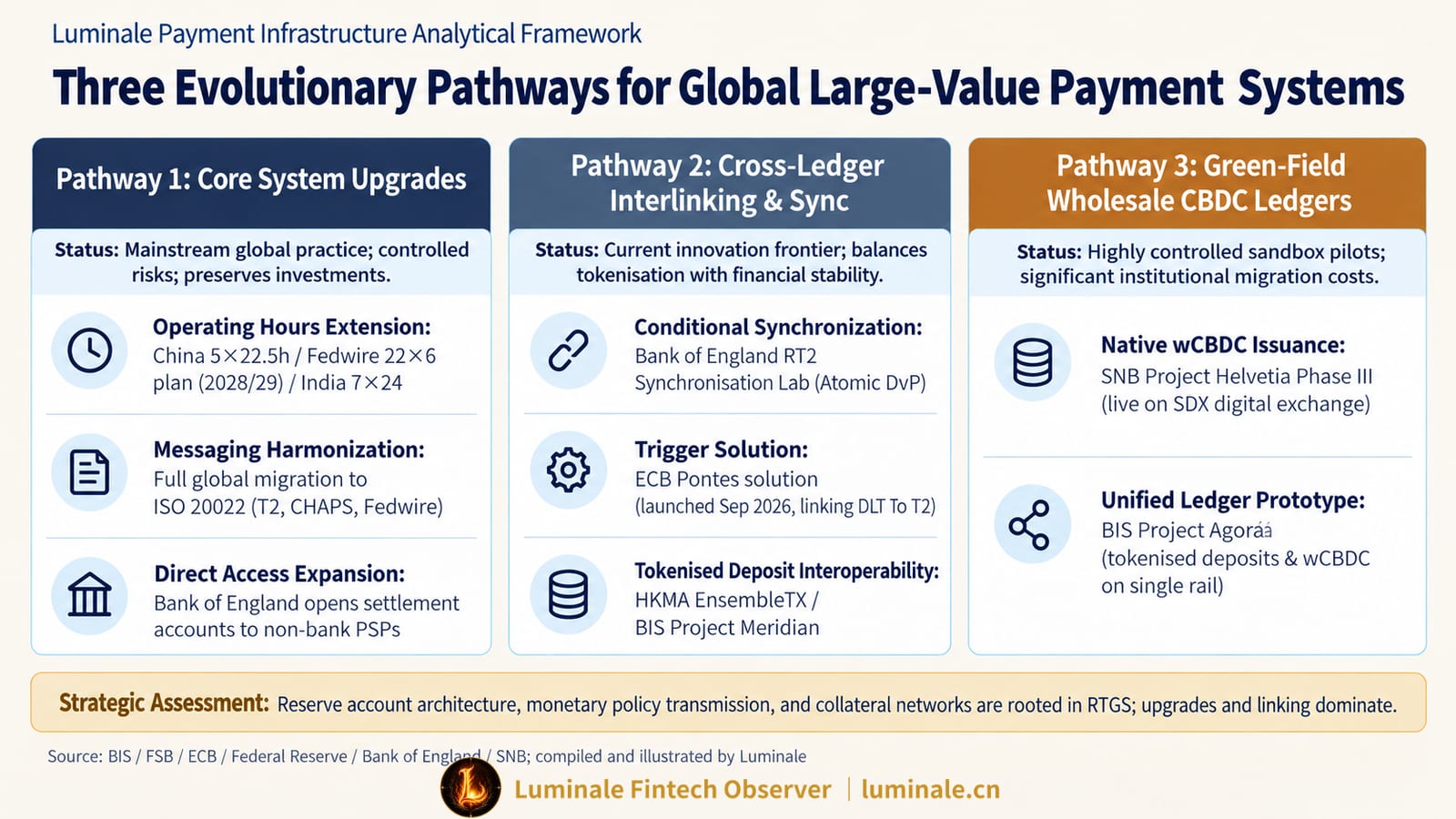
As the most important and sensitive hub of every financial system, the large-value payment system faces multiple pressures: demand for round-the-clock cross-border trade, the rise of non-bank institutions, and the tokenisation of digital assets. Summarising the work of central banks and international organisations, the evolution of large-value payment systems can be grouped into three paths: upgrading existing systems, connecting to external ledgers, and building a separate architecture.
1. Upgrade: Longer Windows, Common Messaging and Open Access
Upgrading existing large-value payment systems is the pragmatic strategy adopted by the great majority of central banks. It protects large existing investments in financial IT while addressing specific weaknesses.
Longer operating hours and time-zone overlap
In the G20 roadmap for enhancing cross-border payments, the lack of overlap in the operating hours of large-value payment systems is listed as one of the main structural obstacles that make cross-border payments slow and expensive (for example, when the Asian working day ends, the American working day has only just begun)[9].
To reduce time-zone differences, central banks are gradually lengthening the operating hours of large-value systems:
- The PBOC extended HVPS operating hours on working days to 22.5 hours in October 2026;
- The Federal Reserve Board formally approved on 9 October 2025, and published in the Federal Register in November, a decision to expand the operating hours of the Fedwire Funds Service and the National Settlement Service (NSS) to six days a week, 22 hours a day (22 hours a day from Sunday to Friday, known as the 22×6 model), with implementation expected in 2028 or 2029. In its decision, the Fed assessed that although a "22×7×365" round-the-clock option had been discussed, "22×6" was the more balanced and prudent choice at this stage, given participating banks'weekend staffing costs, system maintenance windows and the readiness of private liquidity markets[10];
- India has already moved first to 7×24 round-the-clock operation.
Semantic alignment of messaging and wider access
With T2, CHAPS and Fedwire completing ISO 20022 adoption between 2023 and 2025, data communication standards among the main large-value systems have largely achieved semantic alignment. At the same time, the debate on access for non-bank institutions has spread from the UK to more jurisdictions. The CPMI continues to call on jurisdictions to establish transparent, risk-based access criteria, subject to prudent assessment of credit risk, so that more systemically important, compliant payment service providers can connect directly to central bank systems and the risks of multi-layer agency routing are reduced.
2. Connect: Synchronised Settlement as a "Bridge" for On-Chain Assets
With blockchain, distributed ledger technology (DLT) and the tokenisation of real-world assets (RWA) sweeping through the financial industry, a central question has emerged: if securities, FX and bonds are issued on distributed ledgers, what money should settle the "cash leg" of trades in these on-chain assets?
If stablecoins are used for settlement, financial institutions must bear the de-pegging risk, commercial bank credit risk and regulatory compliance risk behind private stablecoins. If each commercial bank issues its own tokenised deposits on-chain, debts between banks still ultimately need a risk-free medium of value for final settlement.
The central banks'answer remains clear: final settlement of core assets must be anchored in central bank money. But central banks need not abolish their existing RTGS systems because of the rise of on-chain assets. Building connection mechanisms that let the existing RTGS act as the cash-leg settlement back end for on-chain transactions has become the main direction of research and pilots among major central banks over the past two years.
Bank of England: Synchronisation and the Synchronisation Lab
In its new-generation RT2 platform, the Bank of England has been advancing a "synchronised settlement" mechanism.
Synchronised settlement links an external asset ledger (for example, a DLT platform trading tokenised real estate or digital government bonds) with the Bank of England's RTGS system through standardised communication middleware and cryptographic verification protocols. When an asset trade takes place on the external platform:
- The external platform sends RTGS a request for pre-verification and conditional locking of funds;
- RTGS places a temporary conditional hold on the corresponding amount in the paying bank's reserve account at the central bank;
- On receiving confirmation of the hold, the external asset platform executes the on-chain change of ownership of the digital asset;
- The cryptographic proof generated by the successful asset transfer is sent back to RTGS, which then releases the debit and credits the receiving bank; if the asset transfer fails for any reason, the locked funds are automatically released and returned.
Logically, this mechanism achieves atomic DvP across heterogeneous systems. In 2026 the Bank of England set up a dedicated Synchronisation Lab, inviting firms to run prototype tests of cross-ledger settlement of property transactions[11].
ECB: Pontes goes live
The ECB has gone further in practical terms in exploring DLT settlement. After a year of trials and testing, Pontes, the connection system developed under the ECB's leadership, formally went live on 21 September 2026[12].
Pontes uses a "trigger mechanism": market participants can trade tokenised securities on vetted market DLT platforms without a digital euro actually being issued on a blockchain. When the DLT platform is ready to settle, Pontes converts the trade into a standardised instruction that triggers real-time reserve debits and credits in the back-end T2 system. Once T2 has debited successfully, a signal is sent back to the DLT platform to release the securities. The ECB has also drawn up the longer-term Appia plan, which aims to establish a unified technical architecture for multi-ledger interconnection and cross-border clearing interaction. For the technical principles of Pontes and Europe's path to rebuilding the cash leg of tokenised securities, see From Pontes to Appia: How Europe Is Rebuilding the "Cash Leg" for Tokenised Securities.
Regional practice and international prototypes
- HKMA Project Ensemble: the HKMA launched Project Ensemble in 2024 and advanced implementation and validation of the EnsembleTX architecture in 2025 and 2026. Its focus is on exploring how tokenised bank deposits, through interconnection with the HKD CHATS large-value payment system, can provide seamless settlement for tokenised real-world assets such as green bonds and carbon credits. For the project's architecture, see What Money Settles Tokenised Assets? A Reading of the HKMA's EnsembleTX.
- The Monetary Authority of Singapore's tokenisation work: MAS is likewise advancing interconnection between wholesale settlement and tokenised financial infrastructure. For the specific path, see How Far Has Singapore's Digital Finance Progressed? From Tokenisation to Payment and Settlement Infrastructure.
- BIS Project Meridian: Project Meridian, carried out by the BIS Innovation Hub with the Bank of England, and its follow-on FX project Meridian FX, built a prototype framework that uses the concept of a synchronisation operator to connect traditional large-value systems with on-chain FX PvP transactions.
3. Build Separately: The Limits of Wholesale CBDC (wCBDC) Exploration
Beyond "upgrade" and "connect", is there any case anywhere of issuing a wholesale central bank digital currency (wholesale CBDC, wCBDC) from scratch on a new distributed ledger, entirely separate from the existing RTGS architecture, to replace the large-value payment system?
The answer is: very few, and mainly limited to controlled, specific sandbox pilots.
The most prominent example is the Swiss National Bank's Project Helvetia Phase III pilot. From December 2023, the SNB went beyond its previous proofs of concept and issued wholesale CBDC in digital Swiss francs, a genuine liability of the SNB, directly on the distributed ledger platform of SIX Digital Exchange (SDX), a private digital exchange licensed by the Swiss Financial Market Supervisory Authority (FINMA)[13].
During the pilot, several major Swiss commercial banks used the on-chain digital Swiss francs for end-to-end, atomic, native DvP settlement of tokenised World Bank digital green bonds and cantonal digital bonds issued on SDX. In these transactions, the tokenised assets and the wCBDC serving as the cash leg exchanged ownership instantly on the same permissioned consortium chain.
Another closely watched international effort is Project Agorá, launched in 2024 by the BIS together with seven major central banks (the Federal Reserve, the Bank of England, the Bank of Japan, the Banque de France, the Bank of Mexico, the Swiss National Bank and the Bank of Korea) and hundreds of international financial firms. The project explores a unified cross-border programmable financial ledger on which wholesale central bank money and commercial banks'tokenised deposits sit on the same operating platform, using smart contracts to automate compliant cross-currency payment and settlement.
4. Assessment: Why Large-Value Systems Will Not Be Easily Replaced
In the face of the wave of blockchain and distributed technology, some in fintech once held a radical view: as decentralised ledgers and programmable digital money matured, the large, cumbersome large-value payment systems would gradually be replaced by public or consortium chains.
A closer look at how the central banking system works shows that this radical replacement hypothesis ignores the real constraints of the modern financial system. A large-value payment system has never been just a piece of software or a messaging channel; it is the concentrated expression of a country's financial institutions, monetary authority and sovereign credit.
For large-value systems, the clear main line of future evolution remains deep upgrades of existing systems as the core, extended by cross-ledger connection mechanisms, and certainly not tearing everything down and starting again. Three underlying arguments support this assessment:
- Monetary policy implementation depends on it:
The central bank's basic tools for macroeconomic management, whether reserve requirement assessment, open market reverse repos, standing lending facilities or the transmission of policy rates, all work through large daily flows in and out of reserve accounts on the existing RTGS. Banks'reserve pools on the traditional RTGS are the reservoir that absorbs the central bank's liquidity supply. Building a new on-chain digital money system separate from RTGS would inevitably split intraday liquidity in the banking system into two separate pools, weakening the price transmission of monetary policy and the financial system's resilience to liquidity runs.
- The huge replacement cost of the established collateral management system:
Commercial banks obtain trillions in intraday overdraft limits in the large-value system on the condition that they pledge large amounts of strictly rated high-quality liquid assets (HQLA), such as government bonds and policy bank bonds, to the central bank's collateral management system. The legal and systems network for automatic mark-to-market, automatic margin top-ups and default management of this collateral has been tested and refined over decades. Moving these heavy mechanisms overnight onto new external digital ledgers would involve incalculable legal title risk and cross-institution coordination costs.
- Sovereign credit cannot be outsourced, and settlement finality needs legal certainty:
The large-value system gives funds settlement legal force (insolvency remoteness and irrevocability), backed by the explicit authority of a country's central bank law and its insolvency and liquidation framework. The on-chain "probabilistic finality" or automatic smart-contract execution promoted by distributed ledger technology lacks a sufficient institutional foundation when confronted with complex real-world judicial restructurings of financial institutions, cross-border sovereign sanctions and disputes over the reversal of large transactions.
Even Switzerland's Project Helvetia, which issued real wCBDC, had to maintain a tightly controlled two-way technical link between the wholesale CBDC issued on-chain and Switzerland's existing SIC settlement system. Swiss commercial banks first had to lock fiat reserves in the traditional SIC system before the corresponding amount of wCBDC could be created on the SDX chain, and could redeem the wCBDC back into traditional central bank reserves at any time after trading.
The durability of large-value payment systems lies in their monopoly as the holder of the "ultimate right to keep the books". Whether financial assets exist as paper share certificates, in centralised electronic databases or as crypto tokens, and whether trades take place on an exchange floor, on electronic trading networks or on smart-contract chains, as long as the parties seek complete discharge of obligations free of credit risk, the flow of funds must still end at the central bank's large-value payment system.
Conclusion
The hour and a half by which the PBOC's HVPS opens earlier from 19 October 2026 looks on the surface like a minor adjustment to the timetable on which banks'online channels accept large-value transfers. Behind it lies a country's financial hub calmly taking on flows of funds across wider spans of time and space.
From transaction-by-transaction settlement of bulk trade in industry and commerce to DvP in the bond and FX markets, and from the final settlement of NetsUnion's overnight net positions to the tokenisation experiments of Europe's Pontes and the UK's Synchronisation Lab, the core of the large-value payment system has remained the same: using central bank liabilities as the ultimate credit medium, it puts an unalterable full stop on the web of claims and obligations that runs through the whole economy.
Gradually longer operating hours, the spread of the ISO 20022 semantic standard, a measured widening of direct access, and cross-ledger synchronisation with external distributed ledgers are all forms of self-evolution that do not weaken the legal discharging power of central bank money. The questions raised by tokenised finance and digital assets will ultimately also have to be answered in front of this core.
If the large-value payment system is dedicated to these large, demanding sums and final net positions that are vital to the financial system, then how do banks settle and deliver to each other the low-value purchases, QR code payments and transfers to family and friends that arrive across banks within seconds on our phone screens every day?
The "speed" and "savings" behind low-value retail payments will be examined in detail in the next article, on fast payment systems (FPS).
References
[1]: People's Bank of China. 2025 Payment System Overview [R]. Beijing: People's Bank of China, 2026. ↩
[2]: Committee on Payments and Market Infrastructures (CPMI). A Glossary of Terms Used in Payments and Settlement Systems[R]. Basel: Bank for International Settlements, 2003 (updated 2024). ↩
[3]: Bank of England. Direct Delivery of CHAPS: Transition of Operations to the Bank of England[R]. London: Bank of England News Release, 2017. ↩
[4]: Bank of England. Non-Bank Payment Service Providers: Access to Settlement Accounts in the Real-Time Gross Settlement System[EB/OL]. (2017-07-19) [2026-10-29]. https://www.bankofengland.co.uk/markets/payments-and-settlement-infrastructure. ↩
[5]: Federal Reserve Board. Federal Reserve Announces Final Timeline for Migration of Fedwire Funds Service to ISO 20022 Messaging Standard[EB/OL]. (2023-06-27) [2026-10-29]. https://www.federalreserve.gov. ↩
[6]: Committee on Payment and Settlement Systems (CPSS). Delivery Versus Payment in Securities Settlement Systems[R]. Basel: Bank for International Settlements, 1992. ↩
[7]: Reserve Bank of Australia. Payments System Board Annual Report 2026[R]. Sydney: Reserve Bank of Australia, 2026. ↩
[8]: Bank of England. Real-Time Gross Settlement (RTGS) Renewal Programme: Transition to the New Core Settlement Engine (RT2)[EB/OL]. (2025-04-28) [2026-10-29]. https://www.bankofengland.co.uk/payment-and-settlement. ↩
[9]: Financial Stability Board (FSB). Enhancing Cross-Border Payments: Stage 3 Roadmap[R]. Basel: Financial Stability Board, 2020. ↩
[10]: Federal Reserve System. Expansion of Operating Hours for Fedwire Funds Service and the National Settlement Service[R]. Federal Register, 2025, 90: Notices. ↩
[11]: Bank of England. Synchronised Settlement in RTGS: Discussion and Consultation Paper on Enabling Future Financial Market Innovations[R]. London: Bank of England, 2025. ↩
[12]: European Central Bank. ECB Successfully Launches Pontes Trigger Solution for Settlement of DLT Transactions in Central Bank Money[EB/OL]. (2026-09-21) [2026-10-29]. https://www.ecb.europa.eu/press/pr/date/2026/html/index.en.html. ↩
[13]: Swiss National Bank. Swiss National Bank Launches Pilot Project with Real Wholesale CBDC (Project Helvetia Phase III)[EB/OL]. (2023-11-02) [2026-10-29]. https://www.snb.ch. ↩
Originally published by Luminale Fintech Observer: https://luminale.cn/articles/large-value-payment-systems-rtgs-en