
On corporate payroll mornings, thousands of employees across diverse enterprises receive salary credit notifications almost simultaneously. During the same period, utility bills for water, electricity, gas, mortgage installments, and subscription fees are debited on scheduled dates from millions of household accounts. These transfers are neither the result of accounting personnel manually executing individual transactions via corporate online banking, nor are they mass pushes of single real-time payments dispatched by backend servers within seconds. Instead, corporations and utility billers bundle tens of thousands of credit or debit instructions into standardized batch files, submit them to their commercial banks, and route them through dedicated bulk payment systems for centralized processing.
The rollout of fast payment systems continues worldwide, and retail consumers across many economies have grown accustomed to 24/7 second-level fund availability. Yet the evolution of underlying payment infrastructures reveals a different institutional equilibrium. In Australia, following the launch of the New Payments Platform (NPP) in 2018, the banking industry established a target to fully retire its legacy bulk system—the Bulk Electronic Clearing System (BECS)—by June 2030. However, on December 16, 2025, the Australian Payments Network (AusPayNet) formally withdrew this fixed retirement target date[1]. In its March 2026 system assessment, the Reserve Bank of Australia (RBA) noted that removing this rigid deadline substantially eased industry risks regarding system resilience, transition economics, and peak capacity constraints on the NPP[2]. In North America, the US Automated Clearing House (ACH) network cleared 35.2 billion payments valued at $93 trillion in 2025, continuing its steady expansion[3]. Furthermore, in April 2026, the National Automated Clearing House Association (Nacha) approved a new rule to raise the per-payment limit for Same Day ACH from $1 million to $10 million, effective September 17, 2027[4].
This paradox raises several foundational questions:
- Why do bulk payment systems insist on batch-file and cycle-based processing rather than pursuing item-by-item real-time settlement?
- How does a bulk file containing thousands of granular entries compress into a single net interbank position settled between commercial banks and the central bank?
- What legal and institutional mechanisms empower a biller to directly debit funds from a payer's bank account, and who absorbs the primary indemnification liability when unauthorized deductions occur?
- Given that instant payment systems achieve second-level crediting, why cannot existing corporate payroll and direct debit volumes simply be migrated wholesale to real-time rails?
In "Which Rail Should a Payment Take? Classifying Payment Systems: Wholesale, Retail and Cross-Border", retail payment systems were classified into bulk payment systems, fast payment systems, and card payment networks. Following "What Powers 24/7 Instant Payments? Understanding Fast Payment Systems (FPS)", which examined real-time retail rails, this article provides a comprehensive analysis of bulk payment systems—their technical architectures, accounting mechanics, legal dispute frameworks, and evolving global landscape.
1. What Is a Bulk Payment System: Definition, Origins, and Operational Boundaries
A Bulk Payment System is an interbank payment infrastructure that ingests retail payment instructions in batched files, executes multilateral netting across pre-scheduled cycles, and settles net obligations across central bank reserve accounts, typically supporting both direct credits and direct debits with designated future value dates. The Committee on Payments and Market Infrastructures (CPMI) of the Bank for International Settlements (BIS) categorizes such infrastructures under Automated Clearing Houses (ACH) or Deferred Net Settlement (DNS) systems[5]. Across continental Europe and parts of Asia, these networks are historically termed GIRO systems. For the systemic definition and taxonomy of global financial market infrastructures, see "What Exactly Is a Payment System? From the BIS Definition to the Global Financial Market Infrastructure Landscape".
Bulk payment systems are not compromises borne of legacy technological shortcomings; their fundamental economic rationale lies in achieving scale economies and minimizing clearing costs across specific business workflows.
1. The Historical Evolution of Batch Processing
During the 1960s and 1970s, interbank and corporate commerce relied overwhelmingly on paper checks, bills of exchange, and manual paper vouchers. As post-war economic activity surged, enterprise payroll volumes, tax remittances, and municipal utility billing expanded exponentially. Local paper clearing houses faced mounting paper volumes; the marginal labor cost of manual sorting, data entry, and physical reconciliation escalated rapidly, accompanied by high processing error rates.
The advent of computerized batch processing transformed this operational bottleneck. In 1968, the British banking sector established the Inter-Bank Computer Bureau, which evolved into today's Bacs payment system[6]. In 1972, the first automated clearing house in the United States was formed in California, after which the Federal Reserve began offering centralized ACH clearing and electronic settlement services to depository institutions[7]. Continental Europe leveraged the postal savings bank network (Postal Giro) to establish highly automated electronic giro transfer infrastructures early on.
Early batch processing depended on physical magnetic tape transport and offline reading. Corporations wrote thousands of salary or billing entries onto magnetic tapes and delivered them to their banks. During nocturnal off-peak hours, bank mainframe programs unpacked, classified, and generated interbank exchange files. In China's payment modernization drive, the People's Bank of China (PBOC) piloted the Bulk Electronic Payment System (BEPS) in selected regions in 2005 and expanded it nationwide in June 2006, absorbing the high-volume paper clearing and interbank credit transfers previously handled across regional paper exchange houses[8].
2. Why Choose Batch Processing Over Real-Time Settlement
Even with modern telecommunications and distributed cloud architectures, batch processing uniquely serves three critical commercial requirements:
- Pre-Scheduled Processing and Designated Future Value Dates: Corporate payroll, loan amortizations, and pension disbursements operate on highly predictable, recurring schedules. Corporate treasury departments frequently prepare transaction data days in advance, complete multi-tiered internal auditing and approvals, lock operational funds, and specify a future target date for execution. Bulk systems natively accommodate this "pre-ingestion with scheduled future execution" workflow.
- Support for Payee-Initiated Direct Debits: Fast payment systems were originally architected for payer-initiated credit transfers (push payments). For recurring billers—such as water, electric, gas, telecommunications, and property management utilities—relying on millions of retail customers to initiate manual payments yields high delinquency rates and substantial collection costs. Billers require payee-initiated pull collections, supported by standardized legal mandate validation and dispute reversal mechanisms.
- Low Marginal Processing Costs and Minimal Liquidity Drag: Real-time gross settlement requires transferring central bank reserves instantaneously for every single transaction. In bulk systems, tens of thousands of retail transactions offset one another within scheduled cycles through multilateral netting. Depository institutions need only transfer a small net fraction of total payment turnover in central bank reserves, keeping per-transaction communication, computational, and liquidity overhead far below those of real-time rails.
3. Operational Boundaries with Adjacent Payment Infrastructures
Delineating bulk payment systems requires contrasting them with adjacent financial market infrastructures:
- Boundaries with Large-Value Payment Systems (LVPS): LVPS networks specialize in interbank money market transactions, foreign exchange settlements, securities clearing legs, and high-value corporate treasury transfers. They operate on a Real-Time Gross Settlement (RTGS) basis, prioritizing the mitigation of systemic credit contagion and the instantaneous legal finality of payments. Bulk payment systems focus on low-value retail and commercial workflows, utilizing multilateral netting and deferred net settlement. In China, net balances generated by BEPS are submitted to the Settlement Account Processing System (SAPS) for final settlement across reserve accounts. For LVPS mechanics and liquidity management, see "How Does Big Money Move Between Banks? Understanding Large-Value Payment Systems" and "When Banks Run Short in RTGS, Where Does the Money Come From? Sources of Intraday Liquidity".
- Boundaries with Fast Payment Systems (FPS): Fast payment systems emphasize 24/7 continuous, item-by-item processing and second-level crediting, delivering immediate usable funds to retail payees. Bulk systems operate intermittently across discrete processing cycles and do not guarantee second-level settlement. While a fast payment system's backend interbank settlement may employ deferred net settlement, its frontend messaging and retail crediting occur strictly on an item-by-item, real-time basis. For fast payment architectures and risk controls, see "What Powers 24/7 Instant Payments? Understanding Fast Payment Systems (FPS)"; for institutional trade-offs between clearing models, see "Why Don't Payment Systems Settle Every Payment Immediately? Understanding RTGS and DNS".
- Boundaries with Card Payment Networks: Bank card networks also execute deferred net settlement at day-end, but card debits depend on real-time online authorization between the cardholder, merchant terminal, and issuing bank at the point of sale. Direct debits in bulk systems rest upon long-term pre-authorized mandate agreements signed by the debtor. When an individual debit instruction executes, the debtor is not present, and dynamic one-time passwords or signatures are neither requested nor generated. For the four-party card network model, see "When You Swipe $100, Who Does It Pass Through? A Guide to Issuers, Acquirers, Card Networks, and Merchants".
- Boundaries with Paper Clearing and Check Truncation Systems: Traditional paper checks and commercial bills rely on physical or truncated instrument exchanges, governed by negotiable instruments law regarding issuance, acceptance, endorsement, presentment, and recourse. Bulk payment systems are entirely electronic account-to-account (A2A) clearing networks, devoid of negotiable instrument physical title properties. For negotiable bills and discounting mechanics, see "Bills of Exchange Are Not Just Another Bank Transfer: Understanding Acceptance, Endorsement, Discounting, and Funds Settlement".
In terms of instructional and accounting flow, bulk payment systems distinguish two primary transaction types:
- Direct Credit (Credit Transfer): The payer initiates the instruction, directing its account-servicing institution to push funds to the payee's account. Information flow and funds flow travel in the same direction, exemplified by corporate payroll and government benefit disbursements.
- Direct Debit (Debit Transfer): The payee initiates the instruction based on prior legal authorization from the payer, directing its bank to pull funds from the payer's account. Information flow and funds flow travel in opposite directions, exemplified by recurring utility bills and mortgage collections.
For the structural distinction between payment instructions, account posting, and interbank asset transfers, see "After the "Transfer Was Successful": Payment Instruction, Account Posting, and Funds Transfer Are Actually Three Different Things".
2. Who Operates, Who Governs, and Who Accesses: Operators, Scheme Rule-Makers, Participants, and Originators
In bulk payment systems, the physical infrastructure operator and the scheme rule-maker are distinct entities across most developed jurisdictions, while originating corporations are not direct clearing participants.
1. Institutional Division Between System Operators and Scheme Rule-Makers
The system operator maintains the physical telecommunications network, mainframe batch processing engines, multilateral netting calculation algorithms, and technical interfaces to the central bank's core accounting system. The scheme rule-maker defines participant eligibility, standardized file formats, processing schedules, return reason codes, and dispute resolution mechanisms.
Across major global economies, this institutional architecture reflects several distinct models:
- China: The PBOC Clearing Center manages the physical construction and day-to-day operations of BEPS, while the Payment and Settlement Department of the PBOC serves as the regulatory authority formulating operational rules and administrative measures—a structure characterized by centralized financial market infrastructure governance.
- United States: A dual-operator, single-rule-maker structure. Two parallel ACH operators exist: the Federal Reserve's FedACH and The Clearing House's (TCH) Electronic Payments Network (EPN), which interoperate to exchange cross-operator traffic. Meanwhile, the National Automated Clearing House Association (Nacha) formulates and maintains the Nacha Operating Rules, which impose self-regulatory and contractual binding force across all participating financial institutions[9].
- United Kingdom: Retail system operator Pay.UK governs and oversees the Bacs system, maintaining the Bacs Scheme Rules[10].
- Eurozone: A "unified rules, distributed clearing" framework. The European Payments Council (EPC) designs the Single Euro Payments Area (SEPA) scheme rulebooks, including the SEPA Credit Transfer (SCT) and SEPA Direct Debit (SDD) rulebooks[11]. At the clearing layer, EBA Clearing's STEP2 operates as a pan-European automated clearing house (PE-ACH), while national ACHs—such as Deutsche Bundesbank's EMZ and France's CORE—clear domestic and regional batches under the common EPC standards.
- Singapore: The Interbank GIRO (IBG) network is operated jointly by a commercial banking consortium, with standardized scheme rules established by The Association of Banks in Singapore (ABS)[12].
- India: The Reserve Bank of India (RBI) directly operates the National Electronic Funds Transfer (NEFT) system[13], while the National Payments Corporation of India (NPCI) operates the National Automated Clearing House (NACH) for high-volume recurring debits and credits[14].
- Hong Kong: Hong Kong Interbank Clearing Limited (HKICL, owned equally by the Hong Kong Monetary Authority and the Hong Kong Association of Banks) manages the physical operations of the Electronic Clearing Group (ECG) and the Faster Payment System (FPS). The Hong Kong Monetary Authority (HKMA) and the Hong Kong Association of Banks (HKAB) jointly formulate debit authorization standards and clearing conventions.
2. The Three-Tier Access Structure in Bulk Payment Systems
Under Luminale's analytical framework, bulk payment systems operate across three clearly demarcated tiers:
- Direct Participants: Commercial banks and regulated financial institutions holding reserve accounts at the central bank. Direct participants possess dedicated routing identifiers, maintain physical connections to the clearing network, and assume legal liability for multilateral net settlement across central bank ledgers at cycle close. For central bank account eligibility criteria, see "Who Can Hold an Account at the Central Bank? Decoding the Account Hierarchy and Settlement Infrastructure".
- Indirect Participants: Smaller financial institutions, such as community banks or foreign bank branches, that lack direct network interfaces or central bank clearing accounts. They sponsor their activity through a direct participant, which aggregates, packages, and transmits batch files while settling the corresponding net funds across its own reserve accounts.
- Originators (Service Users / Corporate Billers): Commercial enterprises, governmental agencies, and utility billers submitting payroll files or collections. Originators are not clearing members of the payment system; they are depositors and corporate banking clients of commercial banks.
3. Originator Onboarding, Financial Liability, and Bank Indemnity
In direct debit workflows, the onboarding review of originators represents the primary defense against systemic fraud. In the US ACH framework, an enterprise submits debit files through its bank—the Originating Depository Financial Institution (ODFI). Under the UK Bacs scheme, an originating biller is designated a Service User and must be sponsored by a direct member bank that assigns a unique Service User Number (SUN).
This sponsorship constitutes an asset-liability exposure:
- Payers enjoy statutory protections against improper direct debits. If an originator commits fraud, manufactures fictitious claims, overbills, or enters liquidation, the debtor's bank must refund the payer under scheme rules and issue an indemnity claim against the biller's sponsoring bank.
- If the originating enterprise has emptied its accounts and dissolved or defaulted, the sponsoring bank cannot recover the disbursed funds and must absorb the full credit loss.
Consequently, commercial banks execute rigorous credit underwriting before granting direct debit origination capabilities, establishing daily batch exposure caps, transaction limits, and requiring security reserves, parent-company guarantees, or pledged accounts based on the originator's credit standing.
4. The Institutional Positioning of Non-Bank Payment Service Providers
In China, non-bank payment service providers (licensed third-party payment institutions) do not maintain direct access to the PBOC's BEPS network. Their recurring collections and disbursements must route through licensed clearing houses such as the National Online Commercial Bank (NetsUnion Clearing Corporation, NUCC) or China UnionPay. Customer funds are held entirely in centralized reserve deposit accounts at the PBOC, preventing the systemic risk of fund commingling across commercial bank accounts. For details on NetsUnion and customer reserve requirements, see "From Bank Cards to NUCC, UnionPay & HVPS: A Comprehensive Map of China's Payment System", "What Do NUCC and UnionPay Actually "Clear"? The Middle Layer of Payment Clearing, Explained", and "Is Money in Alipay the Same as Money in a Bank Account? A Clear Explanation of "Customer Reserve Funds"".
In jurisdictions such as the UK and Singapore, regulatory reforms have enabled authorized payment institutions and electronic money institutions to participate directly or indirectly in bulk systems, subject to strict central bank reserve pre-funding requirements.
3. The Lifecycle of a Bulk File: Ingestion, Netting, Settlement, and Returns
This section traces the end-to-end lifecycle of a bulk payment file from initial formatting to final central bank settlement, analyzing data structures, netting algorithms, and shifting risk exposures.
1. Standard Structural Anatomy of Bulk Payment Files
Bulk systems efficiently process millions of payments because of structured message standardization and nested validation rules.
US Nacha File Structure (Fixed-Length ASCII)
The US ACH network utilizes a 94-byte fixed-length ASCII formatting standard with a five-level nested record hierarchy:
- File Header Record (Type 1): Defines file creation date, time, originating depository financial institution (ODFI) routing number, destination ACH operator (FedACH or EPN), and file sequence identifiers.
- Batch Header Record (Type 5): Identifies service class codes (220 for credits only, 225 for debits only, 200 for mixed), company name, company identification number, Standard Entry Class (SEC) code (e.g., PPD for consumer payroll, CCD for corporate disbursements, WEB for internet authorizations), and the Effective Entry Date.
- Entry Detail Record (Type 6): The core transaction record, specifying transaction codes (e.g., 22 for checking credit, 27 for checking debit), the receiving bank's 9-digit Routing Transit Number, receiving account number, transaction amount in cents, and individual recipient identity.
- Batch Control Record (Type 8): Aggregates batch totals, including total detail entry count, an Entry Hash generated by summing the first 8 digits of all routing numbers within the batch, and total debit/credit dollar amounts.
- File Control Record (Type 9): Summarizes all batches across the entire file, consolidating batch count, total entry count, total file entry hash, and grand totals of debit and credit amounts.
During ingestion, the operator recalculates entry counts, monetary totals, and hash values against Type 8 and Type 9 headers; any discrepancy triggers an immediate batch-level rejection, preventing data truncation, tampering, or syntax corruption.
Eurozone SEPA Standard (ISO 20022 XML)
SEPA relies on the XML-based ISO 20022 business message schema:
- Customer-to-Bank Communication: Corporate ERPs transmit payment initialization messages: credit transfers utilize
pain.001(Customer Credit Transfer Initiation), and direct debits utilizepain.008(Customer Direct Debit Initiation). - Interbank and Clearing Communications: Financial institutions exchange cleared payment instructions: customer direct credits route via
pacs.008(Financial Institutional Customer Credit Transfer), while direct debits usepacs.003(Financial Institutional Customer Direct Debit). Payment status notifications usepacs.002, and reversal/return messages usepacs.004.
China Bulk Electronic Payment System (BEPS)
Under PBOC specifications, BEPS processes standardized message suites for ordinary credit transfers, recurring direct credits, ordinary debits, and recurring direct debits. Bulk instructions are bundled by commercial bank frontend processors into structured batch envelopes for transmission. BEPS enforces a system-wide per-transaction ceiling of CNY 1,000,000, while commercial banks configure customer-specific thresholds within this statutory parameter.
2. Lifecycle Milestones in Batch Processing (D1 / D2 / D3)
To navigate multi-day batch lifecycles, international clearing standards utilize standardized milestone nomenclature:
- D1 (Submission / Ingestion Date): The enterprise compiles its bulk file and transmits it to its bank prior to the daily cut-off time.
- D2 (Processing / Netting Date): The clearing house unpacks, validates, sorts, and groups entries by receiving bank, factoring them into designated multilateral netting cycles.
- D3 (Settlement Value Date / Availability Date): The central bank executes net debit and credit postings across direct participant reserve accounts. Receiving commercial banks credit consumer deposit accounts, rendering funds final and usable.
In the UK Bacs scheme, this flow is known as the "Three-day Cycle"; in US ACH, the "Effective Entry Date" corresponds to D3; and in European SEPA Direct Debit, the creditor's specified "Due Date" corresponds to D3.
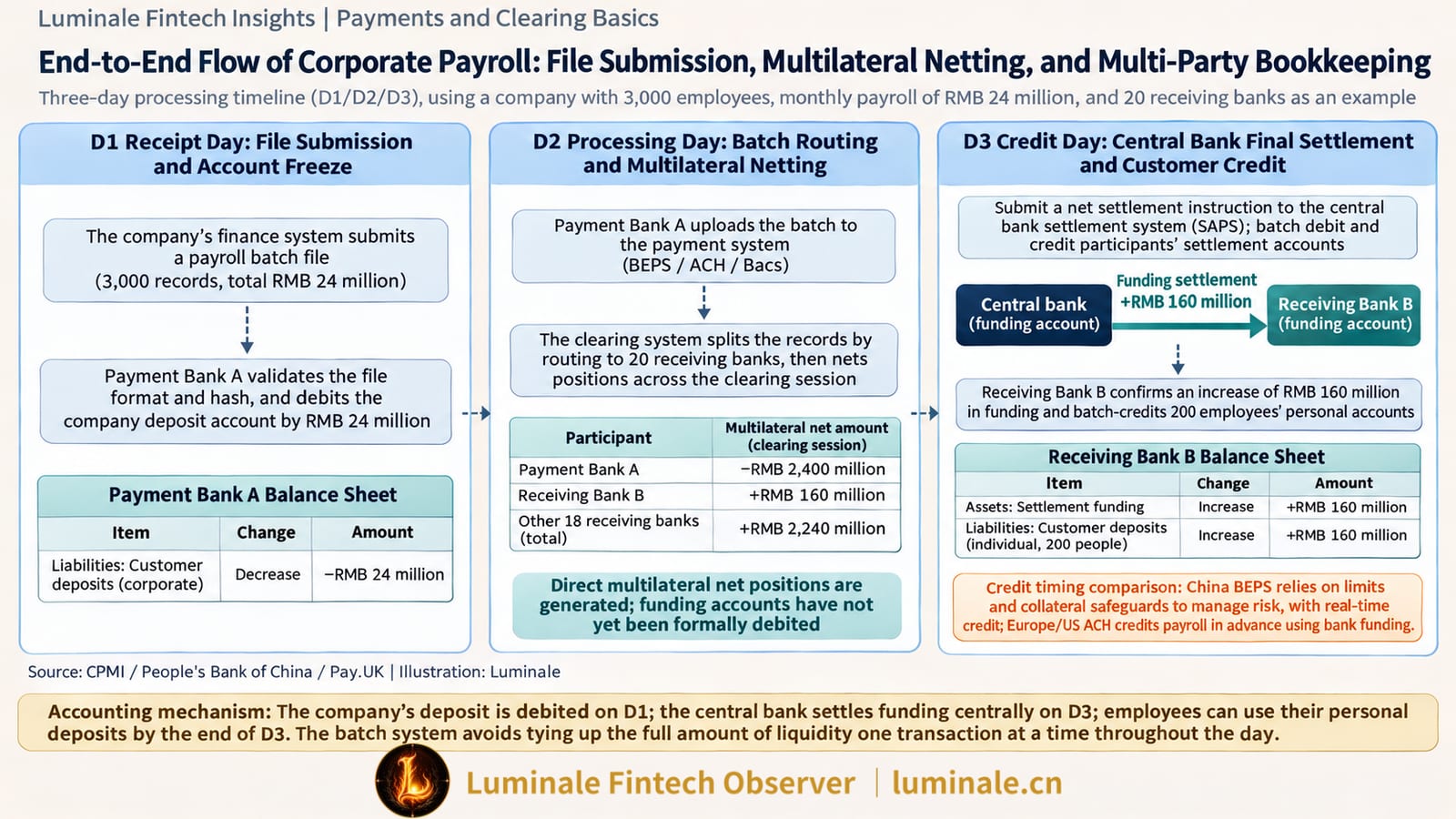
3. Direct Credit Mechanics: The Case of a 3,000-Employee Payroll
Consider a manufacturing corporation distributing CNY 24 million in monthly payroll across 3,000 employees. Employee accounts are dispersed across 20 commercial banks. The corporate employer holds its payroll disbursement account at Paying Bank A, while Receiving Bank B maintains accounts for 200 of these employees (totaling CNY 1.6 million).
The multi-party accounting ledger postings across the balance sheets of all participants reflect the following entries:
| Accounting Entity | Debit Entry | Credit Entry | Balance Sheet Impact |
|---|---|---|---|
| Corporate Employer | Accrued Payroll CNY 24,000,000 | Cash at Bank (Bank A) CNY 24,000,000 | Corporate liabilities decrease; bank deposit assets decrease |
| Paying Bank A | Customer Deposits (Employer) CNY 24,000,000 | Reserve Account at Central Bank CNY 24,000,000* | Bank liabilities decrease; reserve assets decrease |
| Central Bank | Reserve Account (Bank A) CNY 24,000,000* | Reserve Account (Bank B, etc.) CNY 24,000,000* | Total central bank liabilities remain unchanged; reserves reallocated across banks |
| Receiving Bank B | Reserve Account at Central Bank CNY 1,600,000* | Customer Deposits (Employees) CNY 1,600,000 | Bank reserve assets increase; retail deposit liabilities increase |
| Employee (Aggregate) | Cash at Bank (Bank B) CNY 1,600,000 | Accrued Payroll Receivable CNY 1,600,000 | Retail deposit assets increase; wage claim against employer extinguished |
Note: Reserve debit and credit amounts reflect the gross turnover before multilateral netting offsets.
Contrasting Settlement Timing and Interbank Credit Exposure
A pivotal design consideration within this lifecycle is: when should the receiving bank credit retail employees?
Regarding the temporal divergence between customer account crediting and interbank central bank settlement, global bulk systems have adopted two distinct risk architectures:
- China's BEPS Model: Upfront Net Debit Caps, Pre-Netted Routing, and Zero-Exposure Instant Crediting
In China's BEPS, the clearing operator executes upfront net debit cap checks on outgoing batches. The paying bank's recurring credit instructions are forwarded to receiving institutions only after clearing validation and formal inclusion in multilateral netting. Crucially, the PBOC mandates that participating banks secure their net debit caps by pledging high-quality liquid assets (government bonds, central bank bills) and earmarking reserve funds, which mechanically eliminates unwinding risk. Consequently, all netted entries carry a 100% central bank performance guarantee. Receiving banks credit employee accounts in real time upon receiving the pre-netted file, incurring zero uncollateralized interbank credit risk against the paying bank even if final settlement across SAPS takes place hours later at cycle cut-off.
- Anglo-American ACH / Bacs Model: Multi-Day Pre-Distribution, Disconnected Settlement, and Financed "Early Payday"
In mature Western bulk networks, multi-day batching persists. Clearing operators (FedACH or Bacs) forward pre-sorted transaction files to receiving banks one to two business days before the Effective Settlement Date, whereas central bank reserve settlement executes only on the settlement date.
Conventionally, receiving banks credit customers only after interbank settlement completes. In recent years, digital banks such as Chime, Capital One, and Monzo introduced "Early Direct Deposit / Paid Early" features to win retail market share. These institutions advance liquidity from their own balance sheets to credit customer accounts up to two days early upon receiving operator advice. During the 24 to 48 hours prior to central bank settlement, the receiving bank is effectively extending unsecured daylight credit to the paying bank, absorbing liquidity drag and interbank default risk if the underlying transfer is recalled or the counterparty defaults.
4. Direct Debit Mechanics: Utility Collections and Mandate Disputes
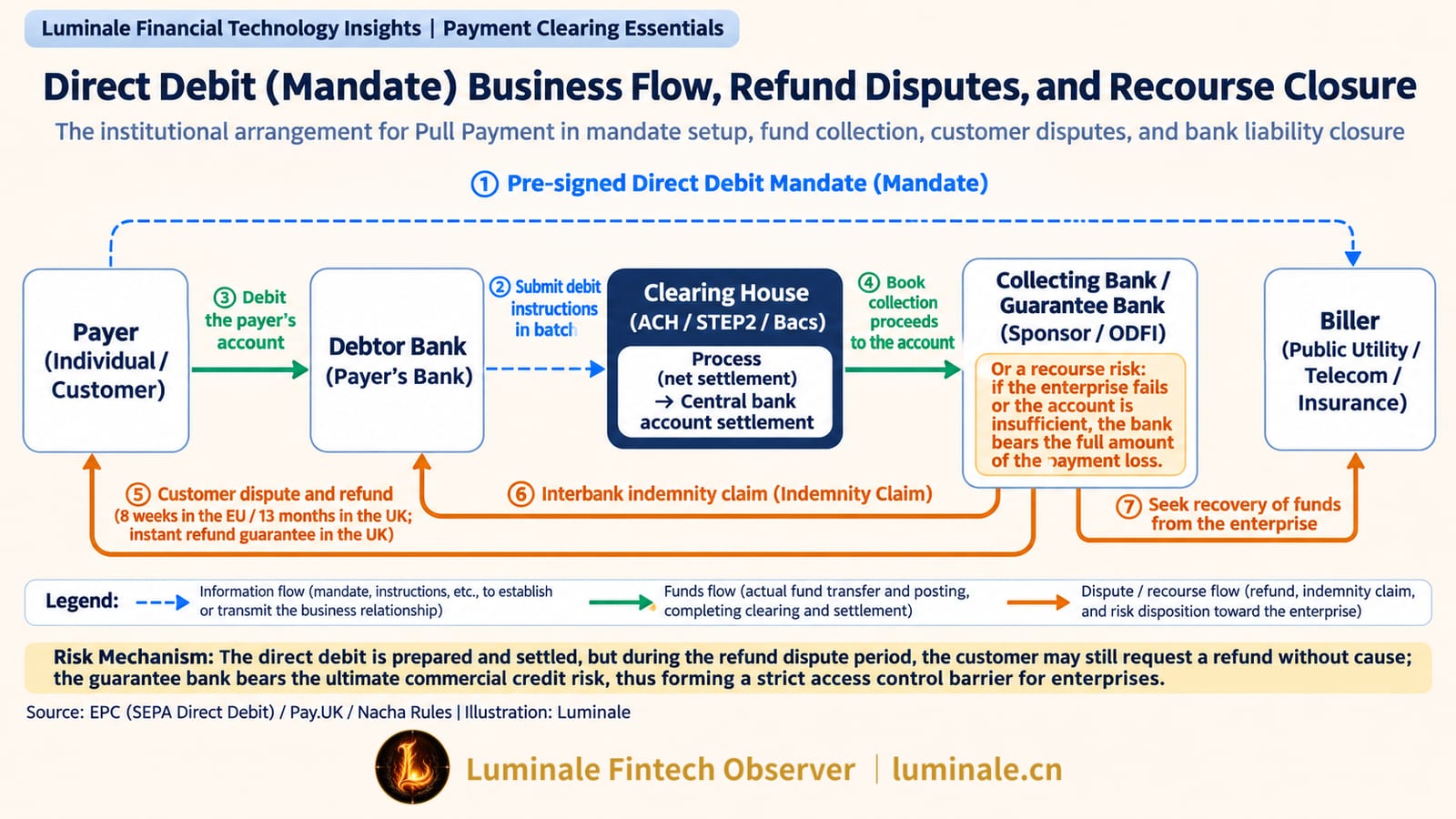
Unlike direct credits, direct debits feature inverted informational and fund flows, founded upon pre-authorized mandates.
Consider a municipal water utility collecting CNY 8 million in monthly water charges across 100,000 households. Consumer John holds his account at Paying Bank C, while the utility deposits at Receiving Bank D.
The process entails three phases: mandate establishment, batch execution, and dispute processing:
- Mandate Setup: John signs a direct debit mandate via mobile banking or customer portal, explicitly authorizing the utility to draw recurring funds from Bank C. This mandate is indexed in banking and billing databases.
- Processing and Execution:
- The utility compiles a batch debit file of 100,000 records and submits it through Bank D to the bulk payment system.
- The clearing operator unpacks the file and routes the debits destined for Bank C.
- Bank C verifies mandate parameters and account balance, debits John's deposit, and submits the position into the clearing cycle. Central bank ledgers debit Bank C's reserves and credit Bank D's reserves. Bank D then credits the utility's commercial account.
- Returns and Disputes:
Direct debits do not always settle successfully. In practice, systems manage two categories of returns:
- Operational Reversals (Processing-Time Returns): If a consumer account has insufficient funds, is frozen, or has been closed, the paying bank returns the item within established operating windows. In the US ACH system, these returns carry standardized Return Reason Codes, prominently R01 (Insufficient Funds), R02 (Account Closed), and R03 (No Account / Unable to Locate Account).
- Post-Settlement Consumer Disputes: Even after funds settle and post to the biller's account, debtors retain statutory dispute rights—for instance, if billing errors cause duplicate debits, or if deductions were entirely unauthorized.
International Practices on Dispute Refunds and Indemnity Schemes
Because direct debit places instructional initiative in the payee's hands, jurisdictions enforce consumer protection frameworks:
- European SEPA Direct Debit (SDD) Rules: Under the SDD Core Scheme, debtors have an 8-week "no-questions-asked refund" window. If requested, the paying bank must return the funds immediately without demanding proof of error. If the consumer asserts an unauthorized debit (i.e., the merchant cannot present a valid mandate), the dispute claim window extends to 13 months[11].
- UK Direct Debit Guarantee: UK scheme rules guarantee that if an error occurs in the deduction amount, date, or frequency, the customer is entitled to an immediate full refund from their bank. The debtor's bank indemnifies the consumer first, subsequently issuing an interbank Indemnity Claim against the originator's sponsoring bank[15].
- US Nacha Operating Rules: A consumer declaring an unauthorized debit (triggering code R10—Customer Advises Unauthorized) has up to 60 calendar days from the date of the account statement to dispute the charge via written statement.
Financial Consequences of Non-Finality in Debit Clearing
These dispute rights produce a structural financial consequence: while interbank reserve transfers for direct debits achieve central bank settlement finality, debtor-creditor discharge at the customer layer remains non-final throughout the dispute window.
Although the utility receives CNY 8 million on D3, those funds remain subject to clawback should consumers file disputes over the following eight weeks or longer. Sponsoring Bank D, upon crediting the utility, holds an off-balance-sheet contingent recourse claim against the merchant. If the corporate biller defaults, dissolves, or commits fraud during this window, the bank absorbs the loss. This exposure is the fundamental reason direct debit access is restricted to vetted entities backed by bank sponsorships and credit underwriting.
5. Cycles, Multilateral Netting, and Queue Scheduling
The foundational clearing mechanism of bulk payment systems is Deferred Net Settlement (DNS).
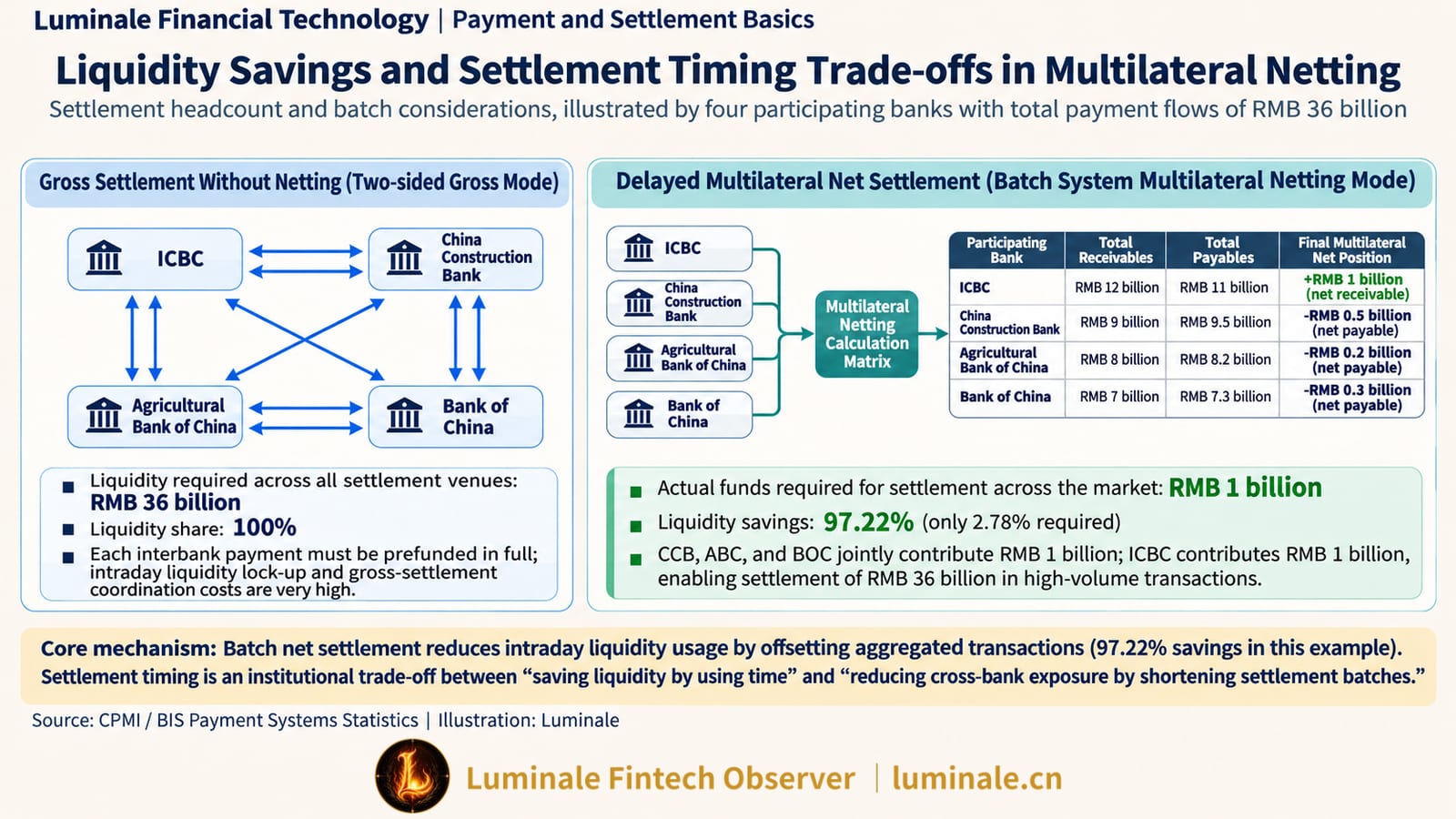
Numerical Example of Liquidity Conservation in Multilateral Netting
Consider a clearing cycle comprising four direct participant banks exchanging bilateral transactions:
| Bank Name | Gross Credit (Receivable from other banks) | Gross Debit (Payable to other banks) | Multilateral Net Settlement Position |
|---|---|---|---|
| ICBC | CNY 120 Billion | CNY 110 Billion | +CNY 10 Billion (Net Receiver) |
| CCB | CNY 90 Billion | CNY 95 Billion | -CNY 5 Billion (Net Payer) |
| ABC | CNY 80 Billion | CNY 82 Billion | -CNY 2 Billion (Net Payer) |
| BOC | CNY 70 Billion | CNY 73 Billion | -CNY 3 Billion (Net Payer) |
| Market Total | CNY 360 Billion | CNY 360 Billion | Total Net Positions to Settle: CNY 10 Billion |
In an unnetted gross settlement environment, these four institutions would require CNY 360 billion in aggregate liquidity to settle every transaction individually. Under multilateral netting, systemic liquidity demand contracts to CNY 10 billion—just 2.78% of gross turnover. CCB, ABC, and BOC transfer CNY 5 billion, CNY 2 billion, and CNY 3 billion respectively from their central bank reserve accounts, while ICBC receives CNY 10 billion, settling all underlying consumer and corporate payments. For central bank reserve multipliers and clearing mechanisms, see "From the Money Multiplier to Payment and Settlement: Central Bank Reserves Explained".
Queue Management and Dispatch Prioritization
Net settlement execution depends on bank liquidity provisioning and queue management. At cycle cut-off, the clearing operator dispatches net debit obligations to the central bank's core accounting ledger (e.g., SAPS).
- If a net debtor bank lacks sufficient reserve balances, the system does not cancel the batch; instead, it places the net debit instruction into a central bank queue.
- In bank operational practice, commercial bank treasury managers possess administrative rights to manually adjust queue prioritization, altering transaction sequencing to optimize outgoing payments.
- At the central bank system layer, to maintain retail payment stability and avoid systemic gridlock, netting obligations from retail bulk systems are typically assigned elevated dispatch priority, clearing ahead of lower-priority routine transactions once reserves arrive.
Settlement Default and Unwinding Risk
The key risk in deferred net settlement is that if a net debtor bank lacks adequate reserves at cycle close and cannot secure market borrowing, the clearing house may be forced to initiate an unwinding procedure if the central bank declines to extend overdraft credit.
Unwinding requires the operator to purge all instructions originating from or destined for the defaulting institution, recalculating net positions across all surviving banks. This recalculation can flip solvent institutions from net receivers to net debtors, propagating liquidity shortfalls and settlement delays across the banking system.
Modern bulk systems deploy structural defenses to prevent unwinding:
- Net Debit Caps: Central banks calculate maximum net debit exposure ceilings based on bank capital adequacy, credit ratings, and pre-funded collateral. If outgoing batches breach this cap, the system halts processing, rejecting instructions with explicit "exceeded net debit cap" reason codes to contain unbacked liabilities.
- Clearing Collateral and Pledged Pools: Participants pledge high-grade collateral (such as treasury bonds or central bank bills) to the central bank, enabling the monetary authority to inject liquidity automatically if a settlement shortfall occurs.
- Loss-Sharing Agreements: In the event losses exceed pledged collateral, surviving participants share default liabilities proportionally based on turnover, preserving settlement finality. For legal mechanisms underpinning settlement finality, see "Can a "Successful Payment" Be Reversed? What Risks Does Settlement Finality Solve?".
6. Trade-offs in Settlement Frequency: Balancing Liquidity Conservation and Credit Exposure
Given that bulk systems rely on scheduled batch cycles, a fundamental design question arises: how many clearing cycles should operate per business day?
Global bulk payment systems display divergent cycle frequencies:
- High-Frequency Model (e.g., India's NEFT): Operates 24/7 across 48 daily cycles, settling every 30 minutes.
- Medium-Frequency Model (e.g., China's BEPS): Runs 6 to 7 settlement cycles during standard operating days.
- Low-Frequency and Next-Day Models (e.g., US Standard ACH, UK Bacs): Historically settled once daily overnight (US ACH) or across a rigid three-day timeline (UK Bacs).
This variance does not stem from technical capacity, but reflects a policy trade-off between netting efficiency, intraday counterparty credit exposure, and bank operational liquidity costs.
Trade-off 1: Accumulation Window Duration vs. Netting Efficiency
Deferred net settlement relies on extending the accumulation window to aggregate bidirectional payment flows.
- Longer Settlement Intervals (Low-Frequency Mode): Over hours or days, payments between banks flow back and forth, offsetting one another. Higher transaction volumes and balanced bilateral flows maximize the netting ratio. As illustrated above, single daily netting cycles regularly compress gross reserve needs by more than 95%.
- Shorter Settlement Intervals (High-Frequency Mode): When cycles contract to 30 minutes, the volume of payments pooled within each window drops. Over half an hour, transaction flows between major institutions are often unidirectional (e.g., a bank disbursing corporate payroll experiences concentrated outflows without offsetting inflows). Consequently, multilateral netting efficiency declines, the proportion of gross turnover requiring actual reserve settlement rises, and systemic reserve consumption increases.
Trade-off 2: Funds in Transit vs. Interbank Credit Exposure
The incentive to compress clearing windows is reducing counterparty risk and accelerating fund availability.
- In low-frequency models, hours elapse between customer initiation and central bank finality. If receiving banks advance funds early to improve customer experience, they assume uncollateralized interbank credit risk across wider windows; if they withhold funds until finality, end-users face settlement delays out of step with digital commerce.
- India's NEFT implemented 30-minute cycles precisely to compress this uncollateralized window. Each payment enters the next available cycle for definitive reserve settlement, curbing the accumulation of unsettled net positions.
Trade-off 3: Bank Liquidity Management Overhead vs. Central Bank Facility Support
Increasing settlement frequency imposes liquidity management demands on commercial banks.
- China's BEPS operates 6 to 7 cycles daily (spaced roughly 2 to 3 hours apart), aligning with High-Value Payment System (HVPS) operating windows and interbank money market trading hours. Bank treasury desks manage reserve balances without continuous monitoring, leveraging interbank repo markets to square positions ahead of each scheduled cycle cut-off.
- By contrast, executing 48 half-hourly cycles daily requires bank treasuries to manage intraday liquidity continuously. During nocturnal hours when money markets are closed, an unexpected debit shock can trigger queuing or settlement defaults if market borrowing is inaccessible. Thus, high-frequency net settlement requires central bank around-the-clock liquidity facilities. When the Reserve Bank of India introduced 48-cycle NEFT, it paired the reform with a 24/7 collateralized Intra-day Liquidity Facility (IDL), enabling automated asset-backed borrowing overnight.
In essence, bulk settlement cycle design represents a calibrated continuum: trading time for liquidity efficiency versus deploying liquidity to achieve speed and counterparty risk reduction. China's BEPS balances liquidity conservation with daytime speed, while India's NEFT demonstrates high-frequency, near-real-time batch settlement backed by round-the-clock central bank collateral facilities.
4. Global Perspectives: China, the US, Eurozone, the UK, India, Singapore, Hong Kong, and Australia
Distinct commercial habits, regulatory traditions, and infrastructure legacies have shaped diverse bulk payment systems globally.
1. Comprehensive Landscape of Major Global Bulk Payment Systems
The table below summarizes the operational parameters and core mechanisms of leading bulk infrastructures:
| Economy | Core Bulk System | Physical Operator | Scheme Rule-Maker | Settlement Mechanism & Cycles | Direct Debit Support | Dispute Windows & Indemnity Rules | Per-Payment Ceiling | Transaction Volume & Value (Latest) | Relationship with Instant Rails |
|---|---|---|---|---|---|---|---|---|---|
| China | Bulk Electronic Payment System (BEPS) | PBOC Clearing Center | People's Bank of China (PBOC) | Deferred Net Settlement (DNS); 24/7 ingestion, multiple daily netting cycles settled across SAPS | Yes (Periodic & Ordinary Debits) | Governed by commercial bank debit mandates and customer pre-authorizations | CNY 1,000,000 (system parameter) | 2025: ~5.092B transactions, CNY 206.18T | Operates in parallel with IBPS (Super Online Banking), focusing on scheduled bulk files |
| United States | ACH (FedACH / EPN) | Federal Reserve (FedACH) & The Clearing House (EPN) | Nacha | Deferred Net Settlement; Next-Day and Same Day ACH (3 daily windows), settled via Fed reserve accounts or NSS | Yes (Direct Debit / ACH Debit) | Consumer unauthorized debits carry a 60-day refund window; robust fraud indemnity | Same Day ACH cap $1M (rising to $10M in Sep 2027); standard ACH has no limit | 2025: 35.2B payments, $93T (Same Day ACH: 1.4B transactions, $3.9T) | Coexists with FedNow and RTP; serves as the primary backbone for payroll and recurring billings |
| Eurozone | SEPA ACH (STEP2 / EMZ, etc.) | EBA Clearing (STEP2) & national ACHs | European Payments Council (EPC) | Deferred Net Settlement; multiple weekday cycles settled via T2 (pan-European RTGS) | Yes (SEPA Direct Debit, SDD) | Core scheme: 8-week no-questions-asked refund; 13 months for unauthorized debits | SCT has no scheme cap (bank-set limits); SCT Inst enforces ceilings | 2024 (STEP2): >18B transactions, >€16T | Interoperates with TIPS and SCT Inst; anchors European corporate-scale payments |
| United Kingdom | Bacs | Managed by Pay.UK | Pay.UK | Deferred Net Settlement; fixed 3-day cycle (D1/D2/D3), settled across Bank of England reserve accounts | Yes (Direct Debit) | Direct Debit Guarantee: immediate full refund for debit errors with bank indemnity | £50,000,000 per payment | 2025: ~6.86B payments, £6.05T (Direct Debit: ~5.03B transactions) | Operates alongside Faster Payments (FPS); undergoing review under the National Payments Vision |
| India | NEFT / NACH | NEFT: Reserve Bank of India; NACH: NPCI | RBI & NPCI | NEFT: 24/7 operation with 48 half-hourly net cycles; NACH: multiple batch cycles on business days | NEFT focuses on credits; NACH supports high-volume debits | Governed by electronic mandates (e-Mandate) with bank-level dispute recourse | NEFT online has no uniform hard cap (bank limits apply); NACH handles large corporate batches | FY 2024-25: NEFT cleared >7B transactions; NACH cleared >3.5B transactions | Coexists with UPI and IMPS; NEFT anchors large-value disbursements, NACH anchors recurring debits |
| Singapore | Interbank GIRO (IBG) | Commercial banking clearing consortium | The Association of Banks in Singapore (ABS) | Deferred Net Settlement; scheduled business-day cycles settled across MAS reserve accounts | Yes (GIRO Direct Debit) | Historically paper-based, now digitized via eGIRO under ABS dispute frameworks | Set by corporate billing contracts and bank risk parameters | Processes hundreds of millions of corporate payroll, tax, and utility entries annually | Operates alongside FAST and PayNow, anchoring recurring corporate billings and credits |
| Hong Kong | Autopay (Legacy ECG) → FPS Batch | Hong Kong Interbank Clearing Limited (HKICL) | Hong Kong Monetary Authority (HKMA) & HKAB | Deferred Net Settlement; legacy ECG settled via CHATS; migrated to FPS Batch multi-cycle settlement | Yes (Paper DDA / FPS eDDA digital mandates) | Governed by HKMA and HKAB standards; supports unauthorized refund claims and interbank indemnity | Governed by bank credit approvals, supporting corporate-scale batches | Processes territory-wide payroll and utility debits; FPS Batch volume expanding steadily | On June 9, 2025, legacy ECG Autopay was formally retired, fully migrating bulk traffic to FPS |
| Australia | BECS (Direct Entry) | Point-to-point bank exchange overseen by AusPayNet | Australian Payments Network (AusPayNet) | Deferred Net Settlement; bilateral exchange with multilateral net settlement across RBA accounts | Yes (Direct Debit) | Governed by Direct Debit Service Agreements; supports unauthorized debit chargeback claims | Determined by bilateral bank arrangements and clearing categories | Clears billions of retail and corporate transactions annually | Originally scheduled to retire by 2030 in favor of NPP; fixed retirement date formally withdrawn in Dec 2025 |
Sources: People's Bank of China Payment System Reports, Nacha Annual Reports, EBA Clearing Statistical Bulletins, Pay.UK Operational Data, RBI Annual Reports, HKICL and HKMA Bulletins, and AusPayNet Industry Releases.
2. Deep-Dive Case Studies: Rules, Incentives, and Participant Behavior
To examine how rule modifications shape market structure, this section analyzes four bulk clearing regimes through the lens of "rule evolution → incentive shifts → participant behavior".
(1) US ACH: Sustaining System Longevity Through Same Day Expansion
- Rule Evolution:
For decades, US ACH adhered to next-day clearing, requiring 1 to 2 business days from submission to settlement. To bridge the gap with expensive real-time gross clearing (Fedwire) and emergent instant rails, Nacha introduced Same Day ACH in 2016:
- Established three daily daytime settlement windows (clearing cut-offs at 10:30, 14:45, and 16:45 ET);
- Progressively raised per-transaction limits: starting at $25,000, moving to $100,000 in 2020, and reaching $1 million in 2022;
- In April 2026, Nacha membership approved raising the per-payment cap to $10 million, effective September 17, 2027[4].
- Incentive Shifts:
For multinational corporations, payroll providers (e.g., ADP), and commercial banks, Fedwire fees often run several dollars per wire, compared to pennies per transaction on ACH. Expanding Same Day ACH capacity allowed originators to achieve same-day finality at minimal cost.
- Participant Behavior:
Corporate treasuries adapted cash management workflows, rerouting urgent supplier payments, supplemental payrolls, and B2B settlements from expensive wires to Same Day ACH. In 2025, Same Day ACH cleared 1.4 billion payments valued at $3.9 trillion, driving total B2B ACH volume to 8.1 billion transactions (up 9.9% year-on-year)[3]. This demonstrated that bulk systems can meet commercial demands for speed through higher batch frequencies without architectural overhauls.
(2) India NEFT: High-Frequency 24/7 Batch Cycles
- Rule Evolution:
Deferred net settlement was historically restricted to banking business hours. On December 16, 2019, the Reserve Bank of India (RBI) transitioned NEFT to 24/7 around-the-clock availability[13]. Rather than adopting real-time gross settlement, NEFT maintained batch processing and multilateral netting, condensing clearing into 48 half-hourly cycles daily. To address liquidity constraints when interbank money markets close overnight, the RBI instituted an automated, collateral-backed Intra-day Liquidity Facility (IDL).
- Incentive Shifts:
Commercial banks avoid managing continuous gross reserve volatility overnight, as payments net down every 30 minutes; meanwhile, central bank collateral facilities mitigate concerns over overnight reserve overdrafts.
- Participant Behavior:
Indian commercial enterprises utilize NEFT for recurring corporate disbursements. While consumer micropayments migrated to the Unified Payments Interface (UPI), large corporate payrolls, supplier settlements, and institutional transfers remain anchored on NEFT's half-hourly cycles, demonstrating the coexistence of instant retail and high-frequency bulk rails.
(3) Australia BECS: From Planned Decommissioning to Withdrawing the Target Date
- Rule Evolution:
Australia's Bulk Electronic Clearing System (BECS) handles the majority of payroll disbursements and recurring bill debits. Following the 2018 deployment of NPP, the domestic payments industry drafted an architectural roadmap: progressively migrate BECS volumes to NPP and decommission BECS by June 2030.
However, during execution, AusPayNet and the RBA confronted non-technical impediments. On December 16, 2025, AusPayNet formally withdrew the 2030 target retirement date[1].
- Incentive Shifts and Structural Friction:
- Economic Asymmetry: Thousands of corporate ERPs and payroll software suites had integrated with BECS fixed-length file standards over decades. Migrating to NPP APIs imposed substantial IT retooling and integration costs on corporates;
- Peak Capacity Strains: Fast payment systems process transactions individually. On peak payroll days (e.g., Thursdays and month-ends), routing millions of discrete entries into instant engines within brief morning windows creates severe concurrency pressure on bank core systems;
- Legal Complexities of Legacy Mandate Migration: Hundreds of millions of legacy BECS direct debit agreements remain active. Re-papering or converting them into NPP's PayTo digital mandate database posed substantial compliance and legal verification hurdles.
- Participant Behavior:
In March 2026, the RBA endorsed withdrawing the fixed retirement date, noting that it prevented operational disruption[2]. Australia's experience demonstrates that the establishment of fast payment systems does not automatically render bulk architectures obsolete. For detailed regulatory perspectives from the Payments System Board regarding RITS, NPP, and BECS decommissioning, see "Reading the RBA Payments System Board Annual Report 2026: What Is Changing in Australia's Payment and Settlement Infrastructure?".
(4) Hong Kong Autopay and FPS: Seamlessly Migrating Legacy Batches to Modern Rails
- Rule Evolution:
Hong Kong's legacy bulk clearing system (Autopay) was built on HKICL's Electronic Clearing Group (ECG), processing Autopay Direct Credits (corporate payroll) and Autopay Direct Debits (utility billing based on paper DDAs), settled via deferred net settlement in HKD CHATS.
When the HKMA launched the Faster Payment System (FPS) in 2018, it incorporated a native bulk processing engine (FPS Batch Payment) and an electronic Direct Debit Authorization (eDDA) module. After phased testing and dual-track operations, HKICL formally decommissioned the legacy ECG Autopay service on June 9, 2025[17], transitioning territory-wide payrolls, dividends, and recurring direct debits to FPS rails.
- Enabling Conditions for Migration:
Unlike Australia's delay, Hong Kong's transition succeeded due to three specific institutional factors:
- Concentrated Market Topology and Centralized Governance: Major commercial banks and billing utilities are concentrated within a tight financial ecosystem. HKICL, owned jointly by the HKMA and HKAB, exercised unified coordination in driving interface standardizations (such as ISO 20022 transitions);
- Native Bulk Architecture and Centralized Mandate Storage: FPS was designed with native bulk file ingestion modules and a centralized eDDA database, allowing paper mandates to be digitized progressively and eliminating mass re-papering legal bottlenecks;
- Unified Settlement Ledgers and Liquidity Pooling: FPS participants settle across unified settlement accounts at the HKMA, sharing liquidity across real-time payments and batch cycles, which minimized reserve fragmentation costs.
- Participant Behavior:
Hong Kong enterprises transitioned legacy billing formats to FPS APIs and ISO 20022 bulk files. Multi-day clearing transitioned to intra-day multi-batch finality, and retail banking consumers manage eDDA mandates directly within mobile banking apps. This transition demonstrates that wholesale migration of bulk workloads to modern rails is achievable when clearing operators provide centralized governance, pre-architected batch capacity, and streamlined digital mandate pathways.
5. Where Are Bulk Systems Headed: Acceleration, Migration to Fast Rails, and Mandate Digitization
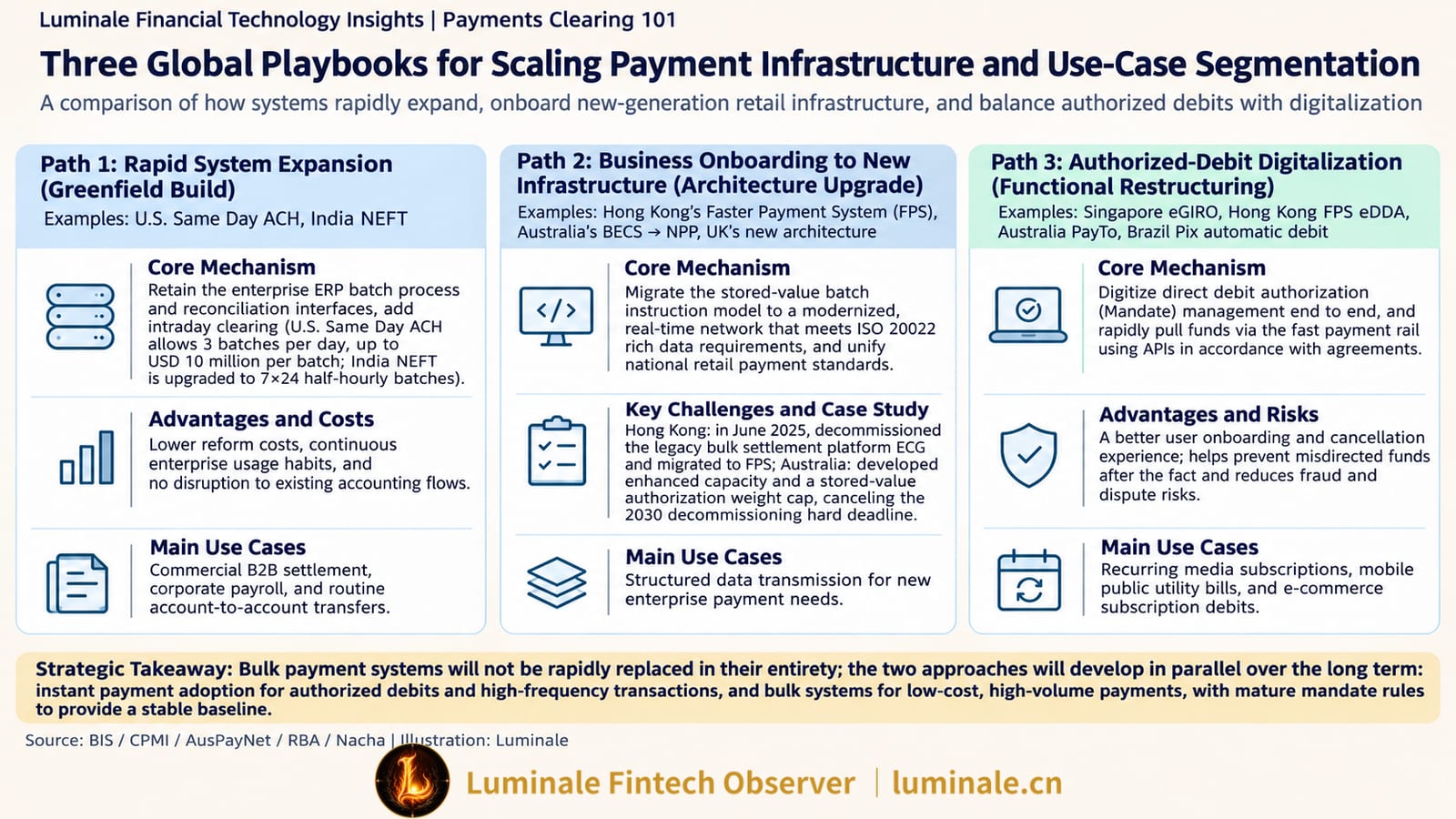
Will bulk payment systems eventually be replaced by fast payments? From market realities, the answer is negative. Global bulk systems are evolving across three complementary pathways:
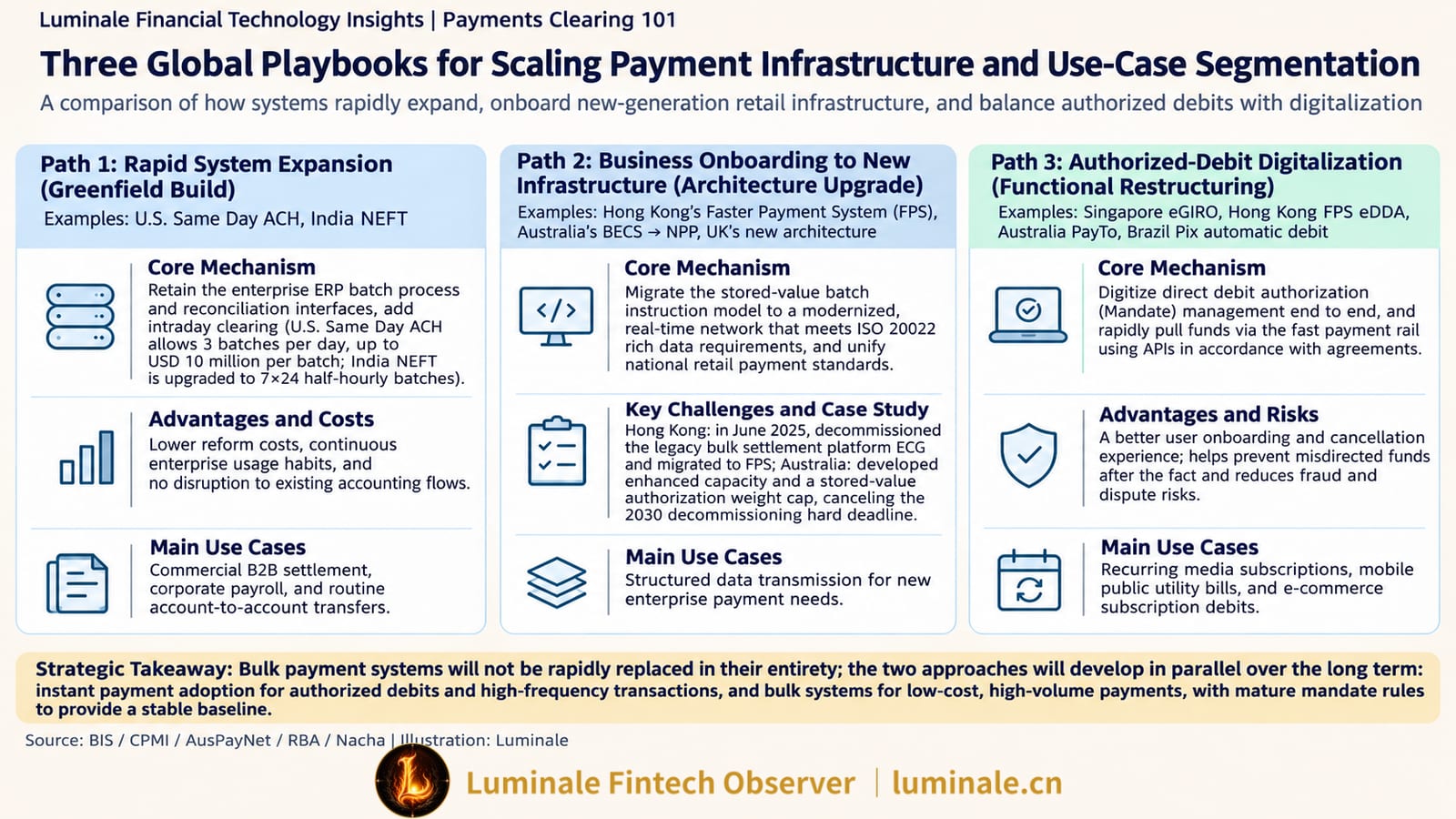
1. Structural Constraints to Replacing Bulk Payment Systems
- Enterprise ERP Batch Rigidities: Corporate accounting and ERP systems are architected around accounting cycles and batch ledger postings. Treasurers do not require supplier payments to post at 02:00 AM; they need predictable disbursements on designated value dates with consolidated, hash-reconciled bank statements for automated ledger matching. Item-by-item real-time transfers add accounting and reconciliation overhead.
- Entrenched Direct Debit Mandate Assets: Data from the Bank of England and European clearing houses indicates that active direct debit mandates number in the billions. These mandates represent legally binding authorizations accumulated over decades. Migrating them to instant rails requires re-validating millions of counterparty permissions, risking billing disruptions.
- Capacity Constraints on Instant Networks: Fast payment networks maintain high availability (99.999%) and sub-second response times, with network bandwidth and clearing account processing designed for peak transactional concurrency. Flooding instant rails with millions of non-urgent payroll records on month-ends would crowd out high-priority retail traffic.
- Liquidity Consumption Disparities: Real-time gross transfers require depository institutions to hold unencumbered central bank reserves continuously, whereas deferred net settlement slashes gross liquidity demand by over 95%. The economic value of liquidity conservation in bulk settlement far outweighs the marginal utility of real-time speed for recurring disbursements.
2. Pathway 1: In-System Acceleration and Capacity Expansion
The first pathway optimizes existing bulk infrastructures while preserving established enterprise ERP integrations:
- Multiplying Clearing Cycles: Systems such as US Same Day ACH continuously add daytime processing windows, reducing clearing latency to several hours.
- Raising Transaction Caps: Increasing Same Day ACH per-payment limits to $10 million incorporates commercial payments previously confined to expensive RTGS wires.
- Expanding Operating Hours and Data Richness: India's NEFT operates 48 cycles continuously 24/7, while Pay.UK is upgrading Bacs data architectures to ISO 20022 messaging standards to improve automated reconciliation and AML compliance screening.
3. Pathway 2: Migrating Bulk Workloads to Fast Rails and Next-Gen Rails
The second pathway introduces dedicated high-throughput bulk processing channels within next-generation retail rails:
- In the UK, the Retail Payments Infrastructure Board (RPIB) is assessing architectural designs under the National Payments Vision (NPV), evaluating phased pathways to transition Bacs direct credits onto resilient, high-throughput retail infrastructures[16];
- Australia's NPP introduced the Batch Settlement Service, enabling banks to route pre-sorted batch files across instant rails;
- Hong Kong's Wholesale Migration: The HKMA and HKICL established native batch processing and centralized eDDA architectures within the FPS, decommissioning legacy ECG Autopay on June 9, 2025, and providing a successful blueprint for wholesale infrastructure replacement.
4. Pathway 3: Digitizing Mandates for Instant Pull Payments
The third pathway digitizes direct debit mandates and pairs them with instant payment rails:
- Singapore eGIRO: The Association of Banks in Singapore (ABS) and the Monetary Authority of Singapore (MAS) launched eGIRO, replacing paper applications with real-time online mandate registration via internet banking, compressing onboarding friction from weeks to minutes[12].
- Hong Kong FPS eDDA: HKICL integrated eDDA protocols into FPS, enabling merchants and e-wallets to initiate real-time pull debits against authenticated mandates.
- Australia PayTo & India UPI AutoPay: Australia's PayTo and India's UPI AutoPay empower consumers to manage, pause, or revoke recurring subscription mandates from mobile apps, with payments executed individually and in real time.
- Brazil Pix Automático: Following the success of Pix person-to-person transfers, the Central Bank of Brazil deployed Pix Automático in 2025, bringing utilities, tuition, and subscription billings onto digital rails with one-click revocation.
However, migrating direct debits from deferred net settlement to real-time rails requires new fraud and consumer dispute architectures. In traditional direct debit, banks have days to review mandates and intercept fraudulent transactions; on instant rails, funds transfer irreversibly within seconds. Without rigorous customer authentication frameworks—such as those implemented by the HKMA for e-wallet top-ups—instant pull debits can become vulnerable to account takeover and fraud.
5. Frontiers in Programmable Payments and Tokenized Finance
In tokenized finance and Central Bank Digital Currency (CBDC) explorations, bulk payment mechanisms are converging with smart contracts. In the Monetary Authority of Singapore's Purpose Bound Money (PBM) trials, corporations and public agencies define conditional disbursement rules, expiration parameters, and merchant whitelists via smart contracts, executing automated disbursements. While these protocols offer prototypes for conditional payroll and supply chain settlements, they remain within regulatory sandboxes and will not displace established interbank bulk clearing systems in the near term. For smart contract architectures and on-chain settlement, see "Smart Contracts, Programmability, and On-Chain Settlement: Foundations of Financial Transaction Automation"; for Singapore's digital finance evolution, see "How Far Has Singapore's Digital Finance Progressed? From Tokenisation to Payment and Settlement Infrastructure".
Conclusion: An Irreplaceable Division of Financial Labor
The evolution of modern payment infrastructures demonstrates that clearing mechanisms specialize according to transaction characteristics.
Fast payment systems satisfy retail demands for immediacy across peer-to-peer transfers, merchant checkouts, and urgent remittances. Bulk payment systems serve the operational cadence of commercial enterprises—characterized by high volume, regularity, scheduled value dates, and low processing costs. Its file-based batch processing fits enterprise accounting cycles; its multilateral netting minimizes central bank reserve demand; and its direct debit governance—encompassing bank sponsorship, standardized return codes, and statutory indemnity protections—provides institutional stability for commercial billing.
As instant payments and mobile wallets expand, bulk clearing volumes worldwide continue to grow. Australia's decision to withdraw its BECS retirement deadline highlights the institutional resilience of bulk clearing. For the foreseeable future, bulk systems will continue to evolve alongside instant payment networks by adding intraday cycles, upgrading data standards, and integrating digital mandates.
Across the retail payments landscape, another foundational rail exists: card payment networks. Operating via real-time online authorization at the point of sale and settling interbank obligations via deferred net settlement at day-end, card networks coordinate issuers, acquirers, merchants, and card schemes to govern consumer credit, interchange fees, and chargeback arbitration. We explore the card clearing system in subsequent articles.
References
[1]: Australian Payments Network (AusPayNet). (2025-12-16). AusPayNet Media Release: Industry Updates BECS Transition Pathway and Retires 2030 Target Date. https://www.auspaynet.com.au/resources/media-releases ↩
[2]: Reserve Bank of Australia (RBA). (2026-03). Assessment of the Bulk Electronic Clearing System (BECS) Closure Risks and Strategy Update. https://www.rba.gov.au/payments-and-infrastructure/ ↩
[3]: National Automated Clearing House Association (Nacha). (2026-02). ACH Network Volume and Value Surpass Records in 2025: 35.2 Billion Payments and $93 Trillion. https://www.nacha.org/news/ach-network-volume-2025 ↩
[4]: National Automated Clearing House Association (Nacha). (2026-04). Nacha Members Approve Increase in Same Day ACH Per-Payment Limit to $10 Million. https://www.nacha.org/rules/same-day-ach-limit-increase-10m ↩
[5]: Committee on Payments and Market Infrastructures (CPMI), Bank for International Settlements (BIS). (2003-03). A Glossary of Terms Used in Payments and Settlement Systems. https://www.bis.org/cpmi/glossary_030301.pdf ↩
[6]: Pay.UK. (2023). History and Governance of the Bacs Payment System. https://www.wearepay.uk/what-we-do/payment-systems/bacs/ ↩
[7]: Federal Reserve Financial Services (FRFS). (2024). FedACH Services: Operations, Schedules and Settlement Mechanics. https://www.frbservices.org/financial-services/ach ↩
[8]: People's Bank of China (PBOC). (2006-06). Notice of the People's Bank of China on the Nationwide Rollout and Operation of the Bulk Electronic Payment System (BEPS) and Measures for the Administration of Bulk Electronic Payment System Business. http://www.pbc.gov.cn/goutongjiaoliu/113456/113469/index.html ↩
[9]: National Automated Clearing House Association (Nacha). (2025). 2025 Nacha Operating Rules & Guidelines: The Guide to the Rules Governing the ACH Network. https://www.nacha.org/rules ↩
[10]: Pay.UK. (2025). Bacs Scheme Rules and System Principles: Participant Rights and Responsibilities. https://www.wearepay.uk/bacs-scheme-rules/ ↩
[11]: European Payments Council (EPC). (2023-11). SEPA Direct Debit Core Rulebook (Version 1.0) & SEPA Credit Transfer Scheme Rulebook. https://www.europeanpaymentscouncil.eu/document-library/rulebooks ↩
[12]: The Association of Banks in Singapore (ABS). (2021). Interbank GIRO and Electronic GIRO (eGIRO) Operational Framework. https://www.abs.org.sg/consumer-banking/giro ↩
[13]: Reserve Bank of India (RBI). (2019-12-06). National Electronic Funds Transfer (NEFT) System – 24x7 Availability (Notification RBI/2019-20/111, DPSS (CO) EPPD No. 1087/04.03.01/2019-20). https://www.rbi.org.in/Scripts/NotificationUser.aspx?Id=11756 ↩
[14]: National Payments Corporation of India (NPCI). (2024). National Automated Clearing House (NACH) Procedural Guidelines. https://www.npci.org.in/what-we-do/nach/product-overview ↩
[15]: Pay.UK. (2024). The Direct Debit Guarantee: Consumer Protections and Bank Obligations. https://www.directdebit.co.uk/direct-debit-guarantee/ ↩
[16]: Bank of England & Payments Vision Delivery Committee (PVDC). (2025-11 / 2026-06). Strategic Direction for the Future Retail Payments Infrastructure in the UK & Retail Payments Infrastructure Board (RPIB) Consultation Paper. https://www.bankofengland.co.uk/financial-stability/financial-market-infrastructure-supervision ↩
[17]: Hong Kong Interbank Clearing Limited (HKICL). (2025-06). Electronic Clearing Group (ECG) Services Update: Migration of Autopay to Faster Payment System (FPS) and Decommissioning Notice. https://www.hkicl.com.hk/eng/clearing_services/bulk_clearing.php ↩
Originally published by Luminale Fintech Observer: https://luminale.cn/articles/bulk-payment-systems-ach-giro-en