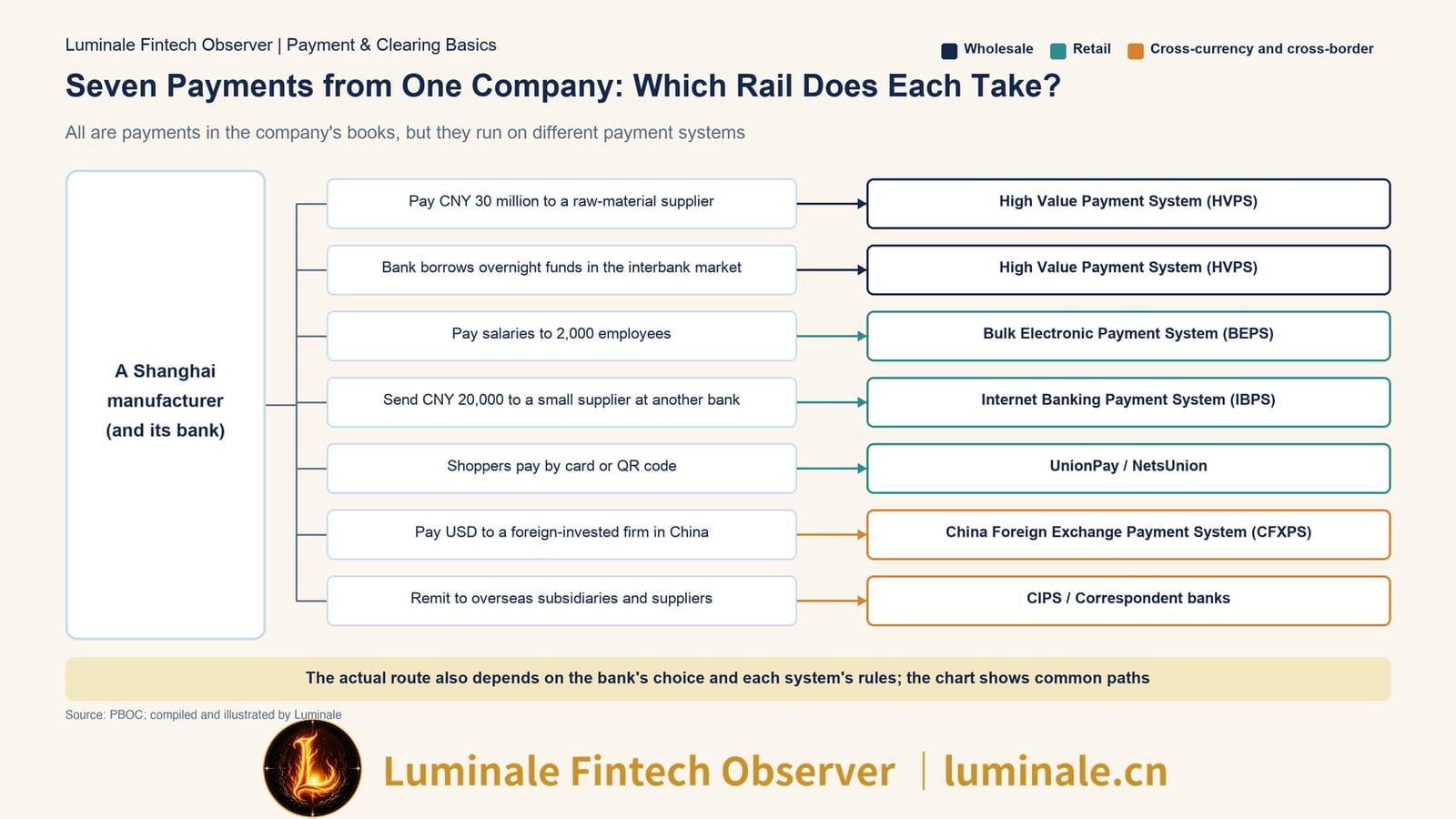
Here is roughly what a Tuesday looks like in the treasury department of a manufacturing company in Shanghai. In the morning, the finance team uses corporate online banking to pay CNY 30 million to a large raw-material supplier. At noon, the HR system pushes a payroll file for 2,000 employees to the bank, and through the afternoon employees receive text messages telling them their salaries have arrived. The cashier sends CNY 20,000 to a small parts supplier that banks elsewhere, and a few seconds later the supplier replies on WeChat: "Got it." In the company's shops, some customers pay by credit card and others scan a WeChat Pay or Alipay code. Finance also has to pay a foreign-invested company in China in US dollars, remit renminbi to a subsidiary in Southeast Asia, and pay a German equipment maker in euros. On the same day, the company's bank borrows overnight funds in the interbank market.
In the company's books, all of these are transfers or payments. In the payment system, they may have run through the High Value Payment System, the Bulk Electronic Payment System, the Internet Banking Payment System, UnionPay or NetsUnion, the China Foreign Exchange Payment System, the Cross-border Interbank Payment System and the correspondent banking network. Why does an economy build so many payment rails? How should these rails be grouped? And the next time we come across an unfamiliar name such as PayNow, UPI or CHIPS, how can we tell which group it belongs to?
This article is the first in Luminale's series on classifying payment systems, and it answers those three questions. The definition of a payment system, the differences between payment, clearing and settlement, and the mechanics of gross and net settlement have already been covered in two earlier articles in this column, What Exactly Is a Payment System? From the BIS Definition to the Global Financial Market Infrastructure Landscape and Why Don't Payment Systems Settle Every Payment Immediately? Understanding RTGS and DNS, so they are only touched on here where needed. Later articles in the series take each type of system in turn.
I. Why an Economy Needs Several Payment Systems
1. They Are All Payments, but They Are Processed Differently
Put the payments from the opening side by side and they differ in six ways: how large each payment is, how urgent it is, how many similar payments are made each day, how much the payer is willing to pay per transaction, which currency is used, and who the two parties are.
The CNY 30 million supplier payment and the interbank loan are large in value and few in number. What the payer cares about most is whether the money has really reached the other side and whether it can be clawed back. Salaries and utility direct debits are numerous and small; what matters is that they are cheap and reliable, and arriving a few hours later is not a problem. For the CNY 20,000 transfer to the small supplier, both sides want speed, ideally at weekends and late at night as well. The problem with the dollar payment is that the People's Bank of China (PBOC) cannot open settlement accounts in US dollars. Money sent to Germany and Southeast Asia also has to cross different legal systems, time zones and regulators.
These requirements conflict with one another. It is hard for one system to be the safest, the fastest and the cheapest at the same time while also handling every currency.
2. Safety, Speed and Cost Have to Be Traded Off
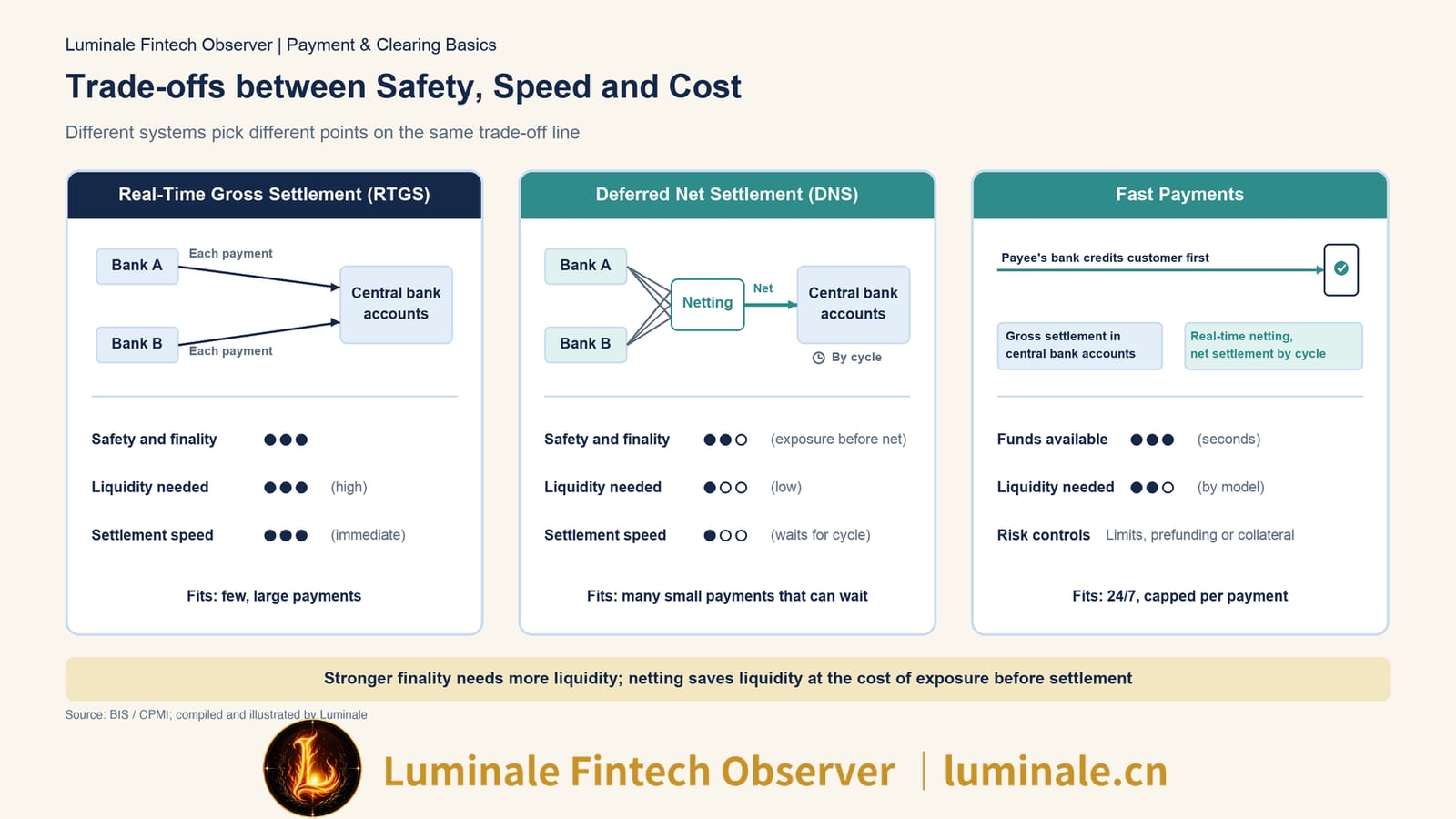
The main trade-off lies in how each payment is settled between banks.
The safest approach is to settle each payment in full, one at a time: every payment is completed immediately and irrevocably on accounts at the central bank. This is real-time gross settlement (RTGS). The cost is that banks must have enough funds ready for every payment, which ties up a lot of intraday liquidity. Payments that are few in number and large in value can bear that cost.
The other approach is deferred net settlement (DNS): the system collects payments over a period, works out each bank's net amount receivable or payable, and then settles the differences in one go. Banks need far less money on hand and the cost per payment is lower. The price is that, until netting and settlement take place, banks are exposed to one another's credit and liquidity risk, and payments are final only when the cycle ends.
Fast payments sit between the two. Customers expect funds within seconds, but banks do not necessarily settle each payment individually. A common arrangement is for the payee's bank to credit its customer first, for banks to net their positions in real time and then settle the net amounts by cycle, with per-payment limits, prefunding or collateral used to contain the exposure. Some systems instead settle each payment directly on central bank accounts. For more detail on both mechanisms, see this column's article on RTGS and DNS and Can a "Successful Payment" Be Reversed? What Risks Does Settlement Finality Solve?
So different systems have, in effect, chosen different points along this trade-off line.
3. Systems Are Not Built All at Once
History is another reason. Most countries built their payment systems in different decades for different needs, and newer systems were layered on top of existing ones rather than replacing them in one step.
The UK's Bacs bulk payment system began processing salaries and direct debits in 1968, while the Faster Payments system did not go live until 2008, and the two still run side by side. In China, the High Value Payment System went live in 2005, the Bulk Electronic Payment System in 2006 and the Internet Banking Payment System in 2010. Bulk systems did not disappear once fast payment systems arrived, because payroll and authorised direct debits are cheaper to process in batches, and corporate finance systems are built around batch files.
Participants are another reason to keep systems separate. The direct participants in a large-value system are mainly banks and other financial market infrastructures. Retail systems have to connect large numbers of small and medium-sized banks, and a growing number of non-bank payment institutions want to connect as well. Cross-border systems also involve overseas banks and correspondent banks. Access criteria, risk controls and rules all differ, and putting everything into one system would make it hard to manage.
4. Volumes and Values in China's Systems
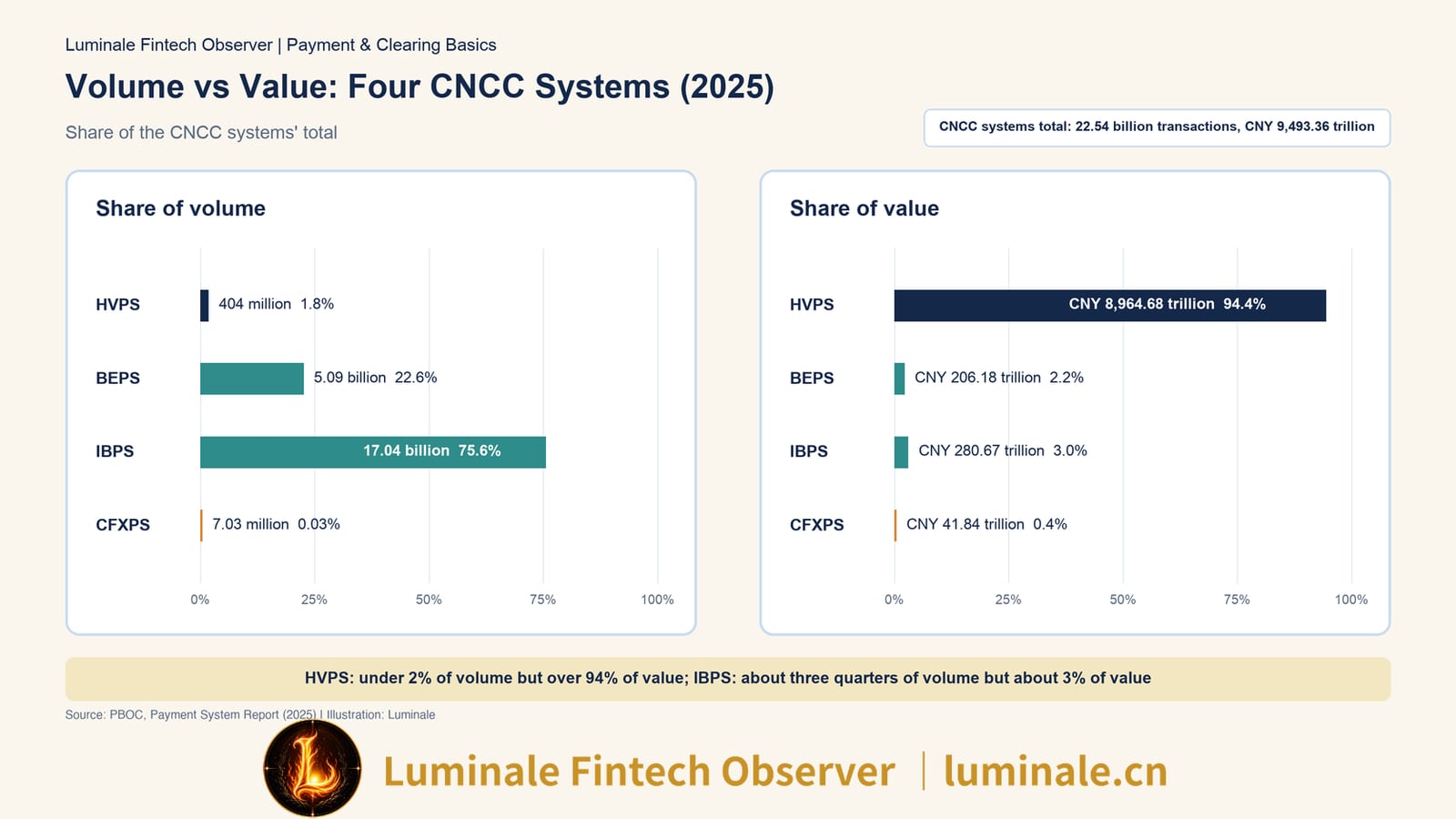
The PBOC's payment system data for 2025 illustrate this division of labour well[1].
| System | Volume, 2025 | Value, 2025 | Days in operation |
|---|---|---|---|
| High Value Payment System (HVPS) | 404 million | CNY 8,964.68 trillion | 248 business days |
| Bulk Electronic Payment System (BEPS) | 5.092 billion | CNY 206.18 trillion | 365 days |
| Internet Banking Payment System (IBPS) | 17.041 billion | CNY 280.67 trillion | 365 days |
| China Foreign Exchange Payment System (CFXPS) | 7.0297 million | CNY 41.84 trillion | 248 business days |
| China National Clearing Center (CNCC) systems, total | 22.544 billion | CNY 9,493.36 trillion |
Source for the table: PBOC, Payment System Report (2025)[1].
The HVPS handles less than 2% of the total volume of the CNCC systems but more than 94% of the value. The IBPS is the opposite: about three quarters of the volume but only about 3% of the value. The two systems also run on different schedules. The HVPS and the CFXPS operate on business days, while the BEPS and the IBPS run 365 days a year.
II. Common Ways to Classify Payment Systems
1. Describing a System Versus Grouping Systems
This column's article What Exactly Is a Payment System? offered six dimensions for observing a system: the nature of transactions, settlement timing, settlement mechanism, settlement asset, geographical coverage and mode of participation. These six dimensions are good for describing the characteristics of a system, much like filling in a medical check-up form, where height, weight and blood pressure all get measured.
Grouping systems is a different task. It requires choosing one main axis and using it to split systems into categories. That axis should ideally meet three conditions:
- Groups do not overlap, so each system falls into only one group;
- Each group has counterparts in the major economies, which makes international comparison possible;
- Group boundaries match real operational and rule boundaries, so that readers given a new system can tell which box it belongs in.
Testing the common approaches against these three conditions shows the strengths and weaknesses of each.
2. Seven Ways of Grouping Compared
| Grouping | How it splits | What it captures | What it misses |
|---|---|---|---|
| Wholesale / retail | Whether users are financial institutions or individuals and businesses, plus payment size | The standard split used by international bodies and central banks; easiest for international comparison | The retail side is too broad; bulk collections and disbursements, fast payments and card networks differ greatly |
| Domestic / foreign currency | Whether the settlement currency is issued by the domestic central bank | Shows that foreign-currency systems use commercial banks as settlement banks | Most economies have no domestic foreign-currency system, so it cannot sustain a major category |
| Domestic / cross-border | Whether payer and payee are in the same jurisdiction | Most intuitive for readers | Cross-border payments are themselves wholesale or retail; this line alone is not enough |
| Settlement method | RTGS, DNS or hybrid | Clear mechanics | The same type of system answers differently in different countries; unsuitable as a basis for grouping |
| Speed | Real-time, same-day, batch | Close to user experience | Easily confuses front-end crediting with interbank settlement |
| Payment instrument | Account transfers, cards, QR codes, wallets, bills | Familiar to business staff | Instruments and systems have a many-to-many relationship |
| Operator | Central bank, private firm, industry body | Shows governance arrangements | The same type of system has different operators in different countries |
Split by settlement method, retail fast payments include TARGET Instant Payment Settlement (TIPS) in the euro area and Brazil's Pix, which settle each payment on central bank accounts, as well as China's IBPS and the UK's Faster Payments, which settle net by cycle, so a single type of system is divided between two groups. Split by payment instrument, the same QR code may sit on top of a card network or a fast payment system. Split by operator, large-value payments in the United States run both through Fedwire Funds, operated by the Federal Reserve, and through the privately operated Clearing House Interbank Payments System (CHIPS).
The wholesale and retail line is used most often because it corresponds directly to what systems are designed to do. The glossary of the Committee on Payments and Market Infrastructures (CPMI) at the Bank for International Settlements describes a large-value payment system as a funds transfer system that typically handles large-value, high-priority payments, many of which are operated by central banks, and a retail payment system as one that typically handles a large volume of relatively low-value payments in such forms as cheques, credit transfers, direct debits and card transactions[2]. Large-value systems have no strict value threshold; the dividing line is the nature and priority of the payments.
3. No Single Dimension Is Enough
The comparison shows that every approach, used on its own, has obvious weaknesses. A workable solution is to choose one main axis, add a second layer of subdivision where needed, and keep the other dimensions as questions that every type of system must answer. Settlement method, speed and operator all fall into this category, and the seven questions in Section V bring them back in.
III. This Series'Classification: Three Blocks by Funds Tier, with Retail Split into Three
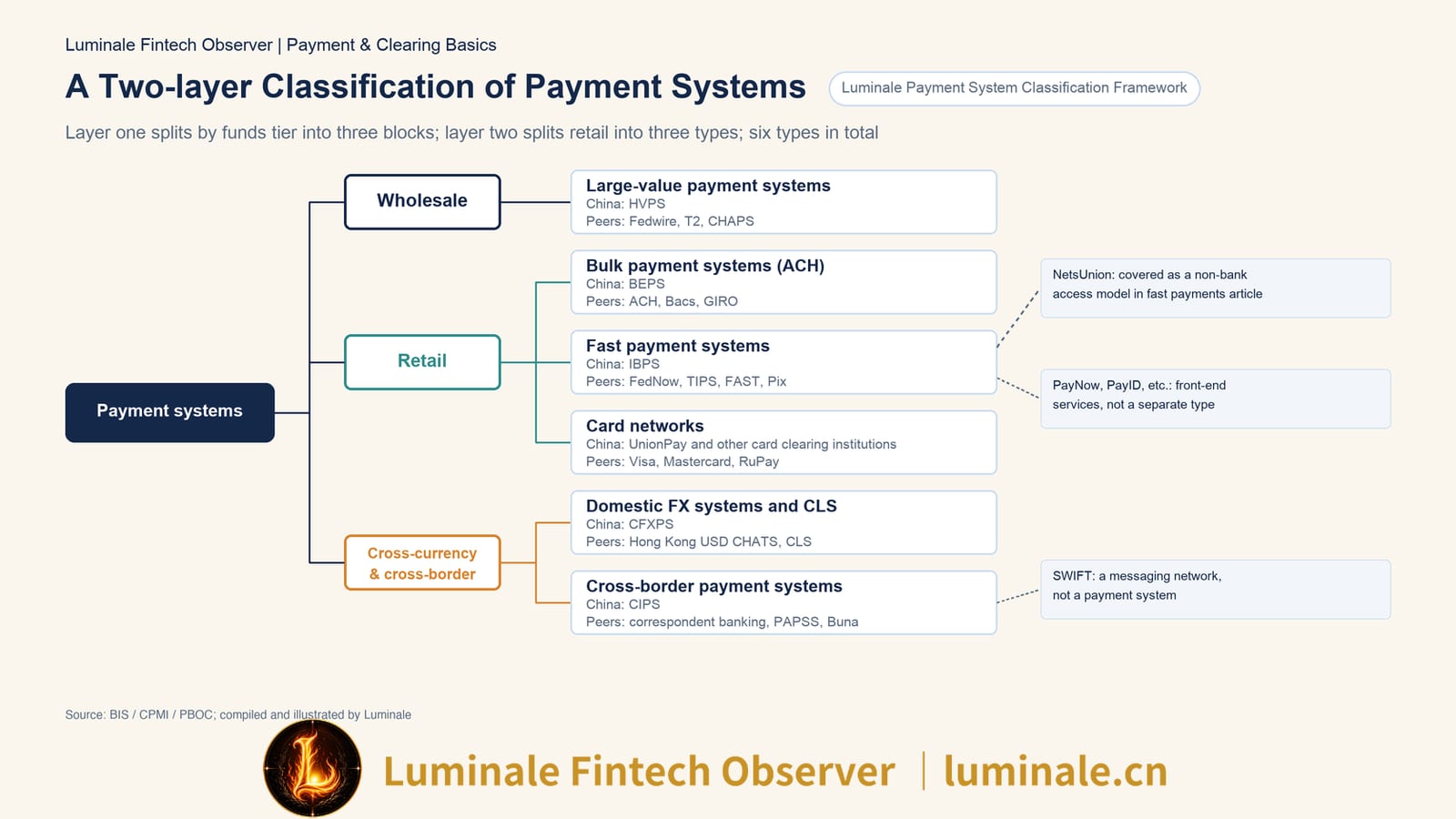
1. A Two-Layer Classification
The first layer splits systems by funds tier into three blocks:
- Wholesale: between financial institutions, large in value, mostly settled in central bank money;
- Retail: initiated by individuals and businesses, high in volume, small per payment;
- Cross-currency and cross-border: payments whose settlement asset is not domestic central bank money, and funds transfers that cross jurisdictions.
The second layer applies only to retail and is based on how payments are initiated, how fast they arrive and who clears them. It splits retail into bulk payments, fast payments and card networks.
That gives six types of system: one wholesale, three retail, and two cross-currency and cross-border. Each type gets its own article in this series.
| First layer | Second layer | Role | Chinese counterpart |
|---|---|---|---|
| Wholesale | Large-value payment systems | Large payments between financial institutions, settled gross and with finality in central bank money; the net positions of other systems are settled here | HVPS |
| Retail | Bulk payment systems | Submitted in batches and netted at set times; handle payroll, collections, authorised direct debits and bills | BEPS |
| Retail | Fast payment systems | Processed one by one, available around the clock, funds in seconds | IBPS |
| Retail | Card networks | Authorisation and clearing networks built around card numbers or payment tokens, settled net daily | UnionPay and other bank card clearing institutions |
| Cross-currency and cross-border | Domestic foreign-currency systems and CLS | How to settle currencies the domestic central bank cannot issue, and how to deliver both legs of an FX trade at the same time | CFXPS |
| Cross-currency and cross-border | Cross-border payment systems | Which route money takes out of the country: correspondent banks, single-currency cross-border clearing systems, regional platforms | CIPS |
2. What the Six Types Are
The large-value payment system is the last stop in a country's payment system. Interbank lending, the cash legs of money market transactions, funds settlement for securities settlement systems and central counterparties, central bank open market operations, large corporate remittances, and the net positions produced by retail systems are all settled here in the end. Most are operated by central banks and use RTGS. There are also privately operated large-value systems, such as CHIPS in the United States and EURO1 in the euro area.
Bulk payment systems are usually called automated clearing houses (ACH) internationally, and GIRO in some economies. They bundle payments into batches, net them by cycle and settle the net amounts in the large-value system. Payroll, collection of utility and insurance bills, and scheduled debits under authorisation are their main business. The US ACH, the UK's Bacs, Singapore's GIRO and India's National Electronic Funds Transfer (NEFT) all belong to this type.
Fast payment systems (FPS) process payments one by one, run around the clock, and let payees use funds within seconds. China's IBPS, RTP and FedNow in the United States, TIPS in the euro area, the UK's Faster Payments, Singapore's FAST, Hong Kong's FPS, Brazil's Pix, India's Immediate Payment Service (IMPS) and Unified Payments Interface (UPI), and South Africa's PayShap all belong to this type.
Card networks are built around card numbers or payment tokens. They have two stages, online authorisation and batch clearing, settle on a daily net basis, and include chargebacks, dispute handling and interchange fees, which account-to-account systems do not have. UnionPay, Visa, Mastercard, American Express, JCB and domestic card networks such as India's RuPay belong to this type. For the four-party model of card networks, see When You Swipe $100, Who Does It Pass Through? A Guide to Issuers, Acquirers, Card Networks, and Merchants.
The problem a domestic foreign-currency payment system solves is this: the domestic central bank can provide settlement accounts only in its own currency, so how are foreign-currency payments within the country settled? China's China Foreign Exchange Payment System (CFXPS) is operated by the PBOC's China National Clearing Center, with designated commercial banks acting as settlement banks for each currency. In Hong Kong, besides the Hong Kong dollar, there are three more CHATS systems, for the US dollar, the euro and the renminbi. The problem of delivering both currencies in an FX trade at the same time is handled by CLS Bank International (CLS) on a payment-versus-payment (PvP) basis; for the mechanics, see What Is the Most Dangerous Moment in FX? Why PvP Is the Market's "Payment-versus-Payment". Both issues arise because the settlement asset is not domestic central bank money, so they are covered in the same article.
Cross-border payment systems fall into three models: correspondent banking chains plus a messaging network; single-currency cross-border clearing systems such as the Cross-border Interbank Payment System (CIPS) for the renminbi; and regional multi-currency or shared platforms such as Buna of the Arab Monetary Fund, the Pan-African Payment and Settlement System (PAPSS) of Afreximbank, and SADC-RTGS of the Southern African Development Community.
3. Why Classify This Way
There are two reasons domestic and foreign currency are not used as the first layer. Most economies have no domestic foreign-currency system, so this type cannot stand as a block on its own. And the essence of the foreign-currency problem is that the settlement asset is not domestic central bank money, which is the same problem cross-border payments face, so it fits better in the same block.
NetsUnion does not get a type of its own. The NetsUnion Clearing platform for online payments by non-bank payment institutions (NetsUnion for short) handles online payments initiated by payment institutions that involve bank accounts. What it does is switching and netting, and the funds are finally settled through the HVPS. For how NetsUnion and UnionPay divide the work, see What Do NUCC and UnionPay Actually "Clear"? The Middle Layer of Payment Clearing, Explained. Functionally, it sits in the same retail clearing layer as card networks. Looking across countries, few economies have built a separate clearing platform for non-banks; the more common approach is to let non-banks connect to the fast payment system directly or indirectly. Singapore, for example, has allowed licensed major payment institutions to connect directly to FAST and PayNow since February 2021[3]. NetsUnion is therefore covered in the fast payments article as one model of non-bank access, compared with direct access.
4. Some Boundary Cases
Some systems are not easy to classify.
CHIPS is a private large-value system that also clears a large share of US dollar cross-border payments. By function it belongs with large-value payment systems, and it will come up again in the cross-border article.
The euro area's T2 covers many countries but only one currency, the euro, and all participants settle within the same central banking system, so it counts as a large-value payment system rather than a cross-border one.
The Society for Worldwide Interbank Financial Telecommunication (SWIFT) carries payment messages. It does not open funds accounts for banks or complete funds settlement, so it is not a payment system; in the cross-border article it appears as the messaging network in correspondent banking chains. For the relationship between correspondent banks and SWIFT, see What Really Happens in a Cross-Border Payment? Correspondent Banking, SWIFT, and Global Payments Reform.
UPI contains both rules and clearing, while the app users see belongs to front-end services. Names like this, which have both a front end and a back end, need to be separated using the three-layer structure in Section IV.
5. Comparison Table for Major Economies
The table below lists representative systems in major economies by the six types and serves as an index for the whole series. It gives system names only; later articles cover each in turn. Items in brackets are front-end or addressing services built on top of a system; they are not separate clearing systems themselves.
| Economy | Large-value | Bulk | Fast payments | Card networks | Domestic foreign currency / cross-border |
|---|---|---|---|---|---|
| Chinese mainland | HVPS | BEPS | IBPS; NetsUnion (non-banks) | UnionPay and other bank card clearing institutions | CFXPS; CIPS |
| United States | Fedwire Funds; CHIPS | FedACH, EPN | RTP, FedNow | Visa, Mastercard, American Express, Discover | CHIPS and correspondent banks |
| Euro area | T2; EURO1 | STEP2 and other SEPA bulk clearing | TIPS, RT1 | International card networks; Cartes Bancaires, girocard, etc. | Correspondent banks |
| United Kingdom | RTGS/CHAPS | Bacs | Faster Payments | International card networks | Correspondent banks |
| Japan | BOJ-NET | Zengin System | Zengin System (24/7 part) | JCB, etc. | Foreign Exchange Yen Clearing System |
| Hong Kong | HKD CHATS | / | FPS | International card networks, UnionPay | USD, EUR and RMB CHATS |
| Singapore | MEPS+ | GIRO | FAST (PayNow, SGQR) | International card networks, NETS | Correspondent banks |
| India | RTGS | NEFT, NACH | IMPS, UPI | RuPay | Correspondent banks |
| Brazil | STR | Pix | Elo, etc. | Correspondent banks | |
| Australia | RITS | BECS | NPP (PayID, Osko) | eftpos | Correspondent banks |
| South Africa | SAMOS | EFT bulk | PayShap | International card networks | SADC-RTGS |
| International / regional | / | / | Nexus (in preparation) | / | CLS; Buna, PAPSS |
Compared with the global comparison table in What Exactly Is a Payment System?, this table splits retail into three columns, gives foreign currency and cross-border their own column, and expands the economies covered from six to eleven, so that later articles can fill in each cell.
IV. Three Layers in One Payment: Infrastructure, Scheme Rules and Front-End Services
1. The Three-Layer Structure
The most common confusion in classification is listing names from different layers side by side in one table. Some people, for example, list PayNow, FAST and GIRO as Singapore's three payment systems, or Alipay, NetsUnion and UnionPay as China's three payment networks.
A retail payment usually passes through three layers at once:
- Front-end services: the entry points users see, such as mobile banking, payment apps, proxy addressing that uses a mobile number instead of an account number, and QR codes;
- Scheme rules: the rights and obligations among participants, message standards, processing time limits, value limits and dispute handling;
- Clearing and settlement: transmitting payment instructions, netting, and completing the transfer of funds on settlement accounts.
This kind of layering was already common as countries built fast payments. The CPMI's 2016 report on fast payments describes two examples[4]. When Europe pushed forward instant payments in euros, it explicitly took a layered approach: the scheme layer is the instant credit transfer rulebook drawn up by the European Payments Council (SEPA Instant Credit Transfer, SCT Inst); beneath it are the clearing and settlement layers that process transactions and discharge the obligations; and on top are end-user solutions, such as mobile payments, developed cooperatively or competitively by the market. Australia's New Payments Platform (NPP) was designed in two parts, basic infrastructure and overlay services: the infrastructure connects participating institutions, and overlay services are tailored payment services that participants can choose to offer their customers.
2. The Three Layers in Several Economies
| Economy | Front-end services | Scheme rules | Clearing | Settlement |
|---|---|---|---|---|
| Singapore | PayNow, SGQR, bank apps | Singapore Clearing House Association (FAST), Association of Banks in Singapore (PayNow) | FAST | MEPS+ |
| China | Mobile banking, Alipay, WeChat Pay | Rules of the PBOC and clearing institutions | IBPS, NetsUnion, UnionPay | HVPS |
| India | BHIM, PhonePe and other apps; virtual payment addresses | UPI rules of the National Payments Corporation of India (NPCI) | UPI | Reserve Bank of India RTGS |
| Australia | PayID, Osko, bank apps | NPP rules | NPP | RBA Fast Settlement Service |
| Card payments | Wallets such as Apple Pay | Card network rules | Card networks | Settlement banks or central bank systems |
For the rule-setters in Singapore, see the MAS announcement[3]; for settlement in Australia, see the Reserve Bank of Australia's description[5].
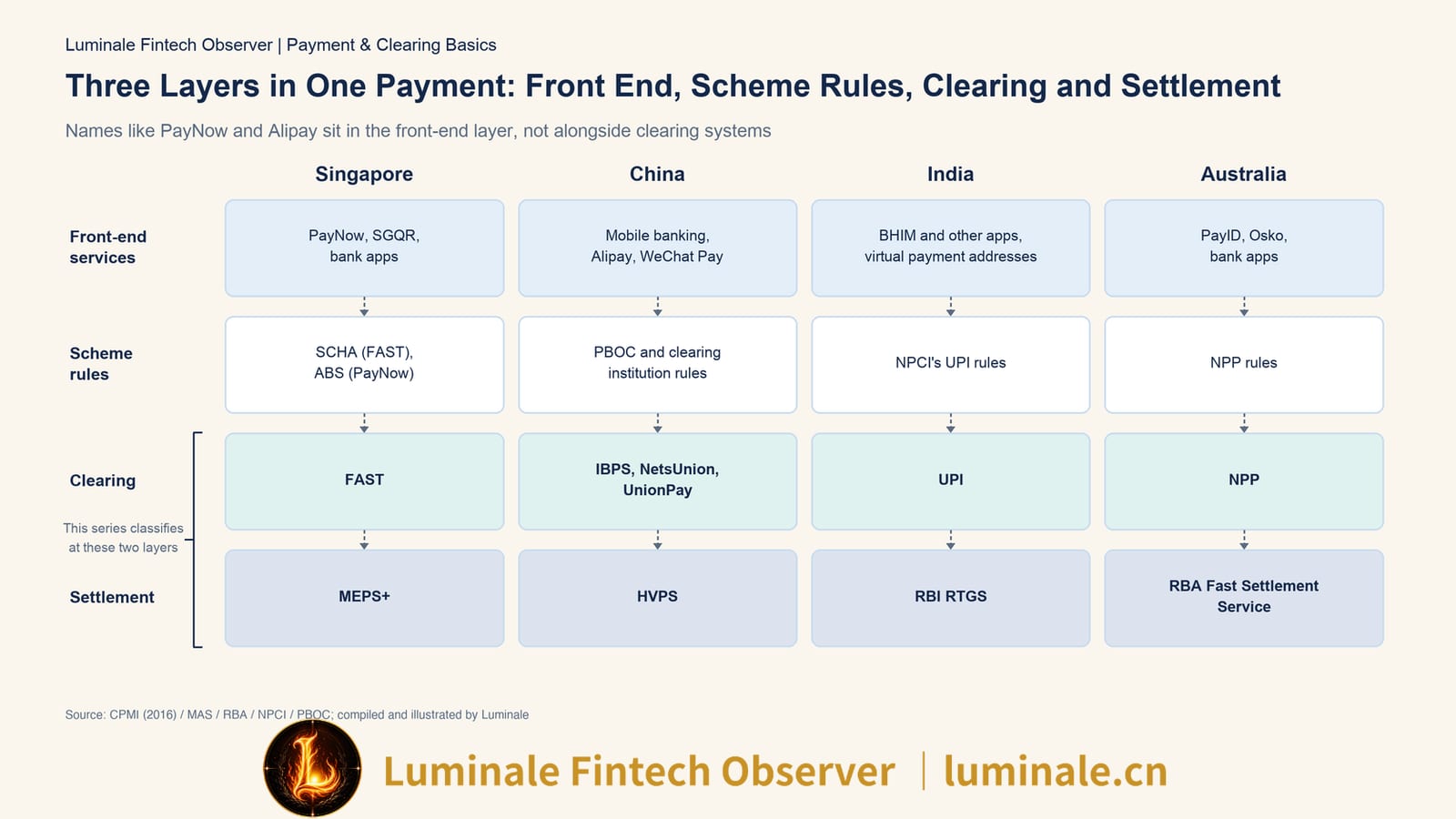
Take Singapore. FAST is a fast payment system launched in March 2014 that handles instant transfers between banks[6]. PayNow is built on top of FAST and lets users send and receive money using a mobile number, national ID number or business registration number instead of a bank account number. SGQR is a unified QR code standard. Interbank positions are ultimately settled on MEPS+, the RTGS system of the Monetary Authority of Singapore. PayNow is an overlay service and is not a separate payment system in its own right. GIRO, like FAST, is a clearing system; it simply handles batch business.
In the same way, Alipay and WeChat Pay belong in this framework to front-end services and payment account providers. When a user pays from Alipay into an account at another bank, the front end is Alipay, clearing happens in NetsUnion, and the funds are finally settled through the HVPS between the banks'accounts at the central bank. Apple Pay uses a payment token in place of the real card number. What changes is the payment credential; authorisation and clearing are still done by the card network. For details, see What Happens Behind an Apple Pay Transaction? From Payment Token to Card Clearing.
3. Which Layer "Funds Received in Seconds" Happens In
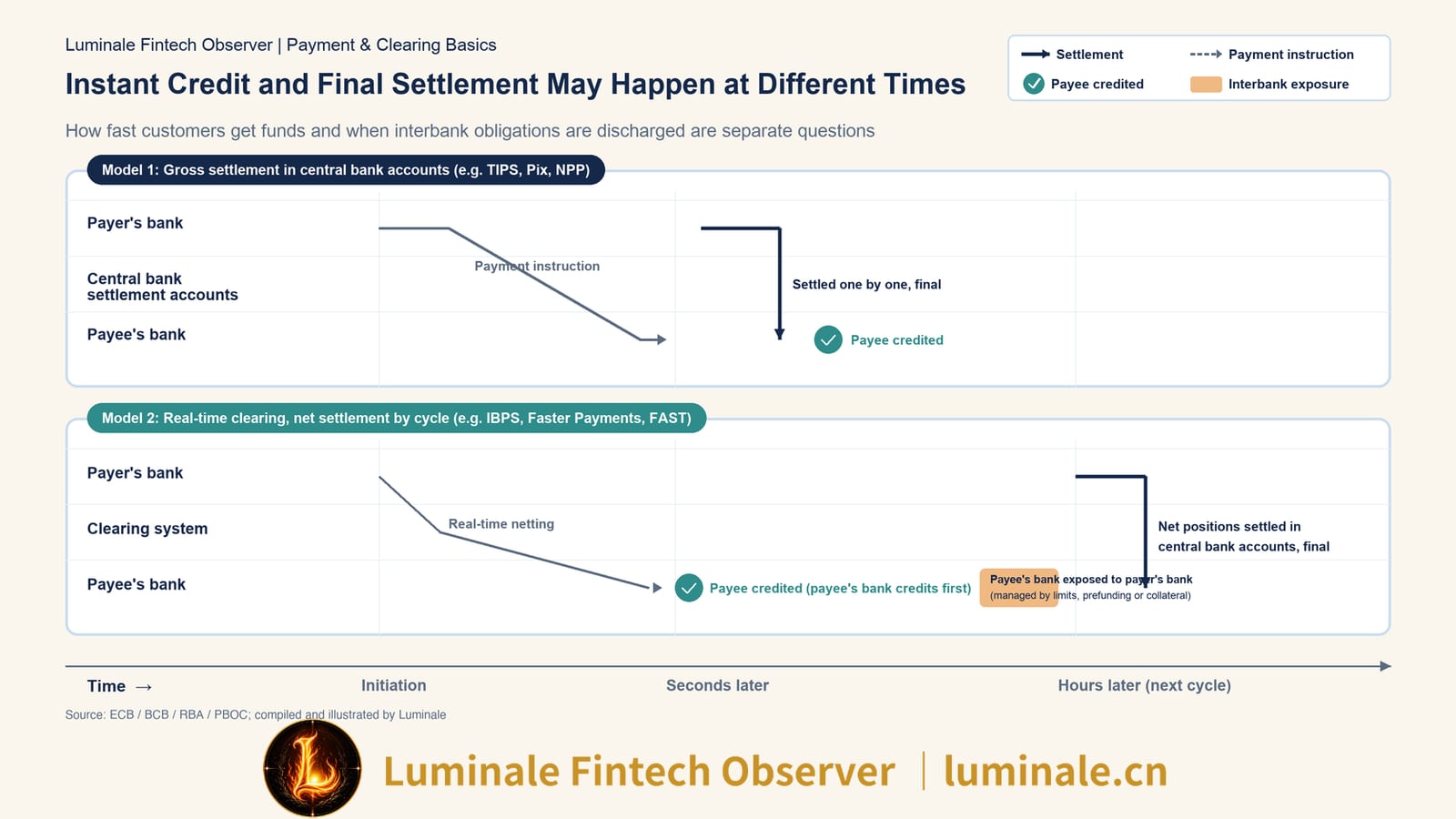
The "funds received" message a user sees happens at the front end and the payee's bank: the payee's bank has credited its customer. When banks settle with each other depends on the clearing and settlement layer, and there are two main arrangements:
- Gross settlement on central bank accounts. TIPS, Brazil's Pix and Australia's NPP work this way; each NPP payment is settled individually, around the clock and in close to real time by the Reserve Bank of Australia's Fast Settlement Service[5][7][8];
- Real-time clearing with net settlement by cycle. China's IBPS, the UK's Faster Payments and Singapore's FAST belong to this group. The payee's bank credits its customer before settlement is complete, which means it carries an exposure to the payer's bank during that period, and the system uses limits, prefunding or collateral to control that risk.
4. How the Three Layers Relate to the Classification
The six types in this series are defined at the clearing and settlement layer. Front-end services are not a type of their own. Addressing services such as PayNow, PayID, Pix keys and UPI virtual payment addresses will be covered together in the fast payments article, and wallets such as Apple Pay in the card networks article.
Non-banks can also be placed in this framework. In most economies, payment institutions provide front-end services, and rely on banks or a dedicated clearing platform for funds and clearing. Some economies allow them to connect directly to the fast payment system or even to open settlement accounts at the central bank. China's approach is centralised safeguarding of payment institutions'customer reserve funds, with online payments cleared through NetsUnion (see Is Money in Alipay the Same as Money in a Bank Account? A Clear Explanation of "Customer Reserve Funds"); in Singapore and the UK, licensed institutions connect directly to the fast payment system. Which institutions can open accounts at the central bank is discussed in Who Can Hold an Account at the Central Bank? Decoding the Account Hierarchy and Settlement Infrastructure.
V. Seven Questions for Reading Any Payment System, and How to Read This Series
1. Seven Questions
Any payment system can be read through the following seven questions. Each later article in the series follows the same order.
- Role and boundaries: what problem does it solve, and how does it divide work with neighbouring systems?
- Operation and rules: who operates it, who sets the rules, and who oversees it?
- Participation and access: who can participate directly, who only indirectly, how do they connect, and can non-banks get in?
- Business types: what business does it handle?
- How the money moves: how does a payment go from initiation through clearing to settlement, is the settlement asset central bank money or commercial bank money, and is settlement gross or net by cycle?
- International comparison: which systems are its counterparts in major economies, and which features deserve a closer look?
- Direction of change: where is it heading, towards upgrading the existing system, building a new one, or interlinking with other systems?
2. Walking Through Singapore's FAST
| Question | FAST |
|---|---|
| Role and boundaries | Instant transfer system for Singapore dollars, running around the clock; large payments go through MEPS+, bulk payroll and collections through GIRO |
| Operation and rules | Rules are overseen by the Singapore Clearing House Association and the system is supervised by MAS; PayNow, built on top of it, is overseen by the Association of Banks in Singapore |
| Participation and access | Participants are mainly banks; since February 2021, licensed major payment institutions can connect directly through a common application programming interface (API) gateway |
| Business types | Personal and business transfers; proxy addressing and QR payments through PayNow and SGQR |
| How the money moves | Cleared one by one with instant credit to payees; interbank positions are settled net by cycle on MEPS+ |
| International comparison | Counterparts include the UK's Faster Payments, Hong Kong's FPS and China's IBPS |
| Direction of change | Mainly interlinking: linked with Thailand's PromptPay in 2021, later connected to more regional corridors, and participating in the multilateral hub Nexus |
For how FAST was linked with PromptPay, see From PayNow–PromptPay to Payment Connect: How Fast Payment Systems Turn into Cross-Border Networks.
3. Series Roadmap
| Order | Type | Working title | Question to answer |
|---|---|---|---|
| 1 | Large-value payment systems | How Do Large Sums Move between Banks? Understanding Large-Value Payment Systems | Why money from every system is settled here in the end |
| 2 | Fast payment systems | What Makes 24/7 Instant Payments Possible? Understanding Fast Payment Systems | Three settlement models and two non-bank access models |
| 3 | Bulk payment systems | Why Don't Salaries, Utility Bills and Direct Debits Need to Arrive Instantly? Understanding Bulk Payment Systems | Why bulk systems survive when instant payments exist |
| 4 | Card networks | Why Can One Card Be Used in Two Hundred Countries? Understanding Bank Card Clearing Networks | Authorisation, clearing and settlement, and domestic card networks |
| 5 | Domestic foreign-currency systems and CLS | How Is Money the Domestic Central Bank Cannot Issue Settled? Understanding Domestic Foreign-Currency Payment Systems and CLS | What it means for commercial banks to act as settlement banks |
| 6 | Cross-border payment systems | Which Route Does Money Take Out of the Country? Understanding Correspondent Banking, Cross-Border Clearing Systems and Regional Payment Platforms | The three cross-border models |
| 7 | Finale | Build Anew, Upgrade or Interlink: Where Payment Systems Are Heading as Finance Tokenises | Why different types choose different paths |
4. Three Paths of Change
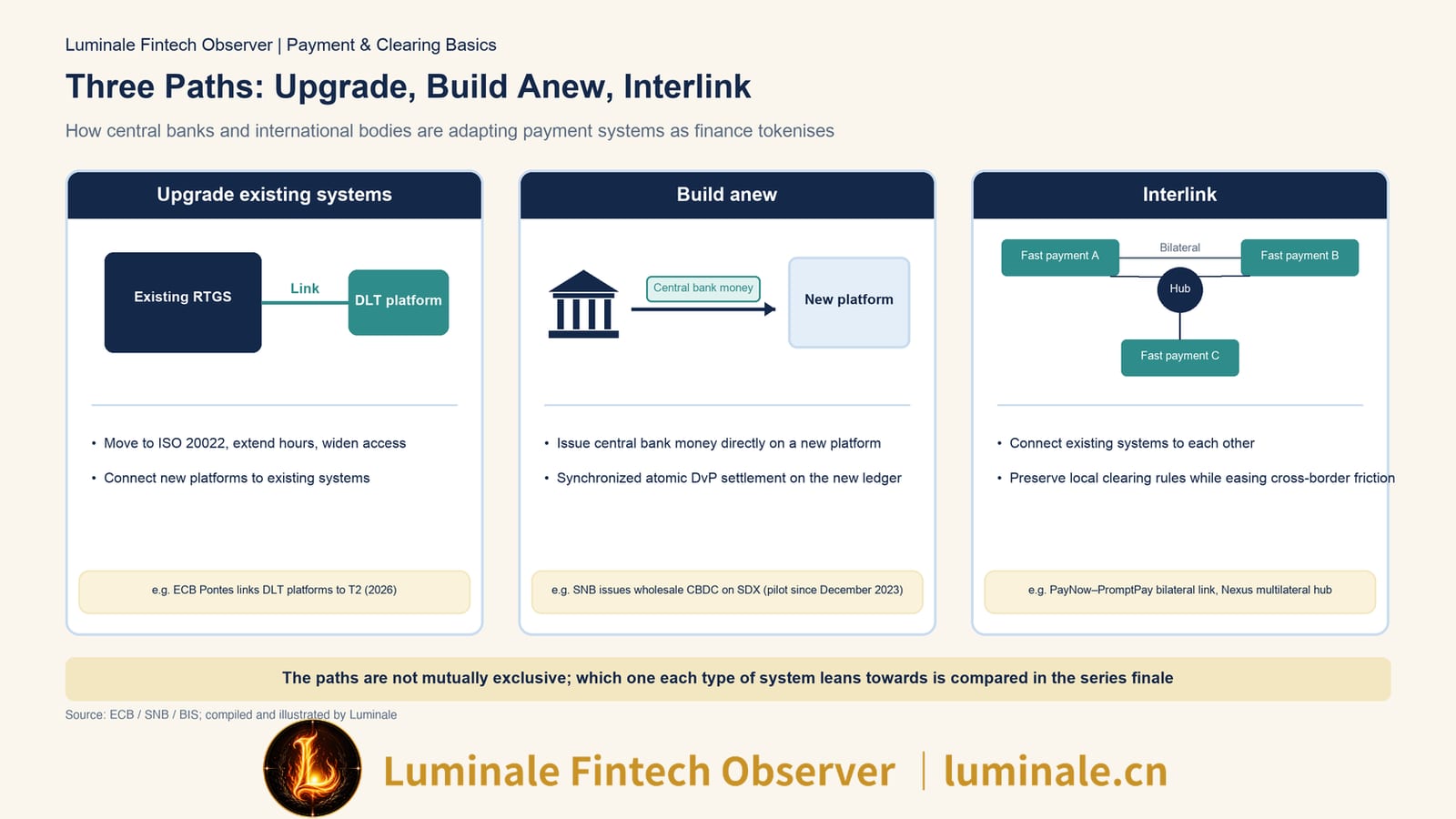
The seventh question is especially worth asking against the backdrop of tokenised finance. What central banks and international bodies are doing can broadly be grouped into three paths:
- Upgrade existing systems: migrate to the ISO 20022 messaging standard (see What Is ISO 20022? Understanding the Common Language of Next-Generation Payment Infrastructure), extend operating hours, widen direct access, or connect new distributed ledger technology (DLT) platforms to existing systems. Pontes, launched by the European Central Bank in 2026, links DLT platforms to T2 so that on-chain transactions can be settled in central bank money[9]; for background, see From Pontes to Appia: How Europe Is Rebuilding the "Cash Leg" for Tokenised Securities;
- Build anew: issue central bank money directly on a new platform. Since December 2023, the Swiss National Bank has been piloting wholesale central bank digital currency issued on SIX Digital Exchange (SDX)[10];
- Interlink: connect existing systems with one another. Bilateral links between fast payment systems, and the multilateral hub Nexus promoted by central banks including those of Singapore, Malaysia and Thailand, follow this path; for the design of Nexus, see From Bilateral Linkages to Multilateral Network: How Nexus Rearchitects Instant Cross-Border Payments.
The three paths are not mutually exclusive, and different types of system lean in different directions. Which path large-value systems, fast payments, card networks and cross-border systems each favour is left for the final article in the series.
Conclusion
Back to the company at the start. Its seven payments took different systems because each had different requirements for safety, speed, cost and currency, and the payment system has divided the work according to those requirements.
Classifying payment systems gives us a place to start when we meet an unfamiliar name. First, work out which layer it sits in: front-end services, scheme rules, or clearing and settlement. Then work out which type it belongs to: wholesale, one of the retail types, or cross-currency and cross-border. Finally, read it through the seven questions. New technology will keep bringing new names, but as long as we ask which layer it changes and what the final settlement asset is, most names will fit into this framework.
The next article introduces large-value payment systems. All the systems mentioned above ultimately settle their money there.
References
[1]: People's Bank of China, 2025 Payment System Overview (Chinese), February 2026; English version Payment System Report (2025). Chinese index page http://www.pbc.gov.cn/zhifujiesuansi/128525/128545/128643/index.html ; English version https://www.pbc.gov.cn/en/3688241/3688663/3688681/5638391/2026030411230367263/2026030411225362669.pdf ↩
[2]: CPMI, A glossary of terms used in payments and settlement systems. https://www.bis.org/cpmi/publ/d00b.htm ↩
[3]: Monetary Authority of Singapore, Non-Bank Financial Institutions to have Access to FAST and PayNow, 2020-11-30. https://www.mas.gov.sg/news/media-releases/2020/non-bank-financial-institutions-to-have-access-to-fast-and-paynow ↩
[4]: CPMI, Fast payments: enhancing the speed and availability of retail payments, November 2016. https://www.bis.org/cpmi/publ/d154.htm ↩
[5]: Reserve Bank of Australia, New Payments Platform. https://www.rba.gov.au/payments-and-infrastructure/new-payments-platform/ ↩
[6]: Monetary Authority of Singapore, Payment Systems. https://www.mas.gov.sg/regulation/payments/payment-systems ↩
[7]: European Central Bank, TARGET Instant Payment Settlement (TIPS). https://www.ecb.europa.eu/paym/target/tips/html/index.en.html ↩
[8]: Banco Central do Brasil, Pix. https://www.bcb.gov.br/en/financialstability/pix_en ↩
[9]: European Central Bank, Pontes. https://www.ecb.europa.eu/paym/target/pontes/html/index.en.html ↩
[10]: Swiss National Bank, SNB launches pilot project with central bank digital currency for financial institutions, 2023-11-02. https://www.snb.ch/en/publications/communication/press-releases/2023/pre_20231102 ↩
Originally published by Luminale Fintech Observer: https://luminale.cn/articles/payment-system-types-wholesale-retail-cross-border-en