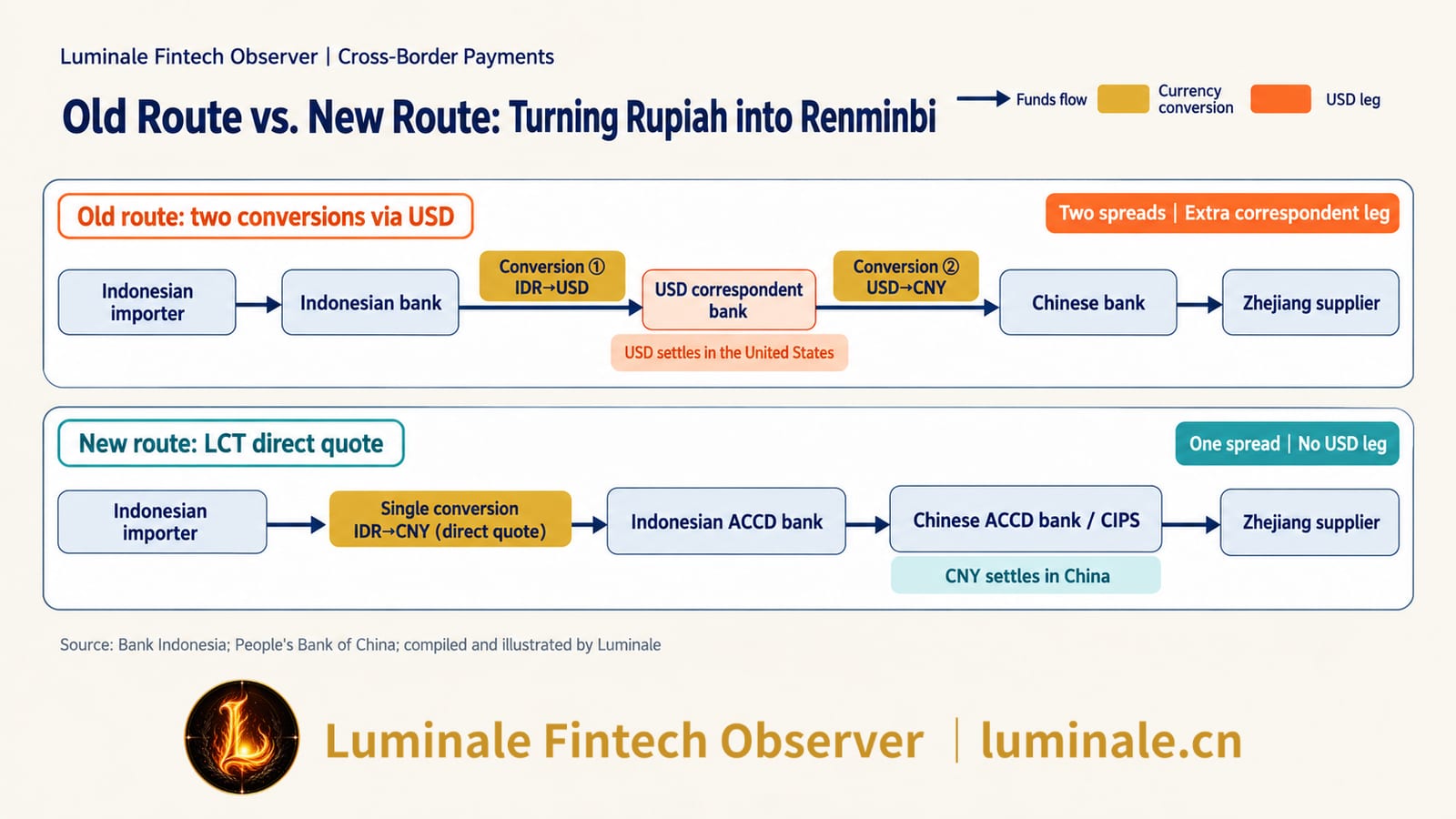
A furniture factory in Jakarta procures hardware components every month from a manufacturer in Zhejiang, with the sales contract invoiced in renminbi (RMB). A few years ago, the factory's treasury had to execute two separate foreign exchange conversions to settle this invoice: first converting Indonesian rupiah (IDR) into US dollars (USD) at an Indonesian bank, and then having the bank convert USD into RMB to remit to the Chinese supplier. Each conversion incurred a bid-ask spread, and the dollar leg required routing through correspondent banks. Today, the factory's bank can directly quote an IDR/RMB rate, enabling the factory to purchase RMB directly from its rupiah account to execute the payment.
Behind this operational shift lies a cluster of institutional arrangements often mentioned in tandem: the China-Indonesia bilateral local currency swap, the Local Currency Settlement (LCS) cooperation framework and its upgraded successor, the Local Currency Transaction (LCT) framework, the designated RMB clearing bank, the Cross-border Interbank Payment System (CIPS), and cross-border QR code interoperability. Because these arrangements frequently appear in the same news reports, readers can easily conflate them as parts of a single monolithic mechanism.
Following the lifecycle of that procurement payment, this article examines the specific operational layer at which each arrangement functions, traces how funds move across bank accounts and domestic payment systems, and identifies what local currency settlement genuinely eliminates—and what frictions remain.
I. Currency Swaps, Local Currency Settlement, and Clearing Banks: Three Distinct Layers
1. Four Deliverables from a Single Governors'Meeting
On 11 June 2026, the People's Bank of China (PBOC) and Bank Indonesia (BI, the central bank of Indonesia) convened the second Governors'Meeting under their Joint Working Mechanism in Shanghai. Key deliverables announced at the meeting included: a Memorandum of Understanding (MoU) signed by both central banks on establishing RMB clearing arrangements in Indonesia; a tripartite MoU on LCT cooperation signed by the PBOC, Bank Indonesia, and the Hong Kong Monetary Authority (HKMA); Bank Mandiri becoming a direct participant in CIPS; and the commercial launch of China-Indonesia cross-border QR code interoperability[1][2]. Both sides also agreed to explore expanding the size of their bilateral currency swap agreement[2]. Two weeks later, the PBOC officially authorized Bank of China (Hong Kong) Limited Jakarta Branch to serve as the RMB clearing bank in Indonesia[3].
A single meeting encompassed currency swaps, the local currency transaction framework, clearing banks, interbank payment systems, and retail payments across five distinct dimensions. While these arrangements share a common objective—enabling bilateral commerce to bypass the US dollar—they are executed by different entities and operate across entirely separate layers.
2. The Three Layers
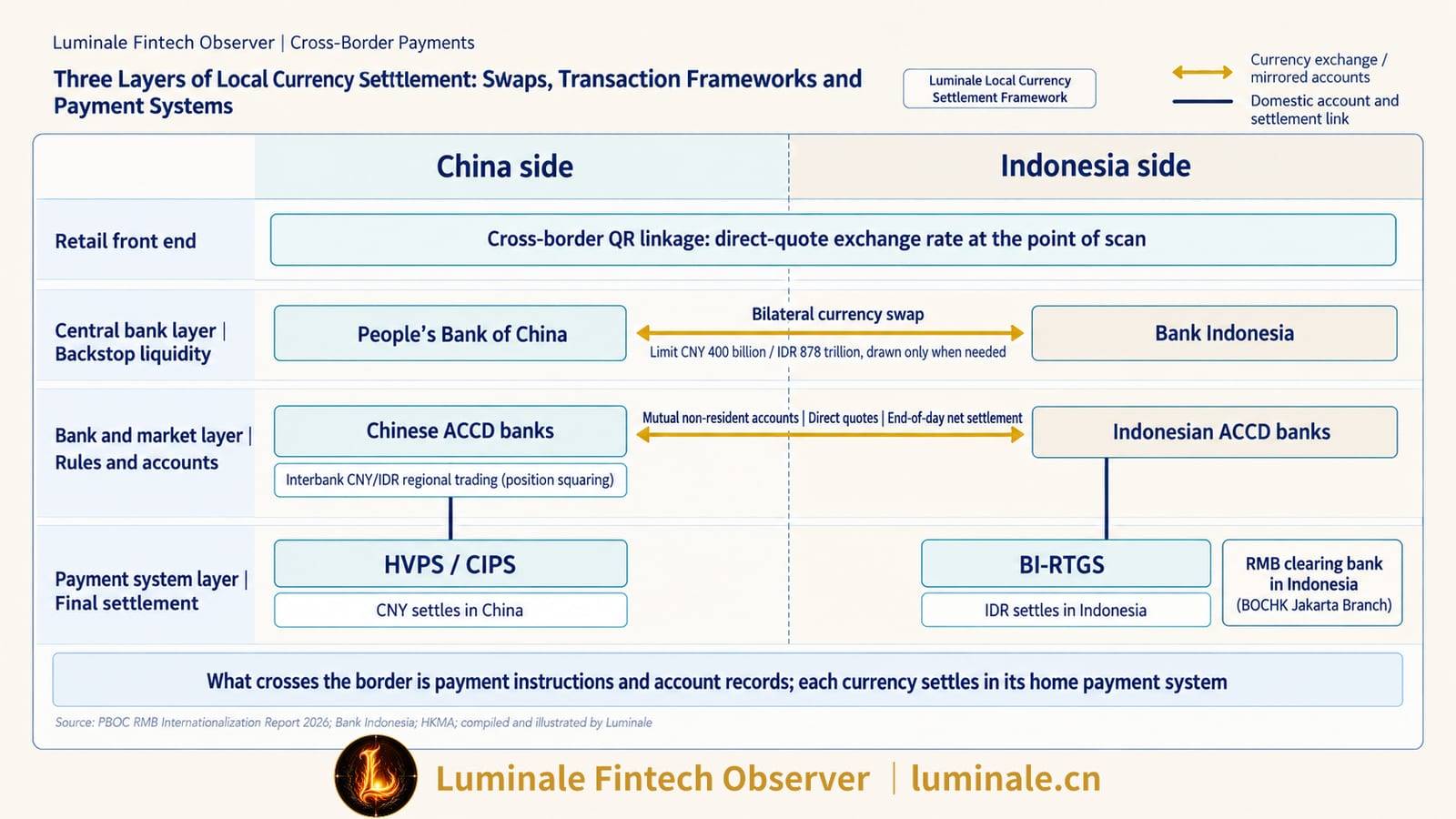
Categorized by where funds and accounts physically reside, these arrangements fall into three primary layers.
At the apex is the central bank layer. A bilateral currency swap is a sovereign agreement between two central banks pledging to exchange local currencies under pre-agreed conditions. It governs whether a nation's financial system can access foreign currency liquidity during periods of stress, functioning effectively as a standby liquidity facility.
In the middle is the banking and market layer. Under the LCS/LCT framework, the two central banks jointly designate a cohort of commercial banks, authorizing them to open reciprocal local currency accounts in each other's jurisdiction, provide direct exchange rate quotations between the two local currencies, and process FX conversions, cross-border payments, and hedging transactions for corporate clients under relaxed regulatory rules. The trading of RMB against Indonesian rupiah in China's interbank foreign exchange market also resides at this layer, providing commercial banks with an onshore wholesale venue to square their foreign exchange positions.
At the foundation is the payment system layer. Indonesian rupiah ultimately settles within Bank Indonesia's Real-Time Gross Settlement system (BI-RTGS), whereas renminbi ultimately settles within Mainland China through the High-Value Payment System (HVPS) or CIPS. For the fundamental distinction between real-time gross settlement and deferred net settlement, refer to Why Don't Payment Systems Settle Every Payment Immediately? Understanding RTGS and DNS. An offshore RMB clearing bank serves as an external clearing node, helping local financial institutions obtain RMB accounts, settlement rails, and liquidity within their local time zone.
Front-facing cross-border QR code payments reside at the retail periphery; the exchange rate consumers see when scanning a merchant code is derived directly from the middle layer's direct quotations.
3. "Local Currency Settlement" in the News Can Mean Three Different Things
In Chinese-language and regional media, the term "local currency settlement" is frequently used in three distinct contexts.
First, it broadly denotes the use of RMB or the counterparty's currency in cross-border settlement—commonly known as cross-border RMB business—regardless of whether a bespoke bilateral cooperation framework exists.
Second, it refers specifically to the formal LCS/LCT frameworks initiated and championed by Bank Indonesia, which feature a designated bank licensing regime, specialized reciprocal account structures, and explicit operational guidelines. This article primarily focuses on this framework.
Third, it designates bilateral local currency settlement or cooperation agreements signed between the PBOC and foreign monetary authorities. For instance, in 2011 China and Russia signed a revised bilateral local currency settlement agreement allowing economic entities to freely choose freely convertible currencies, RMB, or Russian rubles for trade settlement. Similarly, in 2020 and 2021, the PBOC signed bilateral local currency cooperation agreements with the Bank of the Lao PDR and the National Bank of Cambodia, respectively, allowing the direct use of both domestic currencies in authorized current and capital account transactions[3]. These agreements primarily liberalize the permissible choice of invoicing currencies without establishing designated market-making banks or specialized non-resident account structures.
4. Comparing the Key Arrangements
| Arrangement | Signatories | Operational Layer | Problem Solved | What It Does Not Address |
|---|---|---|---|---|
| Bilateral Currency Swap | Central banks of both nations | Central bank layer | Supplies foreign currency liquidity when domestic banks face shortages | Does not set market prices; does not process commercial payments |
| LCS/LCT Framework | Central banks sign MoUs and issue operational guidelines | Banking and market layer | Appoints designated banks, reciprocal local currency accounts, direct quotations, and relaxed FX rules | Does not construct new clearing rails |
| Regional Interbank Market Trading | Approved by PBOC, organized by CFETS | Banking and market layer | Establishes executable onshore wholesale prices for RMB/IDR | Market liquidity depth depends on participating banks |
| RMB Clearing Bank | Authorized by PBOC to a local bank branch | Payment system layer | Provides local banks with direct access to RMB accounts, clearing, and liquidity | Does not handle the counterparty currency leg |
| BI-RTGS, HVPS, CIPS | Independently operated by respective sovereign nations | Payment system layer | Completes final settlement in central bank money within each domestic jurisdiction | Lacks cross-border synchronization between the two currency legs |
| Cross-Border QR Code Interoperability | Spearheaded by central banks; switches and payment providers participate | Retail front-end | Enables consumers to scan and pay at direct-quoted retail exchange rates | Backend net positions must still be settled by designated settlement banks |
II. Bilateral Currency Swaps: Standby Liquidity Between Central Banks
1. What a Swap Agreement Entails
According to the PBOC's official definition, a bilateral local currency swap is an agreement between two central banks or monetary authorities stipulating that, under pre-agreed conditions, either party may exchange a specified amount of its domestic currency for an equivalent amount of the counterparty's currency. These funds are intended to settle bilateral trade and investment or provide short-term liquidity support to financial markets; upon maturity, both parties swap back the principal amounts and settle corresponding interest[3].
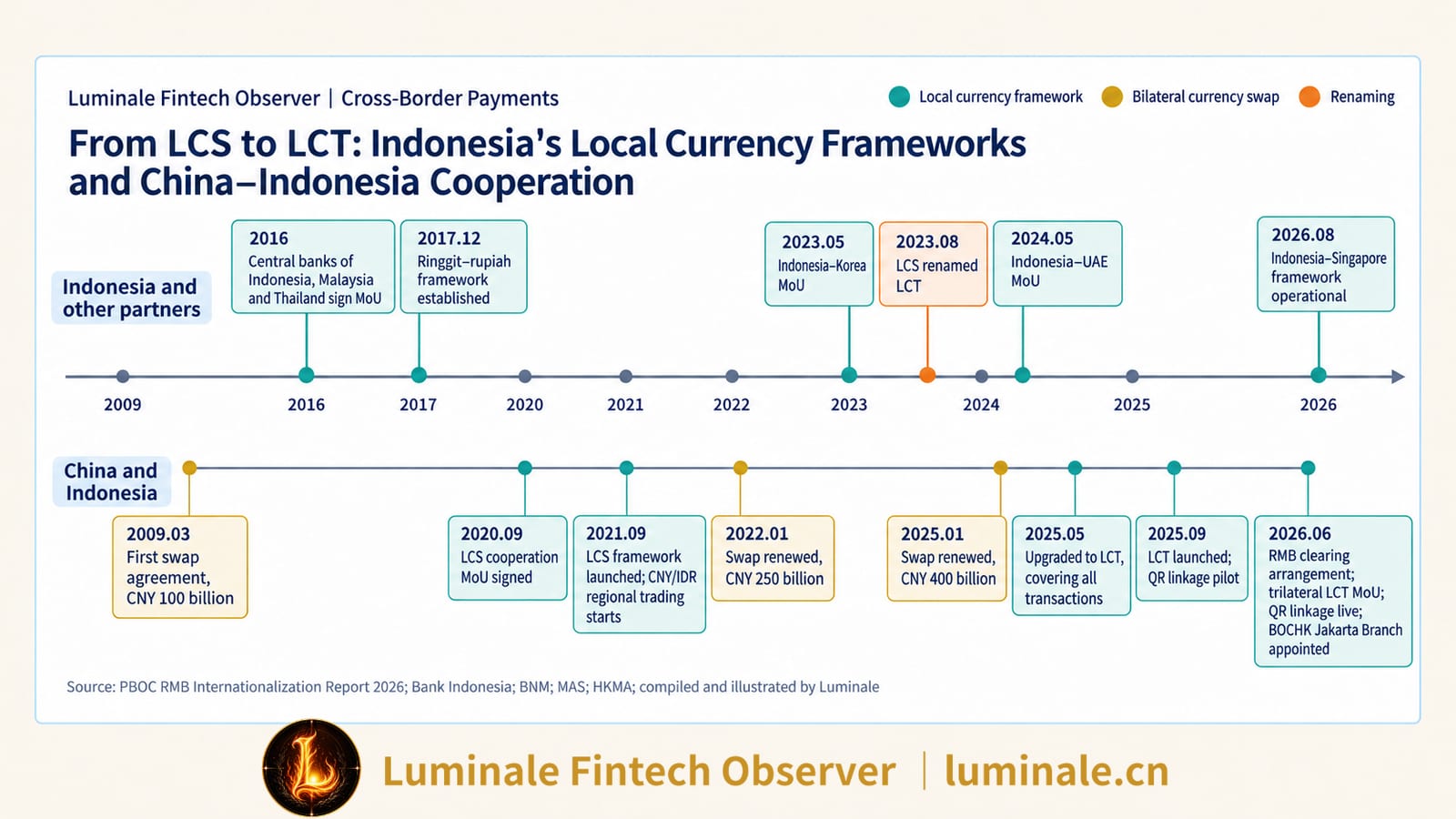
The bilateral swap agreement between China and Indonesia was first signed in March 2009 with a size of RMB 100 billion / IDR 175 trillion. It was renewed in 2013 at the same scale, expanded in 2018 to RMB 200 billion / IDR 440 trillion, expanded again in January 2022 to RMB 250 billion / IDR 550 trillion, and renewed on 31 January 2025 for a five-year term at RMB 400 billion / IDR 878 trillion[3][4].
Signing an agreement does not trigger an immediate movement of money. The agreement establishes a standby credit ceiling; physical currency exchange occurs only when one central bank formally requests a drawdown.
2. Drawing on a Swap Facility: How Both Central Banks Balance Their Books
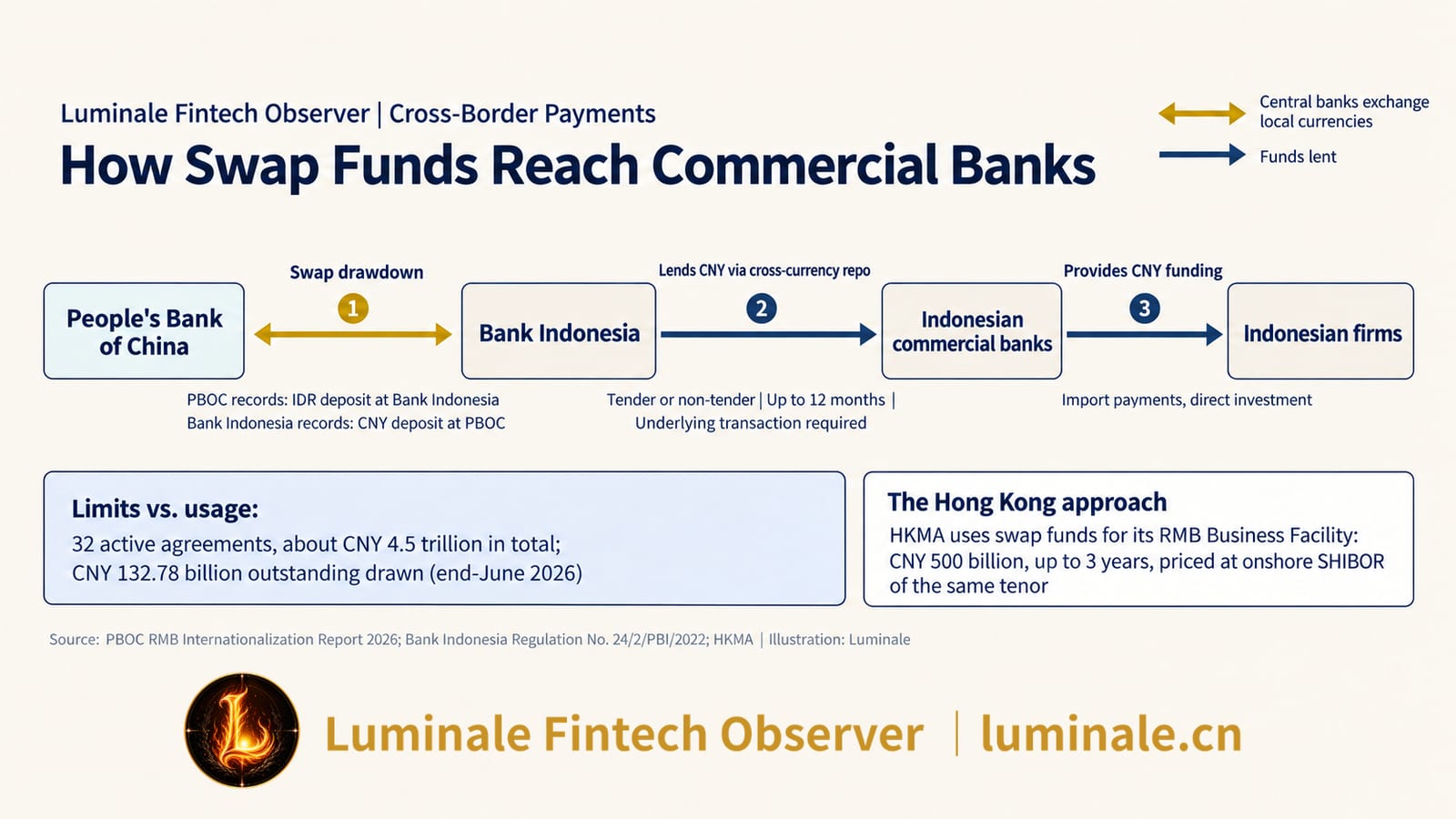
Suppose Bank Indonesia initiates a drawdown of RMB 10 billion under the swap facility, exchanging an equivalent amount of Indonesian rupiah at the agreed exchange rate (for computational simplicity, assume RMB 1 = IDR 2,300, equivalent to IDR 23 trillion). The balance sheets of both central banks expand symmetrically with corresponding assets and liabilities:
People's Bank of China (PBOC)
| Assets | Liabilities |
|---|---|
| Due from Bank Indonesia (IDR) +IDR 23 trillion (equiv. RMB 10 billion) | Bank Indonesia RMB Deposit at PBOC +RMB 10 billion |
Bank Indonesia
| Assets | Liabilities |
|---|---|
| Due from PBOC (RMB) +RMB 10 billion | PBOC IDR Deposit at Bank Indonesia +IDR 23 trillion |
As this balance sheet demonstrates, the renminbi obtained by Bank Indonesia is merely a deposit balance held at the PBOC. To convert this central bank claim into spendable liquidity for commercial enterprises, additional mechanisms are required. For the fundamental mechanics of central bank accounting, refer to Understanding What a Central Bank Does Through Its Balance Sheet.
3. How Swap Liquidity Reaches Commercial Banks
Bank Indonesia promulgated a dedicated regulation, PBI 24/2/PBI/2022, titled Transactions between Banks and Bank Indonesia to Support Local Currency Settlement. The regulation stipulates that Bank Indonesia may engage in foreign currency-to-rupiah transactions with foreign central banks under international financial cooperation agreements, including bilateral currency swaps and bilateral local currency swaps. On this basis, Bank Indonesia is authorized to transact with domestic commercial banks to meet their foreign currency requirements for local currency settlement, specifically for international trade payments, direct investments, and other contractually agreed purposes[5].
These transactions take the form of cross-currency repurchase agreements (cross-currency repos) or other structured transactions conducted via competitive auction or bilateral matching, with a maximum maturity of 12 months, and may not be terminated prematurely by commercial banks. Where Bank Indonesia mandates proof of underlying commercial transactions, the bank's requested funding amount cannot exceed the underlying transaction value, and the same underlying documentation cannot be pledged repeatedly[5].
This regulation bridges the sovereign swap line with day-to-day commercial settlement: Bank Indonesia draws RMB liquidity via the bilateral swap line and on-lends it to domestic commercial banks via repos; commercial banks, in turn, deploy this RMB to finance corporate import payments or direct outbound investments. To explore trade financing structures and how capital accompanies the flow of physical goods, refer to How Is Money Borrowed? Direct Finance, Indirect Finance, Trade Finance and the Infrastructure Behind Them.
Hong Kong offers another structural model. In February 2025, the PBOC supported the HKMA in deploying permanent swap facility funds to establish an RMB Trade Financing Liquidity Arrangement, which was upgraded in October of that year into the RMB Business Facility with an overall quota of RMB 500 billion, a maximum tenor of three years, and interest rates aligned with onshore Shanghai Interbank Offered Rate (SHIBOR) benchmarks. As of end-June 2026, cumulative utilization approached RMB 200 billion[3]. This exemplifies how central bank swap lines can be institutionalized into recurring trade and investment financing facilities, as detailed in RMB Internationalization is More than "Settling in RMB": A Cross-Border Financial Infrastructure is Taking Shape.
4. Facility Size vs. Actual Utilization
As of end-June 2026, the PBOC maintained 32 active bilateral local currency swap agreements with foreign central banks and monetary authorities, totaling approximately RMB 4.5 trillion. In contrast, the outstanding RMB balance actually drawn down and unexpired by foreign central banks stood at RMB 132.78 billion[3]. The total committed facility size exceeds actual utilization by more than thirtyfold, highlighting that the vast majority of bilateral swap lines function primarily as precautionary liquidity backstops.
Consequently, headlines announcing "multi-hundred-billion-yuan swap agreements" should not be interpreted as evidence that bilateral trade has fundamentally shifted to local currency settlement. A swap agreement merely guarantees that a central bank can source counterparty currency during liquidity crunches; day-to-day corporate payments depend entirely on commercial banks, foreign exchange markets, and domestic clearing systems.
Furthermore, Indonesia's swap network extends well beyond China. Bank Indonesia maintains bilateral swap agreements with Japan, South Korea, Australia, and others, such as the local currency swap signed with the Reserve Bank of Australia in 2018[6]. While swap counterparties and LCT partner jurisdictions overlap, they are not coextensive. Another frequent point of confusion is the Chiang Mai Initiative Multilateralisation (CMIM) among ASEAN+3 nations; the CMIM is a multilateral regional crisis-resolution mechanism that primarily disburses US dollar liquidity, differing fundamentally in purpose and legal structure from bilateral local currency swap lines.
III. From LCS to LCT: Designated Banks, Reciprocal Accounts, and Direct Quotation
1. The Framework's ASEAN Origins
The local currency settlement framework did not originate with China and Indonesia. In 2016, the central banks of Indonesia, Malaysia, and Thailand signed a tripartite MoU to promote the use of local currencies in trade and investment across the three economies. The Malaysian ringgit-Thai baht framework between Bank Negara Malaysia and the Bank of Thailand became operational in March 2016, followed by the ringgit-rupiah framework with Bank Indonesia in December 2017[7]. Japan subsequently joined, with the Ministry of Finance representing the Japanese jurisdiction[8].
In its official regulatory Q&A, Bank Indonesia explained the strategic rationale behind this architecture: Indonesia's bilateral trade with trading partners relied overwhelmingly on the US dollar, and this excessive dollar dependence amplified the transmission of global macroeconomic shocks to the domestic economy[8].
The regulatory Q&A also codified the foundational definition of the framework: local currency settlement means that bilateral transactions between two countries are settled in their respective domestic currencies, and the settlement of each currency is executed strictly within its domestic jurisdiction. The Q&A illustrated this with a concrete rule: if trade between Indonesia and Japan is invoiced in rupiah, settlement occurs inside Indonesia; if invoiced in Japanese yen, settlement occurs inside Japan[8]. This principle dictates every subsequent fund-flow path, as detailed in Section IV.
2. Establishment and Upgrades of the China-Indonesia Framework
On 30 September 2020, the PBOC and Bank Indonesia signed the Memorandum of Understanding on Establishing a Framework for Cooperation to Promote the Settlement of Current Account Transactions and Direct Investment in Local Currencies[3]. On 6 September 2021, the framework was officially launched, covering bilateral current account transactions and direct investment. It rested on two core pillars: direct quotation between the renminbi and Indonesian rupiah, and relaxed regulatory constraints to encourage local currency adoption[9].
At its inception, the two central banks designated 20 Appointed Cross Currency Dealers (ACCDs). On the Indonesian side, 12 banks were appointed, including Bank Central Asia (BCA), Bank Mandiri, Bank Negara Indonesia (BNI), Bank Rakyat Indonesia (BRI), Bank of China (Hong Kong) Jakarta Branch, China Construction Bank Indonesia, and Industrial and Commercial Bank of China (ICBC) Indonesia. On the Chinese side, 8 banks were appointed, including ICBC, Agricultural Bank of China, Bank of China, China Construction Bank, Bank of Ningbo, Bank Mandiri Shanghai Branch, Maybank Shanghai Branch, and United Overseas Bank (China)[9]. Both rosters included local subsidiaries and branches of counterpart-nation banks; possessing cross-border footprints in both markets made establishing and managing reciprocal currency accounts straightforward.
In August 2023, Bank Indonesia renamed the cooperation model from LCS to Local Currency Transaction (LCT), reflecting its evolution beyond trade and investment settlement into cross-border retail payments and broader financial applications[10]. In May 2025, the PBOC and Bank Indonesia signed an upgraded MoU, expanding the scope of the China-Indonesia LCT framework from current account transactions and direct investment to all economic transactions, including capital and financial accounts. On 11 September 2025, the two central banks simultaneously inaugurated the comprehensive LCT framework and a cross-border QR code connectivity pilot in Beijing and Jakarta[3][11]. For a structural taxonomy of what constitutes current versus capital account transactions, refer to From Current Account to Capital Account: How Cross-Border Capital Is Classified.
3. What ACCD Banks Can Do
Bank Indonesia Regulation PBI 22/12/PBI/2020 and its accompanying Q&A set out the permissible scope of business for ACCD banks[8].
In terms of account architecture, an Indonesian ACCD may open a dedicated rupiah Special Non-resident Account (SNA) for a partner-country ACCD, as well as hold partner-currency SNAs and sub-accounts. In the PBOC's formulation, ACCD institutions in both jurisdictions open reciprocal non-resident accounts in each other's domestic currency to facilitate trade and investment settlement; the ACCDs maintain reciprocal ledger entries throughout the business day and settle their net balances at day-end[3].
In terms of transaction capabilities, ACCDs can execute funds transfers and financing for corporate clients, providing same-day (TOD), next-day (TOM), and spot (SPOT) FX trading, as well as forward contracts and FX swaps[8].
In terms of market making, Indonesian ACCDs are mandated to provide continuous direct exchange rate quotations between the partner currency and the Indonesian rupiah, reflecting prevailing fair market values[8].
Regulatory exemptions focus on four key areas[8]:
- Underlying Transaction Documentation: Banks may verify underlying transactions using final commercial invoices and contracts, firm payment commitments, or even anticipatory documentation (such as pro forma invoices or purchase orders).
- External Debt Limits: Direct interbank borrowing by an Indonesian ACCD from a partner-country ACCD is excluded from Bank Indonesia's short-term external debt caps for commercial banks.
- Account Balances: While rupiah SNAs are subject to balance limits, day-end balances may exceed these thresholds when backed by qualifying commercial flows; reciprocal rules apply to partner-currency SNAs.
- Permissible Transactions: Full coverage of merchandise and services trade; primary income, including employee compensation and returns on direct, portfolio, and other investments; secondary income, including government and private remittances (excluding unrequited donations and gifts); and foreign direct investment (FDI), requiring an equity stake of at least 10% or qualifying as intra-group shareholder loans.
ACCD designations are evaluated jointly by both central banks and may be revoked following joint supervisory reviews, banking license revocations, corporate restructurings, or voluntary surrender[8].
4. Supporting Infrastructure in China: Regional Interbank Market Trading
For ACCDs to quote continuous two-way prices in RMB/IDR, they require wholesale interbank liquidity channels to square their net currency positions. On the exact day the framework launched, the China Foreign Exchange Trade System (CFETS), with PBOC approval, inaugurated regional interbank market trading for RMB against the Indonesian rupiah. Participating institutions include regional commercial banks located in Zhejiang Province and onshore branches or subsidiaries of Indonesian banks. Permissible trading products comprise spot, forwards (including Non-Deliverable Forwards, NDFs), FX swaps, and cross-currency swaps, operating on working days from 9:30 to 16:30, with spot trading allowed to fluctuate within a ±10% band around the daily central parity fixing[12]. To understand how spot, forwards, and swaps function and how interbank foreign exchange markets match and settle transactions, refer to How Does a Dollar Payment Become Renminbi? Understanding FX Transaction Types, Infrastructure and Exchange Rate Formation.
By end-June 2026, RMB/IDR had become the most active regional currency pair in China's onshore interbank FX market, recording a cumulative trading volume of RMB 166.9 billion[3].
5. Indonesia's Expanding Network and China's Bilateral Agreements
Indonesia's network of LCT partnerships has grown steadily. In May 2023, Bank Indonesia signed an MoU with the Bank of Korea covering current account transactions and direct investment, establishing direct quotations between the Korean won and Indonesian rupiah[13]. In May 2024, Bank Indonesia and the Central Bank of the UAE signed an MoU to establish a local currency settlement framework for the UAE dirham and rupiah[14]. Bank Indonesia and the Monetary Authority of Singapore (MAS) signed an initial MoU in August 2022, finalized operational guidelines in April 2026, and announced the formal operationalization of their bilateral framework on 31 August 2026, with Indonesia designating 9 ACCDs and Singapore appointing DBS, OCBC, and UOB[15]. The tripartite MoU signed in June 2026 extended the framework to transactions between the rupiah and offshore RMB (CNH), tasking Bank Indonesia and the HKMA with issuing operational guidelines and appointing ACCDs in both jurisdictions[1].
According to PBOC disclosures, China-Indonesia LCT transaction volume reached USD 6.23 billion in the first seven months of 2025, accounting for approximately 45% of Indonesia's total LCT transaction volume across all global partners[11].
On China's side, beyond the aforementioned bilateral local currency agreements with Russia, Laos, and Cambodia, the PBOC signed an MoU on establishing a framework for bilateral local currency transactions with the Bank of Thailand on 21 May 2024[16]. Furthermore, the bilateral currency swap between Bank Negara Malaysia and the PBOC was renewed in August 2026 and expanded to RMB 220 billion, with Bank Negara Malaysia explicitly noting that the facility is designed to facilitate local currency settlement in bilateral trade and investment[17]. Structural frameworks vary across nations: some establish formal designated market-maker bank networks and dedicated accounts, while others focus on regulatory permissions governing currency choice.
IV. Tracing a Payment: From a Jakarta Rupiah Account to a Zhejiang Renminbi Account
1. The Scenario
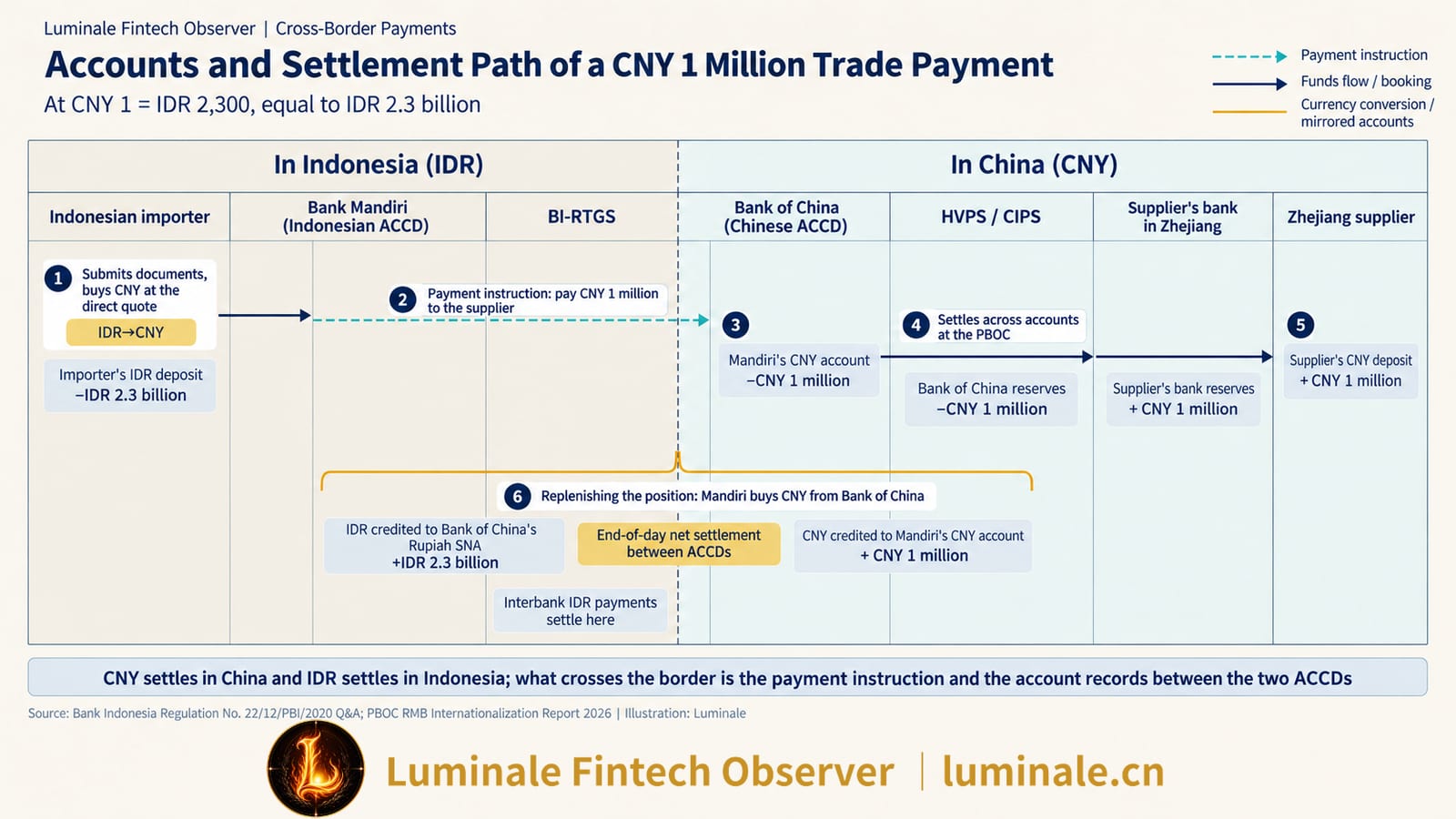
Revisiting the introductory scenario: assume the Jakarta furniture factory must settle an invoice of RMB 1,000,000 with its Zhejiang hardware supplier. The factory maintains its operating account at Bank Mandiri's Jakarta headquarters, while the supplier banks with a city commercial bank in Zhejiang Province. For computational simplicity, assume Bank Mandiri quotes an exchange rate of RMB 1 = IDR 2,300, making the total procurement cost IDR 2.3 billion.
Both Bank Mandiri and Bank of China are accredited ACCDs under the China-Indonesia LCT framework. In this scenario, assume the two institutions have established reciprocal non-resident accounts: Bank Mandiri holds an RMB account at Bank of China, and Bank of China holds an IDR Special Non-resident Account (SNA) at Bank Mandiri.
2. The Legacy Path: Two Conversions Through the US Dollar
Prior to the LCT framework, the standard settlement path operated as follows: the Indonesian factory converted rupiah into US dollars in the Indonesian domestic FX market; Bank Mandiri transferred these USD funds to China via the international correspondent banking network; and the Chinese beneficiary bank subsequently converted the received USD into renminbi before crediting the supplier's account.
This legacy route suffered from two separate FX conversions, two bid-ask spreads, and required transit through the US domestic clearing system via one or more correspondent clearing banks. For a comprehensive deconstruction of correspondent banking mechanics, refer to What Really Happens in a Cross-Border Payment? Correspondent Banking, SWIFT, and Global Payments Reform.
3. Underlying Transaction Verification and Direct Quotation
Under the LCT mechanism, the factory submits its commercial procurement contract or anticipatory trade documentation to Bank Mandiri, which verifies the underlying economic bona fides under framework guidelines. Upon approval, Bank Mandiri executes a direct conversion at its quoted IDR/RMB rate, debiting IDR 2.3 billion from the factory's deposit account in exchange for RMB 1,000,000.
4. The Renminbi Leg: Settling Domestically in China
Bank Mandiri transmits a payment instruction to Bank of China, requesting the debiting of RMB 1,000,000 from its RMB account to pay the Zhejiang supplier. Bank of China debits Bank Mandiri's account balance and routes the funds to the supplier's bank via China's High-Value Payment System (HVPS). Following Bank Mandiri's onboarding as a direct participant in CIPS, it can also transmit RMB payment messages directly through CIPS, eliminating intermediary messaging hops[2]. Under both execution routes, the renminbi achieves final settlement exclusively within payment systems located inside Mainland China. In the accounting table below, "reserves" represent central bank settlement balances held at the PBOC, across which all interbank fund transfers ultimately settle, as explained in From the Money Multiplier to Payment and Settlement: Central Bank Reserves Explained.
| Institution | Assets | Liabilities |
|---|---|---|
| Bank of China | Reserves at PBOC −RMB 1,000,000 | Bank Mandiri RMB Account −RMB 1,000,000 |
| Zhejiang Supplier's Bank | Reserves at PBOC +RMB 1,000,000 | Supplier RMB Deposit +RMB 1,000,000 |
5. The Rupiah Leg and Inter-ACCD Positions
On the Indonesian side, the factory's rupiah deposit is debited internally within Bank Mandiri. Simultaneously, Bank Mandiri's RMB claims on Bank of China decrease by RMB 1,000,000, altering Bank Mandiri's balance sheet as follows:
| Assets | Liabilities |
|---|---|
| Due from Bank of China (RMB) −RMB 1,000,000 (equiv. IDR 2.3 billion) | Factory IDR Deposit −IDR 2.3 billion |
Assets and liabilities contract simultaneously by IDR 2.3 billion (valued at the prevailing exchange rate), maintaining balance sheet equilibrium. Bank Mandiri has deployed its own RMB liquidity position to complete the client's payment, depleting its stock of RMB assets.
When Bank Mandiri needs to replenish its RMB position, it can purchase RMB from Bank of China against Indonesian rupiah. Bank of China credits RMB into Bank Mandiri's RMB account, while Bank Mandiri credits rupiah into Bank of China's IDR SNA held in Jakarta:
| Institution | Assets | Liabilities |
|---|---|---|
| Bank Mandiri | Due from Bank of China (RMB) +RMB 1,000,000 | Bank of China IDR SNA +IDR 2.3 billion |
| Bank of China | Due from Bank Mandiri (IDR) +IDR 2.3 billion | Bank Mandiri RMB Account +RMB 1,000,000 |
This illustrates the core principle articulated in Bank Indonesia's regulatory Q&A: each currency settles strictly within its sovereign domestic jurisdiction. There is no physical "cross-border pipeline" through which cash moves; what crosses borders are payment instructions and reciprocal ledger postings between ACCD balance sheets. What the PBOC describes as "ACCDs maintaining reciprocal ledger entries and settling net balances at day-end" refers to these institutions recording multiple transactions on reciprocal accounts throughout the day, executing settlement on a consolidated net basis at close of business[3]. For the technical distinction between payment messaging, balance posting, and asset settlement, see After the "Transfer Was Successful": Payment Instruction, Account Posting, and Funds Transfer Are Actually Three Different Things; for the architecture of China's domestic clearing rails, see From Bank Cards to NUCC, UnionPay & HVPS: A Comprehensive Map of China's Payment System.
6. Where ACCDs Source Renminbi
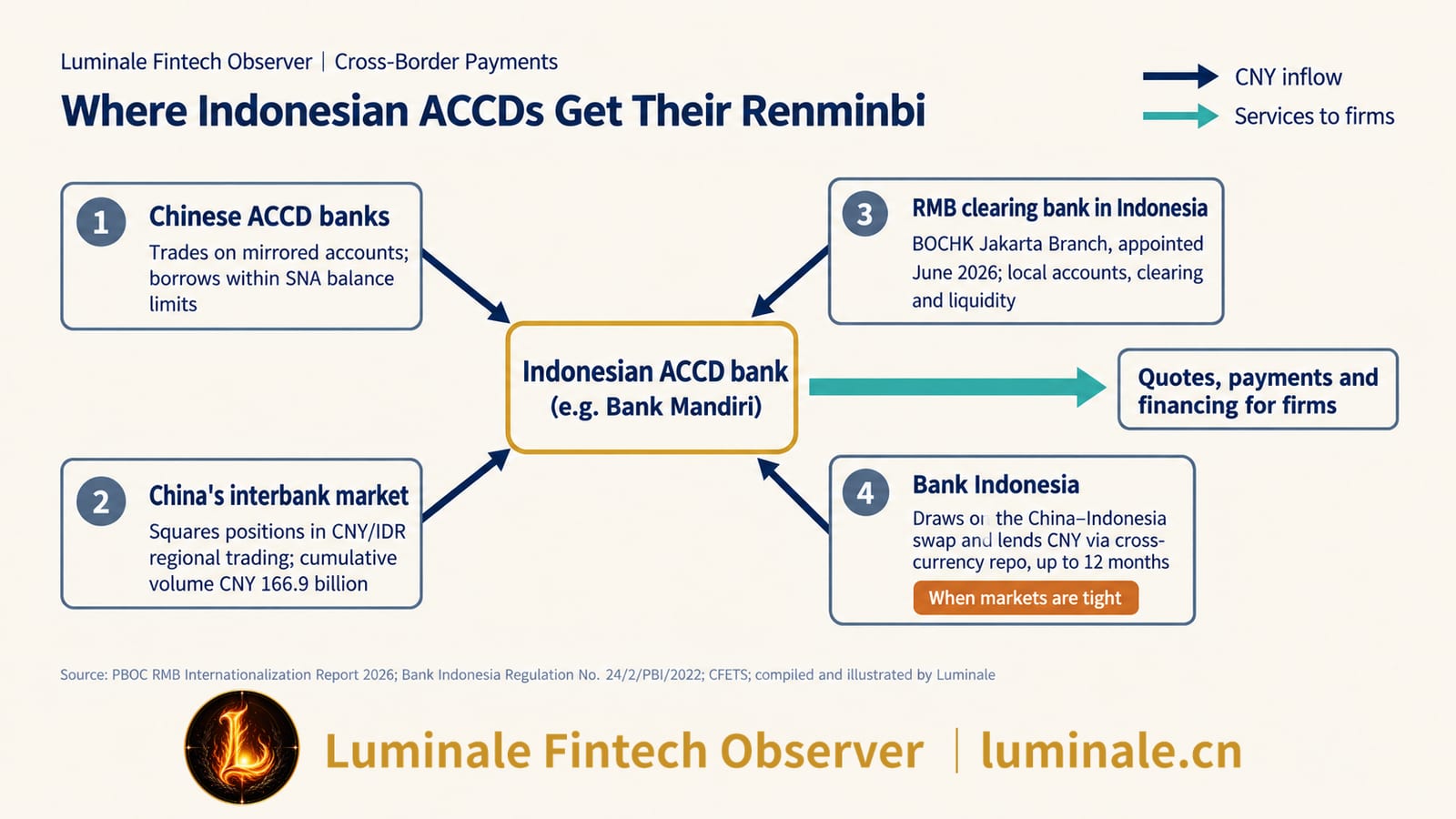
For Bank Mandiri to provide continuous RMB price quotations over the long run, it must either hold sufficient RMB liquidity or possess immediate, reliable channels to replenish its positions. Based on public disclosures analyzed by Luminale, Indonesian ACCDs access renminbi primarily through four channels:
- Inter-ACCD Bilateral Transactions: Direct buying and selling with Chinese ACCDs (such as Bank of China), booked across reciprocal accounts or funded via interbank borrowing within authorized SNA limits.
- Onshore Interbank FX Market: Accessing China's onshore regional RMB/IDR interbank market to square positions, typically executed via onshore branches such as Bank Mandiri Shanghai Branch.
- Local Designated RMB Clearing Bank: Following the appointment of Bank of China (Hong Kong) Jakarta Branch as Indonesia's RMB clearing bank, local Indonesian institutions can open RMB accounts, clear transactions, and access liquidity locally. The PBOC provides policy accommodations allowing the clearing bank to draw liquidity from onshore financial markets, effectively connecting local banks to China's domestic bond, FX, and money markets[3].
- Bank Indonesia's Swap Line Allocation: During episodes of acute liquidity distress or RMB market shortages, Bank Indonesia can draw on the bilateral PBOC swap agreement, on-lending RMB liquidity to domestic commercial banks via cross-currency repos for tenors of up to 12 months[5].
The swap facilities analyzed in Section II, the ACCD framework and regional trading detailed in Section III, and the newly established clearing bank in 2026 all converge on a single operational imperative: ensuring Indonesian banks can reliably and cost-effectively access renminbi liquidity.
7. The Retail Frontier: Cross-Border QR Payments
The China-Indonesia cross-border QR code connectivity pilot commenced in September 2025 and launched commercially in June 2026, encompassing 191 payment institutions on the Chinese side and 24 on the Indonesian side[2]. When Chinese travelers scan Indonesian merchants'QRIS codes, or Indonesian visitors scan payment codes in China, the real-time retail exchange rate is similarly generated by direct LCT market-maker quotations, while backend multi-currency net positions are reconciled and settled by designated settlement banks. This follows the architectural blueprint established by the cross-border linkage between Malaysia's DuitNow and Indonesia's QRIS, analyzed in detail in Same Code to Scan, Why Can't It Work Everywhere? QRIS, Global QR Payment Standards and Cross-Border Interoperability.
8. Where the Risks Remain
While bypassing the US dollar eliminates correspondent intermediary hops, it does not dissolve the underlying financial risks inherent in cross-border settlements:
Foreign Exchange Settlement Risk. When ACCDs execute FX conversions, the RMB and IDR legs are booked and settled asynchronously in separate jurisdictions. If one party delivers its currency leg while the counterparty defaults prior to reciprocal delivery, the paying institution incurs complete principal loss. Although Jakarta and Beijing share a minimal one-hour time-zone difference with substantial operating overlap, public documentation indicates the LCT framework does not incorporate a formal Payment versus Payment (PvP) mechanism. This exposure is managed primarily through reciprocal account credit limits, SNA balance ceilings, and bilateral counterparty credit lines. For the mechanics of FX settlement risk and how PvP functions as a delivery-versus-payment safeguard, refer to What Is the Most Dangerous Moment in FX? Why PvP Is the Market's "Payment-versus-Payment".
Exchange Rate Risk. While corporates avoid dual conversions, they remain fully exposed to volatility in the IDR/RMB exchange rate. Available hedging tools rely primarily on forward and swap contracts offered by ACCDs, whose pricing and liquidity tenor depend entirely on the market depth of this specific currency pair.
Liquidity Risk. ACCDs must maintain inventory in the counterparty currency, yet SNA balances face regulatory ceilings. In times of severe market volatility, market-maker bid-ask spreads can widen sharply or quotations may temporarily cease.
Compliance and Operational Risk. Commercial verification of underlying trade transactions, customs documentation scrutiny, and anti-money laundering (AML) screening are borne entirely by ACCDs. Bank Indonesia imposes regulatory sanctions for non-compliance, such as repeated utilization of identical underlying trade documents[5].
V. How Far Has Local Currency Settlement Progressed?
1. Scale and Volume
As of end-June 2026, cumulative cross-border RMB settlement under the China-Indonesia LCS/LCT framework reached RMB 120.4 billion[3]. By comparison, bilateral merchandise trade between China and Indonesia in 2025 alone stood at approximately USD 167 billion[2]. The multi-year cumulative volume under the local currency framework represents only around 10% of a single year's total bilateral trade volume. While the framework is expanding rapidly, it remains a supplementary channel rather than the primary clearing conduit.
2. Why the US Dollar Still Dominates
The continued dominance of the US dollar stems from systemic forces across both commercial contracts and wholesale financial markets:
A vast share of global commodities and manufactured goods remains invoiced in US dollars. Corporate treasury financing, receivables, payables, and commercial hedging are anchored around dollar infrastructure. Even if an Indonesian importer settles Chinese purchases in renminbi, its export revenues from third-party markets are predominantly received in USD.
Wholesale direct markets for IDR/RMB are substantially shallower than dollar markets. Whether direct quotations can consistently beat the synthetic cross rate (converting through the dollar) depends on market-maker inventory and turnover. When trading volumes are low, wider spreads erode corporate incentives to adopt local currency settlement.
Furthermore, while regulatory verification of underlying transactions has been simplified, documentation requirements still impose administrative overhead on small- and medium-sized enterprises (SMEs). Lowering the cost of verifying trade documentation and commercial data across borders is precisely the objective pursued by the HKMA's Project Cargoᵡ, explored in Trade Finance Lacks Trusted Data, Not Money: What Hong Kong's Project Cargoᵡ Is Doing.
3. Implications for Banks, Corporates, and Central Banks
For ACCD banks, designation confers institutional prestige, customer acquisition opportunities, and FX business, but also introduces capital costs for balance sheet inventory, compliance burdens, and core system reconfiguration expenses.
For corporates, the LCT framework introduces an alternative clearing rail. Adoption hinges on a hard cost-benefit calculation: comparing all-in direct transaction costs against legacy dollar paths, evaluating hedging availability, and assessing counterparty willingness to accept local currency invoicing.
For central banks, local currency frameworks insulate domestic foreign exchange markets from dollar liquidity shocks, providing a macroeconomic buffer when global dollar conditions tighten. This explains why Bank Indonesia explicitly links LCT to domestic exchange rate stability[2]. The operational tradeoff is that central banks must commit sustained administrative capital—negotiating bilateral treaties, drafting detailed operational guidelines, and orchestrating multi-agency coordination. In September 2023, Indonesia formalized this commitment by establishing an inter-ministerial National LCT Task Force[10].
4. Key Developments in 2026
Several milestone achievements in 2026 converged on expanding renminbi access channels within Indonesia.
The establishment of an offshore RMB clearing bank in Jakarta provided Indonesian institutions with a localized clearing and liquidity hub alongside inter-ACCD corridors and regional onshore trading. Bank Mandiri's accession as a direct CIPS participant enabled cross-border RMB clearing messages to enter CIPS directly. The tripartite LCT memorandum incorporated the Hong Kong offshore market, enabling Indonesian entities to transact directly between rupiah and offshore renminbi (CNH)[1]. The rollout of cross-border QR interoperability extended LCT direct exchange rates from wholesale corporate transactions to retail consumer spending.
Concurrently, in September 2026, Bank Negara Malaysia and the Ministry of Finance of Japan signed an MoU promoting local currency settlement in ringgit and yen alongside a bilateral swap arrangement of up to USD 6 billion[18]. The bilateral local currency network across ASEAN is becoming increasingly dense.
5. Transitioning from Bilateral Rails to Multilateral Networks
To date, these frameworks have followed a strictly bilateral architectural paradigm: a pair of central banks signs an agreement, authorizes a cohort of ACCDs, and establishes dedicated operational rulebooks. As the number of bilateral partner corridors grows, commercial banks must establish separate accounts, maintain discrete inventory, and quote independent rates for every single currency pair, compounding operational overhead. A 2023 policy paper by the ASEAN+3 Macroeconomic Research Office (AMRO) examined structural pathways for scaling local currency transactions multilaterally across the ASEAN+3 region[19].
A parallel evolution occurred in cross-border fast payment connectivity. The PayNow–PromptPay linkage between Singapore and Thailand was initially constructed as a bespoke bilateral corridor. Subsequently, Project Nexus, spearheaded by the Bank for International Settlements (BIS), designed a multilateral nexus to connect diverse national instant payment systems into a single hub-and-spoke network, as analyzed in From PayNow–PromptPay to Payment Connect: How Fast Payment Systems Turn into Cross-Border Networks and From Bilateral Linkages to Multilateral Network: How Nexus Rearchitects Instant Cross-Border Payments. While fast payment interlinking addresses message routing and orchestration, local currency frameworks resolve wholesale currency conversion; the two layers are already converging within retail QR and instant payment ecosystems.
Conclusion
The local currency settlement cooperation framework does not construct a brand-new cross-border clearing system from scratch. Instead, it authorizes a vetted cohort of commercial banks, enables them to open reciprocal accounts in each other's currency, mandates direct foreign exchange quotations, and relaxes restrictive foreign exchange rules—constructing an alternative non-dollar exchange corridor across existing domestic clearing infrastructures. Renminbi settles domestically within China, Indonesian rupiah settles domestically within Indonesia, and reciprocal ledger accounts maintained between ACCD institutions bridge the two sovereign systems. Sovereign currency swap lines supply standby backstop liquidity, the clearing bank and CIPS streamline the renminbi clearing leg, and retail QR interoperability extends direct pricing to consumer endpoints.
In assessing the true maturity of such frameworks, committed swap limits and headline bilateral agreements serve merely as directional signals. Far more decisive are market fundamentals: whether ACCD market makers can consistently offer tighter pricing than synthetic dollar conversions, whether enterprises can efficiently hedge IDR/RMB foreign exchange risk, and whether cross-border settlements achieve guaranteed same-day finality. Only when these commercial conditions are met will local currency settlement evolve from a state-sponsored policy alternative into the default commercial rail for corporate treasuries.
References
[1]: Hong Kong Monetary Authority, Bank Indonesia, the Hong Kong Monetary Authority and the People's Bank of China sign Memorandum of Understanding to promote use of IDR and offshore RMB in bilateral transactions between Indonesia and Hong Kong, Press Release, 11 June 2026. https://www.hkma.gov.hk/gb_chi/news-and-media/press-releases/2026/06/20260611-4/ ↩
[2]: Yicai, Four Deliverables Landed, China-Indonesia Financial Cooperation Accelerates, 12 June 2026. https://www.yicai.com/news/103228293.html; Indonesia Business Post, Bank Indonesia, PBOC expand local currency and cross-border payment cooperation, 15 June 2026. https://indonesiabusinesspost.com/6710/markets-and-finance/bank-indonesia-pboc-expand-local-currency-and-cross-border-payment-cooperation ↩
[3]: People's Bank of China, 2026 RMB Internationalization Report, 24 September 2026. http://www.pbc.gov.cn/ ↩
[4]: Antara News, BI, PBOC extend bilateral currency swap agreement for five years, 7 February 2025. https://en.antaranews.com/news/344101/bi-pboc-extend-bilateral-currency-swap-agreement-for-five-years ↩
[5]: Bank Indonesia, Bank Indonesia Regulation Number 24/2/PBI/2022 on Transactions between Banks and Bank Indonesia to Support Local Currency Settlement, 2022. https://www.bi.go.id/en/publikasi/peraturan/Documents/PBI_240222_EN.pdf ↩
[6]: Reserve Bank of Australia, Bilateral Local Currency Swap Agreement with Bank Indonesia, Media Release, 2018. https://www.rba.gov.au/media-releases/2018/mr-18-18.html ↩
[7]: Bank Negara Malaysia, Information on Local Currency Settlement Framework, 30 August 2019. https://www.bnm.gov.my/-/information-on-local-currency-settlement-framework ↩
[8]: Bank Indonesia, Q&A on Bank Indonesia Regulation Number 22/12/PBI/2020 on Settlement for Bilateral Transactions Using Local Currencies Through Bank, 2021. https://www.bi.go.id/en/publikasi/peraturan/Documents/FAQ_PBI_221220.pdf ↩
[9]: Bank Indonesia, Bank Indonesia and People's Bank of China Established a Framework for Cooperation to Promote the Use of Local Currencies for Settlement of Bilateral Trade and Direct Investment, Press Release No. 23/227/DKom, 6 September 2021. https://www.bi.go.id/en/iru/highlight-news/Pages/BI-and-PBOC-Established-Framework-for-Cooperation-to-Promote-the-Use-of-LCS.aspx ↩
[10]: Kontan, Istilah Kerja Sama Penggunaan Mata Uang Lokal Berubah dari LCS ke LCT, Ini Alasannya, 2023. https://nasional.kontan.co.id/news/istilah-kerja-sama-penggunaan-mata-uang-lokal-berubah-dari-lcs-ke-lct-ini-alasannya; Bank Indonesia, Indonesia Forms National Task Force to Expand Use of Local Currency Transactions in Indonesia with Partner Countries, 2023. https://www.bi.go.id/en/publikasi/ruang-media/news-release/Pages/sp_2524523.aspx ↩
[11]: People's Bank of China, The People's Bank of China and Bank Indonesia Launch Local Currency Transaction Framework and QR Code Connectivity, 11 September 2025. https://www.pbc.gov.cn/en/3688110/3688172/5552468/5837101/index.html ↩
[12]: China Foreign Exchange Trade System (CFETS), Announcement on Launching Regional Interbank Market Trading for RMB against Indonesian Rupiah, 6 September 2021. https://www.chinamoney.com.cn/chinese/rmbFXxgpl/20210906/2054157.html ↩
[13]: Antara News, BI, Bank of Korea cooperate to encourage local currency use, 2023. https://en.antaranews.com/amp/news/280182/bi-bank-of-korea-cooperate-to-encourage-local-currency-use ↩
[14]: Central Bank of the UAE, CBUAE and Bank Indonesia Sign Two MoUs to Promote the Use of National Currencies for Bilateral Trade, May 2024. https://www.centralbank.ae/media/wu5mwq5q/cbuae-and-bank-indonesia-sign-two-mou-to-promote-the-use-of-national-currencies-for-bilateral-trade-en.pdf ↩
[15]: Monetary Authority of Singapore, Bank Indonesia and the Monetary Authority of Singapore Operationalise Local Currency Transaction Framework for Bilateral Trade Transactions, 31 August 2026. https://www.mas.gov.sg/news/media-releases/2026/bi-and-mas-operationalise-local-currency-transaction-framework-for-bilateral-trade-transactions ↩
[16]: Belt and Road Portal, China, Thailand sign MOU to promote bilateral transactions in local currencies, 22 May 2024. https://eng.yidaiyilu.gov.cn/p/0QA3UJF8.html ↩
[17]: Bank Negara Malaysia, Bank Negara Malaysia and the People's Bank of China Renew Bilateral Currency Swap Arrangement, August 2026. https://www.bnm.gov.my/en/-/bcsa26-pboc ↩
[18]: Business Today Malaysia, Malaysia, Japan Deepen Financial Ties With Local-Currency Push, US$6 Billion Swap Deal, 15 September 2026. https://www.businesstoday.com.my/2026/09/15/malaysia-japan-deepen-financial-ties-with-local-currency-push-us6-billion-swap-deal/ ↩
[19]: AMRO, Policy Position Paper: Expanding Local Currency Transactions in ASEAN+3 Cross-Border Payments, December 2023. https://amro-asia.org/wp-content/uploads/2023/12/AMRO-PPP_Expanding-LCT-in-ASEAN3-Cross-Border-Payments_Dec-2023.pdf ↩
Originally published by Luminale Fintech Observer: https://luminale.cn/articles/local-currency-settlement-lcs-lct-framework-en