In mid-October 2026, multiple domestic commercial banks in China released official announcements stating that the daily business opening window for the People's Bank of China's (PBOC) High-Value Payment System (HVPS) would be brought forward from 20:30 on the prior day to 19:00, while the end-of-day cutoff remained unchanged at 17:30. Consequently, HVPS operating hours expanded to "5×22.5 + 13.5 hours." Concurrently, the banks reminded customers that the Bulk Electronic Payment System (BEPS) and the Internet Banking Payment System (IBPS) continue to operate 24/7/365 continuously, unaffected by the adjustments to the large-value payment system window.
For retail users, the vast majority of ordinary interbank transfers initiated daily via mobile or online banking rely directly on IBPS. Within China's financial market infrastructure (FMI) landscape, fast payment systems shoulder exceptionally high-frequency retail payment volumes. According to the PBOC's Overall Operation of the Payment System in 2025, IBPS processed 17.041 billion transactions totaling 280.67 trillion RMB in 2025. Among all business processed across clearing systems operated by the China National Clearing Center (CNCC), IBPS accounted for 75.59% of transaction volume and 2.96% of transaction value, with an average transaction size of approximately 16,500 RMB[1]. Compared to HVPS, where the average transaction exceeds 20 million RMB, IBPS exhibits classic hallmarks of high concurrency, small ticket size, and round-the-clock availability.
A familiar operational scenario illustrates the core logic of this system: At 21:00 on a Saturday evening, a customer transfers 5,000 RMB from Bank A to an account at Bank B via mobile banking. Within seconds, the payee receives an SMS confirmation from Bank B, and the 5,000 RMB deposit is immediately available for debit card purchases, offline QR code scanning, or subsequent interbank transfers.
Yet at 21:00 on Saturday evening, the central bank's large-value RTGS system is fully closed, and the Settlement Account Processing System (SAPS) does not process routine reserve transfers. In other words, the statutory reserve accounts of Bank A and Bank B held at the central bank have experienced zero asset movements on Saturday night.
This discrepancy raises several fundamental questions:
- What are the precise legal and accounting characteristics of the 5,000 RMB instantly credited and freely usable in the payee's account on Saturday night?
- When, and with what underlying assets, is the interbank debt between Bank A and Bank B definitively extinguished?
- In the time wedge where customer funds are fully available but interbank claims remain unsettled, who bears the interbank credit risk, and what risk-mitigation tools does the system deploy?
- Across the globe, what distinct settlement arrangements have jurisdictions such as the United States, the Eurozone, the United Kingdom, Singapore, Hong Kong SAR, India, and Brazil devised for their domestic fast payment systems?
- As transaction caps increase, cross-border multilateral linkages expand, and central bank digital currencies (CBDCs) emerge, along what structural trajectories are retail payment infrastructures evolving?
This article is the third installment in the Luminale Payment System Classification Series. Following our taxonomy outline in 《Which Rail Should a Payment Take? Classifying Payment Systems: Wholesale, Retail and Cross-Border》, our deep dive into the wholesale core in 《How Does Big Money Move Between Banks? Understanding Large-Value Payment Systems》, and establishing our analytical coordinate framework in 《What Exactly Is a Payment System? From the BIS Definition to the Global Financial Market Infrastructure Landscape》, this piece comprehensively dissects the institutional and mechanical foundations of Fast Payment Systems (FPS).
I. Why Fast Payments Emerged in Retail Payments: Origins, Definitions, and Boundaries
1. Historical Evolution and the Emergence of an Independent System Class
Understanding where fast payment systems sit within modern financial architecture requires examining the evolution of clearing and settlement infrastructures over the latter half of the twentieth century.
According to the World Bank's 2021 report Fast Payment Systems: A Quick Assessment of the Global Landscape, prior to the consolidation of modern fast payment frameworks, domestic interbank payment infrastructures in most jurisdictions comprised three to four system categories[2]:
- Large-value payment systems serving financial institutions and financial markets, typically utilizing Real-Time Gross Settlement (RTGS) mechanisms, such as the Federal Reserve's Fedwire Funds Service or China's HVPS;
- Automated Clearing Houses (ACH) or bulk payment systems for payroll and utility bills, such as ACH in the United States or Bacs in the United Kingdom;
- Payment card clearing and switching networks handling POS transactions and interbank ATM withdrawals;
- Proprietary, closed-loop e-money schemes operated by specific non-bank entities in certain economies.
Within this legacy setup, wholesale payment and settlement modernized first. In 1990, fewer than ten RTGS systems operated globally; by 2017, over 176 countries and jurisdictions had deployed central bank RTGS systems[2]. RTGS proved that computer networks could execute legally final, gross interbank funds transfers in real time.
However, large-value payment systems were designed to mitigate systemic risk, handling low-frequency, high-value, and time-critical interbank wholesale transactions. The RTGS mechanism mandates that direct clearing members hold sufficient central bank reserve balances for every outgoing payment instruction. If reserves are inadequate, payment instructions must queue within the central bank system. In actual operations, queuing is not purely passive First-In, First-Out (FIFO); commercial bank front-office treasury desks retain discretion to manually reorder queue priorities based on liquidity urgency. Nevertheless, routing high-frequency, massive retail consumer purchases and personal transfers directly into RTGS would force commercial banks to idle massive precautionary liquidity reserves at the central bank, driving daylight intraday funding costs unsustainably high. Furthermore, scheduled overnight maintenance closures of central bank RTGS engines could never accommodate retail users'demand for anytime, anywhere money movement.
On the retail side, traditional batch-processing ACH systems faced significant friction. ACH networks generally operate on a Deferred Net Settlement (DNS) model that collects instructions offline and executes centralized multilateral netting. Settling funds from payer to payee routinely required T+1 or T+2 business days, and the entire clearing chain shut down over weekends and statutory holidays. For an extensive analysis of the trade-offs between deferred net settlement and real-time gross settlement, see 《Why Don't Payment Systems Settle Every Payment Immediately? Understanding the Trade-offs Between RTGS and DNS》.
While payment card networks achieved sub-second authorization at POS terminals, merchant-side settlement still occurred via delayed daily batches. Interchange and acquiring fees were relatively steep, and transactions required payers to hold physical plastic or digital card credentials. For a detailed breakdown of four-party card clearing, see 《When You Swipe $100, Who Does It Pass Through? A Guide to Issuers, Acquirers, Card Networks, and Merchants》.
With the rise of the internet, personal computers, and smartphones, individuals and small businesses demanded round-the-clock availability, sub-second settlement, and direct account-to-account (A2A) transfers via bank accounts or mobile numbers to displace inefficient cash and paper checks.
The global evolution of fast payment systems unfolded across three distinct phases:
- Phase One (Pioneering Era: 1970s to Late 1990s):
Japan's Zengin System commenced operations in 1973. During bank business hours, Zengin processed interbank credit transfer notifications electronically within seconds; receiving banks credited payee accounts immediately upon receiving messages, while interbank claims settled via net positions at the end of each business day. Both World Bank reports and the Reserve Bank of Australia's (RBA) 2014 study Fast Retail Payment Systems identify Zengin as among the world's earliest implementations of fast payment characteristics[2][3]. However, early Zengin only operated during weekday banking hours. It was not until the launch of the "More Time System" extension in October 2018 that Zengin evolved into a true 24/7/365 modern fast payment engine[2].
- Phase Two (Early Institutionalization: 2000s):
Several emerging and developed economies launched dedicated instant retail payment networks. In 2001, the Electronic Banking System (EBS) operated by Korea Financial Telecommunications & Clearings Institute (KFTC) went live, supporting round-the-clock retail fund transfers. In 2002, the Central Bank of Brazil launched the SITRAF system for low-value electronic transfers. In 2004, the Bank of Mexico introduced the SPEI system, supporting real-time gross settlement for small-dollar retail payments. In 2006, South Africa launched Real-Time Clearing (RTC). In May 2008, the UK Faster Payments Service (FPS) went live[3]. The PBOC Clearing Center followed in August 2010 by launching IBPS to provide a centralized interbank clearing channel for online and mobile banking transfers[4].
The UK FPS origin story exemplifies why jurisdictions built new rails rather than retrofitting legacy systems. In March 2004, the UK Office of Fair Trading (OFT) formed the Payment Systems Taskforce, driven by persistent complaints from consumers and business groups regarding three-day Bacs settlement delays. By May 2005, banks agreed to provide same-day clearing for phone and internet banking; in December 2005, the Taskforce adopted the Association for Payment Clearing Services (APACS) recommendation to target funds availability within seconds to minutes of instruction entry. Crucially, they chose not to rebuild decades-old Bacs batch mainframes, electing instead to construct an independent real-time messaging and clearing engine[5]. This paved the way for FPS in 2008.
- Phase Three (Global Proliferation and Central Bank Leadership: 2010s to Present):
According to the Committee on Payments and Market Infrastructures (CPMI) at the Bank for International Settlements (BIS), the number of fast payment services across CPMI jurisdictions more than doubled between 2010 and 2016[6]. By 2021, over sixty countries had established fast payment systems[2]. In this phase, central banks shifted from passive regulators to direct builders and institutional catalysts. The Eurosystem introduced TARGET Instant Payment Settlement (TIPS) in 2018; the Central Bank of Brazil launched Pix in 2020; and the Federal Reserve launched FedNow in 2023. Systems in this era uniformly emphasize standardized ISO 20022 messaging, proxy alias addressing (mobile phone numbers, national IDs, tax IDs), standardized QR codes, and direct access for non-bank payment service providers.
Four primary drivers established fast payments as an independent category between wholesale and retail:
- Advances in Telecommunications and Distributed Computing: High-concurrency message queuing, in-memory databases, and low-latency private financial extranets drastically reduced the unit cost of gross message processing;
- Real-Time Demands of Mobile Internet and E-Commerce: Round-the-clock digital commerce and P2P mobile payments rendered traditional business-day batch cycles obsolete;
- Slashing Society-Wide Paper Handling Costs: Central banks and commercial lenders sought to curtail high operational expenditures associated with cash printing, armored logistics, and manual check clearing;
- Public Policy and Financial Inclusion Mandates: Regulators leveraged fast payment rails to break commercial bank deposit oligopolies, reduce consumer fees, and facilitate direct digital disbursement of government welfare subsidies.
Consequently, fast payment systems occupy a unique architectural niche: on the front end, they adopt RTGS-style gross receipt and immediate routing; on the back end, they utilize deferred net settlement backed by collateral caps or dedicated pre-funded liquidity pools, achieving instant retail funds movement without imposing massive intraday liquidity burdens on member banks.
2. Core Definition and Four Operational Boundaries
In its 2016 benchmark report Fast payments - Enhancing the speed and availability of retail payments, the CPMI provided the standard definition recognized by international organizations and central banks[6]:
Fast Payments: Payments in which the transmission of the payment message and the availability of "final" funds to the payee occur in real time or near-real time and on as near to a 24/7 basis as possible.
Under this definition, whether a platform qualifies as a fast payment system hinges on gross transaction processing, 24/7 availability, and immediate, legally final funds availability to the payee; whether interbank final reserve settlement occurs simultaneously is not a defining prerequisite.
Under the Luminale payment infrastructure framework, tracing a fast payment requires distinguishing three discrete chronological milestones:
- Timestamp One (): The moment the receiving bank officially credits the payee's deposit account and grants unrestricted availability to withdraw or spend those funds (typically within seconds of payer initiation);
- Timestamp Two (): The moment the central fast payment engine completes validation, format parsing, and returns an acceptance receipt to both banks (also completed in seconds);
- Timestamp Three (): The moment the paying bank and receiving bank execute statutory, irrevocable funds transfer across central bank reserve accounts or designated settlement accounts.
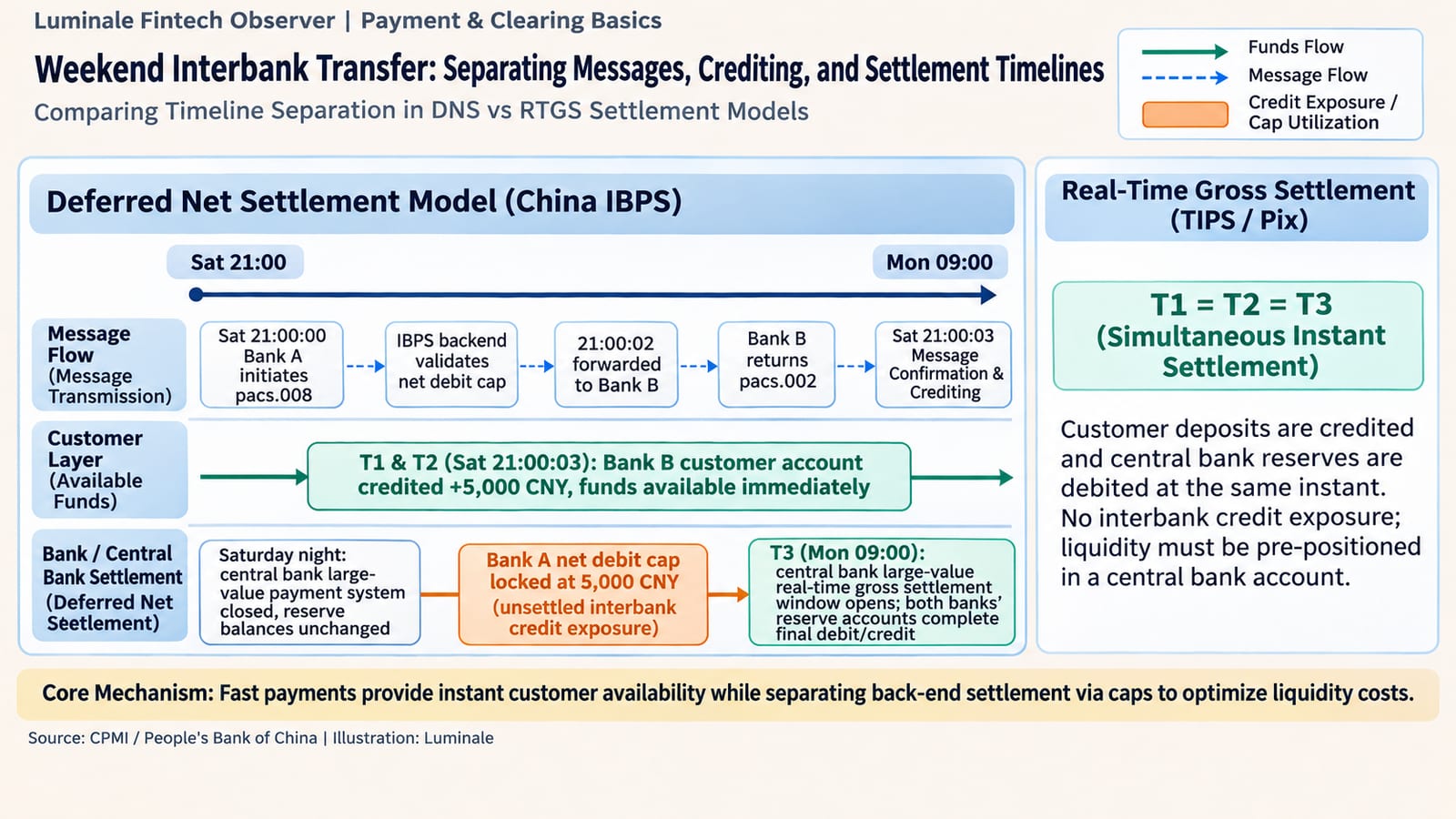
Across different settlement architectures, the occurrence of diverges sharply: under real-time gross central bank settlement, , , and coincide; under deferred net settlement, may lag by several hours, or over weekends, span dozens of hours.
When precedes , the financial reality is that the receiving bank has expanded its balance sheet by creating a demand deposit liability for the payee before receiving central bank money from the paying bank. Between and , the receiving bank holds an uncollateralized interbank claim against the paying bank. If the paying bank becomes insolvent or enters regulatory resolution during this gap, the receiving bank faces direct counterparty credit loss. The net debit caps, collateral earmarks, and pre-funded liquidity pools implemented by fast payment networks exist precisely to insulate against this exposure.
To precisely position fast payment systems, four operational boundaries must be delineated:
- Boundary with Large-Value Payment Systems (RTGS):
RTGS serves wholesale financial markets, enforces no maximum value caps, settles on a gross real-time basis across central bank reserves with instant statutory finality, and aligns operating windows with central bank and money market trading hours. Fast payment systems serve retail individuals and SMEs, enforce transaction size caps (China's IBPS initially set a 50,000 RMB cap in 2010, subsequently raised to 1 million RMB), mandate 24/7/365 continuous availability, and routinely rely on liquidity-efficient deferred netting or pooled pre-funding.
- Boundary with Automated Clearing Houses (ACH):
Fast payment systems process instructions individually and route instant notifications; transactions are predominantly "credit transfers" (push payments) initiated by the payer. ACH networks process instructions in scheduled batches and primarily support recurring "direct debits" (pull payments) initiated by the payee under prior authorization, such as utility bills and taxes.
- Boundary with Payment Card Networks:
Card networks operate on a four-party model (cardholder, issuer, acquirer, merchant). Front-end card swiping executes real-time authorization (freezing open credit or funds balances), while interbank money transfers settle in deferred daily batches, accompanied by merchant interchange fees and dispute/chargeback mechanisms. Fast payment systems execute direct account-to-account (A2A) credit transfers; once confirmed and credited to the payee, funds belong irreversibly to the recipient, and the underlying rail provides no unilateral chargeback channel. For an analysis of why settlement finality must legally override bankruptcy clawbacks and zero-hour rules, see 《Can a Payment Be Revoked After Being Marked Successful? What Risks Settlement Finality Actually Resolves》.
- Boundary with Internal Closed-Loop Transfers of Non-Bank PSPs:
Peer-to-peer balance transfers between two users within Alipay, WeChat Pay, or PayPal are internal ledger adjustments within a single institution. They touch no interbank clearing rail and generate no reserve reallocation. Only when funds move across accounts at different commercial banks (such as cashing out from an e-wallet to a third-party bank card) do instructions enter financial market infrastructures to trigger interbank clearing. For detailed accounting mechanics, see 《After the "Transfer Was Successful": Payment Instruction, Account Posting, and Funds Transfer Are Actually Three Different Things》.
Institutionally, mature fast payment schemes comprise three distinct architectural tiers:
- Infrastructure Layer (System): The technical network executing real-time messaging, routing, and ledger settlement (e.g., Singapore FAST, UK FPS, China IBPS);
- Scheme Layer (Scheme): The institutional framework governing participant eligibility, rights, obligations, transaction caps, risk metrics, and dispute resolution;
- Overlay Services Layer: User-facing features, such as proxy alias directories linking mobile numbers to bank accounts (e.g., Singapore PayNow, Thailand PromptPay), unified payment QR codes, and Request-to-Pay (R2P) protocols.
II. Governance, Participation, and Access: Bank Direct Connection, Agency Access, and Non-Bank PSP Pathways
1. Governance Structures and Operator Types
Globally, fast payment systems exhibit three primary operational and ownership archetypes:
- Direct Central Bank Ownership and Operation:
Examples include IBPS operated by the PBOC Clearing Center, FedNow operated by the Federal Reserve, TIPS operated by the Eurosystem, and Pix operated by the Central Bank of Brazil. Direct central bank ownership leverages the central bank's status as monopoly issuer of sovereign legal tender. It allows direct debiting and crediting of reserve accounts, ensures neutral governance, and facilitates administrative standardization of technical protocols.
- Commercial Bank Consortia or Private Clearing Entities:
Examples include the Real-Time Payments (RTP) network operated by The Clearing House (TCH) in the US, the Faster Payments Service (FPS) managed by Pay.UK, the Fast and Secure Transfers (FAST) network operated by Banking Computer Services (BCS) on behalf of the Association of Banks in Singapore (ABS), and Australia's New Payments Platform (NPP). Private or industry consortia respond rapidly to commercial bank product needs, but still require dedicated central bank settlement accounts or statutory regulatory charters to achieve legal settlement finality and extinguish credit risk.
- Quasi-Public Entities or Specialized Industry Franchises:
A prominent example is the National Payments Corporation of India (NPCI). Established in 2008 under the guidance of the Reserve Bank of India (RBI) and the Indian Banks'Association, NPCI operates as a specialized not-for-profit umbrella entity. It oversees the Immediate Payment Service (IMPS) and Unified Payments Interface (UPI), balancing public infrastructure mandates with market-driven execution.
2. Participant Tiers and Access Criteria
Access to fast payment systems typically divides into three tiers:
- Direct Settlement Participant:
Directly connected to the fast payment network and maintaining an independent settlement account at the central bank or settlement agent. These institutions transmit and receive transaction messages directly and bear gross or net financial settlement liabilities from their own clearing accounts. Direct settlement participants must meet rigorous technical availability standards, maintain robust liquidity reserves, and deploy 24/7 real-time treasury monitoring.
- Direct Access Non-Settling Participant:
Maintains direct technical connectivity to the fast payment hub to send and receive messages in real time, but lacks an independent reserve settlement account at the central bank. All financial settlement must be bound to a designated direct settlement bank acting as clearing sponsor to fund and sweep liquidity.
- Indirect Participant:
Lacks direct technical connections to the central fast payment engine. Both transaction messaging and funds settlement are sponsored through a direct participant bank. Community banks and rural credit cooperatives routinely adopt this tier to minimize development and operational overhead.
3. Two Classic Access Pathways for Non-Bank Payment Service Providers
As non-bank payment service providers (PSPs) and fintech platforms capture growing shares of retail payments, whether and how non-banks access fast payment rails has become a key regulatory dividing line. Global practice reflects two distinct pathways:
Pathway 1: Direct Access of Non-Bank PSPs to Fast Payment Systems
Under this model, licensed Electronic Money Institutions (EMIs) or major payment institutions enjoy access parity with commercial banks, directly calling fast payment APIs to transmit instructions and accessing central bank settlement channels.
- Singapore Model: The Monetary Authority of Singapore (MAS) expanded direct access in February 2021, allowing licensed Major Payment Institutions (MPIs) such as GrabPay and Liquid Group to connect directly to FAST and PayNow. E-wallet users can execute seamless, real-time transfers to and from conventional bank deposit accounts. For further analysis, see 《Where Has Singapore's Digital Finance Reached? From Tokenisation to Payment and Settlement Infrastructure》.
- UK and Hong Kong Models: In 2017, the Bank of England enacted regulatory reforms allowing non-bank payment service providers to open settlement reserve accounts, enabling non-banks to join FPS as direct settlement members. Similarly, when the Hong Kong Monetary Authority (HKMA) launched Faster Payment System (FPS) in 2018, it included licensed Stored Value Facilities (SVF) operators (e.g., Octopus, Alipay HK, WeChat Pay HK) alongside commercial banks as direct participants from day one. For an analysis of central bank account eligibility and legal hierarchies, see 《Who Can Hold an Account at the Central Bank? Decoding the Account Hierarchy and Settlement Infrastructure》.
- Risk Ring-Fencing: Direct non-bank access does not imply relaxed prudential oversight. Regulators enforce strict safeguarding rules (100% segregation of customer float) and require non-banks to maintain liquid collateral or pre-funded reserves to prevent non-bank insolvency from spilling into the interbank clearing core.
Pathway 2: Centralized Intermediary Routing via Dedicated Clearing Houses (The China Model)
China developed a distinct, centralized intermediary framework to manage connections between commercial banks and non-bank PSPs.
Under PBOC regulations, non-bank PSPs like Alipay and Tenpay do not connect directly to IBPS, nor do they hold settlement accounts across commercial banks. Following the 2018 "severing direct connections" (断直连) reform, all cross-institutional network payments involving bank accounts and non-bank payment institutions must route through the NetsUnion Clearing Corporation (NUCC) or China UnionPay.
This model exhibits clear regulatory features:
- 100% Centralized Reserve Float Depository: Customer reserve funds collected by non-bank PSPs are no longer dispersed across commercial banks. Instead, 100% of float is deposited in dedicated reserve accounts at the PBOC, centralized under central bank interest administration and prudential supervision, eliminating misappropriation risks. For a complete analysis, see 《Is Money in Alipay the Same as Money in a Bank Account? A Clear Explanation of "Customer Reserve Funds"》.
- Dedicated Clearing Intermediaries: NUCC operates as a licensed financial market infrastructure, processing massive concurrent online payment instructions and calculating multilateral net positions. Net interbank and inter-institutional claims are submitted to the PBOC HVPS for final debiting and crediting across centralized reserve accounts. For background, see 《What Do NUCC and UnionPay Actually "Clear"? The Middle Layer of Payment Clearing, Explained》 and 《From Bank Cards to NUCC, UnionPay & HVPS: A Comprehensive Map of China's Payment System》.
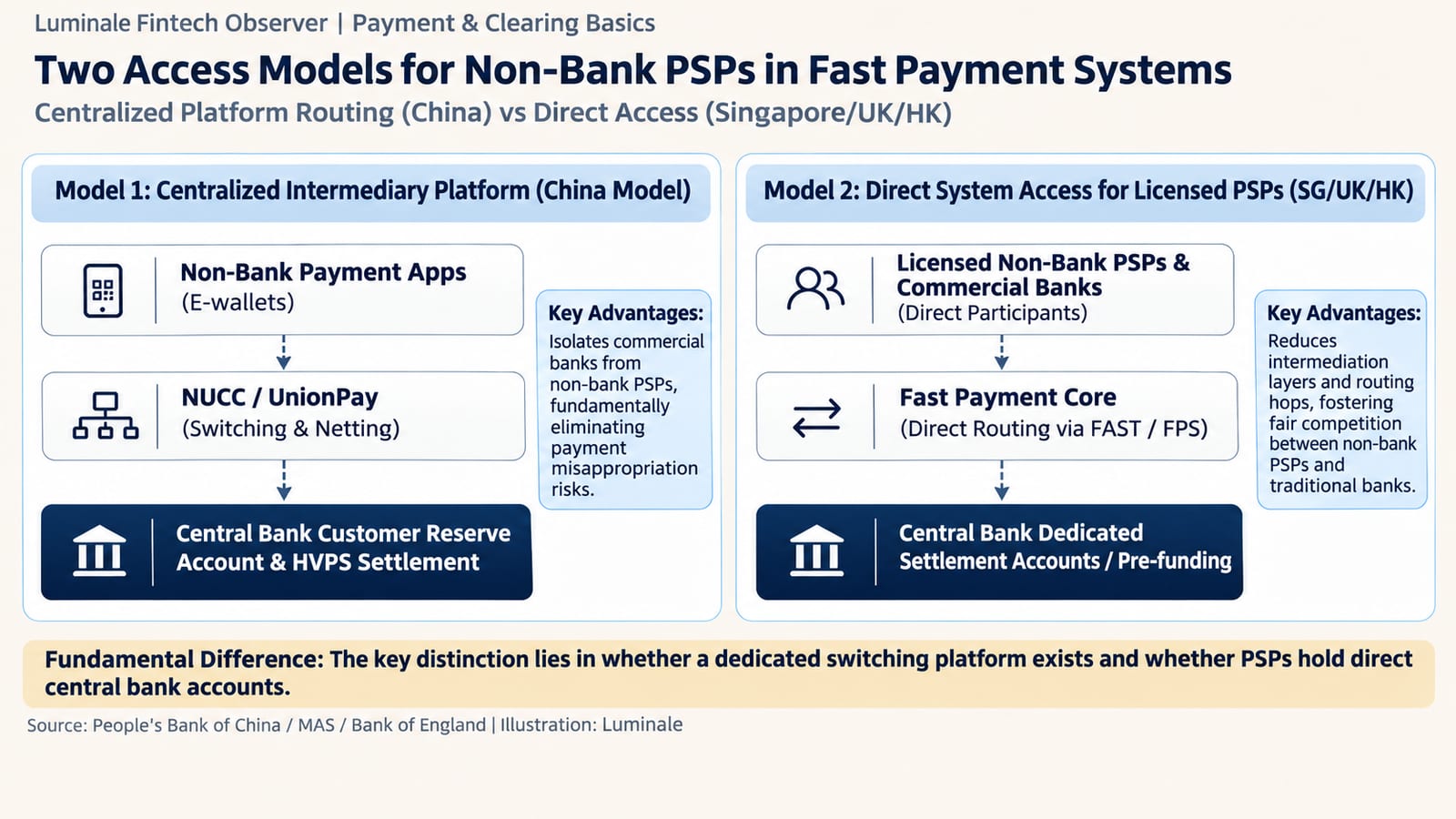
In contrast, US fast payment rails maintain conservative access criteria. Both FedNow and TCH RTP restrict direct participation to depository institutions holding banking charters subject to federal or state regulation. Fintechs and non-bank mobile wallets cannot connect directly and must partner with sponsoring commercial banks.
4. Mandatory Institution Onboarding and Financial Inclusion
Fast payment systems exhibit strong two-sided network externalities. If only small lenders join while large retail banks protect proprietary closed ecosystems, the network cannot achieve critical mass. Consequently, jurisdictions where fast payments scaled fastest uniformly enacted regulatory mandates:
- Brazil Model: When launching Pix, the Central Bank of Brazil mandated that all licensed financial institutions and payment institutions with more than 500,000 active customer accounts must onboard Pix and prominently feature Pix in their mobile applications. This mandate allowed Pix to cover over 90% of active bank accounts within months of launch.
- EU Instant Payments Regulation (IPR): Enacted in 2024 by the European Parliament and Council, the IPR mandates that all payment service providers in the Eurozone offering standard SEPA Credit Transfers (SCT) must be capable of receiving SEPA Instant Credit Transfers (SCT Inst) by January 9, 2025, and capable of sending them by October 9, 2025. Furthermore, the regulation stipulates that fees charged for instant payments must not exceed those charged for standard, non-instant credit transfers.
III. End-to-End Payment Lifecycle: Message Flows and Three Settlement Models
1. Standard Interactive Message Transmission Flow
Modern fast payment systems predominantly adopt the ISO 20022 messaging standard. A standard Customer Credit Transfer executes via the following end-to-end messaging flow:
- Instruction Initiation and Front-End Verification: The payer enters payment details in mobile or online banking. The sending bank authenticates identity, checks available balance, conducts AML screening, and debits the payer's available demand deposit balance.
- Dispatch of Credit Transfer Message: The sending bank formats an ISO 20022 customer credit transfer message (
pacs.008.001.xx) and transmits it across a secure financial extranet to the fast payment switch. - Switch Validation and Capacity Verification: Upon receiving the
pacs.008, the switch validates message syntax and evaluates the sending bank's settlement capacity. In a gross real-time model, it verifies adequate central bank reserve balances; in a deferred net settlement model, it confirms the transaction remains within the bank's Net Debit Cap (NDC). - Message Routing and Forwarding: Upon successful validation, the switch routes the
pacs.008payment instruction to the receiving bank in real time. - Receiving Bank Validation and Acceptance: The receiving bank verifies the payee's account status (confirming the account is active, valid, and unencumbered). It then returns a positive payment status report (
pacs.002.001.xx) to the central switch. - Final Status Broadcast and Account Crediting: The switch logs the transaction as successfully processed and broadcasts a confirmation to both sending and receiving banks. The receiving bank immediately credits the payee's deposit account and dispatches an alert. The entire cycle concludes within two to five seconds.
Under China's IBPS, operating under second-generation China National Automated Payment System (CNAPS2) specifications, the sending bank sends credit messages, IBPS validates participant net debit caps before routing to the receiver, the receiver checks account status and returns business acknowledgments, IBPS broadcasts results, and the receiver instantly credits the payee[4].
2. Deep Dive into Three Underlying Clearing and Settlement Architectures
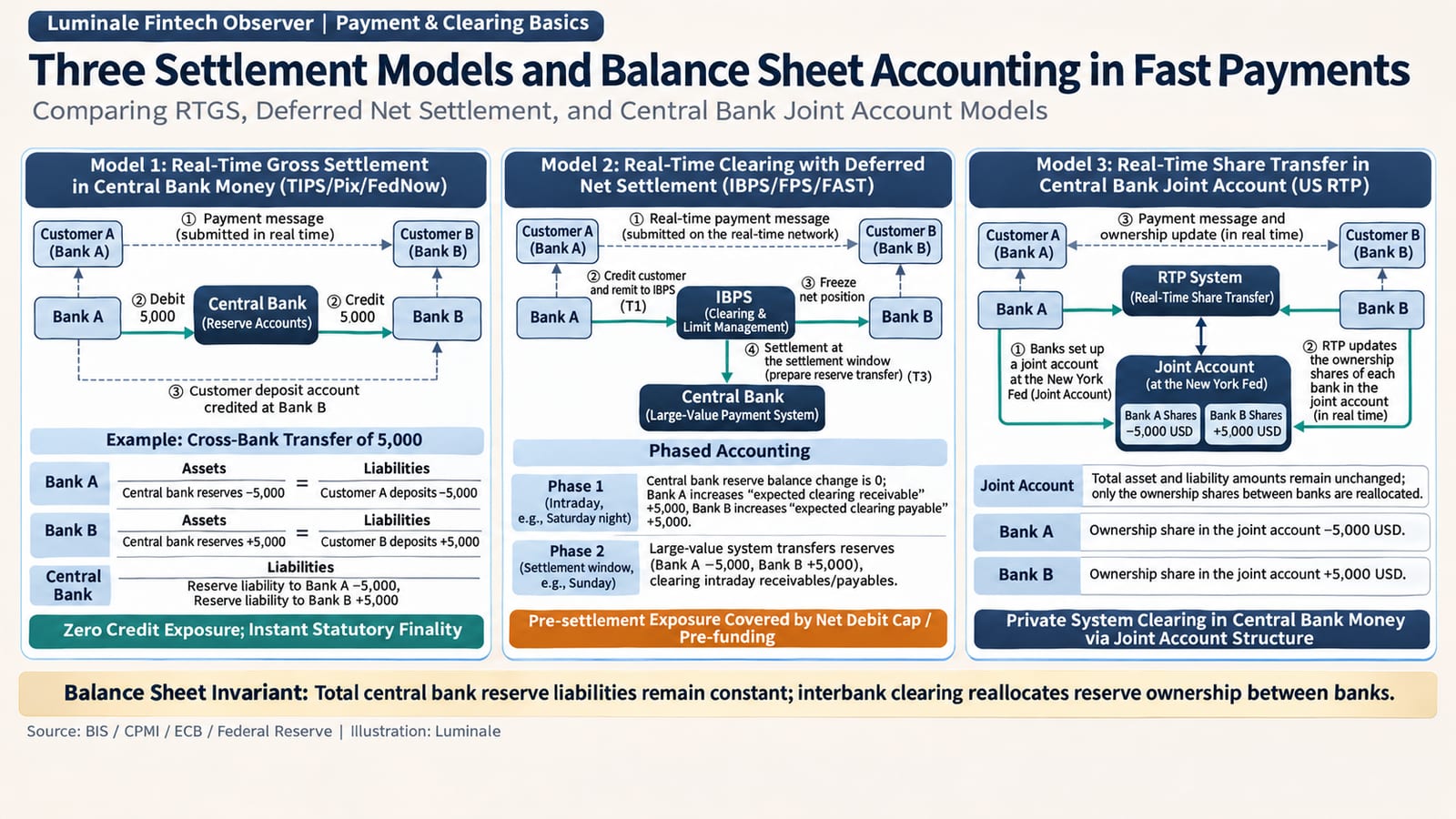
Accelerating message transmission only solves the "information rail." What defines a fast payment system's risk profile and liquidity costs is how the underlying "financial rail" clears and settles interbank funds. Global systems reflect three principal settlement architectures:
Model 1: Real-Time Gross Settlement in Central Bank Money (RTGS Derivative Model)
- Representative Systems: Eurosystem TIPS, Brazil Pix, Federal Reserve FedNow, Australia NPP (via the RBA's Fast Settlement Service - FSS).
- Mechanism: Every fast payment message triggers an immediate, gross debit against the sending bank's reserve account and a gross credit to the receiving bank's reserve account directly on the central bank ledger. Information confirmation and final settlement in sovereign central bank money are simultaneous.
- TIPS Dedicated Cash Account (DCA) Architecture: In the Eurosystem, the large-value RTGS platform TARGET2 (now T2) shuts down overnight and over weekends. To support 24/7/365 gross settlement, TIPS introduced Dedicated Cash Accounts (DCAs) legally tied to primary T2 reserve accounts. During T2 operational windows, banks transfer reserves between their main accounts and DCAs. During T2 closure, instant payments settle continuously against DCA balances in central bank money.
- Trade-Offs: This model eliminates interbank counterparty risk, providing absolute statutory settlement finality. The cost lies in liquidity: member banks must forecast volume and lock substantial reserve liquidity in dedicated accounts ahead of weekends and maintenance windows, incurring daylight liquidity opportunity costs.
Model 2: Real-Time Clearing with Deferred Net Settlement (DNS with Risk Controls)
- Representative Systems: China IBPS, UK FPS, Singapore FAST, India UPI / IMPS.
- Mechanism: The central clearing switch processes payment messages individually in real time and returns immediate confirmations, enabling receiving banks to credit payees instantly. However, interbank reserve balances do not transfer on a transaction-by-transaction basis. Instead, the switch tracks continuous bilateral or multilateral positions and settles accumulated net obligations across central bank reserve accounts during designated clearing cycles or on the next business day.
- Deep Dive: China IBPS Net Debit Cap Algorithm and Settlement Assurance:
China's IBPS operates on a "real-time crediting, scheduled netting" principle[4]. Under PBOC regulations (Yinfa [2011] No. 198), direct participants must establish a Net Debit Cap (NDC) shared with the Bulk Electronic Payment System (BEPS). Within actual clearing operations, the NDC is not an abstract figure, but an operational collateralized risk engine:
- Collateralized Capacity Pool (Baseline Limit Source): Direct clearing members must provide qualifying clearing collateral to establish their NDC. This comprises two pools: Earmarked Reserves sequestered within the central bank Settlement Account Processing System (SAPS), and Collateral Credit Lines derived from pledged government and policy bank bonds. Earmarked reserves cannot be diverted for large-value daytime credit transfers and are reserved to back retail net settlement obligations.
- Intraday Dynamic Available Limit Algorithm:
During each netting cycle, the IBPS engine computes real-time available headroom on a continuous basis:
When a bank initiates an outgoing transfer, the system verifies and decrements available NDC headroom; incoming transfers restore headroom. If a bank exhausts its available headroom (available limit reaches zero), IBPS rejects subsequent outgoing payments, citing insufficient net debit cap.
- Settlement Priority and Reserve Liquidation Logic:
When a netting cycle concludes and IBPS submits multilateral net positions to SAPS, SAPS assigns these obligations elevated queue priority and processes settlement via the following sequence:
- Priority 1: Draws upon the member bank's unencumbered free reserve balance in its primary SAPS settlement account;
- Priority 2: If free balances are insufficient, the system unfreezes and debits the bank's pre-locked earmarked reserves;
- Priority 3: If deficits persist, the central bank initiates automated collateral repo financing or liquidates pledged bonds.
This strict sequence guarantees that even if a commercial bank encounters severe wholesale liquidity shortfalls during business hours, its earmarked collateral ensures retail multilateral net positions settle cleanly, preventing counterparty default contagion under deferred net settlement.
- UK FPS Pre-Funded Clearing Model:
The UK FPS also utilizes deferred net settlement (executing three settlement cycles per business day). To eliminate systemic risk from pre-settlement bank failures, the Bank of England implemented a 100% pre-funded settlement model in 2016. Direct members must maintain dedicated, non-interest-bearing reserve accounts at the Bank of England, holding central bank balances covering 100% of their maximum Net Debit Caps. If a participant collapses between settlement cycles, the Bank of England draws upon its pre-funded cash pool to settle outstanding net debts, shielding receiving institutions from credit losses.
- Trade-Offs: This model conserves intraday central bank liquidity, freeing banks from funding every minor retail payment individually. However, credit risk during the settlement lag is converted into liquidity lockups via collateral earmarks or pre-funded accounts. For analysis on how fast payment systems influence RTGS intraday liquidity demands, see the 2021 CPMI report[7].
Model 3: Real-Time Book-Entry Ownership Share Transfers within a Central Bank Joint Account
- Representative Systems: The Clearing House Real-Time Payments (RTP) network in the United States[11].
- Mechanism: TCH is a private entity and cannot legally alter the Federal Reserve's official master reserve ledgers directly. To provide final settlement in sovereign central bank money, TCH established a specialized "Joint Account" at the Federal Reserve Bank of New York (FRBNY) on behalf of all participating banks.
- Book-Entry Share Transfer: Legally, balances in the joint account are owned co-equally by member banks in proportion to their contributed funds. The RTP switch maintains an internal distributed real-time ledger tracking each bank's exact beneficial interest ("ledger balance") in the joint account. When a payer initiates an RTP transfer, the switch debits the sending bank's interest in the joint account and credits the receiving bank's interest within seconds. Because underlying assets remain irrevocable central bank liabilities at the New York Fed, transferring beneficial interests constitutes legal settlement finality in central bank money. Member banks inject or withdraw liquidity from the joint account via Fedwire during standard operating hours.
| Comparative Dimension | Model 1: RTGS in Central Bank Money | Model 2: Real-Time Clearing with DNS | Model 3: Central Bank Joint Account Book-Entry |
|---|---|---|---|
| Representative Systems | Eurozone TIPS, Brazil Pix, US FedNow | China IBPS, UK FPS, Singapore FAST, India UPI | US RTP (operated by TCH) |
| Underlying Settlement Asset | Central bank reserve deposits | Central bank reserve deposits (cycle settlement) | Beneficial ownership shares in a central bank joint account |
| Interbank Credit Exposure | Zero (instant gross extinguishment) | Present (fully mitigated by NDC or pre-funding) | Zero (real-time legal share transfer) |
| Liquidity Demand Profile | Must fund every payment; liquidity locked over weekends | Netting economizes liquidity; highest funding efficiency | Requires 100% pre-funding in joint account; cannot sweep dynamically |
| Dependence on Wholesale RTGS | Minimal (operates 24/7 independently) | Dependent on RTGS windows to clear net batches | Dependent on RTGS windows to fund/sweep joint account |
| Settlement Finality Milestone | Instant upon message confirmation | Customer crediting is conditional; interbank reserves settle at batch cutoff | Real-time book-entry update establishes statutory finality |
3. Accounting Entries and T-Account Walkthrough for a 5,000 RMB Interbank Transfer
Revisiting the introductory scenario: Customer A transfers 5,000 RMB from Bank A to Customer B at Bank B. The following walkthrough contrasts balance sheet and T-account dynamics under Model 1 (Gross Real-Time) versus Model 2 (Deferred Net Settlement).
Scenario A: Model 1 (Real-Time Gross Settlement in Central Bank Money)
Customer deposit adjustments and central bank reserve adjustments execute simultaneously:
| Entity | Asset Adjustments | Liability Adjustments |
|---|---|---|
| Sending Bank (Bank A) | Reserve Deposits at Central Bank: -5,000 RMB | Demand Deposits (Customer A): -5,000 RMB |
| Receiving Bank (Bank B) | Reserve Deposits at Central Bank: +5,000 RMB | Demand Deposits (Customer B): +5,000 RMB |
| Central Bank | Assets: No Change | Due to Bank A (Reserves): -5,000 RMBDue to Bank B (Reserves): +5,000 RMB |
Bank A's balance sheet contracts by 5,000 RMB; Bank B's balance sheet expands by 5,000 RMB; central bank aggregate liabilities remain unchanged, with reserves reallocated between the two commercial banks in real time. There is no time wedge and zero unsettled interbank debt.
Scenario B: Model 2 (Real-Time Crediting with Deferred Net Settlement — Saturday Evening Example)
Under deferred net settlement systems (such as China's IBPS), accounting divides across two distinct phases:
Phase 1: Saturday 21:00:03 (Message Confirmation, Customer Credited)
The central bank large-value RTGS system is closed; statutory reserve accounts experience zero movement. Both commercial banks record entries via transitional interbank clearing accounts:
| Entity | Asset Adjustments | Liability Adjustments |
|---|---|---|
| Sending Bank (Bank A) | Assets: No Direct Change | Demand Deposits (Customer A): -5,000 RMBClearing Payable (Due to IBPS Net): +5,000 RMB |
| Receiving Bank (Bank B) | Clearing Receivable (Due from IBPS Net): +5,000 RMB | Demand Deposits (Customer B): +5,000 RMB |
| Central Bank | No Change (RTGS closed, reserves unadjusted) | No Change |
Phase 2: Monday Morning Netting Window (Multilateral Batch Settlement Across Reserves)
Assuming this was the sole transaction over the weekend, when the large-value RTGS system opens on Monday, the clearing switch submits net instructions, and the central bank ledger updates:
| Entity | Asset Adjustments | Liability Adjustments |
|---|---|---|
| Sending Bank (Bank A) | Reserve Deposits at Central Bank: -5,000 RMB | Clearing Payable (Extinguished): -5,000 RMB |
| Receiving Bank (Bank B) | Clearing Receivable (Extinguished): -5,000 RMBReserve Deposits at Central Bank: +5,000 RMB | Liabilities: No Change (Credited in Phase 1) |
| Central Bank | Assets: No Change | Due to Bank A (Reserves): -5,000 RMBDue to Bank B (Reserves): +5,000 RMB |
Upon concluding Phase 2, transitional interbank claims are extinguished, reserve transfers settle, and balance sheets reach the exact end-state achieved in Model 1.
4. Overlay Services and Front-End Interaction Mechanisms
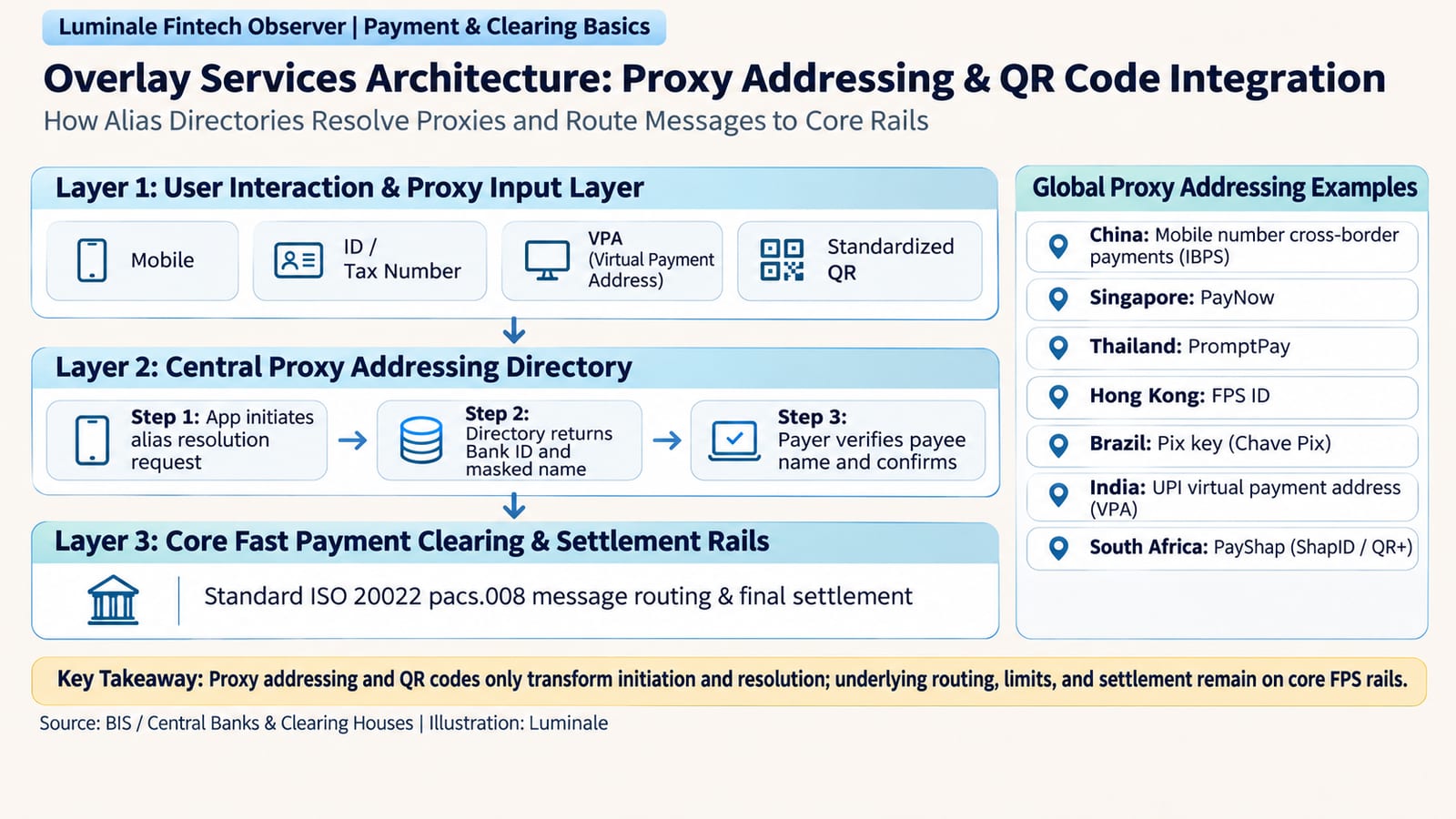
While fast payment systems provide high-throughput clearing backbones, end users interact with the "Overlay Services Layer."
Proxy Addressing / Alias Directory Systems
Traditional interbank transfers require payers to input the beneficiary's bank name, routing number, and long bank account number (or IBAN)—a friction-laden process prone to human error. Proxy addressing directories maintain centralized, highly available databases that map bank accounts to intuitive, everyday aliases.
| Jurisdiction | Overlay Scheme | Supported Proxy Identifiers | Underlying Fast Payment System |
|---|---|---|---|
| China | Mobile Number Interbank Transfer | Registered Mobile Phone Number | Internet Banking Payment System (IBPS) |
| Singapore | PayNow | Mobile Number, Singapore NRIC/FIN, Unique Entity Number (UEN) | FAST |
| Thailand | PromptPay | Mobile Number, National Citizen ID, Corporate Tax ID | ITMX / PromptPay |
| Hong Kong SAR | Faster Payment System (FPS) | Mobile Number, Email Address, FPS Identifier (FPS ID) | Hong Kong FPS (HKICL) |
| Brazil | Pix | Tax ID (CPF/CNPJ), Mobile Number, Email, 32-character Random Key | Pix |
| India | UPI | Virtual Payment Address (VPA, e.g., name@okhdfcbank) | IMPS / UPI Switching Core |
| Australia | PayID | Mobile Number, Email Address, Australian Business Number (ABN) | NPP |
| South Africa | PayShap | Registered Mobile Phone Number (ShapID) | PayShap |
Operationally, when a payer enters a mobile number in an app, the front end queries the central directory. The directory returns the beneficiary's receiving bank code, masked account number, and masked legal name. Upon payer confirmation, the app generates a standard credit transfer message. Proxy addressing alters how payment instructions are initiated and resolved, while routing and settlement rely entirely on incumbent clearing rails.
Evolution of Front-End Interactions: From Manual Input to Unified QR Codes and Recurring Payments
Front-end interactions have transitioned from manual alias entry to standardized static and dynamic QR codes. In Brazil, the central bank's standardized BR Code accelerated Pix adoption across merchant checkouts.
Furthermore, fast payment schemes are expanding from pure payer-initiated "push payments" into payee-initiated "pull payments." For instance, Brazil's Pix Automático (scheduled recurring debits) and India's UPI AutoPay enable automated recurring payments for utility bills, streaming subscriptions, and rent. By offering negligible transaction fees and immediate crediting, fast payments are increasingly replacing traditional direct debit mandates and credit card recurring billing.
IV. Global Fast Payment Systems: A Comparative Matrix and Three Landmark Case Studies
1. Comprehensive Landscape Matrix of Major Global Fast Payment Systems
Diverse jurisdictions have developed bespoke fast payment systems shaped by domestic market structures, regulatory objectives, and banking industry concentration. The matrix below synthesizes major implementations worldwide:
| Jurisdiction | System Name | Operator and Legal Status | Inception Year | Settlement Architecture | Transaction Cap | Key Overlay Services | Non-Bank PSP Direct Access |
|---|---|---|---|---|---|---|---|
| China | Internet Banking Payment System (IBPS) | PBOC Clearing Center (Central Bank) | 2010 | Real-time clearing, DNS across HVPS reserve accounts | 1,000,000 RMB (raised from 50k RMB; banks set policy caps) | Mobile alias transfer, online banking interconnect | No direct access; routed via NUCC/UnionPay |
| United States | RTP | The Clearing House (TCH, Private Bank Consortium) | 2017 | Real-time book-entry transfer within FRBNY Joint Account | $10,000,000 USD | Request for Payment (R2P), E-invoicing | Restricted; insured depository institutions only |
| United States | FedNow | Federal Reserve Banks (Central Bank) | 2023 | RTGS across Federal Reserve Master Accounts | $10,000,000 USD (raised in Nov 2025)[9] | Core credit transfer, R2P, balance inquiry | Restricted; entities eligible for Fed master accounts only |
| Eurozone | TIPS | Eurosystem / European Central Bank | 2018 | Gross real-time settlement across Dedicated Cash Accounts (DCAs) | €100,000 EUR (governed by SEPA SCT Inst rules) | Mobile proxy lookup, cross-currency support | Open under PSD2; licensed PIs and EMIs eligible |
| United Kingdom | Faster Payments Service (FPS) | Pay.UK (Private Not-for-Profit Operator) | 2008 | DNS with 100% pre-funding at Bank of England (3x daily) | £1,000,000 GBP (individual banks enforce lower caps) | Confirmation of Payee (CoP), Paym proxy lookup | Open; authorized non-bank PSPs/EMIs hold settlement accounts |
| Singapore | FAST | BCS (Operated on behalf of ABS) | 2014 | Multilateral DNS via MEPS+ batch clearing | $200,000 SGD (raised in 2018) | PayNow (individual and corporate proxy addressing) | Open; licensed Major Payment Institutions (MPIs) directly access |
| Hong Kong SAR | Faster Payment System (FPS) | HKICL (Regulated by HKMA) | 2018 | 24/7 RTGS in HKD and offshore RMB (CNH) | Discretionary limits set by participants | FPS ID, mobile, email, Common QR Code | Open; banks and licensed Stored Value Facilities (SVF) access |
| India | UPI / IMPS | NPCI (Specialized Umbrella Entity) | 2016 / 2010 | Multi-batch DNS across Reserve Bank of India RTGS | 100k to 500k INR (categorized by merchant sector) | Virtual Payment Address (VPA), UPI AutoPay | Open; TPAPs access via bank sponsorship; PPIs interoperable |
| Brazil | Pix | Central Bank of Brazil (Central Bank) | 2020 | Gross real-time settlement across Instant Payment Accounts (PI) | No statutory cap (banks establish daytime/nighttime caps) | Pix keys, unified BR Code, Pix Automático | Mandatory; licensed entities exceeding size thresholds must join |
| Australia | NPP | NPP Australia / Australian Payments Plus | 2018 | Gross real-time settlement across RBA Fast Settlement Service | No mandatory system cap (managed by participants) | PayID alias directory, Osko retail interface | Open access architecture; restricted direct access tiers |
| Japan | Zengin System (More Time) | Zengin-Net (Japanese Bankers Association) | 2018 (Ext) | Multilateral DNS across Bank of Japan current accounts | No uniform statutory limit | Zengin rapid account lookup | Open; funds transfer service providers admitted since Oct 2022 |
| South Africa | PayShap | BankservAfrica / PayInc (Bank Consortium) | 2023 | Multilateral DNS across SARB SAMOS RTGS system | 3,000 ZAR (tailored for micro-payments) | ShapID proxy lookup, unified QR+ standard | Expanding; non-bank frameworks under phased rollout |
2. In-Depth Case Studies
Case 1: Why Brazil's Pix Scaled Rapidly: End-to-End Central Bank Leadership from Rulemaking to Operations
Since its deployment in November 2020, Brazil's Pix has become one of the fastest-scaling retail payment networks globally. According to official Banco Central do Brasil (BCB) data, Pix processed approximately 79.8 billion transactions totaling 35.36 trillion BRL in 2025, eclipsing conventional debit card purchases and legacy TED interbank transfers.
Pix's rapid adoption stems from the central bank's integrated governance strategy:
- Unified Regulator and Operator: Unlike Western models that separate scheme governance from clearing house operation, the BCB simultaneously serves as regulator, rulebook author, core clearing switch operator, and custodian of the centralized proxy addressing directory (DICT). This centralized authority eliminated interbank coordination friction.
- Mandatory Onboarding for Incumbents: The BCB mandated that all financial institutions and licensed payment institutions with over 500,000 active customer accounts connect to Pix, ensuring large private lenders could not withhold liquidity to protect closed-loop ecosystems.
- Real-Time Settlement on Central Bank Ledgers: Direct participants maintain Instant Payment Accounts (PI) at the central bank, with transactions settling individually in central bank money, eliminating credit exposure.
- Functional Expansion into Merchant Checkouts and Recurring Debits: Supported by the mandatory BR Code standard, Pix expanded from P2P transfers into B2C retail checkouts. Subsequent introductions of Pix Automático (direct debit) and installment Pix directly contested market segments historically dominated by credit cards, promissory notes, and conventional direct debits.
Case 2: The Coexistence of RTP and FedNow in the United States and Resulting Liquidity Fragmentation
Unlike economies operating unified national fast payment backbones, the United States presents a dual-track landscape:
- In November 2017, The Clearing House (TCH)—owned by a consortium of major commercial banks including JPMorgan Chase, Citi, and Bank of America—launched RTP[11];
- Following extensive industry consultation and antitrust debate, the Federal Reserve launched its own public fast payment rail, FedNow, in July 2023.
By year-end 2025, participating FedNow institutions exceeded 1,500, and both FedNow and RTP raised single-transaction limits to $10 million to contest corporate wholesale payments[9].
However, the two networks lack technical interoperability; payment messages cannot route across platforms. This structural separation generates two operational challenges:
- Interoperability Gaps Across Member Tiers: Tier-one money-center institutions own and actively clear across RTP; conversely, thousands of smaller community banks and credit unions, wary of TCH's big-bank governance, chose to onboard FedNow. If a receiving bank only connects to FedNow while the sending bank only connects to RTP, instant payment instructions cannot execute. Commercial banks seeking comprehensive coverage must incur the overhead of connecting to both rails.
- Liquidity Fragmentation Across Disconnected Pools: Operating across both systems requires corporate treasuries to partition intraday liquidity between the New York Fed Joint Account (backing RTP) and primary Federal Reserve master accounts (backing FedNow). Because funds cannot sweep autonomously across these accounts overnight, commercial banks face heightened liquidity fragmentation.
Case 3: Mandatory APP Scam Reimbursement in the UK and Payee Verification in the EU
Fast payments utilize a "credit push" architecture that provides instant, irrevocable finality. This renders traditional unauthorized pull-payment fraud defenses ineffective. Fraudsters no longer need to steal card numbers or online credentials; instead, they use impersonation, investment scams, and social manipulation to induce victims into voluntarily initiating transfers. This is known as Authorised Push Payment Scams (APP Scams).
Under traditional commercial law, if a payer passes Strong Customer Authentication (SCA) and authorizes an instruction, the bank operates strictly as a messaging conduit and bears no liability, leaving victims to absorb all financial losses.
To realign fraud incentives, the UK Payment Systems Regulator (PSR) enacted major structural reforms[10]:
- Mandatory Reimbursement Framework: Commencing October 7, 2024, victims of APP scams executed over the UK Faster Payments Service are entitled to mandatory reimbursement from financial institutions, subject to an £85,000 maximum claim cap (with the Bank of England applying the same cap to CHAPS transfers).
- Symmetric 50:50 Liability Allocation: The core institutional design mandates that reimbursement costs are split equally (50:50) between the sending bank and the receiving bank[10].
Under this 50:50 allocation, receiving banks that fail to detect money-mule accounts must fund half of the fraud reimbursement directly. This has forced all FPS participants to upgrade KYC verification and deploy real-time fraud monitoring on incoming credits.
Concurrently, the European Union implemented parallel requirements under the Instant Payments Regulation: Eurozone banks must provide free Verification of Payee (VoP) services to all customers by October 2025. When a payer enters an IBAN, the system compares the input against official account registrations and displays the match status before payment confirmation, intercepting misdirected payments and impersonation scams at source. Both policies demonstrate that irreversible settlement requires front-end validation and balanced liability allocation.
V. Upgrading, Linking, or Starting Anew: Where Are Fast Payment Systems Heading?
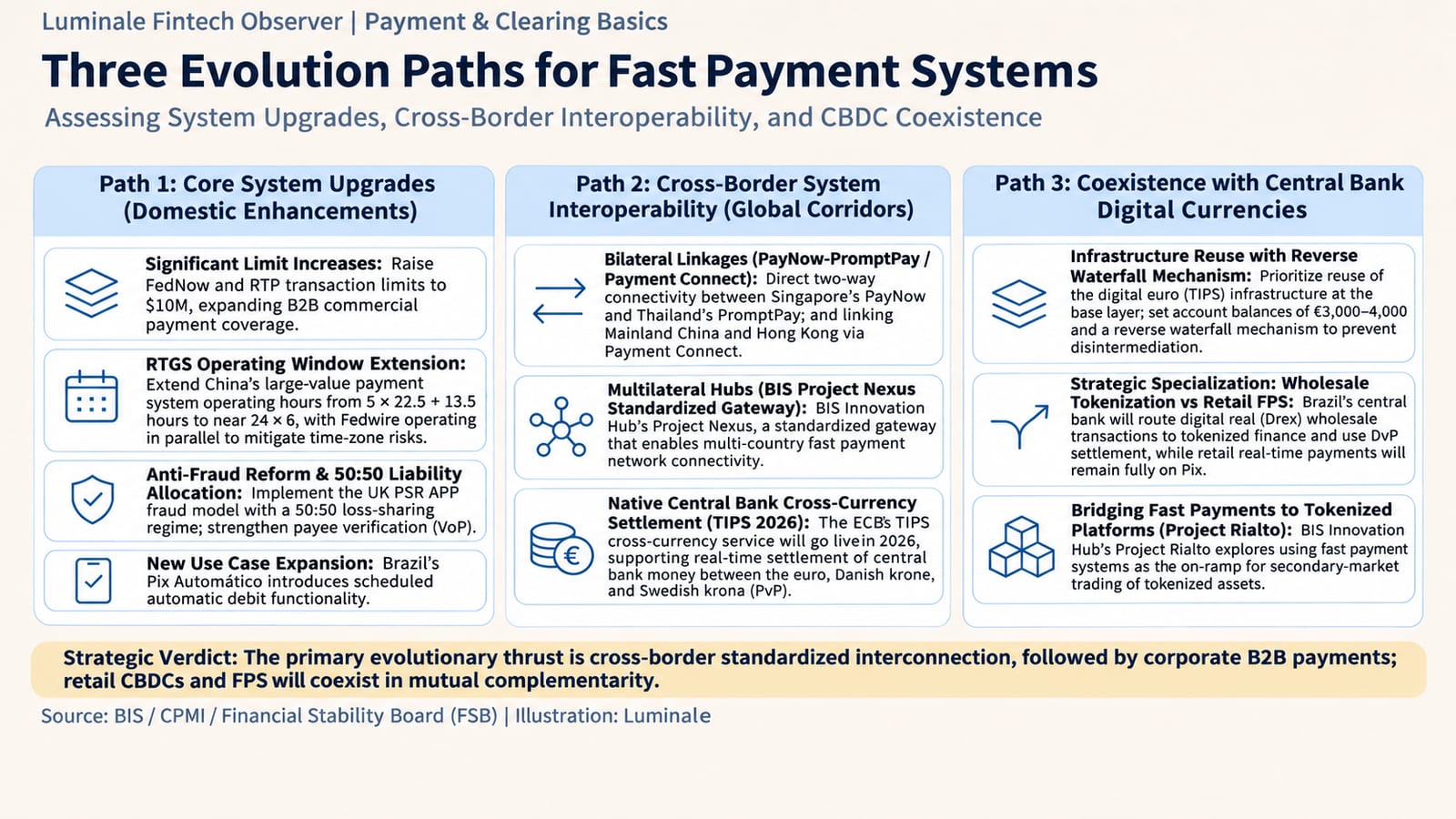
The global evolution of fast payment systems is progressing along three complementary trajectories: upgrading legacy capabilities, establishing cross-border multilateral linkages, and determining the long-term relationship with retail central bank digital currencies (CBDCs).
1. Functional Upgrades and Operational Support for Incumbent Systems
The first trajectory focuses on optimizing established systems by raising caps, expanding operating hours, and extending into new use cases:
- Elevating Transaction Limits for Corporate Payments:
Supported by enhanced fraud analytics, major systems are raising transaction caps. FedNow and RTP elevated caps to $10 million[9], extending fast payments beyond P2P transfers and retail point-of-sale into B2B supply chain settlement, bulk payroll, and commercial real estate deposits—domains historically dominated by wholesale RTGS or batch ACH. The boundary between retail fast payments and wholesale RTGS is blurring.
- Aligning Central Bank RTGS to Continuous Operating Windows:
Operating fast payment schemes 24/7/365 places operational demands on central bank RTGS systems. Under deferred net settlement, if RTGS systems remain closed over weekends for dozens of hours, commercial banks cannot access interbank money markets. If a bank experiences unexpected retail outflows overnight, its Net Debit Cap can deplete rapidly; unable to borrow reserves in closed interbank markets, the bank risks liquidity deadlock or unintended overdraft defaults.
To alleviate this constraint, central banks are extending RTGS operating windows:
- In October 2026, the PBOC expanded HVPS operational availability to "5×22.5 + 13.5 hours," minimizing overnight maintenance windows;
- The Federal Reserve announced strategic plans to extend Fedwire Funds Service and National Settlement Service (NSS) operations to 22×6, with an eventual trajectory toward 24/7/365 operations (targeted for 2028–2029). Expanding RTGS availability ensures smooth central bank reserve liquidity backstops for retail fast payment schemes. For analysis of commercial bank liquidity management strategies, see 《When Banks Run Short in RTGS, Where Does the Money Come From? Sources of Intraday Liquidity》.
- Pragmatic Deliberation in Infrastructure Modernization:
The UK originally planned to develop the New Payments Architecture (NPA) to replace both FPS and Bacs with a consolidated modern codebase. However, due to migration costs and transition risks across hundreds of institutions, the Payment Systems Regulator (PSR) paused the comprehensive NPA overhaul, directing Pay.UK to prioritize incremental upgrades to FPS through 2026. This illustrates that for systemically important retail infrastructures, operational stability takes precedence over radical architectural shifts.
2. Cross-Border Interoperability and Multilateral Linkages
The second trajectory addresses cross-border frictions by interconnecting domestic payment systems to create cross-currency retail corridors. The Financial Stability Board (FSB) and G20 prioritized linking domestic fast payment systems within the G20 Roadmap for Enhancing Cross-Border Payments to accelerate speeds and compress remittance costs[12].
Global exploration reflects three distinct models:
- Bilateral Linkages:
In April 2021, the Monetary Authority of Singapore (MAS) and Bank of Thailand (BOT) linked Singapore's PayNow with Thailand's PromptPay, creating the world's first bilateral fast payment linkage. Retail users initiate cross-border remittances within seconds using mobile numbers at costs substantially below legacy SWIFT correspondent banking rails. For an extensive case study, see 《From PayNow–PromptPay to Payment Connect: How Fast Payment Systems Turn into Cross-Border Networks》.
Building on this, authorities in Mainland China and Hong Kong SAR launched "Payment Connect" in June 2025, linking Mainland China's IBPS with Hong Kong's FPS. This enables instant cross-boundary remittances via mobile numbers, supporting financial integration across the Guangdong-Hong Kong-Macao Greater Bay Area.
- Multilateral Hub Architecture (Nexus):
While bilateral links succeed between trade pairs, connecting economies bilaterally requires $ rac{N(N-1)}{2}$ links and bespoke foreign exchange agreements, resulting in high integration costs. To address this, the BIS Innovation Centre Singapore Centre developed Project Nexus. Nexus deploys a standardized multilateral gateway; domestic fast payment networks connect via standard APIs to achieve interoperability with all participating networks, while competitive FX Providers (FXPs) quote exchange rates and settle currency legs in real time. For architectural analysis, see 《From Bilateral Linkages to a Multilateral Network: How Nexus Rearchitects Cross-Border Fast Payment Connections》 and ASEAN regional implementations in 《Scanning the Same Code: Why Isn't It Globally Universal? Understanding Global QR Standards and Interoperability from QRIS》.
- Native Multi-Currency Settlement within Central Bank Systems:
On June 10, 2026, the European Central Bank (ECB) launched the TIPS Cross-Currency Service[8]. This capability allows instant foreign exchange Payment versus Payment (PvP) settlement across Euro (EUR), Danish Krone (DKK), and Swedish Krona (SEK) directly within the central bank TIPS engine, eliminating settlement principal risk. The Central Bank of Iceland subsequently joined the TIPS multi-currency network in June 2026. This marks the first implementation of native multi-currency real-time gross settlement within a central bank fast payment platform.
3. Starting Anew or Symbiotic Coexistence: Fast Payments vs. Retail CBDCs
The third trajectory examines the fundamental relationship between currency instruments and clearing infrastructures. As central bank digital currency research advances, policymakers face a key question: In economies with efficient, ubiquitous, low-cost fast payment systems (such as Pix, FPS, or IBPS), must central banks deploy retail CBDCs from scratch?
Mechanically, the distinction between fast payments and retail CBDCs lies not in user-facing transaction speed, but in the legal status of the settlement asset and holding vehicle:
- Fast payments transfer commercial bank demand deposits (claims on commercial banks), with operations mediated by the commercial banking system;
- Retail CBDCs represent direct central bank liabilities (claims on the central bank), possessing statutory legal tender status and theoretically supporting fully offline peer-to-peer transfers independent of commercial bank balance sheets.
In practical institutional design, central banks increasingly pursue symbiotic integration rather than outright displacement:
- Reusing Established Infrastructure: In designing the Digital Euro settlement architecture, the ECB confirmed that the Digital Euro will leverage the high-throughput TIPS network as its underlying settlement engine, while commercial banks and licensed intermediaries retain customer-facing wallet and account distribution. To prevent bank disintermediation and bank runs during stress, the ECB proposed holding caps (approximately €3,000 to €4,000) and a "Reverse Waterfall" mechanism that automatically sweeps excess balances into conventional commercial bank accounts. For architectural analysis, see 《The Digital Euro Landscape: Why Build It, How It Works, and Where the Project Stands》.
- Strategic Reorientation from Retail to Wholesale and Tokenization: Following Pix's retail success, the Central Bank of Brazil repositioned its digital currency initiative, Drex: retail instant payments remain the domain of Pix, while Drex focuses on wholesale finance, tokenized bank deposits, government bond Delivery versus Payment (DvP), and smart contract programmable settlement.
- Interfacing Tokenized Asset Platforms: The BIS Innovation Centre's Project Rialto studies modular gateways and smart contracts linking traditional fast payment networks with tokenized asset platforms, deploying fast payment systems as the settlement cash leg for secondary asset markets.
4. Comprehensive Assessment of Evolutionary Trajectories
Based on institutional developments and financial mechanics, the medium-to-long-term evolution of fast payment systems reflects a clear trajectory:
The primary evolutionary path for fast payment systems is multilateral cross-border linkage, followed by corporate limit expansions and settlement backstop upgrades on domestic rails; standalone retail CBDCs and incumbent fast payment systems will coexist as complementary infrastructures rather than mutually exclusive substitutes.
Key supporting factors include:
- Settlement Asset Homogeneity and Cost Efficiency: Fast payment systems settle across central bank reserves (or beneficial interest shares in central bank joint accounts), matching the credit quality of central bank money. By upgrading proxy addressing directories and adopting ISO 20022 messaging, jurisdictions achieve cross-border connectivity with low marginal investment, avoiding the friction of changing domestic consumer habits;
- Network Externality Moats of Incumbent Rails: Established fast payment networks maintain deep integrations across tens of thousands of financial institutions and hundreds of millions of retail accounts, representing prohibitive nationwide switching costs;
- Distinct Functional Roles: Fast payments optimize round-the-clock commercial bank deposit mobility, while retail CBDCs preserve the central bank cash anchor in digital formats and offer offline programmable channels. They serve complementary roles within modern financial architecture.
Conclusion
From an SMS credit notification received on a Saturday evening to the interbank reconciliation executed across central bank reserve accounts on the next business day, fast payment systems and large-value payment systems maintain a functional division of labor: fast payments handle high-frequency, small-dollar instant transfers for the public, while large-value RTGS systems provide back-end final reserve settlement between banks. By decoupling instant customer funds availability from interbank reserve movements, supported by net debit caps, earmarked collateral, or real-time central bank gross transfers, the system prevents counterparty defaults from propagating systemic risk.
China's payment and clearing architecture—combining commercial bank direct access to IBPS, non-bank PSP routing via NUCC/UnionPay, 100% centralized float deposit at the central bank, and final settlement across HVPS—reconciles massive transaction concurrency with rigorous systemic risk insulation.
The evolution of fast payment systems continues to advance. In Africa, following the 2023 launch of PayShap by the South African Reserve Bank and commercial banking sector, authorities introduced the unified "QR+" standard in 2025 to lower integration barriers for the informal economy and micro-merchants, illustrating how fast payment networks continue to expand overlay capabilities into new use cases. How South Africa leverages a unified QR standard to link instant settlement rails will be examined in subsequent installments of this series. Concurrently, our research will extend into the mechanics of bulk payment systems and Automated Clearing Houses (ACH).
References and Official Publications
[1]: People's Bank of China. (2026). Overall Operation of the Payment System in 2025 [EB/OL]. (2026-03-20). http://www.pbc.gov.cn/goutongjiaoliu/113456/113469/index.html. ↩
[2]: World Bank. (2021). Fast Payment Systems: A Quick Assessment of the Global Landscape [R]. World Bank Group. https://thedocs.worldbank.org/en/doc/8f85b06f02562c802e97d9ec9d413b0e-0350012021/original/Fast-Payment-Preview-April21.pdf. ↩
[3]: Reserve Bank of Australia. (2014). Fast Retail Payment Systems [R]. RBA Bulletin, December 2014. https://www.rba.gov.au/publications/bulletin/2014/dec/6.html. ↩
[4]: People's Bank of China. (2011). Administrative Measures for the Business of Internet Banking Payment System (Yinfa [2011] No. 198) [EB/OL]. (2011-08-05). http://www.pbc.gov.cn/zhifujiesuansi/128525/128535/128626/2872882/index.html. ↩
[5]: Payment Systems Taskforce / OFT. (2005). Final Report of the Payment Systems Taskforce [R]. London: Office of Fair Trading. https://webarchive.nationalarchives.gov.uk/ukgwa/20140402142426/http://www.oft.gov.uk/OFTwork/financial-power/payment-systems/. ↩
[6]: Committee on Payments and Market Infrastructures (CPMI). (2016). Fast payments - Enhancing the speed and availability of retail payments (CPMI Papers No. 154) [R]. Basel: Bank for International Settlements. https://www.bis.org/cpmi/publ/d154.pdf. ↩
[7]: Committee on Payments and Market Infrastructures (CPMI). (2021). Developments in retail fast payments and implications for RTGS systems [R]. Basel: Bank for International Settlements. https://www.bis.org/cpmi/publ/d201.pdf. ↩
[8]: European Central Bank. (2026). TIPS cross-currency service goes live [EB/OL]. (2026-06-10). https://www.ecb.europa.eu/press/intro/news/html/ecb.mipnews260610.en.html. ↩
[9]: Federal Reserve Financial Services. (2025). FedNow Service Transaction Limit Increase to $10 Million [EB/OL]. (2025-11-12). https://www.frbservices.org/news/communications/111225-fednow-transaction-limit-increase. ↩
[10]: Payment Systems Regulator. (2024). PS24/3: High-value APP scams reimbursement requirement [R]. London: PSR. https://www.psr.org.uk/news-and-updates/latest-news/news/psr-confirms-its-decision-on-app-scams-reimbursement/. ↩
[11]: The Clearing House. (2024). RTP System Operating Rules and Joint Account Structure Overview [EB/OL]. https://www.theclearinghouse.org/payment-systems/rtp. ↩
[12]: Financial Stability Board. (2020). Enhancing Cross-Border Payments: Stage 3 Roadmap [R]. Basel: FSB. https://www.fsb.org/2020/10/enhancing-cross-border-payments-stage-3-roadmap/. ↩
Originally published by Luminale Fintech Observer: https://luminale.cn/articles/fast-payment-systems-instant-payments-en