In the second half of 2026, the global regulatory landscape for stablecoins underwent a decisive structural shift.
In earlier discussions, such as "Understanding Stablecoins in One Article: How Do They Actually Stay 'Stable'?", analytical frameworks primarily focused on the generation mechanisms of fiat-referenced stablecoins, the logic of asset collateralisation, and initial proposals for framework legislation. At that time, official positions across most jurisdictions remained largely aspirational, leaving a temporary observation window awaiting detailed implementation rulebooks.
By November 2026, global stablecoin regulation had fully moved beyond exploratory principles into the deep waters of granular operational rules, market clearing of non-compliant tokens, and integration with foundational financial infrastructure. The US Office of the Comptroller of the Currency (OCC) finalised its comprehensive 721-page federal implementation rule; the 60-day public comment window for parallel prudential proposals from the Federal Reserve and the Federal Deposit Insurance Corporation (FDIC) drew to a close; the expiration of the transition period under the European Union's Markets in Crypto-Assets Regulation (MiCA) forced the comprehensive delisting of non-compliant tokens from regulated platforms, triggering targeted reviews of cross-border multi-issuance arrangements; the UK Financial Conduct Authority (FCA) opened authorization gateways for non-systemic stablecoins while the Bank of England (BoE) formulated stringent unremunerated central bank reserve rules for systemic coins; Hong Kong, having granted its initial pair of issuer licenses, advanced explorations of interoperability with global commercial banking networks; Singapore, Japan, South Korea, and Mainland China refined statutory boundaries across legislative amendments, trust expansions, banking qualifications, and sovereign currency protections; and the Financial Stability Board (FSB) delivered a report to the G20 highlighting cross-border financial vulnerabilities and reserve asset concentration risks in multi-currency stablecoin arrangements[7].
Beneath complex legal texts, regulators worldwide are answering the exact same set of foundational questions: Who is eligible to issue? Where must reserve assets be held, and under what constraints? How quickly must redemption requests be fulfilled under stress? And crucially, can stablecoins legally pay interest to holders? Differing answers to these four questions outline both remarkable global convergence and deep structural divergence in stablecoin governance.
1. Peering Beneath the Chain: What Three Core Questions Are Global Regulators Answering?
While stablecoins record transactions on Distributed Ledger Technology (DLT) blockchain networks—boasting technical attributes such as peer-to-peer transfers and continuous operations—their redemption and reserve clearing remain heavily bound to the operating hours of traditional financial markets. Outside normal business hours and during overnight closures of interbank money markets, an issuer facing heavy redemptions cannot quickly replenish liquidity via interbank borrowing or Treasury discounting, leaving it exposed to liquidity depletion and technical default. The fundamental creditworthiness and financial risks that determine whether a stablecoin can reliably maintain its 1:1 par exchange value with sovereign fiat currency remain anchored entirely within the traditional banking system and legal contracts off-chain.
To understand the financial risk profile of a stablecoin, one can look through the simplified balance sheet of a fully compliant issuer:
| Assets | Liabilities & Equity |
|---|---|
| Reserve Assets | Tokens in Circulation |
| • Commercial bank demand deposits & central bank account balances | • Customer claims for par-value token redemption |
| • Sovereign Treasury bills with remaining maturity ≤ 93 days | • Institutional & market-maker liabilities earmarked for redemption |
| • Overnight sovereign reverse repurchase agreements (Reverse Repo) | Equity Capital |
| • Government money market funds invested exclusively in short Treasuries | • Statutory paid-in capital (e.g., $5 million or HK$25 million) |
| Operational Capital Buffer | • Retained expense reserves (e.g., 12 months of operating expenses) |
| • Issuer's own operating capital and qualifying subordinated debt | |
| Total Assets = 105 | Total Liabilities & Equity = 105 |
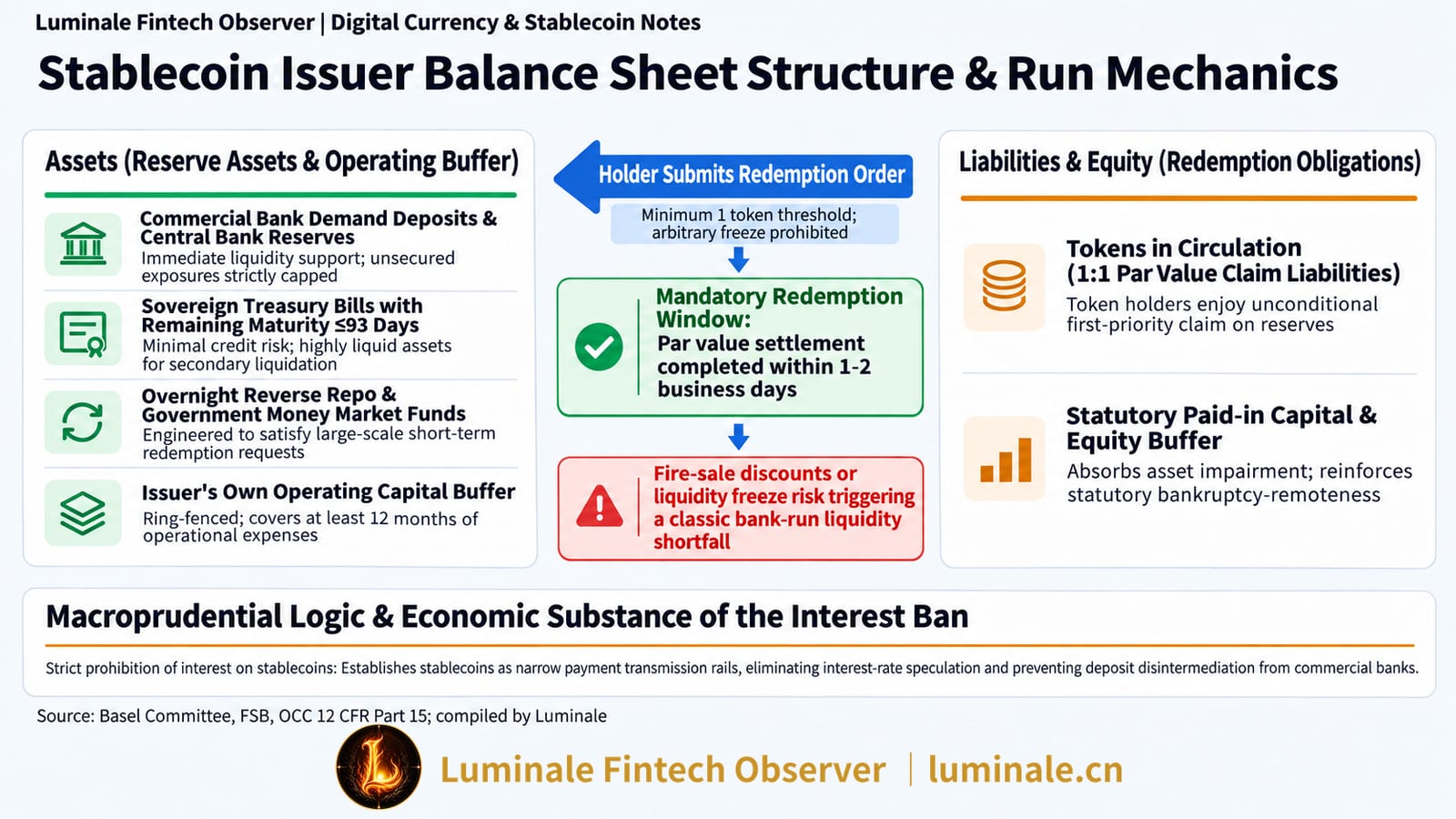
This micro-structure lays bare the classic run vulnerability inherent to stablecoins. On the asset side, if an issuer holds assets with extended maturities, encounters market liquidity freezes, or faces custodian bank insolvencies, the market value of its reserves will deviate from par. On the liability side, token holders on-chain can initiate mass redemptions at any moment. The instant asset liquidation speed fails to match redemption demand, a liquidity shortfall emerges, triggering a classic bank-run dynamic.
Constrained by this balance sheet reality, global regulatory bodies have coalesced around three mandatory questions:
- Who Can Issue (Issuer Eligibility and Capital): Issuers must possess regulated corporate status and prudential capital, bearing direct legal responsibility for unconditional redemption. Regulators restrict issuance to prudentially supervised commercial banks, credit institutions, or specialized non-bank corporate entities subject to rigorous capital adequacy requirements, eliminating unregulated anonymous issuance.
- Where Reserves Are Kept (Asset Segregation and Liquidity): Reserve assets must maintain at least 100% coverage at all times and be legally segregated from the issuer's own balance sheet. Much like customer reserve funds in payment institutions—an arrangement analyzed in "Is Money in Alipay the Same as Money in a Bank Account? A Clear Explanation of 'Customer Reserve Funds'"—reserves must be deposited under statutory trusts or independent Special Purpose Vehicles (SPVs) with qualified custodians. This ensures that in the event of issuer insolvency or restructuring, reserve assets are ring-fenced from general bankruptcy claims.
- How Fast to Redeem (Par-Value Settlement Finality): Issuers must provide holders with an enforceable legal right to redeem tokens at 1:1 par value in fiat currency, compressing redemption processing times to within one or two business days. This requires reserve assets to maintain ultra-short weighted average maturities, as any liquidation haircut could immediately wipe out equity capital.
Underpinning these three questions is a near-universal consensus on the Prohibition of Interest. Regulatory authorities strictly forbid issuers from granting interest solely for holding or transacting stablecoins. In Luminale's analytical framework of global financial infrastructure, the interest ban serves a vital macroprudential function: if non-bank stablecoins were permitted to distribute yield to the public, they would rapidly morph into "on-chain shadow banks" unburdened by reserve requirements and Liquidity Coverage Ratios (LCR). Such yield-bearing coins would siphon retail and corporate deposits out of the commercial banking system, triggering widespread bank deposit disintermediation.
Thus, the baseline consensus across major regulatory authorities is unmistakable: fiat-referenced stablecoins are legally anchored as high-liquidity, zero-credit-creation narrow payment transmission rails, rather than savings-absorbing deposit substitutes.
2. Transatlantic Divergence: The Fed Master Account Debate and EU MiCA Review Friction
Despite shared consensus on narrow payment functionality, the United States and the European Union have taken sharply divergent regulatory paths in concrete institutional mechanics and integration with their respective banking systems.
1. United States: Finalised OCC Rulebook Sets the Stage Amid White-Hot Master Account Debates
Federal stablecoin legislation in the US centers on the Guiding Uniformity and Innovation in National Underwriting for Stablecoins Act (GENIUS Act). Providing an 18-month transitional implementation runway, the statute is slated to enter full legal effect on January 18, 2027. Acting ahead of peer agencies, the OCC released its final 721-page operational rulebook (12 CFR Part 15) on October 21, 2026, establishing precise standards for national bank subsidiaries and federal qualified non-bank issuers[1]:
- Eligible Reserve Assets (§15.11): Reserves must never fall below the aggregate nominal value of outstanding tokens. Eligible assets are strictly confined to: US currency and Federal Reserve account balances; demand deposits at federally regulated commercial banks withdrawable within one business day; US Treasury bills with remaining maturities of 93 days or less; overnight repurchase and reverse repurchase agreements backed by sovereign collateral; government money market funds invested exclusively in qualifying sovereign assets; and tokenised representations of these instruments.
- Liquidity Diversification Floors: Issuers must maintain at least 5% of total reserves in unrestricted commercial bank demand deposits or Federal Reserve master accounts. Unsecured counterparty exposure to any single commercial bank must not exceed 40% of total reserves (excluding direct obligations of the US Treasury or segregated assets under qualifying trust arrangements).
- Mandatory Redemption Windows (§15.12): Redemptions must be executed within two business days of receiving a valid order, with a mandatory minimum redemption threshold set at 1 token. Whenever daily redemption requests exceed 10% of total circulating supply, issuers must notify the OCC within 24 hours. However, the legal authority to suspend redemptions remains reserved exclusively for the regulatory agency, preventing issuers from arbitrarily freezing queues.
- Interest Ban and Foreign Token Access (§15.31): The OCC removed draft provisions that automatically presumed third-party partner rewards were illegal interest, adopting a substance-over-form case-by-case review standard. For foreign payment stablecoin issuers, the OCC requires that if US holders account for more than 50% of outstanding circulation, or if home-country equivalence cannot be established, the issuer must maintain at least 50% of its reserve assets inside qualified US financial institutions.
While the OCC finalised its rules, the 60-day public feedback window for parallel proposals issued on September 24, 2026 by the Federal Reserve and the FDIC concluded in late November. The core friction between the banking sector and the digital asset industry centers on two structural battlegrounds:
The first is access to Federal Reserve Master Accounts. Non-bank qualified issuers argue vocally for direct access to central bank reserve accounts, which would allow them to maintain 100% of reserves in risk-free central bank money, entirely bypassing commercial bank credit risk and the 40% counterparty concentration cap. Traditional banking associations fiercely resist this, contending that extending master account access to non-bank entities would undermine the foundations of the two-tier fractional reserve banking system.
The second is the boundary of federal deposit insurance. Under unambiguous FDIC supervisory guidance, while stablecoins require full asset backing and confer priority claims in liquidation, stablecoins themselves do not enjoy federal deposit insurance. Conversely, as examined in "Tokenized Deposits: How Commercial Bank Money Enters the On-Chain World", tokenised commercial bank deposits maintain traditional deposit legal status, fully retaining FDIC pass-through coverage up to the statutory $250,000 threshold.
In terms of market adoption, regulated institutions are accelerating technical integration. In the autumn of 2026, OCC-regulated SoFi Bank partnered with Mastercard to announce the migration of traditional debit and credit card back-end clearing to its bank-issued SoFiUSD stablecoin, targeting over $25 billion in annualized transaction volume. Concurrently, Visa expanded its settlement capabilities across nine public blockchains, demonstrating that regulated payment tokens are embedding themselves into real-world commercial clearing pipelines.
2. European Union: Full MiCA Implementation and Review Clashes Over Multi-Jurisdictional Issuance and Deposit Concentration
The EU's Markets in Crypto-Assets Regulation (MiCA) represents the world's earliest comprehensive digital asset regime. Its rules governing Asset-Referenced Tokens (ART) and Electronic Money Tokens (EMT) took effect on June 30, 2024, while the final grandfathering period for Crypto-Asset Service Providers (CASPs) officially expired on July 1, 2026[2].
This milestone triggered substantial consolidation across European digital asset markets. Because Tether (USDT)—the historically dominant stablecoin by global market capitalization—failed to secure an authorized EMT license from an EU national competent authority prior to the deadline, regulated centralized exchanges across the European Economic Area (such as Kraken, Coinbase, and Bitstamp Europe) systematically delisted all non-compliant stablecoin trading pairs.
Official statistics from the European Banking Authority (EBA) indicate that by autumn 2026, the total number of compliant EMTs authorized under MiCA reached 39. Of these, 36 were issued by regulated Electronic Money Institutions (EMIs)—such as Circle's EURC and compliant USDC, alongside Societe Generale's EURCV—while only three were issued directly by traditional credit institutions. Authorized multi-asset ART tokens remained at zero.
Yet, as compliant tokens assumed market control, targeted review consultations launched by the European Commission revealed two acute structural dilemmas:
The first centers on "Multi-Jurisdictional Third-Country Issuance". Major global stablecoin issuers typically maintain an offshore corporate parent issuing global dollar tokens, paired with an EU subsidiary issuing local tokens. In consultation filings, the European Central Bank (ECB) took an uncompromising supervisory stance, advocating for outright legal prohibitions against multi-jurisdictional joint issuance structures. The ECB warned that cross-border reserve pools cannot guarantee absolute legal ring-fencing; an offshore run could trigger immediate panic that transmits contagion to EU-regulated entities bearing the same brand. Conversely, the European Parliament and industry representatives urged bilateral equivalence agreements to prevent European liquidity from becoming completely isolated from global markets.
The second issue is the reverse run paradox created by commercial bank deposit concentration rules. Under MiCA's current framework, EMT issuers must deposit at least 30% of their reserves (60% for significant tokens) in demand deposit accounts at regulated commercial banks. Practical experience has shown that as compliant stablecoins expand, tens of billions of euros in cash reserves have become concentrated within a handful of mid-to-large European banks willing to service the digital asset sector. These highly volatile corporate deposits can be swiftly withdrawn whenever on-chain redemptions surge, exposing the banks themselves to unprecedented liquidity management strains. In response, the EBA recommended reducing the rigid cash deposit quota, allowing issuers to hold higher proportions of high-quality liquid sovereign debt (HQLA) from across the Eurozone.
3. The Anglo-Asian Approach: The Bank of England's Narrow Banking Code and East Asia's Three Lines of Defense
While transatlantic debates focus on the power balance between traditional lenders and non-bank innovators, the UK and East Asian economies demonstrate distinct sovereign governance priorities focused on safeguarding financial stability and protecting the role of legal tender.
1. United Kingdom: A Two-Tier Regulatory Architecture and the Bank of England's Narrow Banking Logic
The UK established a coordinated two-tier regulatory framework split between the Financial Conduct Authority (FCA) and the Bank of England:
- Non-Systemic Stablecoins (Regulated by the FCA): The FCA published its definitive Policy Statement PS26/10 on June 30, 2026, opening license application portals on September 30, with full implementation scheduled for October 25, 2027[9]. The FCA mandates that issuers hold all reserve assets under an irrevocable Statutory Trust for the sole benefit of token holders, cleanly extinguishing general creditor claims in insolvency. Concurrently, the FCA lowered its capital requirement coefficient (K-SII) from an initial 2% proposal to 1%, reducing compliance friction for innovative non-bank firms while preserving bankruptcy-remoteness.
- Systemic Sterling Stablecoins (Regulated by the Bank of England): For stablecoins capable of achieving systemic scale in UK retail or wholesale payments, the Bank of England established an extraordinarily stringent prudential regime. Its finalized Code of Practice introduces three binding structural constraints[3]:
- Central Bank Unremunerated Reserve Floor: Issuers must hold at least 30% of their total reserves directly in central bank reserve accounts at the Bank of England, with the remaining 70% restricted to UK government Treasury bills with maturities under six months.
- Absolute Prohibition of Interest and Zero Central Bank Remuneration: The Bank of England pays zero interest on balances held in these central bank reserve accounts, while issuers are strictly barred from distributing interest to token holders, extinguishing interest rate arbitrage.
- Temporary £40 Billion Single-Token Cap: To prevent abrupt deposit flight from the commercial banking sector into stablecoins, the BoE imposed an initial circulation cap of £40 billion per systemic stablecoin brand.
This design effectively adopts an economic "Narrow Banking" model. Issuers collect funds from the public but are barred from credit creation, leaving their capital parked as unremunerated balances inside the central bank. As discussed in "From the Money Multiplier to Payment and Settlement: Central Bank Reserves Explained", central bank money represents the ultimate anchor of settlement finality and par value. The Bank of England elected to constrain issuer profit margins to ensure that systemic stablecoins match the par redemption certainty of physical banknotes under extreme stress.
2. East Asia: Japan's Trust Expansion, South Korea's Issuer Deadlock, and Mainland China's Sovereignty Firewalls
Unlike Western regimes centered on non-bank fintech licensing, East Asian economies reflect their specific corporate banking structures, capital account arrangements, and state financial strategies:
| Governance Dimension | Japan: Bank-Trust Hybrid | South Korea: Issuer Eligibility Controversy | Mainland China: Strict Currency Ring-Fencing |
|---|---|---|---|
| Legal Classification | Electronic Payment Means (Trust-based) | Under debate; central bank favors tokenised bank liabilities | De facto currency substitution; classified as virtual currency |
| Reserve Requirements | Up to 50% in short-term sovereign debt & deposits | Proposed 100% deposit in regulated financial institutions | Domestic issuance banned; offshore RMB issuance strictly prohibited |
| Primary Proponent | Megabanks advancing Progmat Coin | Bank of Korea testing Project Hangang tokenised deposits | PBOC and joint ministries |
| Latest Status | New Cabinet order took effect June 2026; 2027 rollout | Interagency debate between BOK and FSC | Notice Yinfa [2026] No. 42 sets sovereign perimeter |
- Japan (Trust-Based Stablecoins and Interbank Platforms): Japan established the statutory concept of "Electronic Payment Means" under its revised Payment Services Act in 2023, restricting issuance to banks, funds transfer service providers, and trust companies. On June 1, 2026, the Financial Services Agency (FSA) implemented new Cabinet Office Orders that significantly modernized trust-based models: trust issuers are now permitted to invest up to 50% of trust assets in short-term Japanese and foreign sovereign bonds with maturities under three months, while licensed crypto-asset exchange service providers (such as SBI VC Trade) were authorized to distribute qualified foreign trust-based stablecoins. Capitalizing on this framework, Japan's three megabanks—Mitsubishi UFJ Financial Group (MUFG), Sumitomo Mitsui Financial Group (SMBC), and Mizuho Financial Group—are utilizing the shared Progmat Coin platform to launch a unified yen stablecoin targeted for Q1 2027, primarily supporting Delivery versus Payment (DvP) settlement for Security Token (ST) offerings.
- South Korea (Issuer Qualification Impasse and Tokenised Deposits): In drafting Phase 2 of the Digital Asset Basic Act, the South Korean National Assembly stalled over issuer eligibility for won-pegged stablecoins. The Bank of Korea (BOK) maintained an uncompromising stance, insisting that stablecoin issuers must be consortiums where regulated commercial banks hold at least 51% equity, preventing private digital tokens from destabilizing bank balance sheets and monetary policy transmission. Conversely, the Financial Services Commission (FSC) and tech firms advocated for non-bank payment stablecoin licenses similar to the US model. Facing legislative gridlock, the BOK moved aggressively to advance its Project Hangang initiative, deploying wholesale CBDC and commercial bank tokenised deposit networks to establish a domestic digital payment standard before private stablecoin legislation could pass.
- Mainland China (Notice Yinfa [2026] No. 42 and Sovereign Currency Defense): On February 6, 2026, the People's Bank of China (PBOC) alongside seven ministries issued Notice on Further Preventing and Disposing of Risks in Virtual Currency and Related Activities (Yinfa [2026] No. 42), formally repealing the 2021 Notice No. 237 while establishing an explicit legal characterization of stablecoins[6]. Notice No. 42 determined that fiat-referenced stablecoins function as de facto substitutes for legal tender in circulation, posing severe risks of financial spillover and cross-border capital disruption. The document drew a firm regulatory line: "Without prior statutory approval from relevant authorities, no domestic or overseas entity or individual may issue stablecoins pegged to the Renminbi offshore"; domestic entities and their controlled offshore branches are strictly prohibited from issuing virtual currencies abroad; and corporate registries must refuse any entity names or business scopes containing "stablecoin." This directive firmly established Mainland China's position: decisively severing domestic financial links with private offshore stablecoins to safeguard the RMB exchange rate and capital account controls.
4. Hong Kong's Breakthrough: From Initial Licenses to Cross-Chain Interoperability with Swift and Ensemble
Hong Kong and Mainland China operate complementary yet legally segregated regulatory frameworks. Following the formal enactment of the Stablecoin Ordinance (Cap. 656) in August 2025, the Hong Kong Monetary Authority (HKMA) implemented a disciplined licensing gate.
On April 10, 2026, the HKMA granted its initial two fiat-referenced stablecoin issuer licenses:
- Anchorpoint Financial (a joint venture consortium comprising Standard Chartered Bank Hong Kong, HKT, and Animoca Brands; License No. FRS01);
- The Hongkong and Shanghai Banking Corporation Limited (HSBC) (License No. FRS02).
The HKMA approved only two of 36 initial applicants, reiterating to market participants that "the total number of licensed issuers will remain strictly limited." Hong Kong regulatory guidelines impose exacting criteria: minimum paid-up share capital of HK$25 million; 100% segregation of high-quality liquid reserve assets; redemption settlement at par value within one business day (T+1); and an explicit ban on paying interest to token holders. Operational data six months post-licensing showed that licensees prioritized enterprise cross-border treasury management, supply chain liquidity, and wholesale capital market settlement over speculative retail distribution.
However, if stablecoins remain confined to closed private ledgers or single-bank environments, their liquidity stays isolated inside proprietary systems, unable to support multi-bank institutional clearing. On November 16, 2026, the HKMA announced an infrastructure breakthrough: expanding its partnership with the Society for Worldwide Interbank Financial Telecommunication (Swift) to explore interoperability between the Swift Shared Ledger (Swift Ledger) and Hong Kong's Project Ensemble tokenised settlement layer[4]. Participating institutions in the initial architecture and verification phase included Bank of China (Hong Kong), Standard Chartered Bank (Hong Kong), and HSBC.
This innovation does not replace traditional bank clearing networks with a single blockchain; instead, it establishes a two-tier architecture that coordinates international messaging with local tokenised settlement:
| Coordination Layer | Infrastructure System | Core Functions & Operational Mechanism |
|---|---|---|
| International Coordination Layer | Swift Shared Ledger (Swift Ledger) | Coordinates cross-network transaction identifiers (UETRs), global sanctions screening, AML verification, and cross-ledger atomic state locking. |
| Interoperability Interface | Standardised Gateway | Translates ISO 20022 message semantics to smart contract events, managing conditional hash triggers and status synchronization receipts. |
| Local Tokenised Settlement Layer | Project Ensemble Architecture | Executes commercial bank tokenised deposit accounting, licensed stablecoin reserve transfers (Anchorpoint & HSBC), and local DvP asset delivery. |
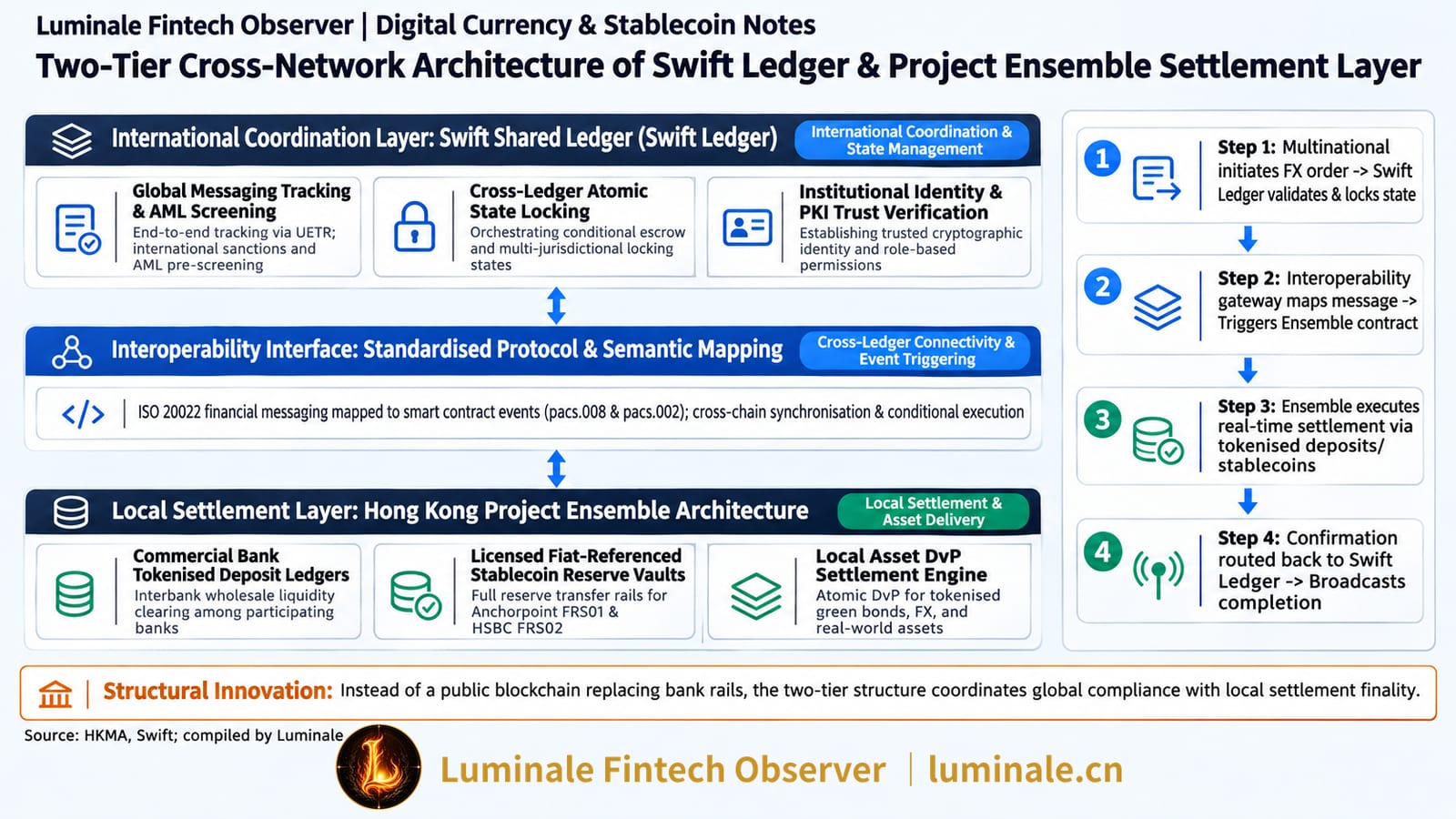
As analyzed in "What Money Settles Tokenised Assets? A Reading of the HKMA's EnsembleTX", Project Ensemble provides the domestic settlement infrastructure for tokenised commercial bank deposits and compliant stablecoins. The integration of Swift Ledger on November 16 positions Swift's global messaging and distributed ledger capabilities as an overarching cross-border orchestration hub:
When a multinational enterprise initiates a cross-border multi-currency payment, the Swift Ledger verifies transaction credentials, confirms participant identities, and coordinates conditional asset locks. The instruction is then mapped via standardized interfaces into Hong Kong's Ensemble layer, triggering on-chain fund reservation and final debiting via licensed stablecoins or tokenised bank deposits.
This mechanism marks the transition of compliant stablecoins from isolated on-chain experiments into integrated components of global bank clearing pipelines. It demonstrates that under rigorous AML supervision and full reserve backing, fiat-referenced stablecoins can function as compliant settlement instruments interoperable with traditional banking rails.
5. The Ultimate Outlook: Three Convergences, Three Divergences, and Future Infrastructure Division of Labor
A comparative analysis across the US, EU, UK, Hong Kong, Singapore, Japan, South Korea, and Mainland China reveals the emerging global blueprint for stablecoin governance:
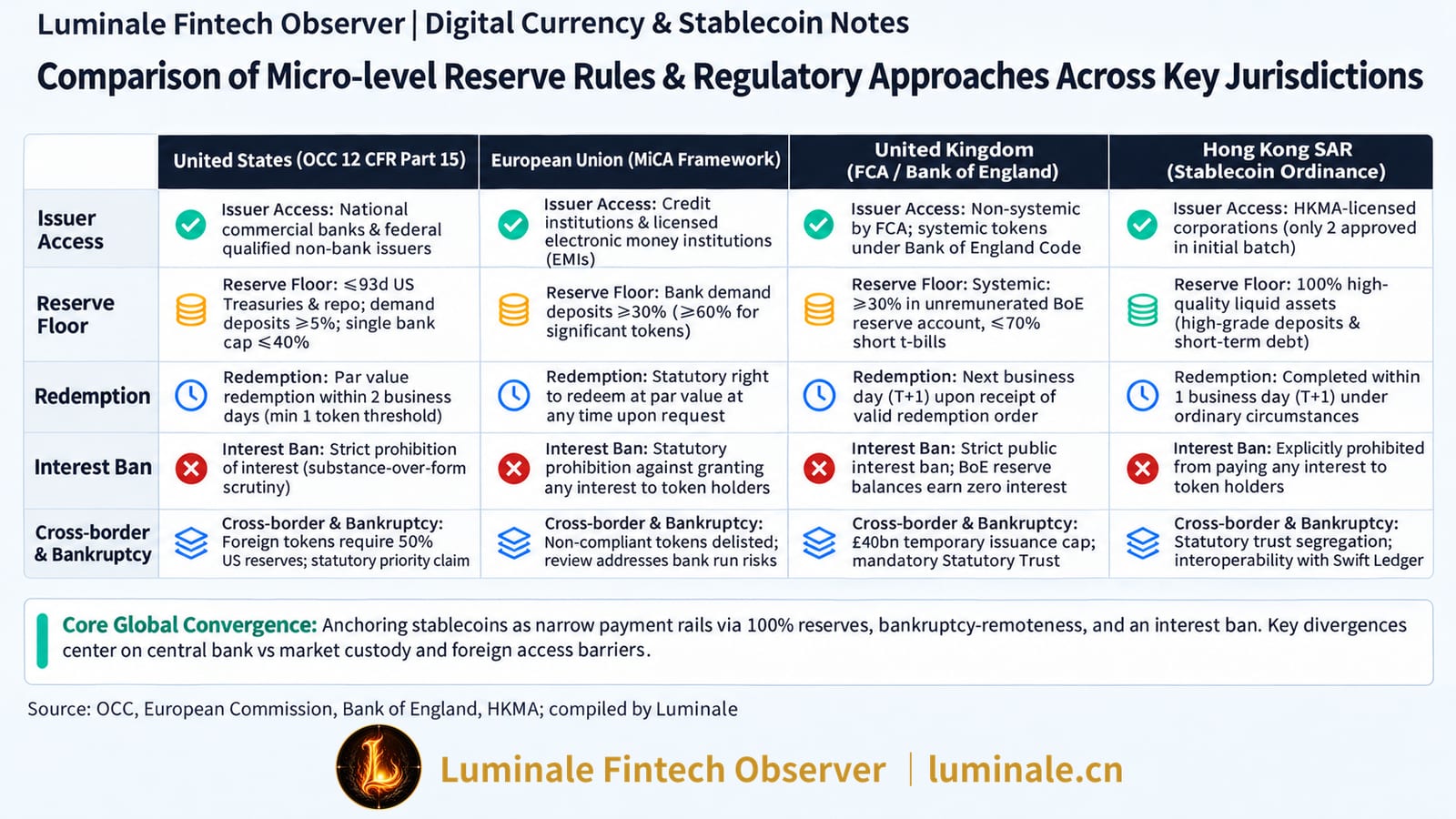
| Regulatory Dimension | United States (OCC 12 CFR 15) | European Union (MiCA) | United Kingdom (FCA / BoE) | Hong Kong SAR (Stablecoin Ordinance) | Singapore (P015 PSA Amendments) | Japan (Payment Services Act) |
|---|---|---|---|---|---|---|
| Legislative Status | Final OCC rulebook published; effective Jan 2027 | Fully effective; targeted review ongoing | FCA applications open; BoE Code finalized late 2026 | Initial licenses issued; testing interbank links | Consultation ended; statutory amendments drafted | Expanded Cabinet order in effect June 2026 |
| Issuer Licensing | National banks & federal qualified non-banks | Credit institutions & authorized EMIs | Non-systemic: FCA authorized; Systemic: BoE designated | Strictly vetted corporations licensed by HKMA | Designated licensed stablecoin issuers | Banks, funds transfer operators, trust firms |
| Eligible Reserves | ≤93d Treasuries, reverse repo, GMMFs, cash | Bank deposits, cash, low-risk liquid assets | HQLA short-term debt; BoE deposits for systemic | High-quality liquid assets (cash & short-term debt) | Cash, cash equivalents, sovereign debt | Cash deposits, up to 50% short sovereign debt |
| Cash & Reserve Floor | ≥5% in demand deposits or Fed master accounts | ≥30% (≥60% for significant) in commercial bank deposits | Systemic stablecoins: ≥30% in unremunerated BoE account | Sufficient bank demand deposits & overnight balances | Adequate liquid buffers to support instant redemption | Strict liquidity reserve obligations |
| Single Counterparty Limit | Commercial bank exposure capped at ≤40% | Statutory concentration caps on bank deposits | Strict group and custodian concentration controls | Multi-custodian asset segregation required | Single counterparty and custodian exposure caps | Trust property legally segregated |
| Redemption Window | ≤ 2 business days (min 1 token threshold) | Par-value redemption available at all times | Next business day (T+1) upon valid request | Typically within 1 business day (T+1) | Within 5 business days (proposed acceleration) | Dictated by statutory electronic payment contracts |
| Interest Restrictions | Strictly prohibited (substance-over-form) | Strictly prohibited to distribute any interest | Strictly prohibited (zero BoE deposit remuneration) | Strictly prohibited to pay any form of interest | Strictly prohibited from granting interest | Prohibited from paying deposit-style interest |
| Bankruptcy Ring-Fencing | SPV trust structures; statutory priority claim | Dedicated reserve pool ring-fenced by law | Mandatory Statutory Trust structure | Statutory trust segregation; zero insolvency clawback | Statutory trust and holder priority claims | Absolute trust property bankruptcy remoteness |
| Foreign Token Access | §15.31: 50% US reserves or specific approval | Multi-jurisdictional issuance disputed | Requires specific FCA authorization or mutual recognition | Requires local presence or explicit approval | Statutory regime for mutual regulatory recognition | Local licensed intermediaries distribute trust tokens |
1. Three Emerging Global Regulatory Convergences
Across differing national jurisdictions, regulatory approaches show striking consistency across three core principles:
- Full Reserve Backing and Statutory Bankruptcy Segregation: Algorithmic and uncollateralized stablecoins have been systematically expelled from regulated payment perimeters. Reserves must consist of high-grade sovereign debt or cash equivalents held under statutory trusts or bankruptcy-remote SPVs, insulating token holders from issuer insolvency.
- Mandatory Par-Value Redemption Commitments: Redemption windows are compressed to within 1–2 business days, barring issuers from imposing artificial barriers or suspending redemption queues during stress. Liquidity risk is pushed entirely onto asset-side management.
- Strict Prohibition of Interest to Protect Commercial Deposits: Regulators universally forbid stablecoins from distributing interest. Authorities recognize that yield-bearing tokens would operate as shadow-banking liquidity pools, directly undermining the lending and deposit intermediation of commercial banks.
2. Three Persistent Structural Divergences
Significant national divergences remain across three practical areas:
- Reserve Custody: Capital Markets vs. Central Bank Vaults: The US and Hong Kong encourage issuers to invest reserves across high-liquidity government Treasury bills and repurchase agreements, using capital markets to absorb stablecoin volume. In contrast, the Bank of England mandates that systemic stablecoins lock 30% of reserves directly inside unremunerated central bank vaults. Meanwhile, the EU's requirement that 30%–60% be held as commercial bank deposits has sparked debate over the risk of sudden deposit outflows during crypto market runs.
- Cross-Border Market Access Barriers: For cross-border dollar stablecoins, the US OCC mandates a 50% onshore reserve requirement. The Monetary Authority of Singapore established a mutual recognition framework for comparable foreign regimes in Consultation Paper P015-2026[5], while Japan uses domestic trust intermediaries to bridge foreign tokens. Conversely, the ECB's push to ban multi-jurisdictional joint issuance reflects a more restrictive, ring-fenced approach to the Eurozone.
- Regulatory Scrutiny of Platform Yield and Marketing Incentives: While direct interest from issuers is outlawed, crypto trading venues and brokers frequently distribute marketing yield, staking returns, or trading rebates to stablecoin holders. In the US Senate, debates over the CLARITY Act generated a narrow 49:50 vote on closing these loopholes, leaving the OCC to enforce substance-over-form oversight across a complex gray area.
3. A Three-Tier Division of Labor in Future Digital Financial Infrastructure
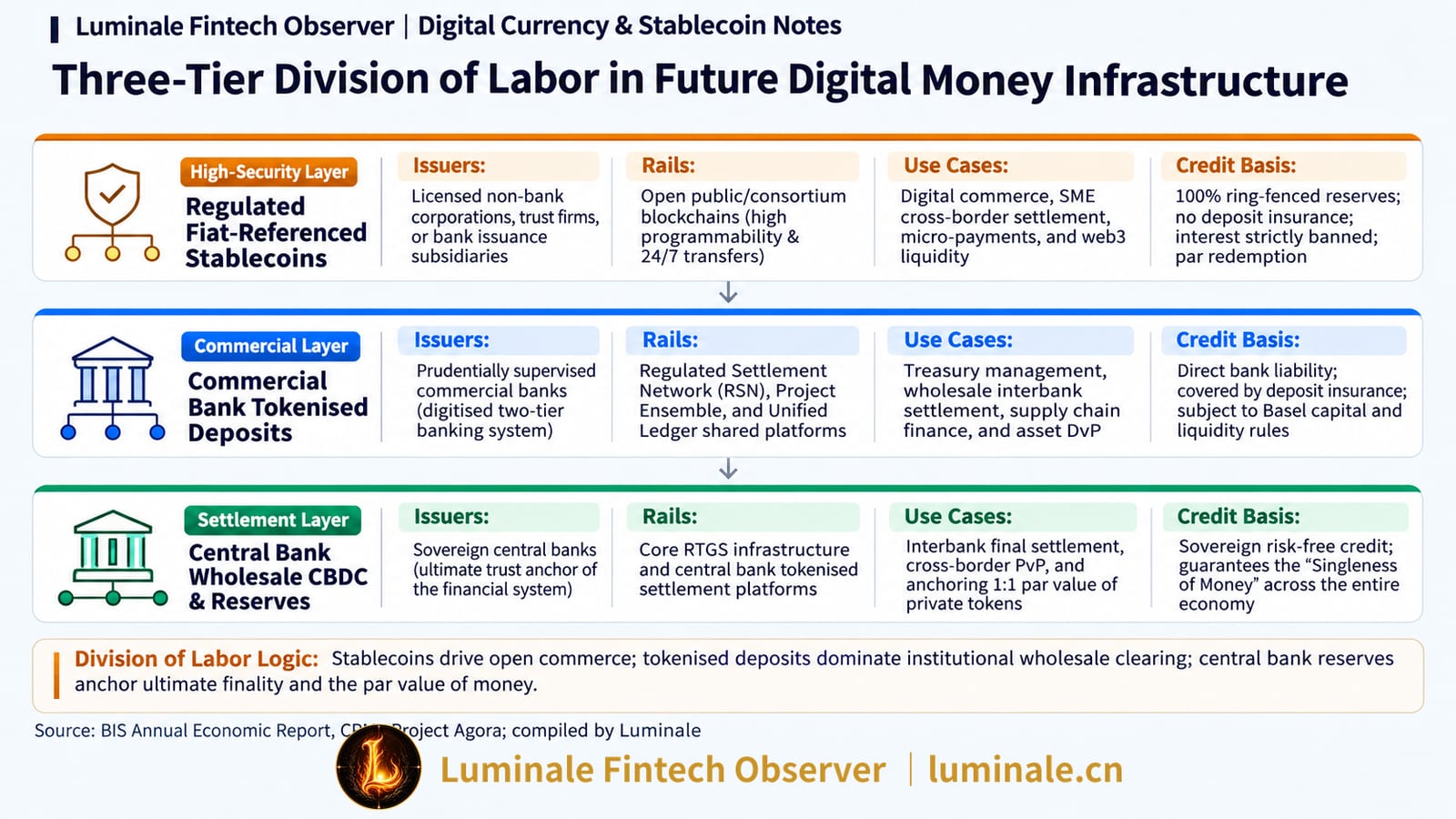
The formalization of stablecoin regulation does not signal that private tokens will dominate all aspects of digital finance. Rather, as legal boundaries crystallize, digital currency infrastructure is separating into a clear three-tier division of labor:
First, Regulated Fiat-Referenced Stablecoins: Issued by qualified non-bank fintech firms, trusts, or specialized bank subsidiaries, these tokens operate across open public and consortium blockchains. They primarily serve internet commerce, SME cross-border payments, micropayments, and decentralized market liquidity.
Second, Commercial Bank Tokenised Deposits: Issued directly by regulated commercial banks by bringing existing deposit liabilities on-chain, these instruments inherit full statutory deposit insurance and existing capital frameworks. As demonstrated across Project Ensemble, the Regulated Settlement Network (RSN), and Project Agora, tokenised deposits are positioned to dominate wholesale interbank clearing, cross-border corporate treasury operations, supply chain finance, and Delivery versus Payment (DvP) for digital securities.
Third, Central Bank Wholesale Reserves and Wholesale CBDC: Central banks remain the ultimate foundation of trust in the monetary architecture. As detailed in "Why Is One Yuan The Same Across Banks, While Stablecoins May Not Be? Understanding BIS's Singleness of Money", all privately issued stablecoins and tokenised deposits represent liabilities of private institutions. Only through risk-free central bank money can diverse private currencies achieve par exchange and settlement finality, preserving the foundational Singleness of Money across the economy[8].
The regulatory milestones of 2026 mark the transition from initial framework design to the live operational deployment of cross-institution, cross-border clearing architecture. Subsequent analyses will delve into the granular mechanics of the OCC rulebook, the practical scope of interest prohibitions, foreign token market barriers, and multi-chain liquidity management.
References
[1]: Office of the Comptroller of the Currency. (2026). 12 CFR Part 15: Payment Stablecoin Issuers (Final Rule). NR 2026-92a. https://www.occ.gov/news-issuances/news-releases/2026/nr-occ-2026-92a.pdf ↩
[2]: European Parliament and Council of the European Union. (2023). Regulation (EU) 2023/1114 on Markets in Crypto-assets (MiCA). EUR-Lex. https://eur-lex.europa.eu/legal-content/EN/TXT/?uri=CELEX:32023R1114 ↩
[3]: Bank of England. (2026). The Bank of England's Approach to the Regulation of Sterling-denominated Systemic Stablecoins. Policy Statement. https://www.bankofengland.co.uk/paper/2026/ps/sterling-denominated-systemic-stablecoin ↩
[4]: Hong Kong Monetary Authority. (2026). HKMA and Swift continue collaboration through Project Ensemble and Swift ledger. Press Releases. https://www.hkma.gov.hk/eng/news-and-media/press-releases/2026/11/20261116-4/ ↩
[5]: Monetary Authority of Singapore. (2026). Consultation on Proposed Amendments to the Payment Services Act for Stablecoin Regulation (P015-2026). https://www.mas.gov.sg/publications/consultations/2026/consultation-on-proposed-amendments-to-the-payment-services-act-for-stablecoin-regulation ↩
[6]: People's Bank of China et al. (2026). Notice on Further Preventing and Disposing of Risks in Virtual Currency and Related Activities (Yinfa [2026] No. 42). https://www.pbc.gov.cn/tiaofasi/144941/3581332/2026020619591971323/index.html ↩
[7]: Financial Stability Board. (2026). Global Stablecoin Arrangements: Progress on Cross-Border Vulnerabilities and Monitoring Report to G20. https://www.fsb.org/2026/10/fsb-chair-sets-out-fsb-work-on-ai-and-stablecoins/ ↩
[8]: Bank for International Settlements. (2026). Blueprint for the future monetary system: improving the old, enabling the new. Annual Economic Report. https://www.bis.org/publ/arpdf/ar2026e3.htm ↩
[9]: Financial Conduct Authority. (2026). FCA confirms final rules for cryptoasset regime: PS26/10. Policy Statements. https://www.fca.org.uk/publications/policy-statements/cryptoasset-regime ↩
Originally published by Luminale Fintech Observer: https://luminale.cn/articles/global-stablecoin-regulation-latest-developments-en