On 13 October 2026, the Hong Kong Centre of the Bank for International Settlements (BIS) Innovation Hub published the report for Phase 2 of Project Aurum. Conducted in collaboration with the Hong Kong Monetary Authority (HKMA) and other partners, the project explored how retail digital cash can preserve privacy for day-to-day payments while fulfilling anti-money laundering and countering the financing of terrorism (AML/CFT) requirements. Among several technologies tested in the prototype, one was the zero-knowledge proof (ZKP). One sentence in the report captured its underlying philosophy: privacy should be guaranteed by technology, rather than relying solely on institutional promises that "we will not look."[1]
A little over a year earlier, the Banco Central do Brasil reached a different conclusion in its Phase 1 report for the digital real pilot, Drex. The privacy solutions tested in the pilot were all built on zero-knowledge proofs. While they made progress on anonymisation, they faced constraints that prevented them from meeting business requirements. The lack of regulatory control over tokens, combined with limitations on programmability and composability, demonstrated that these solutions remained far from satisfying the fundamental requirements of a robust financial system.[2]
Both reports addressed the same question: when financial activities move onto a shared ledger, who gets to see what? Several previous articles on this site examined blockchains, smart contracts, stablecoins, central bank digital currencies, and tokenised deposits. This article focuses on zero-knowledge proofs: what they actually prove, how they operate on blockchains, what business problems they solve in tokenised finance, and how far initiatives by the BIS, central banks, and financial institutions have progressed.
I. The more transparent the blockchain, the harder for financial institutions to onboard
The article What Is Blockchain? noted the inherent trade-off in blockchain architecture: a shared ledger allows all participants to verify transactions, but the trade-off is that privacy protection becomes far more complex.
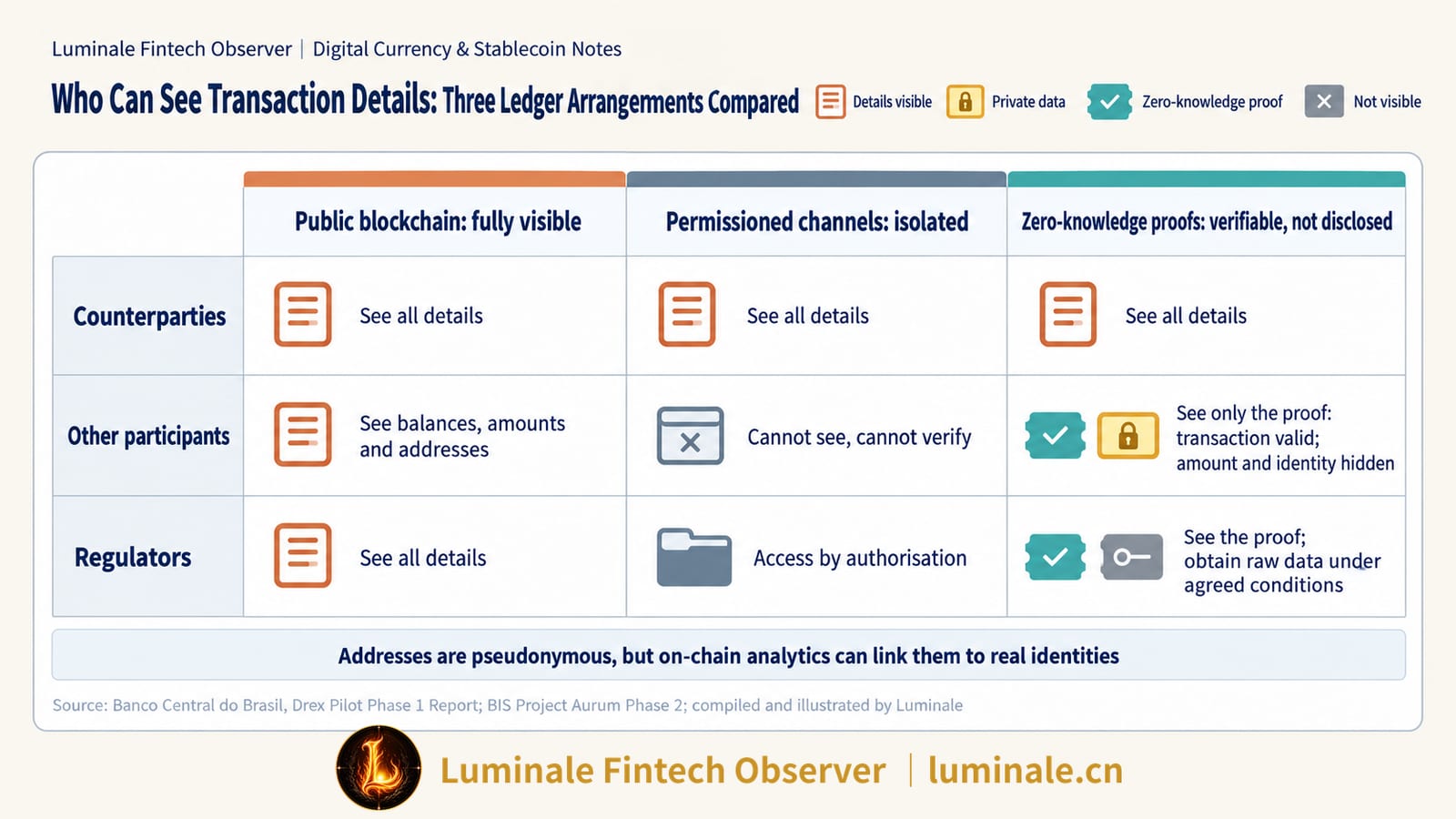
On public blockchains such as Bitcoin and Ethereum, addresses themselves carry no legal names, yet account balances, transaction amounts, and payment destinations are accessible to anyone. This state is commonly termed pseudonymity. How assets and addresses function on public blockchains is explained in What Are Cryptoassets? The Financial Logic of Bitcoin, Ether, and Unbacked Cryptoassets. The Banco Central do Brasil described this directly in its Drex report: a distributed ledger exposes participants, transactions, and balances to every member of the network; privacy hinges on how difficult it is to link account numbers to real identities. This correlation is not always straightforward, but it can be achieved using on-chain analytics tools.[2] Much of the business of blockchain analytics firms consists precisely of establishing these links.
For financial institutions, this means three categories of information are at risk of exposure.
The first is customer information. Banks bear statutory duties of confidentiality regarding customer account balances, transaction records, and counterparties.
The second is commercial and proprietary business information. If a bank's holdings, quotes, counterparties, and liquidity positions in a tokenised bond market are placed on a ledger visible to all participants, competitors can infer its trading strategies and funding pressures.
The third is regulatory reporting data. Certain transaction details are required by law to be submitted only to regulatory authorities or trade repositories and should not be disclosed to other market participants.
The traditional financial system handles this problem through segregated recordkeeping. Each commercial bank maintains books only for its own customers. The clearing house sees net obligations among banks, while regulators access data according to statutory powers. Trust is built on institutional creditworthiness, legal liability, and regulatory supervision. During a fund transfer, the sending and receiving banks update their respective ledgers and settle on the central bank's books via the payment system; no single party observes the entire picture. This process is detailed in How Does Digital Money Keep the Books?: From Accounts and Tokens to CBDC Ledger Design.
When tokenisation places assets and money on a shared ledger, the information segregation provided by separate books weakens. A common approach on permissioned (consortium) blockchains is to restrict access, such as splitting the ledger into multiple channels or allowing only transaction counterparties to retain transaction details. While this preserves confidentiality, other participants can no longer verify transactions, undermining the value of collective verification. Furthermore, when executing cross-institutional or cross-chain transactions, isolated ledgers require additional interfaces.
What financial institutions require is an alternative arrangement between total transparency and complete isolation: other ledger participants can verify that a transaction is valid and that rules have been followed, without needing to see the transaction amounts, identities, or asset holdings. Zero-knowledge proofs provide precisely this capability.
Privacy requirements involve three distinct stakeholders. Customers want their transactions kept private from unrelated third parties; financial institutions must protect proprietary commercial information; and regulators require the ability to inspect and trace transactions when necessary. These requirements constrain one another, and no single party's interest can simply override the other two.
II. What is a zero-knowledge proof?
2.1 Proving a condition is met without revealing the underlying data
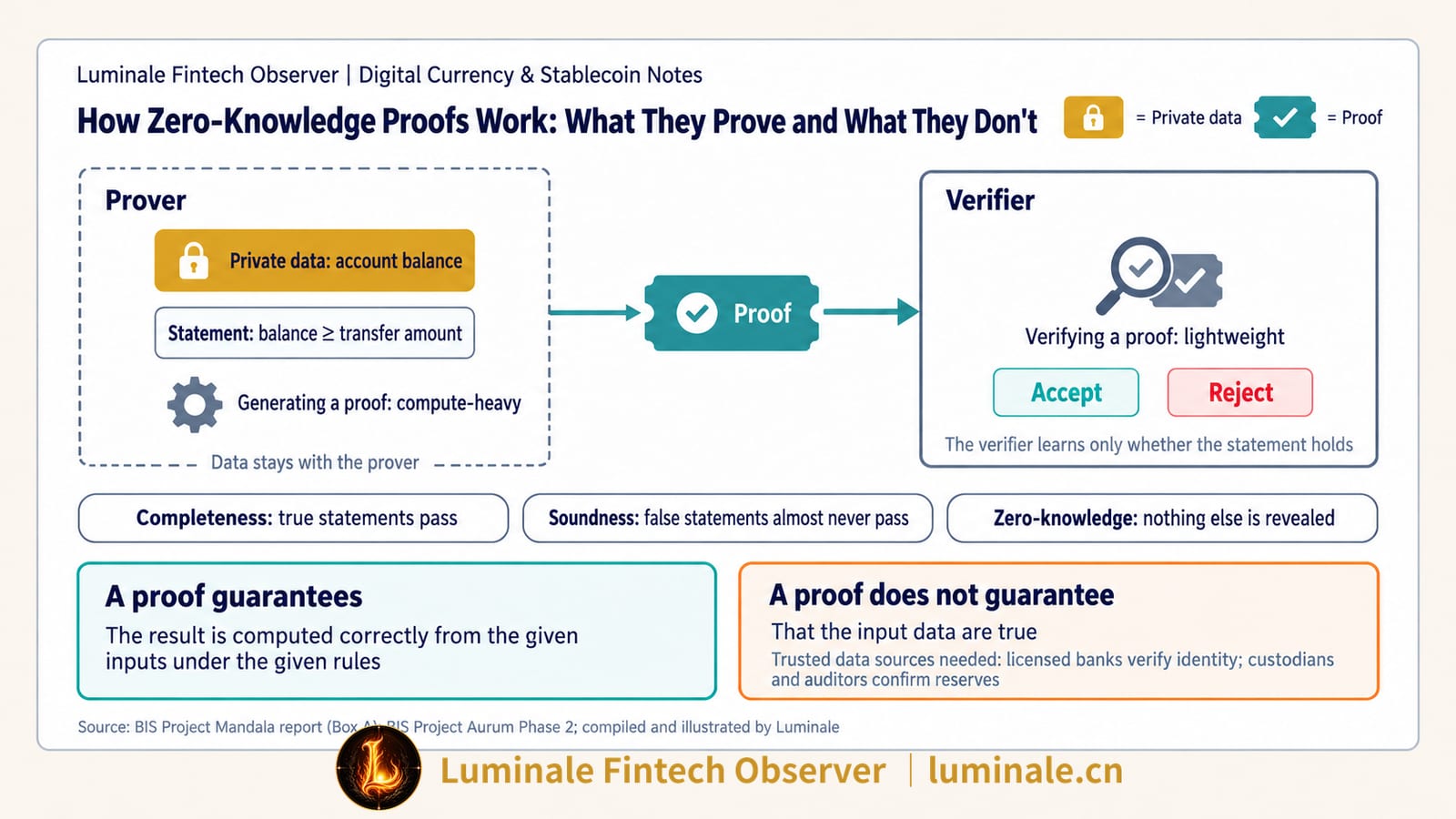
The concept of zero-knowledge proofs first appeared in a 1985 paper by Goldwasser, Micali, and Rackoff. It describes a protocol where a prover demonstrates to a verifier that a statement is true, while the verifier learns nothing beyond the fact that the statement holds.
Consider an everyday analogy: applying for a visa. Applicants are often required to demonstrate sufficient bank balances. Today, the applicant submits bank statements to the visa officer. The officer verifies the balance, but also observes every item of income and expenditure. If the applicant could instead submit a proof stating solely that "this account balance exceeds \$50,000," and the officer could verify the proof's authenticity without viewing the exact balance or transaction history, significantly less personal information would be exposed. That is what zero-knowledge proofs achieve.
Cryptography textbooks often use the Ali Baba cave analogy to illustrate the mechanism. A circular cave has two paths, left and right, connected deep inside by a door that opens only with a secret passphrase. The prover enters the cave, and the verifier randomly shouts from the entrance, "Come out from the left" or "Come out from the right." If the prover does not know the passphrase, they have only a 50% chance of being on the requested side. If they successfully exit on the requested side twenty or thirty times in succession, the probability of having guessed correctly by chance becomes negligible. The verifier becomes convinced that the prover knows the passphrase, without ever hearing the passphrase itself.
A zero-knowledge proof system must satisfy three fundamental properties:
| Property | Meaning |
|---|---|
| Completeness | If the statement is true, an honest prover will convince the verifier. |
| Soundness | If the statement is false, a cheating prover has a negligible probability of convincing the verifier. |
| Zero-knowledge | If the statement is true, the verifier learns nothing other than the fact that the statement is true. |
The cave analogy requires multiple rounds of back-and-forth challenges and responses, making it an interactive proof. In blockchains and financial architectures, most systems employ non-interactive zero-knowledge proofs (NIZKPs): the prover generates a single proof payload that can be independently verified by anyone who receives it, without further communication with the prover. Such proofs can be embedded in smart contracts for automated verification by code, or attached to payment instructions routed across institutions. How smart contracts execute such automated checks is discussed in Smart Contracts, Programmability, and On-Chain Settlement: Foundations of Financial Transaction Automation.
2.2 Common statements in financial use cases
In financial operations, the statements verified by zero-knowledge proofs generally fall into three categories.
The first category consists of range proofs: proving that a hidden number falls within a specific range, such as demonstrating that an account balance exceeds the transfer amount, or that income meets a mortgage threshold. In 2017, ING open-sourced a zero-knowledge range proof library, using the example of mortgage applicants proving their income fell within an eligible band without disclosing their exact salary.[3]
The second category consists of set membership proofs: proving that an entity belongs to, or does not belong to, a given set—such as proving that an address is on an accredited investor whitelist, or that a customer is not on a sanctions list. Age verification in digital identity also falls into this category. In July 2025, Google open-sourced its zero-knowledge proof library to allow users to prove they are over 18 without disclosing their date of birth or other personal details to websites.[4]
The third category consists of proofs of computational correctness: proving that a set of computations was executed correctly according to specified rules, such as verifying that a batch of transactions was processed according to ledger rules and balance state transitions occurred without error. The scaling applications discussed in Section III rely primarily on this category.
Practical implementations rely on several proof systems, each with distinct trade-offs:
| Scheme | Characteristics | Considerations |
|---|---|---|
| zk-SNARK (Zero-Knowledge Succinct Non-Interactive Argument of Knowledge) | Compact proof size, fast verification; well-suited for on-chain or mobile verification | Some schemes require a trusted setup; proof generation is computationally intensive |
| zk-STARK (Zero-Knowledge Scalable Transparent Argument of Knowledge) | No trusted setup required; quantum-resistant | Larger proof sizes than SNARKs |
| Bulletproofs | No trusted setup required; well-suited for range proofs | Slower verification than SNARKs |
A trusted setup is a procedure used by certain SNARK schemes to generate public parameters at system launch. Generating these parameters produces toxic waste (secret data); if this data is not destroyed and falls into malicious hands, valid-looking false proofs can be forged. Many projects therefore use multi-party computation ceremonies where parameters are generated jointly; as long as a single participant honestly destroys their secret share, the parameters remain secure. Other implementations choose schemes that eliminate trusted setups altogether.
One fundamental characteristic underpins the subsequent discussion: generating a proof requires substantial computational power, while verifying a proof is computationally inexpensive. This asymmetry makes zero-knowledge proofs well-suited for scaling: one party expends resources computing the proof, while numerous verifiers check it with minimal overhead. In retail payments, however, this asymmetry introduces a performance constraint, as a payer's mobile phone or wallet must generate the proof at the point of sale.
2.3 What it proves and what it does not
A zero-knowledge proof guarantees that, for given inputs and defined rules, the computed output is correct. It does not guarantee that the input data itself is authentic.
If an institution uses fraudulent customer documents to generate a proof of "having passed KYC," the proof itself will verify successfully. Similarly, if a stablecoin issuer feeds false reserve balances into a proof system, the proof of reserves will still indicate that everything is in order. Zero-knowledge proofs therefore depend on trusted data sources: customer identities must still be verified by licensed banks, and reserve assets must be attested by custodians and auditors.
A zero-knowledge proof is also distinct from encryption. Encryption conceals data so that only keyholders can read it; a zero-knowledge proof proves that concealed data satisfies a specific condition without revealing the data itself. In operational systems, the two are frequently used together.
Within the broader family of privacy-enhancing technologies (PETs), zero-knowledge proofs represent only one approach. Multi-party computation (MPC) allows multiple parties to compute a joint output without sharing their private inputs; homomorphic encryption enables computations directly on encrypted data; trusted execution environments (TEEs) protect data using hardware-isolated enclaves; and blind signatures allow an authority to sign a message without seeing its contents. Project Tourbillon, conducted by the BIS and the Swiss National Bank, implemented payer anonymity for retail CBDCs using blind signatures.[11] The defining feature of zero-knowledge proofs is that one party generates a proof that anyone can independently verify, making them particularly well-matched to shared ledgers.
III. How it is used on blockchains: privacy and scaling
On blockchains, zero-knowledge proofs follow two primary paths. The first is privacy: enabling ledgers to record transactions without exposing their contents. The second is scaling: relieving the mainnet from re-executing every individual transaction. Both paths use the same cryptographic foundations, but address different challenges.
3.1 Privacy: how a shielded transaction is verified
In standard on-chain transfers, the ledger records that "Address A decreased by 100, Address B increased by 100," visible to all nodes. Zcash, launched in 2016, was the first public blockchain to deploy zk-SNARKs at scale, introducing what are known as shielded transactions. Many subsequent privacy designs, including trials by financial institutions, adopted a similar structure.
On a shielded transaction ledger, records consist of commitments to individual notes. A commitment can be understood as a sealed envelope: the envelope is publicly visible, and contains the amount and owner, but outsiders cannot see inside; once sealed, its contents cannot be altered.
When a payer spends a note, they submit three elements to the ledger:
| Submitted data | Purpose |
|---|---|
| Commitments for new notes | Places amounts (and change) for the recipient into new sealed envelopes |
| Nullifier | Marks an old note as spent without revealing which note it is |
| Zero-knowledge proof | Proves the spent note existed and belonged to the sender, input amounts equal output amounts, and the nullifier was correctly computed |
Validating nodes verify the proof's mathematical validity and check whether the nullifier has appeared on-chain previously. If the nullifier already exists, the note is being spent a second time, and the transaction is rejected. Throughout this process, validating nodes learn neither the payer's identity, the payee's identity, nor the transaction amount. Yet they can confirm three essential conditions: the funds are genuine, no money was created out of thin air, and no double spending occurred.
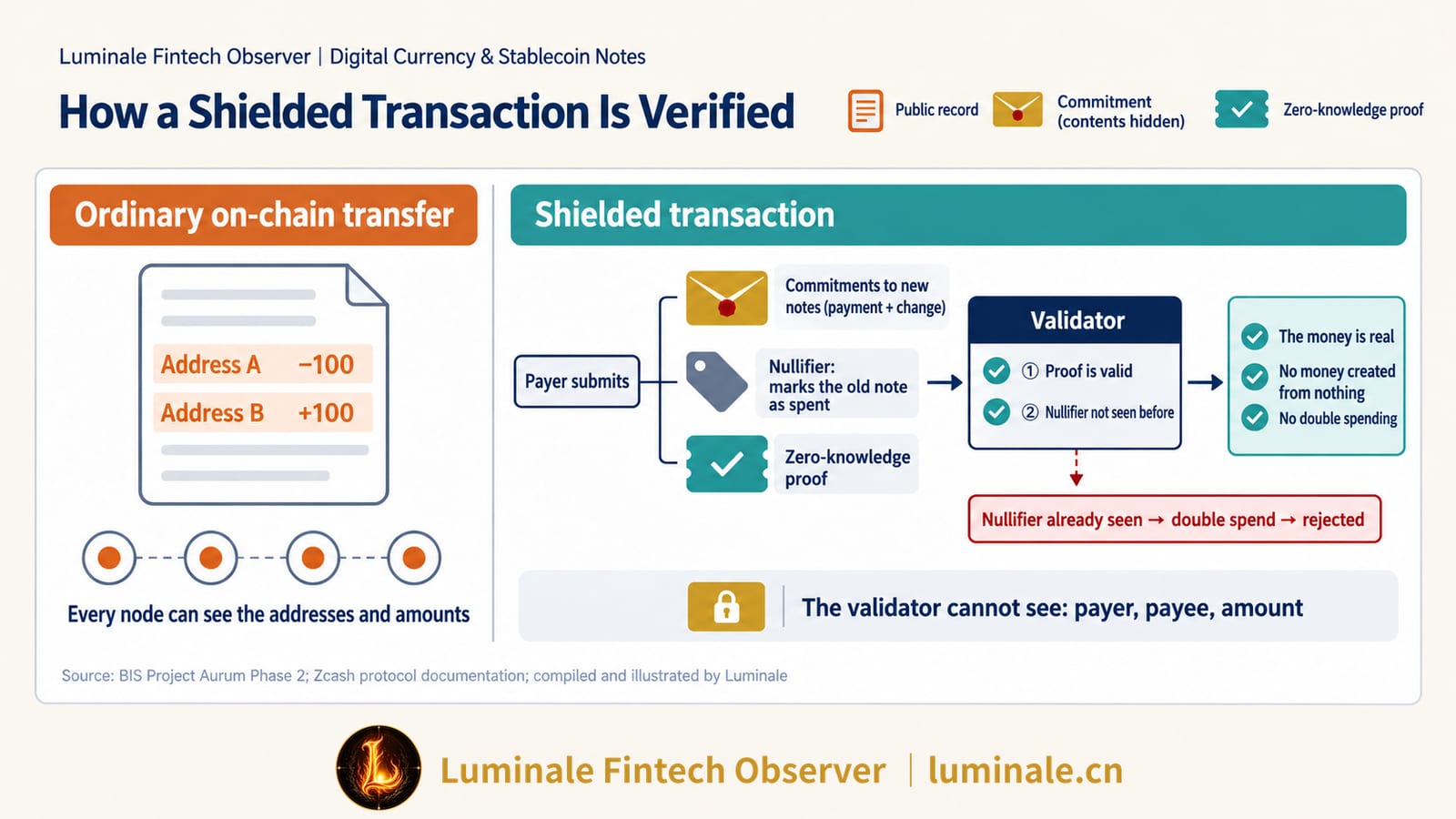
Preventing double spending is a classic challenge in digital cash. Project Aurum Phase 2 adopted a comparable design: each unit of digital cash is assigned a unique anti-double-spending tag. Verifiers can check whether that cash unit has already been spent, but cannot infer any further information about the cash or the payer from the tag. The zero-knowledge proof guarantees to the verifier that the spent cash was valid, and that the total value spent equals the amount received by the payee plus change.[1]
Institutional privacy solutions feature an additional requirement: selective disclosure. The system can provide auditing bodies or regulators with dedicated viewing keys, or mandate automated identity disclosure when a transaction exceeds a designated threshold. The Aurum Phase 2 prototype incorporated bank-defined disclosure thresholds; payments exceeding the limit automatically reveal masked payer names and identification numbers to the recipient bank.[1] This selective auditability marks the boundary between institutional privacy frameworks and anonymous privacy coins.
Privacy tools have also been exploited for illicit finance. In 2022, the US Department of the Treasury's Office of Foreign Assets Control (OFAC) placed Ethereum-based mixer Tornado Cash on its sanctions list. In March 2025, OFAC removed Tornado Cash from the list after the US Court of Appeals for the Fifth Circuit ruled that immutable smart contracts do not constitute property capable of being blocked.[13] This history underscores that when privacy technologies enter the financial system, they must be designed alongside compliance mechanisms.
3.2 Scaling: how ZK rollups compress a thousand transactions into a single proof
The second path is scaling. The Ethereum mainnet processes a limited number of transactions per second, and transaction fees can spike during periods of network congestion. Zero-knowledge rollups (ZK rollups) operate by executing large batches of transactions off-chain on a Layer 2 (L2) network. The operator then submits the resulting state transition alongside a zero-knowledge proof to the Layer 1 (L1) mainnet. A smart contract on L1 verifies the proof; upon successful verification, the new state is accepted.
The mainnet does not need to re-execute each individual transaction; it verifies only a single concise proof. By analogy, rather than having a head teacher re-grade one thousand exam papers, the grading committee completes the marking and submits an easily verifiable proof certifying that the grading was performed without error. By verifying this proof, the head teacher can validate the entire score sheet.
A variation of ZK rollups is known as Validium: the mainnet records only the proof and state root, while transaction data is stored off-chain by the operator or a designated data availability committee. This architecture offers enhanced privacy and lower costs, but whether users can recover assets in the event of operator failure depends on the accessibility of off-chain data.
Layer 2 networks used by financial institutions predominantly adopt this model combined with permissioned access control. Deutsche Bank's Dama 2 technical litepaper, published in June 2025, describes a platform anchored to an Ethereum Layer 2 deployed by Memento Blockchain using ZKsync technology. This network features permissioned access and a permissioned sequencer, using the Ethereum mainnet as its settlement anchor; Axelar provides cross-chain interoperability, with a minimum viable product planned for mainnet deployment in the second half of 2025.[8] In such networks, transaction execution and data storage remain within institutional control, while the mainnet provides settlement finality and public verification.
3.3 When is a Layer 2 transaction considered final?
For financial institutions evaluating ZK rollups, one issue is unavoidable: at what exact point does a transaction on a Layer 2 network achieve final settlement?
When a transaction is received and executed by an L2 sequencer, the user interface may immediately display "Completed." At that moment, however, the transaction exists only as Layer 2 state. It achieves anchor on the mainnet only after the operator generates the proof, submits it to L1, the L1 contract verifies the proof, and the corresponding L1 block itself achieves finality. These milestones may be separated by minutes to several hours.
Another common Layer 2 design is the Optimistic rollup, which presumes transactions are valid upon receipt and provides a challenge period during which participants can dispute fraud—a window typically lasting several days. ZK rollups, by contrast, prove validity before acceptance, achieving final confirmation much faster. This property makes them particularly attractive in financial contexts.
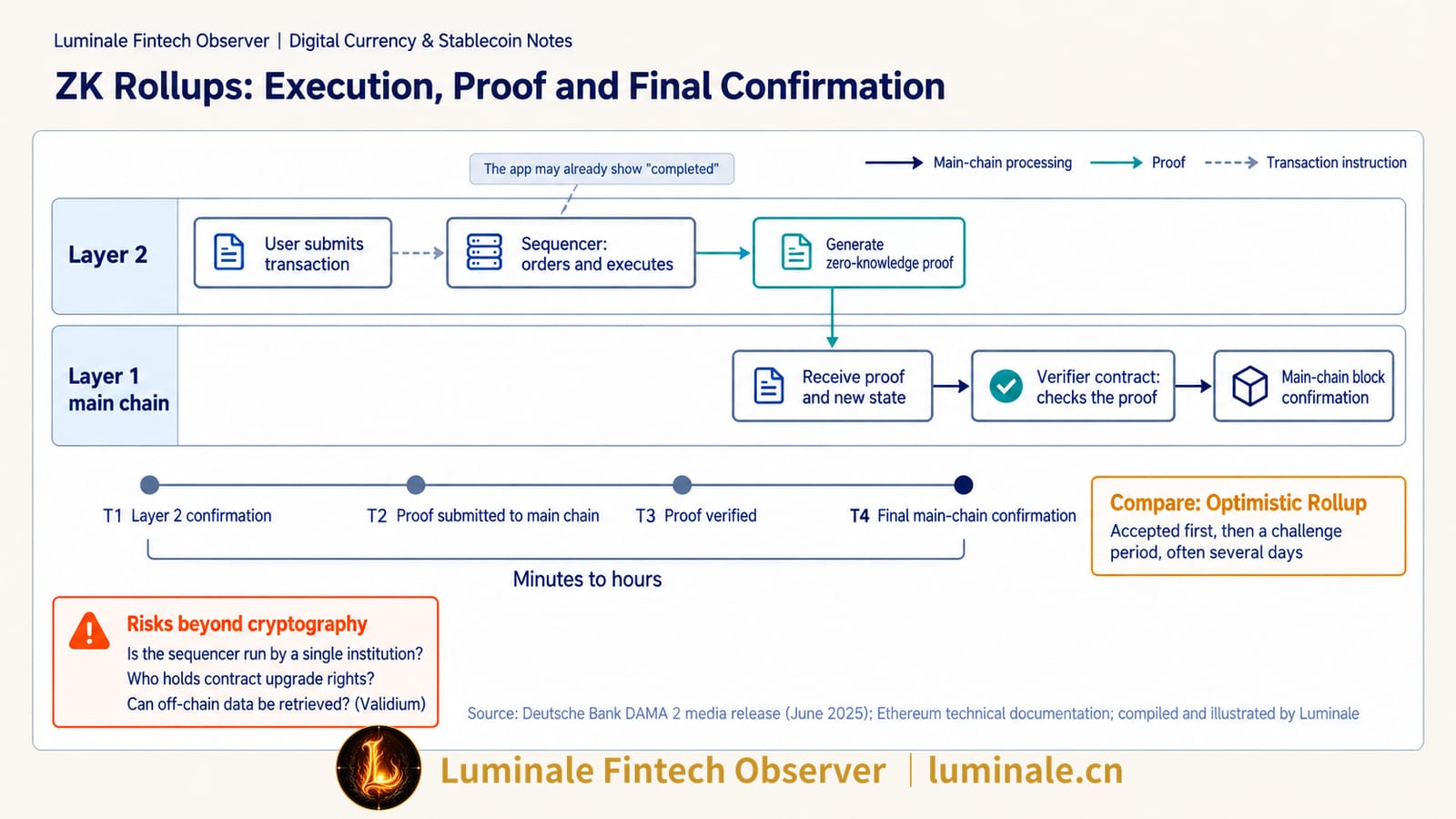
Even when cryptographic proofs are correct, Layer 2 networks carry operational and governance risks beyond cryptography: whether the sequencer is concentrated within a single entity, whether that entity can censor or delay transactions, who holds contract upgrade privileges, and how users recover assets if the operator experiences an outage. These are operational risk and governance questions. The legal and risk dimensions of settlement finality are explored in Can a "Successful Payment" Be Reversed? What Risks Does Settlement Finality Solve?.
IV. Applied to tokenised finance: what business problems zero-knowledge proofs solve
4.1 The context of tokenised finance
In its 2025 Annual Economic Report, the BIS proposed that the next-generation monetary and financial system could be built on a tokenised unified ledger, hosting tokenised central bank reserves, commercial bank money, and government bonds side by side.[10] In practice, tokenised deposits, stablecoins, and wholesale CBDCs are converging on shared ledgers, while securities and fund shares are moving on-chain. European initiatives to rebuild central bank money settlement for tokenised securities are examined in From Pontes to Appia: How Europe Is Rebuilding the "Cash Leg" for Tokenised Securities; how tokenisation accelerates transactions and risk transmission is analyzed in IMF GFSR Reading: Does Tokenisation Make Trading Faster, and Does Risk Arrive Faster Too?.
The more ledgers are shared, the more access permissions must be determined during system architecture design. In traditional finance, access is managed through institutional access controls and statutory obligations; on a shared ledger, it must be encoded into protocol rules. Zero-knowledge proofs provide architects with an alternative option: decoupling verification from data visibility.
4.2 Six business use cases
The table below outlines the primary applications of zero-knowledge proofs in tokenised finance by business challenge:
| Business use case | Statement to prove | Prover | Verifier | Information kept private | Representative project |
|---|---|---|---|---|---|
| Confidential payments | Sufficient balance, conservation of value, no double spending | Payer or wallet | Ledger validating nodes, payee | Transaction amount, payer identity | Project Aurum Phase 2 |
| Commercial confidentiality in securities and fund trading | Trade complies with rules; delivery versus payment occurs simultaneously | Trading parties or their banks | Other ledger participants | Price, volume, position size | Dama 2, EY Nightfall |
| Verifiable compliance | Sanctions screening passed, foreign exchange quota not exceeded | Sending bank | Receiving bank, central bank | Customer identity data | BIS Project Mandala |
| Retail digital currency privacy | Payer is a verified, legitimate user | User wallet | Validating nodes, merchant | Real-world identity, spending history | Project Aurum Phase 2 |
| Proof of reserves | Reserve assets equal or exceed circulating liabilities | Issuer or custodian | Token holders, the public | Individual account balances | Selected crypto exchanges |
| Reusable digital identity | Meets age threshold, completed KYC | User | Web services, financial institutions | Identity document details | Google age assurance |
Confidential payments and balances. When transferring tokenised deposits or stablecoins, transaction amounts and counterparties remain visible only to the transacting parties, the issuing bank, and regulators; other ledger participants can confirm only that the transaction is valid. The underlying assets in these scenarios represent commercial bank liabilities circulating on-chain, as examined in Tokenized Deposits: How Commercial Bank Money Enters the On-Chain World.
Commercial confidentiality in securities and fund trading. In tokenised bond or fund transactions, trade prices, volumes, and position sizes are shielded from other participating institutions to prevent front-running and position exposure. Delivery versus payment (DvP) requires that securities and funds settle simultaneously; on a shared ledger, smart contracts can execute this atomically, while zero-knowledge proofs ensure the transaction details remain confidential. The risks DvP prevents are detailed in Securities and Money Must Move "Delivery Versus Payment": What Risk Does DvP Actually Prevent?. EY open-sourced the Nightfall protocol specifically for enterprise private transactions on Ethereum, updating the codebase alongside Polygon in 2023;[9] the Ethereum Foundation's Institutional Privacy Task Force (IPTF) also developed a zero-knowledge private bond prototype.[14]
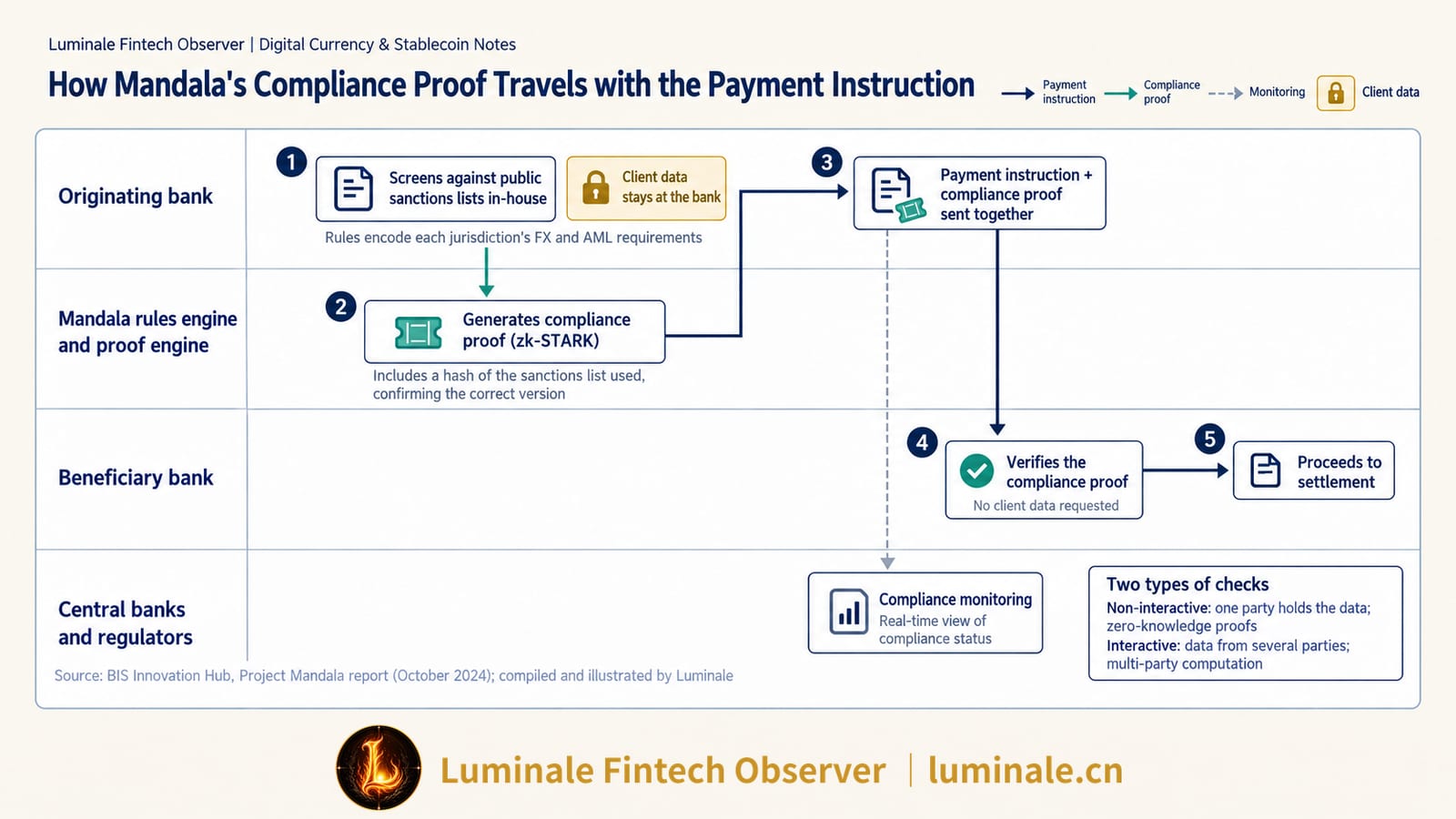
Verifiable compliance. A cross-border payment often travels through multiple intermediary banks, each repeating sanctions screening and customer due diligence. The BIS Project Mandala piloted encoding national compliance rules into a peer-to-peer protocol: checks are completed prior to transaction initiation, generating a compliance proof that travels with the payment instruction. Downstream institutions verify the proof rather than requesting raw customer documents.[5] Section V examines this project in detail. Duplicative compliance checks along cross-border corridors are discussed in What Really Happens in a Cross-Border Payment? Correspondent Banking, SWIFT, and Global Payments Reform.
Privacy in retail digital currency. Day-to-day small-value payments conceal payer identity by default; for large amounts or suspicious activity, licensed banks can re-identify the customer in accordance with statutory procedures. The Aurum Phase 2 prototype implemented this model: users obtain a credential after completing KYC at their bank, and subsequently transact using rotating pseudonyms. Merchants and validating nodes observe no real-world identity, while the user's account-holding bank can unmask the identity if legally required.[1]
Proof of reserves and solvency. Stablecoin issuers or custodians can prove that "reserve assets equal or exceed tokens in circulation" without publishing individual holder balances. This mechanism is currently seen primarily among cryptoasset exchanges. Its limitations are clear: an on-chain proof can verify only assets held on-chain; whether off-chain reserves such as bank deposits and short-term Treasury bills genuinely exist and remain unencumbered must still be verified by custodians and external auditors. Furthermore, verifying liabilities remains challenging: the proof system cannot independently detect unrecorded liabilities omitted by the issuer. Stablecoin reserve and redemption mechanisms are examined in Understanding Stablecoins in One Article: How Do They Actually Stay "Stable"?.
Reusable digital identity. After completing identity verification with one licensed institution, a user receives a verifiable credential. When subsequently accessing services at other institutions, the user presents only a proof of having been verified, avoiding repetitive document submissions. Google's open-source age assurance tool and the European Digital Identity Wallet both follow this trajectory.[4]
4.3 What changes and what remains unchanged
Under the Luminale payment infrastructure analytical framework, several questions clarify where zero-knowledge proofs sit.
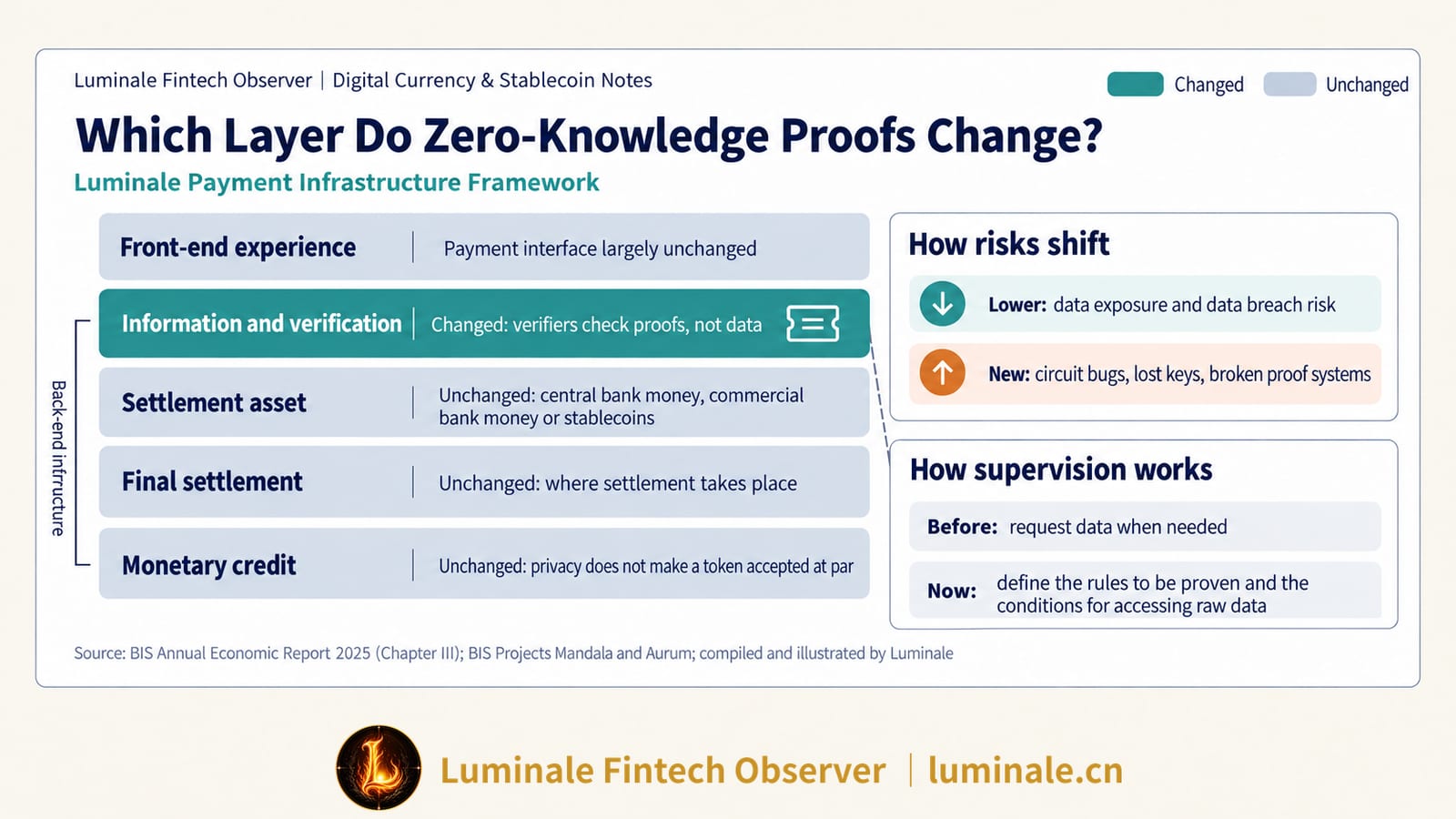
They alter how information is transmitted and how transactions are verified; they operate as backend infrastructure, without necessarily altering the end-user payment experience. They do not alter the underlying settlement asset: value circulating on-chain remains central bank money, commercial bank money, or stablecoins. Nor do they alter where final settlement occurs.
They cannot alter the credit profile of money. A zero-knowledge proof can conceal the amount of a stablecoin transfer, but it cannot make that stablecoin universally accepted at par like a commercial bank deposit. Privacy and monetary creditworthiness are distinct questions, the latter of which is discussed in Why Is One Yuan from Any Bank Still One Yuan, but a Stablecoin May Not Be? Understanding the BIS Idea of the Singleness of Money.
They reallocate risks. Compliance risks and data leakage risks arising from data exposure are reduced, while new technical risks emerge, including circuit specification errors, private key loss, and cryptographic vulnerabilities.
They also transform how regulators operate. Traditionally, regulators inspect raw data ex post upon request. In a zero-knowledge architecture, regulators must participate ex ante in defining "what to prove"—translating statutory rules into cryptographic circuits—and establish clear legal terms governing when underlying data may be unmasked. Once rules are compiled into circuits, governance mechanisms are required for rule amendments, circuit audits, and liability allocation in the event of system failure. Stating that zero-knowledge proofs "solve AML compliance" is therefore inaccurate: they prove that checks were executed according to coded rules; whether those rules are sufficient and whether input data is truthful remain separate questions.
V. Progress across the BIS, central banks, and financial institutions
5.1 Project stocktake
The table below summarizes major projects employing zero-knowledge proofs based on public disclosures, categorized by leading institution:
| Category | Project | Lead and partner organisations | ZKP use case | Status |
|---|---|---|---|---|
| International organisations and central banks | Mandala | BIS Innovation Hub Singapore Centre, central banks of Australia, Malaysia, Singapore, and others | Proving cross-border transactions passed sanctions screening and compliance checks | Phase 1 completed in October 2024; Phase 2 launched in November 2025 |
| International organisations and central banks | Aurum Phase 2 | BIS Innovation Hub Hong Kong Centre, Hong Kong Monetary Authority, Hong Kong Polytechnic University, ASTRI | Retail digital cash amount and identity privacy, double-spending prevention | Report published in October 2026; exploratory prototype |
| International organisations and central banks | Drex Pilot | Banco Central do Brasil | Testing four ZKP privacy solutions | Phase 1 found solutions not yet mature; Phase 2 continues privacy research |
| International organisations and central banks | Digital Euro Legislation | European Parliament, Council of the EU, European Central Bank | Parliamentary committee text references ZKPs to protect transaction privacy | Legislation under inter-institutional negotiations |
| Commercial banks | Quorum Zero-Knowledge Security Layer | JPMorgan Chase, Zcash team | Obscuring transaction amounts and participants on a permissioned ledger | Announced in 2017 |
| Commercial banks | Zero-Knowledge Range Proofs | ING | Proving a value lies within a range without disclosing the value | Open-sourced in 2017 |
| Commercial banks | Dama 2 | Deutsche Bank, Memento Blockchain, Axelar | Permissioned Layer 2 network based on ZKsync technology | Litepaper published in June 2025; planned mainnet launch in H2 2025 |
| Technology and service providers | Nightfall, Starlight | EY | Enterprise private transactions; compiling standard contracts into zero-knowledge applications | Open-source |
| Technology and service providers | longfellow-zk | Age assurance in digital identity | Open-sourced in July 2025 |
Sources for table: BIS Project Mandala reports and project portal,[5][6] BIS Project Aurum Phase 2 report,[1] Banco Central do Brasil Drex Phase 1 report,[2] European Parliament legislative observatory,[12] MIT Technology Review coverage on JPMorgan Chase,[7] ING press release,[3] Deutsche Bank press release,[8] EY press release,[9] Google Official Blog.[4]
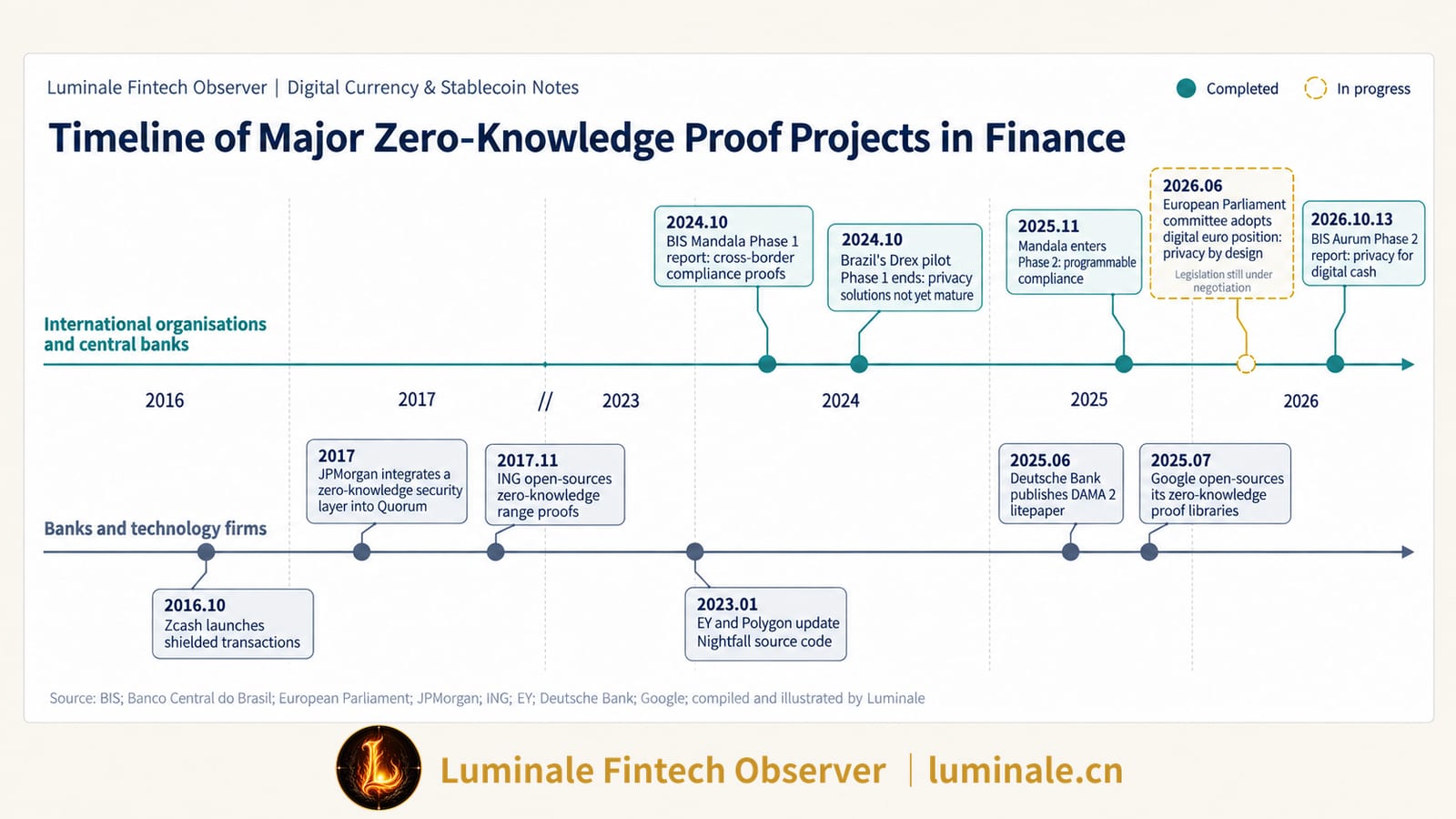
Mandala: transforming compliance checks into proofs. Led by the BIS Innovation Hub Singapore Centre, Phase 1 of Project Mandala partnered with the Reserve Bank of Australia, the Bank of Korea, Bank Negara Malaysia, and the Monetary Authority of Singapore, testing two corridors: cross-border lending between Singapore and Malaysia, and capital investment financing between South Korea and Australia.[5] It categorized compliance checks into two types. Non-interactive checks apply when one institution holds all necessary data, such as public sanctions screening: the originating bank possesses customer data and public sanctions lists; after screening, it generates a zk-STARK proof containing a hash of the sanctions list version used, ensuring screening occurred against the correct list.[5] Interactive checks, requiring confidential data from multiple parties, were executed via multi-party computation. In November 2025, Phase 2 expanded to include central banks from Australia, France, India, Kuwait, Malaysia, the Philippines, and Singapore, broadening its scope to programmable compliance for digital assets.[6] Mandala's compliance approach is also discussed in Reading the RBA Payments System Board Annual Report 2026: What Is Changing in Australia's Payment and Settlement Infrastructure?.
Aurum Phase 2: privacy in retail digital cash. Phase 1 of Project Aurum delivered a two-tier retail central bank digital currency prototype in 2022. Phase 2 integrated encryption, BBS+ signatures, pseudonym-based ownership, and zero-knowledge proofs into the codebase. The retail and wholesale ledgers are separated: the central bank cannot access the retail ledger, and commercial banks'retail ledgers remain isolated from one another.[1] The report provided concrete performance metrics: on a 4-core cloud virtual machine, generating a complete zero-knowledge proof for a single input note took 2.86 seconds, while a transaction containing 20 input notes took 29 seconds; with GPU acceleration, these times fell to 0.4 seconds and 1.76 seconds, respectively. These figures represent proof generation times in a testbed environment and cannot be equated directly with end-to-end processing times in live retail payments. The report noted that stronger privacy introduces trade-offs, including slower transaction throughput, difficulty in supporting complex financial instruments, and recovery challenges upon wallet loss; the prototype is not yet production-ready.[1] The architectural foundations of retail CBDCs are outlined in What Is a Central Bank Digital Currency (CBDC)? From "Digital Cash" to Financial Infrastructure; the relationship between Aurum and Hong Kong's retail CBDC trials is examined in From Retail CBDC to Tokenised Settlement: What Did the Two Phases of Project e-HKD Reveal?. How Hong Kong prepares settlement funds for tokenised assets at the wholesale level is discussed in What Money Settles Tokenised Assets? A Reading of the HKMA's EnsembleTX.
Drex: privacy frameworks fall short of institutional requirements. The first phase of the Banco Central do Brasil's Drex pilot ran from 2023 to October 2024, testing four privacy architectures: Anonymous Zether developed by JPMorgan Chase and ConsenSys (account-based), EY's Starlight (token-based), Rayls (network isolation combined with zero-knowledge proofs), and Microsoft's Nova zero-knowledge framework (joined late, leaving testing inconclusive in the report).[2] The central bank concluded that while these frameworks achieved progress in anonymisation, regulators lacked adequate control over tokens, and programmability and composability were restricted; the solutions could not yet support operational banking requirements. Phase 2 continues privacy research while testing new use cases.[2] The Aurum Phase 2 report cited Drex's findings, noting that the trilemma among privacy, scalability, and programmability persists.[1]
Digital euro: privacy embedded in legislative negotiations. In June 2026, the European Parliament's Committee on Economic and Monetary Affairs (ECON) adopted its negotiating mandate on digital euro legislation. Media reports indicated that the committee's draft embedded privacy-by-design principles, referencing zero-knowledge proofs to verify transactions without exposing user identities, ensuring the European Central Bank has no access to personal identifying data.[12] The legislation remains in trilogue negotiations among the Parliament, the Council of the EU, and the European Commission; whether and in what form zero-knowledge proofs are included in the final regulation remains to be determined. The broader digital euro architecture is explored in The Digital Euro Landscape: Why It Is Built, How It Works, and Current Progress.
Banks and technology firms. In 2017, JPMorgan Chase integrated Zcash's Zero-Knowledge Security Layer into its enterprise Quorum blockchain to conceal transaction amounts and participants while preserving auditing visibility.[7] Anonymous Zether, tested in Drex, was also developed by JPMorgan and ConsenSys.[2] ING open-sourced zero-knowledge range proofs that same year.[3] Deutsche Bank's Dama 2 was developed under the Monetary Authority of Singapore's Project Guardian framework; the broader Guardian initiative is analyzed in How Far Has Singapore's Digital Finance Progressed? From Tokenisation to Payment and Settlement Infrastructure.
5.2 Shared bottlenecks
Reviewing these initiatives collectively reveals that the deployment of zero-knowledge proofs in financial architecture confronts several shared bottlenecks:
Performance and cost. Proof generation remains computationally demanding, as illustrated by Aurum's benchmarks. Wholesale interbank transactions, characterised by lower transaction volumes and higher values, can tolerate proof generation times of several seconds. Retail payments, which require high concurrency and instant settlement, have yet to be proven at commercial scale.
Regulatory acceptance. Regulators must determine whether a cryptographic proof constitutes valid evidence of compliance, how underlying transaction data can be accessed when required, and how asset-freezing and recovery powers are preserved. The Drex pilot demonstrates that if a privacy solution impairs supervisory oversight, central banks will deliberately moderate implementation timelines.
Implementation risk. The security of zero-knowledge proofs relies on the correctness of circuit construction. If a circuit omits a constraint, an invalid transaction can generate a mathematically valid proof that is virtually impossible to detect externally. Expertise and methodologies for auditing zero-knowledge circuits remain scarce.
Governance. Multi-party trusted setup ceremonies, key management protocols, circuit upgrade procedures following statutory rule changes, and liability allocation for system failures must all be contractually agreed upon before production deployment.
Long-term security. Mathematical assumptions underpinning certain schemes face potential vulnerabilities from future quantum computing. Project Tourbillon tested quantum-resistant blind signatures, observing significant performance penalties;[11] the Aurum Phase 2 report also examined quantum computing risks.[1]
The Principles for Financial Market Infrastructures (PFMI) regarding legal foundations, operational risk, and transparency apply equally to systems incorporating zero-knowledge proofs; cryptography does not supersede these standards. The core principles are examined in Reading the PFMI: The Lines Financial Market Infrastructures Must Hold Behind the 24 Principles.
Current trajectories suggest that zero-knowledge proofs will likely deploy in wholesale finance before retail payments—focusing first on inter-institutional compliance proofs and transaction confidentiality, before addressing mass retail privacy. They are more likely to function as an embedded infrastructure component within payment, settlement, and compliance workflows than as standalone, independent privacy chains.
Conclusion
Blockchains initially achieved universal verifiability by making all transaction data public. For the financial industry to adopt shared ledgers, these two properties must be separated: verification can be public, but data need not be. Zero-knowledge proofs deliver this separation.
Their primary impact is on the flow of information within financial systems. Determining who generates proofs, who verifies them, and who accesses underlying data under what conditions was previously an internal institutional access control matter; on a shared ledger, it must be encoded into protocol rules. For this reason, the most challenging aspects of zero-knowledge proofs are not mathematical. Whether regulators accept proofs as legal evidence, who bears liability when circuits fail, and where the boundary between privacy and traceability lies are questions that central banks, supervisory authorities, and the industry must resolve together.
From Mandala and Aurum to Drex, technology has demonstrated functional prototypes. The transition to production operations still faces hurdles in performance, regulatory acceptance, and legal architecture. Zero-knowledge proofs make data minimization technologically feasible; whether they can be deployed depends on whether legal and governance frameworks keep pace.
References
[1]: BIS Innovation Hub: Project Aurum Phase 2: exploring privacy-enhancing technologies for digital cash, 13 October 2026. Project page: https://www.bis.org/project/aurum-2 ; Report: https://www.bis.org/publications/project-aurum-phase-2-exploring-privacy-enhancing-technologies-digital-cash.pdf ↩
[2]: Banco Central do Brasil: Relatório do Piloto Drex – Fase 1. https://www.bcb.gov.br/content/estabilidadefinanceira/real_digital_docs/piloto/Relatorio_Drex_piloto_fase_1.pdf ↩
[3]: ING: Blockchain transactions just got a whole lot safer, November 2017. https://www.ing.com/Newsroom/News/Blockchain-transactions-just-got-a-whole-lot-safer.htm ↩
[4]: Google: Opening up 'Zero-Knowledge Proof'technology to promote privacy in age assurance, 3 July 2025. https://blog.google/technology/safety-security/opening-up-zero-knowledge-proof-technology-to-promote-privacy-in-age-assurance/ ↩
[5]: BIS Innovation Hub: Project Mandala: streamlining cross-border transaction compliance, 28 October 2024. https://www.bis.org/publications/project-mandala-streamlining-cross-border-transaction-compliance.pdf ↩
[6]: BIS Innovation Hub: Project Mandala project page (Update November 2025: Project Mandala Phase 2). https://www.bis.org/project/mandala ↩
[7]: MIT Technology Review: Why America's biggest bank digs anonymous cryptocurrency, 24 November 2017. https://www.technologyreview.com/2017/11/24/147487/why-americas-biggest-bank-digs-anonymous-cryptocurrency/ ↩
[8]: Deutsche Bank: DAMA 2 litepaper delivers an institutional blueprint for asset tokenisation and servicing on Ethereum Layer-2, 18 June 2025. https://www.db.com/news/detail/20250618-dama-2-litepaper-institutional-blueprint-for-asset-tokenisation-and-servicing-on-ethereum-layer-2 ↩
[9]: EY: The EY and Polygon organizations update source code for blockchain privacy-based protocol Nightfall, January 2023. https://www.ey.com/en_au/newsroom/2023/01/the-ey-and-polygon-organizations-update-source-code-for-blockchain-privacy-based-protocol-nightfall ↩
[10]: BIS: Annual Economic Report 2025, Chapter III: The next-generation monetary and financial system, 24 June 2025. https://www.bis.org/publ/arpdf/ar2025e3.htm ↩
[11]: BIS Innovation Hub: Project Tourbillon project page. https://www.bis.org/project/tourbillon ↩
[12]: European Parliament: Legislative Train Schedule, Digital euro (procedure 2023/0212(COD)). https://www.europarl.europa.eu/legislative-train/theme-an-economy-that-works-for-people/file-digital-euro ; Committee vote coverage: https://www.andante-invest.com/en/post/the-digital-euro-reaches-a-key-milestone-what-the-econ-committee-vote-changes ↩
[13]: Steptoe: Treasury Department Delists Tornado Cash Following the Fifth Circuit's Decision, 2025. https://www.steptoe.com/en/news-publications/international-compliance-blog/treasury-department-delists-tornado-cash-following-the-fifth-circuits-decision.html ↩
[14]: Ethereum Foundation: Institutional Privacy Task Force. https://iptf.ethereum.org ↩
Originally published by Luminale Fintech Observer: https://luminale.cn/articles/zero-knowledge-proofs-tokenised-finance-en