
In our previous discussion, "From Meridian to the APAC FX Trial: Who Coordinates Synchronised Settlement Across Central Bank Systems?", we reviewed the evolutionary trajectory of the Bank for International Settlements (BIS) Project Meridian series—from its initial domestic property transaction prototype to multilateral foreign exchange experiments[4][5]—and analysed the baseline institutional mandate of the Synchronisation Operator (SO) alongside the macroeconomic asset characteristics of the three participating central bank testing environments. However, when descending into engineering implementation and frontline treasury operations, more granular questions arise: how do two mirrored cross-border FX payment instructions achieve deterministic matching across network boundaries? Across three disparate architectures—traditional accounts, a centralised tokenised ledger, and a distributed ledger—how does the system achieve verifiable funds earmarking while preserving commercial banks'control over their balance sheets? When network outages or liquidity shortfalls occur, how does the underlying state machine enforce the rule that transactions must either settle completely or abort cleanly? And within a multilateral net batch spanning multiple currencies, how does the coordinator compute net settlement obligations and negotiate a common transaction set acceptable to all participating central bank systems?
In November 2026, the Bank of England (BoE), the Monetary Authority of Singapore (MAS), and the Bank of Thailand (BoT) jointly published the Meridian FX APAC Technical Report and Policy Report, providing comprehensive test telemetry and mechanism design blueprints addressing these operational questions[1][2]. Following the processing lifecycle of an FX transaction, this article breaks down the underlying operational mechanics of cross-system foreign exchange Payment versus Payment (PvP) synchronised settlement.
I. The Lifecycle of an FX Transaction: From Bilateral Mirrored Instructions to Cross-System Matching
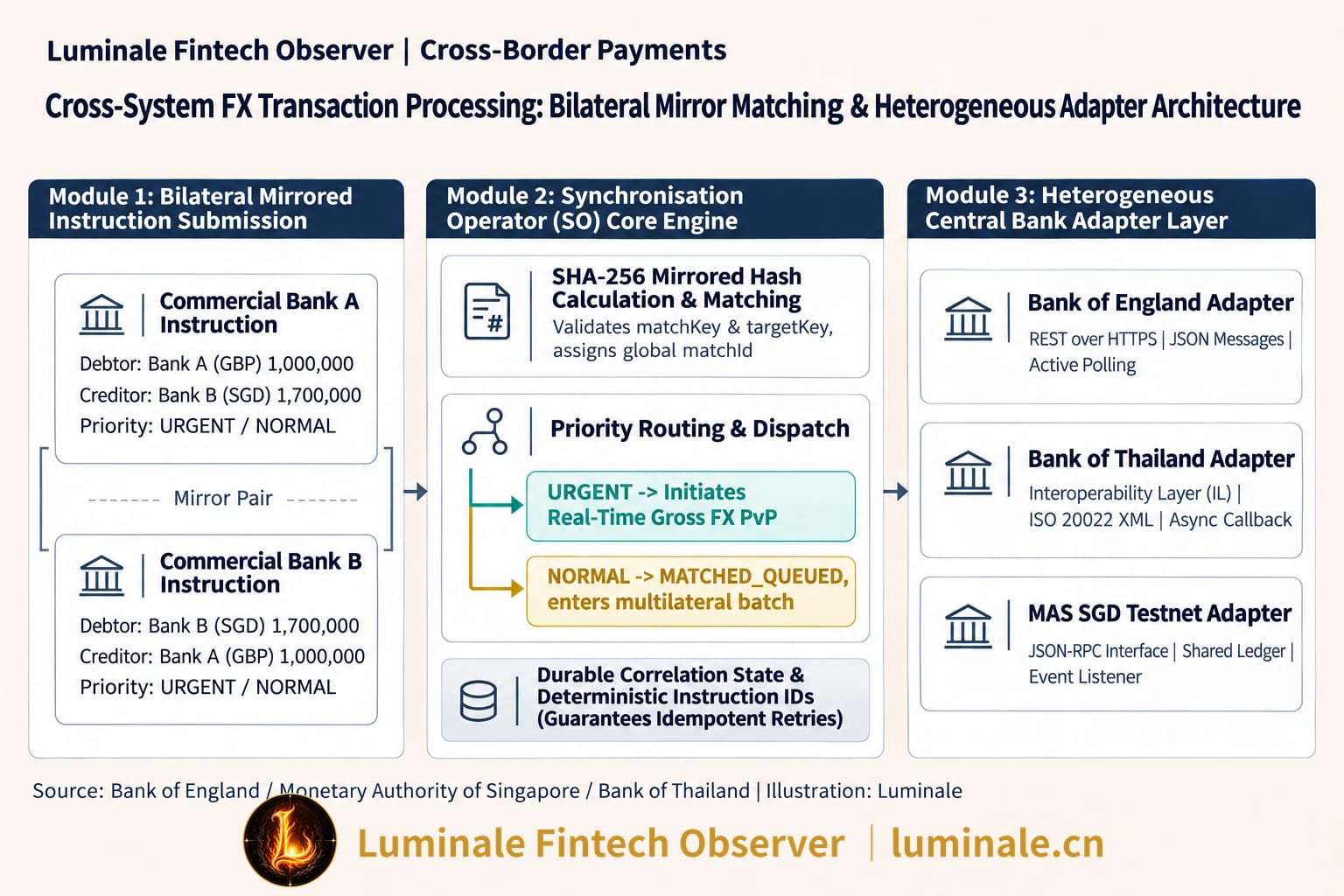
Bilateral settlement in traditional foreign exchange naturally faces cross-time-zone and cross-system segregation. As examined in "What Is the Most Dangerous Moment in FX? Why PvP Is the Market's 'Payment-versus-Payment'", if currency legs are not conditionally bound, paying out one currency while facing delays or default on the counterparty leg exposes institutions to severe principal risk. In the Meridian FX APAC architecture, the trading counterparties (Commercial Bank A and Commercial Bank B) first execute their FX trade within their respective internal dealing systems, and subsequently submit synchronised settlement requests to the Synchronisation Operator (SO).
Because both banks reside in distinct jurisdictions and connect through their respective central bank clearing interfaces, the settlement instructions submitted to the SO exhibit a strict "bilateral mirror" structure:
| Instruction Attribute | Original Settlement Instruction by Bank A | Original Settlement Instruction by Bank B |
|---|---|---|
| Debtor Agent | Commercial Bank A | Commercial Bank B |
| Debtor Amount & Currency | GBP 1,000,000 | SGD 1,700,000 |
| Creditor Agent | Commercial Bank B | Commercial Bank A |
| Creditor Amount & Currency | SGD 1,700,000 | GBP 1,000,000 |
| Settlement Date & Time | 2026-11-18 10:00:00 UTC | 2026-11-18 10:00:00 UTC |
| Priority | NORMAL or URGENT | NORMAL or URGENT |
The SO itself does not operate as an order-matching exchange, nor does it act as a Central Counterparty (CCP) assuming novation or close-out netting responsibilities. Its primary operational function is to perform automated bilateral hash matching on the two independently received messages. To prevent payload discrepancies or concurrency race conditions during transmission, the SO extracts the debtor agent, settlement amount, creditor agent, settlement currency, and settlement timestamp from each instruction, concatenates them into a formatted string delimited by pipes (|), and computes its SHA-256 hash value. This derives the instruction's matching key (matchKey) and its corresponding counterparty target key (targetKey).
When Commercial Bank A's instruction reaches the SO first, the system finds no corresponding record in its persistent local database; the instruction is flagged as UNMATCHED and suspended. Once Bank B's mirrored instruction arrives, the SO calculates its matchKey and targetKey, discovers that they map symmetrically to Bank A's parameters, and validates the match. The system assigns both instructions a globally unique matching identifier (matchId) and matching timestamp, transitioning their lifecycle state to MATCHED.
At this point, the system introduces a priority routing mechanism:
- Real-Time Gross FX PvP Routing: If either bank marks its instruction as high priority (
URGENT), the SO immediately initiates a dedicated bilateral real-time gross synchronisation workflow, querying both central bank environments to lock funds and execute final settlement; - Multilateral Net Batch Routing: If both banks designate their instructions as standard priority (
NORMAL), the status is updated toMATCHED_QUEUED, placing the trade into the queuing pool to await periodic multilateral net batch processing.
To ensure that the unified state machine orchestration logic remains decoupled from heterogeneous central bank infrastructures, Partior designed an independent Adapter Layer within the SO prototype. The core workflow engine issues standardized state commands—such as "Earmark", "Settle", and "Release"—while transmission protocol differences across underlying systems are abstracted within the adapters:
- Bank of England (Synchronisation Lab): The adapter operates over REST over HTTPS, exchanging standard JSON payloads and actively querying transaction state updates via polling;
- Bank of Thailand (Project SAN): The adapter interfaces via an HTTPS-based Interoperability Layer (IL), exchanging ISO 20022 XML messages, with execution confirmations delivered asynchronously via system callbacks to the SO;
- Monetary Authority of Singapore (SGD Testnet): The adapter communicates directly with shared ledger nodes via JSON-RPC interfaces, capturing on-chain state transitions through a dedicated event listener.
To prevent duplicate debiting caused by network interruptions and timeout retries, all adapters incorporate deterministic instruction identifiers and durable correlation state. Before dispatching any network command, the SO durably records the pending operational step and its unique deterministic identifier into persistent storage. When timeout retries occur, the underlying central bank systems rely on this deterministic ID to enforce idempotent processing, identifying duplicate transmissions rather than initiating additional debits.
II. Earmarking Compared: How the Three Central Bank Systems Adapt Ledgers and Cryptographic Signatures
Within the Luminale analytical framework for payment infrastructures, the operational core of cross-system settlement lies not in message transmission, but in the design of the funds earmarking mechanism. Cross-system FX transactions carry principal risk because traditional interbank transfers transfer control once a unilateral debit occurs; if the counterparty system subsequently fails, the debited institution faces total principal loss on that leg. The economic substance of funds earmarking is straightforward: prior to executing an irrevocable final transfer across central bank books, each sovereign system ring-fences the participating bank's available intraday balance, preventing those funds from being absorbed by other wholesale payment queues while keeping legal claims and obligations untransferred.
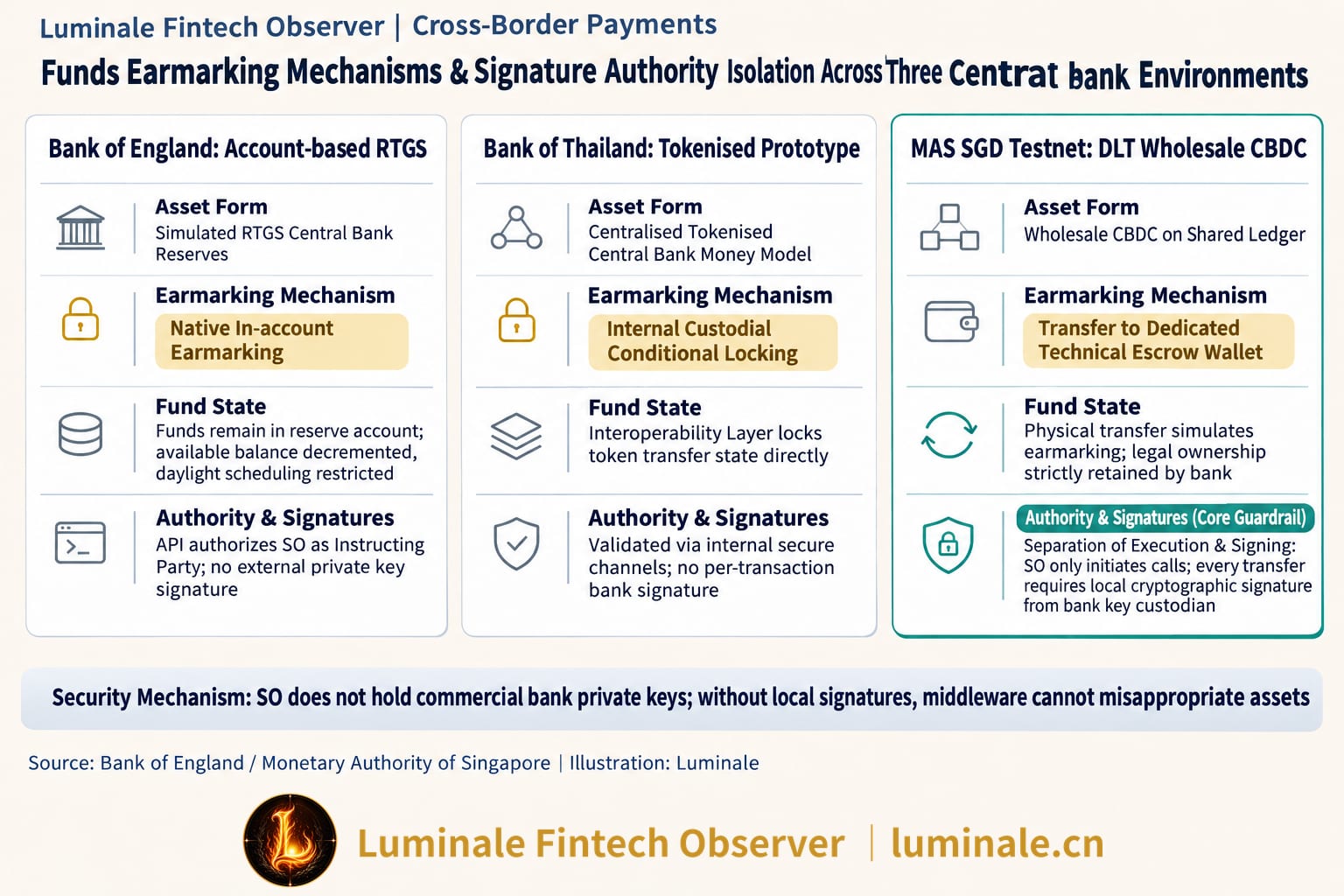
As demonstrated in "Why Does Settlement Still Anchor in Central Bank Money as Payment Means Proliferate? — Reading the CPMI Report The Roles of Central Banks and Central Bank Money in the Evolving Payment System", interbank final settlement relies on central bank money as a credit-risk-free foundational asset[6]. In Meridian FX APAC, the three central banks integrated three architecturally distinct test environments, leading to differentiated engineering pathways regarding account control rights and cryptographic signature chains:
| Analytical Dimension | Bank of England: Synchronisation Lab | Bank of Thailand: Project SAN | Monetary Authority of Singapore: SGD Testnet |
|---|---|---|---|
| Underlying Architecture | Traditional account-based Real-Time Gross Settlement (RTGS) | Centralised tokenised central bank money ledger | Distributed ledger wholesale Central Bank Digital Currency (wCBDC) |
| Test Settlement Asset | Simulated central bank RTGS reserves | Centralised tokenised central bank money test model | Simulated wholesale CBDC on a shared ledger |
| Earmarking Implementation | Native in-account ring-fencing: Available limit segregated within the bank's own reserve account without transferring funds | Internal escrowed conditional lock: Interoperability layer invokes system logic to freeze token transferability | Dedicated technical escrow wallet: Tokens transferred from the bank's main wallet to an authorized dedicated escrow wallet |
| Asset Legal Ownership | Commercial bank | Commercial bank | Commercial bank |
| Operational Trigger Authority | API-level authentication designating the SO as the Instructing Party | SO submits instructions via the Interoperability Layer and receives state callbacks | SO holds API invocation rights over the dedicated escrow wallet |
| Cryptographic Signature Authority | Internal API authentication; no external private key signature process | Internal secure communication verification; no per-transaction commercial bank signature | Commercial bank external key custodian holds private key; every asset movement requires bank digital signature |
| State Return Mechanism | Adapter performs active polling until state updates | Underlying system pushes confirmations asynchronously via callback endpoints | Adapter monitors ledger events via a dedicated event listener |
In the Bank of England's Synchronisation Lab, the environment adopts a mature centralised account model. The UK system natively supports reserve "in-account earmarking". When Commercial Bank A initiates a settlement, its GBP 1,000,000 balance remains entirely within its own central bank reserve account; only its available balance decreases while its earmarked balance increases, preventing the bank's treasury desk from mobilizing those reserves for general wholesale payment queues. The SO holds only authorized instructing party credentials authenticated by BoE interfaces, with no authority to alter the central bank's core general ledger directly.
The Bank of Thailand's Project SAN employs a centralised tokenised architecture connected to its settlement core via a dedicated Interoperability Layer (IL). Funds earmarking here does not rely on an external third-party escrow account; instead, it utilizes internal conditional locking logic at the token layer. The SO submits locking requests via the IL, and the core confirms the lock asynchronously through callbacks. Project SAN in this trial served strictly as a tokenised testing prototype, distinct from Thailand's live production BAHTNET system, and the trial reports offer no production-level legal characterization of its test tokens.
In its engineering implementation, the Monetary Authority of Singapore's SGD Testnet environment implemented an earmarking solution based on dedicated escrow wallets. Because this test ledger lacked granular native "in-account balance ring-fencing" mechanisms comparable to traditional RTGS systems, the project team designed an adaptation framework: establishing a dedicated technical escrow wallet for each participating commercial bank—owned by the bank, but operated under mandate by the SO. During the earmarking phase, wCBDC tokens are transferred from the commercial bank's primary wallet into this dedicated wallet, achieving balance segregation through ledger-level isolation.
From an operational and regulatory perspective, this architecture addresses an essential division of rights and responsibilities: whether authorizing the SO to invoke movements from a dedicated wallet amounts to granting it balance-sheet custody or control over commercial bank assets.
To address this, the trial established a clear institutional and technical boundary:
- Statutory Asset Ownership Preserved: The dedicated wallet remains registered on-ledger under the legal ownership of the commercial bank; token assets never enter the SO's own balance sheet;
- Separation of Operational Triggers from Signature Authority: While interfaces allow the SO to initiate transfer workflows, all asset movements out of the dedicated wallet require local digital signature authorization by the commercial bank. When the MAS adapter receives a transfer request from the SO, it constructs an unsigned transaction payload and forwards it to the commercial bank's locally deployed External Key Custodian. Only after the bank validates and signs the payload is the transaction submitted to the shared ledger for consensus validation and execution.
The SO holds only its own system operator keys, without accessing or storing commercial bank private keys. Lacking a cryptographic signature from the commercial bank, token transfer instructions cannot execute on the ledger. This mechanism ensures that the technical intermediary cannot mobilize liquidity within the dedicated wallet without explicit institutional authorization.
III. Around the Point of Commitment: Preventing Non-Deterministic Outcomes in System Outages and Liquidity Shortfalls
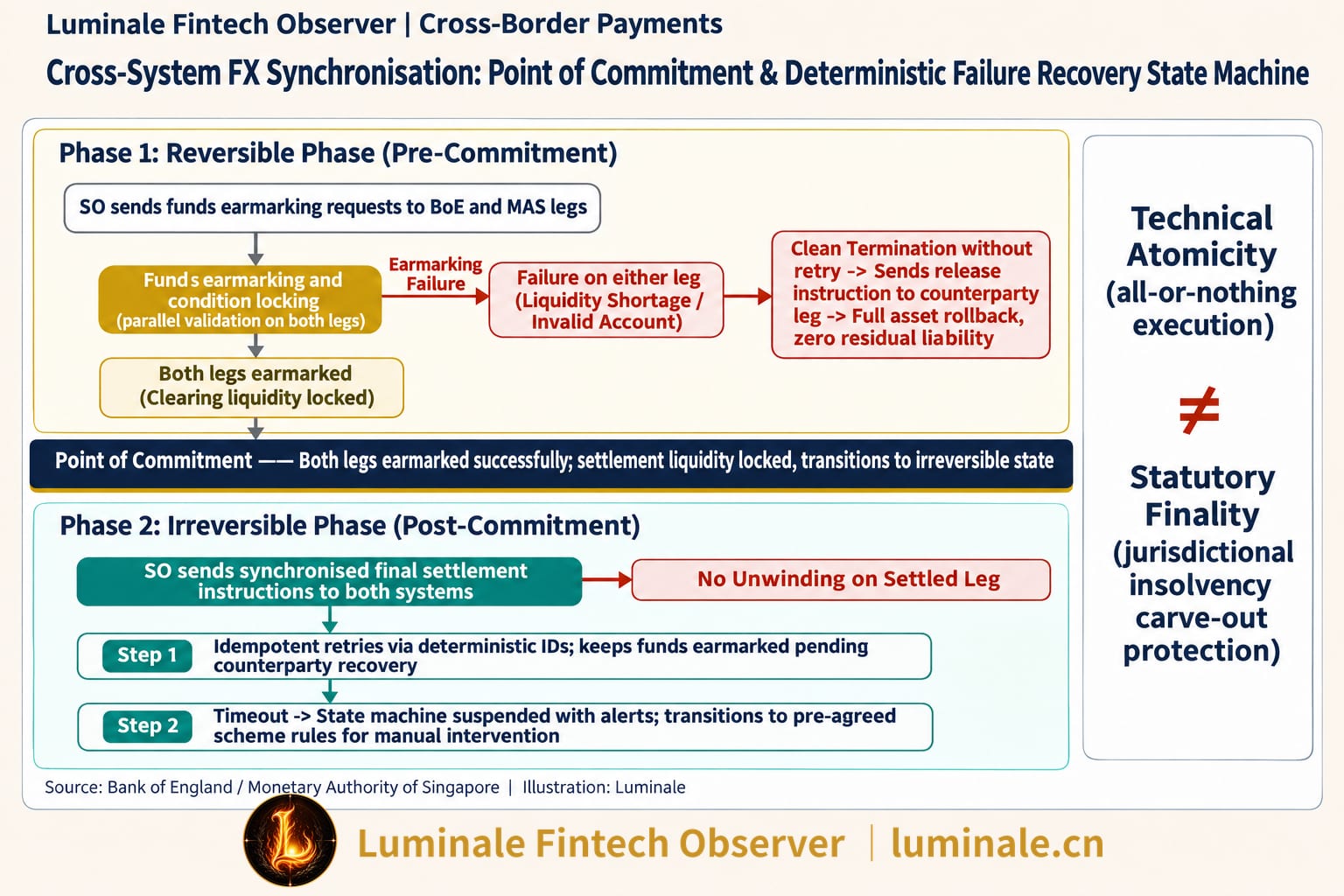
A major operational hurdle in cross-border, cross-system settlement is the risk that communication interruptions or hardware/software failures cause one system to execute a debit while the counterparty system fails to respond in time. Such unilateral execution invalidates the conditional binding of Payment versus Payment (PvP), reintroducing principal risk. The resilience testing framework in Meridian FX APAC establishes the Point of Commitment as a strict demarcation dividing the transaction lifecycle into reversible and irreversible phases, designed fundamentally to eliminate non-deterministic outcomes.
In a synchronised settlement system, a non-deterministic outcome occurs when the settlement status of an individual payment leg remains indeterminate, leaving the SO unable to establish whether the trade should complete or roll back. To prevent this ambiguity, the state machine applies definitive state transition rules structured around the Point of Commitment:
| Phase | System Trigger | Disruption Scenario & Resolution Mechanism | Final State |
|---|---|---|---|
| Reversible Phase (Pre-Commitment) | SO dispatches funds earmarking requests to UK and Singapore systems | Earmark failure on either leg (insufficient intraday liquidity or invalid account): State machine terminates cleanly, releases earmarked funds on the counterparty leg, and halts automated retries | Complete rollback; no residual claims or obligations; returns standardized error reason code |
| Point of Commitment | Both systems return successful funds earmark confirmations | Irreversible commitment reached: All liquidity required for settlement is locked in respective sovereign systems; lifecycle shifts to non-cancellable execution | Transaction commitment locked; immediately triggers bilateral final transfer instructions |
| Irreversible Phase (Post-Commitment) | SO synchronises final settlement transfer instructions to both central bank systems | Network timeout or system outage on either leg: The executed leg does not support unilateral unwinding; counterparty leg maintains earmarked funds while executing idempotent retries via deterministic IDs; transitions to manual intervention if thresholds expire | Both legs execute and close trade; or reconciliation completes offline under multilateral legal agreements |
1. Pre-Commitment (Reversible Phase): Clean Termination and Full Rollback
During the funds earmarking phase, if either central bank system fails to reserve the requisite funds, the entire workflow terminates cleanly.
- Scenario 1: Insufficient Liquidity (
LIQUIDITY_FAILURE). If Commercial Bank A maintains insufficient available reserves in its UK account, the UK RTGS simulator returns an earmark rejection response. The system classifies liquidity shortfalls as non-recoverable operational conditions, and the state machine dictates that no automatic retries are initiated. The SO immediately terminates the workflow and transmits a cancellation command to the Singapore leg. Earmarked tokens in Singapore's dedicated wallet are refunded to Commercial Bank B's main wallet. Both counterparties retain their original balances in their respective domestic accounts, achieving a complete rollback without creating residual debt obligations; - Scenario 2: Invalid Account (
ACCOUNT_INVALID). If a counterparty enters an invalid creditor account format or the account lacks central bank clearing access configurations, the system classifies this as a permanent operational error, immediately releasing earmarked funds on the counterparty leg and aborting the trade.
In frontline commercial bank operations, this sequence is reflected in standardized error reason codes (such as rejection due to insufficient available balances or net debit caps), preventing balances from becoming stranded indefinitely across jurisdictions.
2. Post-Commitment (Irreversible Phase): No Unwinding and Idempotent Retries
Once both the sterling and Singapore dollar legs return successful earmark confirmations, the trade formally crosses the Point of Commitment. At this juncture, all liquidity required for complete settlement has been locked, and the transaction enters its irreversible phase. The SO immediately issues final settlement execution commands to both systems.
If, after dispatching these commands, the Singapore leg experiences a sudden network disconnection or hardware outage preventing delivery of confirmation messages, how do the systems respond?
In this phase, the system enforces a fundamental settlement principle: completed sterling settlement entries on the UK leg do not support unilateral unwinding. Reversing or adjusting an already credited RTGS payment would violate the foundational principles of wholesale payment finality, disrupt the receiving bank's intraday liquidity management, and introduce operational uncertainty into related clearing workflows.
Under these conditions, system recovery proceeds in two stages:
- Idempotent Retries: The incomplete Singapore leg maintains its funds locked in the dedicated escrow wallet, while the adapter repeatedly issues retry queries and resends instructions using the original deterministic instruction ID according to backoff algorithms. Once communication with Singapore is restored, the underlying ledger recognizes the deterministic ID as an already authorized operation, completing the debit and credit smoothly without duplicate processing;
- Manual Intervention: If an outage persists and retries exceed maximum thresholds, the SO state machine enters an explicit suspended exception state, broadcasting alerts to operations personnel at both central banks and participating commercial banks. Operational reconciliation then shifts to offline manual procedures governed by multilateral system rulebooks. Throughout this process, the system prevents silent message loss and prohibits unilateral automatic reversals.
This separation illustrates the conceptual distinction between technical atomicity and statutory settlement finality. Technical atomicity refers to the computational property enforced by distributed state machines where all state changes execute or none do. Settlement finality, by contrast, is the statutory protection conferred by sovereign legal frameworks upon settlement entries—once completed, even if the paying institution enters insolvency proceedings immediately thereafter, the transfer remains legally protected against clawback or unwinding by bankruptcy liquidators. As articulated in "Can a 'Successful Payment'Be Reversed? What Risks Does Settlement Finality Solve?", statutory finality is the core institutional safeguard protecting financial market infrastructures against the zero-hour rule in insolvency.
The Meridian FX APAC Policy Report emphasizes that while an SO prototype can establish a technical point of commitment within its codebase, this does not create a supranational statutory finality regime across the United Kingdom, Singapore, and Thailand[3]. The exact point at which a UK reserve debit achieves statutory irrevocability remains governed by the UK Financial Markets and Insolvency Regulations and domestic RTGS system rules; similarly, the point at which a wCBDC transfer discharges debt obligations is defined by Singapore law. A technical synchronisation platform cannot supersede the statutory determinations of national legal jurisdictions.
IV. Multilateral Netting Batch Negotiation: When the Synchronisation Operator Calculates Net Positions
While bilateral real-time PvP eliminates principal risk in foreign exchange settlement, it imposes substantial intraday liquidity demands, requiring commercial banks to fully fund every gross payment obligation. To balance safety and liquidity efficiency, Meridian FX APAC explored a second primary use case: Multilateral Net FX PvP.
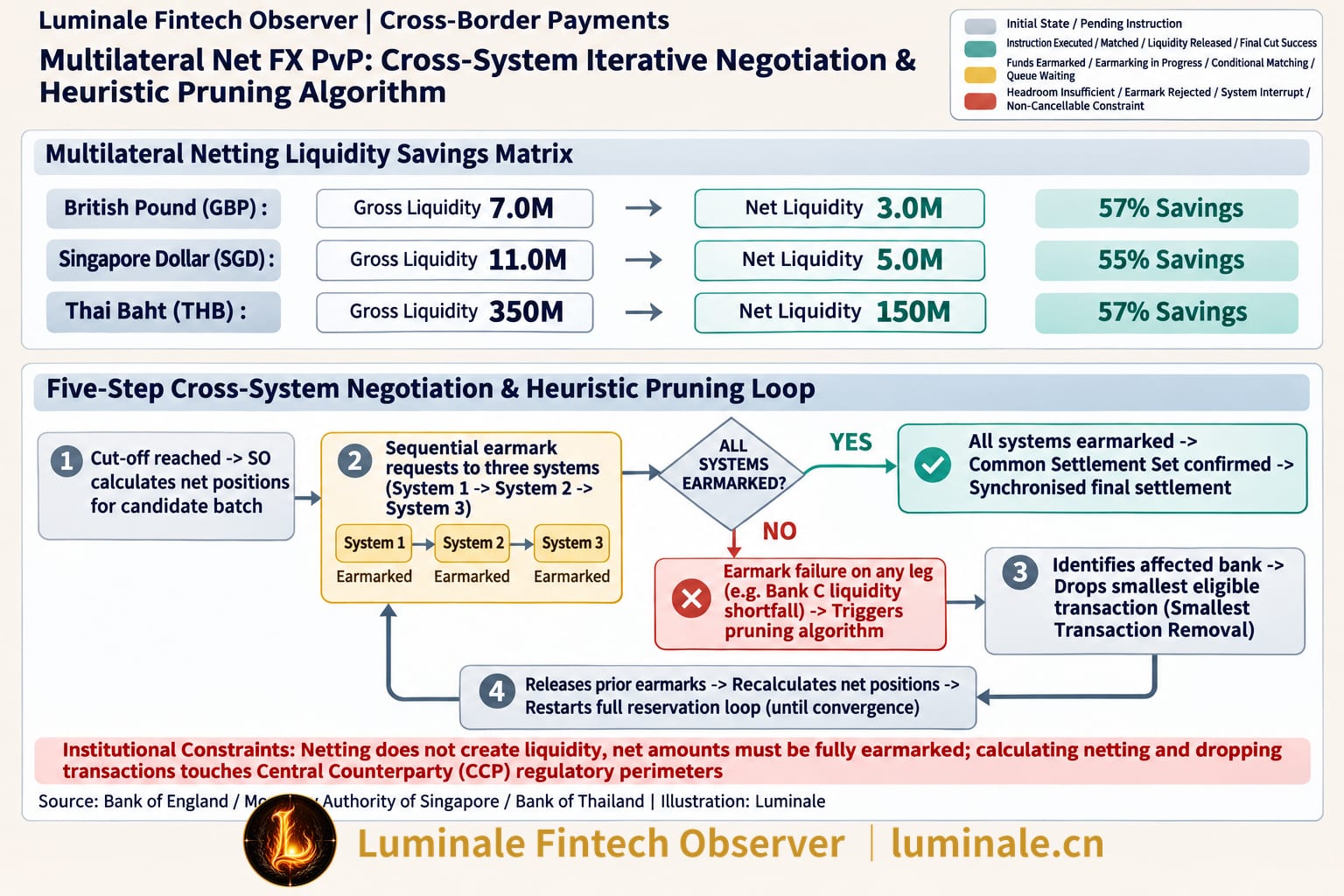
Within scheduled settlement cycles, the SO aggregates standard-priority transactions from the queue (MATCHED_QUEUED) to conduct centralised multilateral netting. Multilateral netting mechanisms are well established within single-currency systems; detailed queuing and offsetting algorithms are discussed in "Not Enough Funds, So Payments Just Wait? How RTGS Queuing and Liquidity-Saving Mechanisms Work". In a cross-system environment spanning heterogeneous central bank ledgers, however, multilateral netting introduces an unprecedented engineering requirement: all participating central bank systems must simultaneously earmark funds for the exact same Common Settlement Set of transactions.
Consider a candidate batch comprising 6 FX trades involving Commercial Banks A, B, and C across the UK, Singapore, and Thailand. The comparison between original gross volumes and netted positions across the three currencies is summarized below:
| Commercial Bank | Gross GBP Debit / Credit | Net GBP Position | Gross SGD Debit / Credit | Net SGD Position | Gross THB Debit / Credit | Net THB Position |
|---|---|---|---|---|---|---|
| Commercial Bank A | Pay 5.0M / Receive 2.0M | Net Payable 3.0M | Pay 3.0M / Receive 8.0M | Net Receivable 5.0M | Pay 0 / Receive 0 | 0 |
| Commercial Bank B | Pay 2.0M / Receive 5.0M | Net Receivable 3.0M | Pay 0 / Receive 0 | 0 | Pay 250M / Receive 100M | Net Payable 150M |
| Commercial Bank C | Pay 0 / Receive 0 | 0 | Pay 8.0M / Receive 3.0M | Net Payable 5.0M | Pay 100M / Receive 250M | Net Receivable 150M |
| System Totals | Gross Liquidity: 7.0M | Net Liquidity: 3.0M (57% saved) | Gross Liquidity: 11.0M | Net Liquidity: 5.0M (55% saved) | Gross Liquidity: 350M | Net Liquidity: 150M (57% saved) |
Through multilateral netting, participating banks reduce their liquidity requirements across all currencies by more than half. However, coordinating three central bank systems to lock this net liquidity simultaneously poses a challenge: because the SO cannot predict which bank might encounter balance shortages in which domestic ledger, it implements a cross-system iterative negotiation and heuristic pruning algorithm:
| Algorithm Step | Stage | System Actions & Decision Rules |
|---|---|---|
| Step 1 | Cut-off & Net Calculation | Following cycle cut-off, the SO aggregates candidate trades from the queue and computes multilateral net debit/credit positions for each participant across currencies. |
| Step 2 | Sequential Cross-System Earmarking | The SO dispatches net debit earmarking requests across the three central bank systems in a fixed sequence (e.g., System 1 System 2 System 3). |
| Step 3A | Full Earmark Success (Main Path) | If all systems confirm successful earmarking, the SO establishes a validated Common Settlement Set, issues simultaneous final transfer commands, and closes the batch. |
| Step 3B | Partial Earmark Failure (Branch) | If any system reports earmark rejection (e.g., Bank C exceeds its net debit limit or reserve balance), the SO triggers heuristic pruning. |
| Step 4 | Heuristic Pruning & Recalculation | The algorithm locates the impacted institution based on error payloads, prunes the qualifying transaction with the smallest monetary value under that bank (Smallest Transaction Removal), releases prior earmarks, and recalculates net positions for remaining trades. |
| Step 5 | Iterative Negotiation to Convergence | The SO dispatches updated net earmark requests across all systems. If further rejections occur, pruning repeats iteratively until all three systems converge on an agreed reduced batch. |
In prototype testing, if Commercial Bank C experiences an earmark rejection in the third central bank system due to insufficient net debit limits, the SO does not abandon the entire batch. Instead, it locates Bank C via error diagnostic codes and prunes the eligible transaction with the smallest monetary value belonging to Bank C (Smallest Transaction Removal). Following removal, the SO unwinds preliminary net earmarks across the prior two systems, recalculates net positions across the remaining 5 transactions, and reinitiates sequential earmarking. This cycle repeats until all three systems successfully lock liquidity for an agreed reduced transaction set, whereupon the SO executes batch final settlement.
While demonstrating operational flexibility, this algorithm highlights two fundamental structural constraints:
- Multilateral Netting Does Not Create Liquidity: Multilateral offsetting reduces the aggregate volume of gross transfers mathematically, but net debit obligations must still be fully funded by commercial banks within central bank reserve accounts. If a participant faces a severe liquidity deficit, repeated transaction pruning may prevent the batch from reaching convergence, returning excluded trades to bilateral queues;
- Clearing House Regulatory Perimeter Overlap: In bilateral mode, the SO acts purely as a passive messaging coordinator and state orchestrator. In multilateral batches, however, the SO computes multilateral net settlement positions and exercises algorithmic discretion over which transactions to prune. The Policy Report notes that once a technology provider calculates net positions and structures settlement batches, its operational role intersects with the regulatory definition of a Clearing House or Central Counterparty[3]. Under the CPMI-IOSCO Principles for Financial Market Infrastructures (PFMI), such entities are subject to stringent oversight requirements—including default management funds, loss-sharing rules, and capital adequacy standards—imposing extensive compliance obligations on what was originally conceived as a lightweight coordination platform.
V. From Sandbox to Production: Untested Real-World Constraints and Operational Challenges
Transitioning from controlled test environments into live global financial markets, Meridian FX APAC confirmed the technical feasibility of cross-system synchronisation while identifying critical operational gaps between proof-of-concept testing and production deployment. The participating central banks highlighted several untested practical constraints:
1. Cross-Time Zone Operating Hours and Liquidity Constraints
The APAC trial operated under an idealized assumption: that the operational hours of all three central bank systems overlap completely. In reality, London, Bangkok, and Singapore occupy distinct time zones. While Asian financial centres share partial operating windows with Europe, extending system hours to achieve 24/7 continuous synchronised settlement introduces substantial liquidity management hurdles for commercial banks.
The primary operational constraint stems from the closure of interbank money markets outside regular hours. During standard operating windows, banks facing unexpected intraday liquidity shortfalls can borrow reserves in the interbank market or tap intraday credit facilities provided by their central bank. Outside standard hours, money markets are closed, leaving banks unable to access emergency funding. Pre-funding central bank reserve accounts around the clock to avoid queue blockages increases liquidity costs and carries default risks if uncollateralized overdrafts occur without secondary funding sources.
2. Earmark Expiry and Timing Coordination
In the trial environment, earmarking workflows resolved into final settlement or rollback within minutes; the protocols were not subject to extended stress testing regarding earmark expiry. In live operations, funds cannot remain ring-fenced or locked in dedicated escrow wallets indefinitely. If one system hangs during an outage, clear rules must govern when the counterparty leg unlocks its funds.
If rigid, short timeout thresholds are enforced, one system might release funds due to timeout just as the recovering counterparty completes its debit, invalidating the conditional binding of PvP. Conversely, omitting expiry limits leaves liquidity locked indefinitely, impeding participants'daily treasury operations. Resolving this operational friction requires binding multilateral legal frameworks rather than software parameters alone.
3. Commercial Bank Live Accounts and High-Concurrency Scheduling
Participating banks in the trial were simulated software nodes with parameterized balances. In live commercial bank core banking environments, foreign exchange settlement interfaces directly with credit limit approvals, credit line monitoring, regulatory compliance screening, and intraday liquidity stress testing.
Under high-concurrency conditions, commercial bank reserve accounts in central bank systems encounter account hot-spotting and lock contention. When high-value payments, multilateral net batches, and instant retail transactions compete simultaneously to lock liquidity against the same reserve account, queuing logic becomes intricate. Bank treasury desks require capabilities to adjust queue priorities manually according to urgency, an operational dimension not fully captured within the sandbox environment.
4. Independent Central Bank Roadmaps
Technical progress achieved in joint experimentation must be evaluated independently from domestic infrastructure deployment roadmaps. The Bank of England's planned production synchronisation interface for its renewed RTGS service is targeted for 2028 as an autonomous domestic modernisation initiative; the joint APAC trial established no collective timetable or commitment for live cross-border FX synchronisation services across the three jurisdictions.
VI. Conclusion
By examining the operational mechanics of Meridian FX APAC, cross-system synchronised foreign exchange settlement demonstrates technical viability at the protocol level: the adapter architecture accommodates traditional accounts, internal condition locks, and dedicated technical escrow wallets; state machines anchored around the Point of Commitment provide deterministic recovery logic; and iterative pruning algorithms confirm the potential for significant liquidity savings in multilateral batches.
Yet compared to technical implementation, the harmonization of legal rules and operational frameworks remains the primary challenge. In asset governance, dedicated technical escrow wallets require cryptographic signature delegation to maintain clear boundaries between operational triggers and asset ownership; in regulatory classification, calculating multilateral net positions and exercising pruning authority places technology operators within the perimeter of clearing house supervision; and in cross-time-zone environments, non-overlapping operating hours and liquidity costs necessitate robust market mechanisms and multilateral legal coordination.
The core challenge of connecting cross-system financial market infrastructures lies not merely in engineering network interfaces, but in balancing statutory settlement finality, clearing oversight mandates, and liquidity provision while respecting the operational sovereignty of national central bank ledgers. Operational mechanisms addressing liquidity bridge facilities and cross-border insolvency recognition under asynchronous operating windows will be explored in subsequent analyses.
References
[1]: Bank of England. The Bank of England, Monetary Authority of Singapore and Bank of Thailand media release on Project Meridian FX APAC [EB/OL]. (2026-11-13). https://www.bankofengland.co.uk/news/2026/november/the-boe-monetary-authority-of-singapore-and-bank-of-thailand-media-release. ↩
[2]: Bank of England, Monetary Authority of Singapore. Project Meridian FX APAC: Technical Report [EB/OL]. (2026-11-13). https://www.bankofengland.co.uk/payments/payments-innovation/wholesale-experiments-programme/project-meridian-fx-apac-technical-report. ↩
[3]: Bank of England, Monetary Authority of Singapore. Project Meridian FX APAC: Policy Report [EB/OL]. (2026-11-13). https://www.bankofengland.co.uk/payments/payments-innovation/wholesale-experiments-programme/project-meridian-fx-apac-policy-report. ↩
[4]: Bank for International Settlements. Project Meridian: Innovating transactions with synchronisation [EB/OL]. (2023-04-19). https://www.bis.org/publications/project-meridian-innovating-transactions-synchronisation.pdf. ↩
[5]: Bank for International Settlements. Project Meridian FX: Exploring synchronised settlement in foreign exchange [EB/OL]. (2025-04-24). https://www.bis.org/publications/project-meridian-fx-exploring-synchronised-settlement-fx.pdf. ↩
[6]: Committee on Payments and Market Infrastructures. Central bank digital currencies: foundational principles and core features [EB/OL]. (2020-10-09). https://www.bis.org/cpmi/publ/d197.pdf. ↩
Originally published by Luminale Fintech Observer: https://luminale.cn/articles/meridian-fx-apac-cross-system-pvp-settlement-en