In everyday consumer experience, as long as mobile transfers settle in seconds, the underlying payment infrastructure often appears complete. A user enters the recipient's mobile number, confirms the displayed name, taps transfer, and the funds arrive almost instantly. Since its rollout in 2017, PayNow has become an exceptionally widespread retail instant payment service in Singapore. According to disclosures from the Monetary Authority of Singapore (MAS) and the Association of Banks in Singapore (ABS), by the end of 2025, total PayNow proxy registrations reached approximately 11 million. Adult population coverage and corporate acceptance both exceeded 90%, with 2025 consumer payment volume reaching approximately S$154 billion and business transaction volume totaling S$147 billion.[1]
However, on November 18, 2026, MAS and ABS jointly released the report titled PayNow Generation 2: Defining the Next Wave of Innovation for Singapore's Instant Payments System — Phase 2 Report (hereafter referred to as the "Phase 2 Report"), unveiling a phased implementation roadmap spanning 2026 through 2028.[1][2] This roadmap demonstrates that Singapore does not view its existing instant payment system as the finish line. Instead, it has embarked on a systemic overhaul covering mobile app deep-linking, offline QR code acquiring routing, enterprise structured data, merchant payment dispute governance, and candidate micropayment rail validation. More importantly, the Phase 2 Report clarifies that PayNow Gen2 serves merely as a transitional phase toward next-generation payment infrastructure. MAS plans to formulate a comprehensive Future Payment Rails Blueprint starting in 2027, steering Singapore toward an integrated architecture characterized by "Multi-rail, Multi-functional, and Multi-service" capabilities.[1]
For a fast payment system that already boasts widespread adoption and second-level execution, the primary impetus for this upgrade is not a quest for marginal latency reduction. Rather, as the system expands from simple person-to-person (P2P) transfers into complex merchant commerce, e-commerce checkout, high-value public collections, bulk government disbursements, and autonomous machine micropayments, it encounters operational constraints across connectivity standards, data syntax, liquidity management, and clearing economics.
Starting from a representative merchant payment, this article traces the transaction lifecycle across application redirection, cross-network instruction routing, post-payment reconciliation, and dispute resolution. It then contrasts the structural demands of high-value government collections and high-frequency machine micropayments, evaluating the institutional logic and practical trade-offs behind Singapore's multi-rail payment infrastructure roadmap.
I. Why Gen2 When Instant Transfers Already Work?
To understand the scope of PayNow Gen2, one must first delineate the division of labor across Singapore's existing retail payment architecture. Many users instinctively treat "PayNow" as the fund transfer network itself. In the strict taxonomy of financial market infrastructures, however, PayNow is neither an independent clearing house nor a settlement rail.
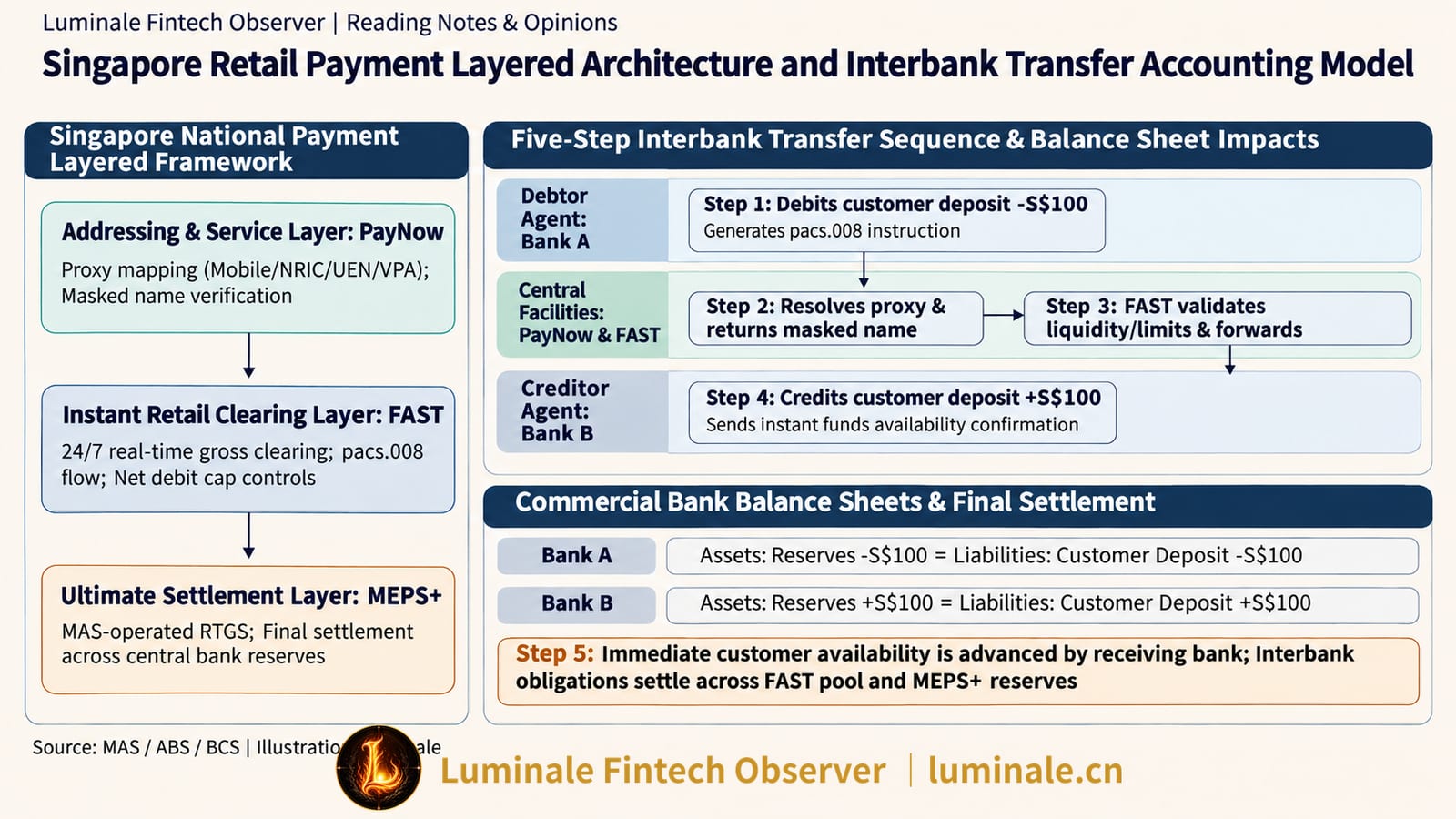
Within Singapore's national payment ecosystem, each infrastructural tier performs distinct, specialized responsibilities:
- Proxy Addressing and Service Tier (PayNow): PayNow functions fundamentally as a Central Addressing Scheme and unified branding layer. Its primary role is maintaining proxy mappings between a user's mobile number, Singapore National Registration Identity Card (NRIC/FIN), Unique Entity Number (UEN), or Virtual Payment Address (VPA) and their specific underlying bank account or stored-value wallet. The payer can initiate a transfer instruction without knowing the payee's formal bank account number.
- Real-Time Retail Clearing Rail (FAST): Launched in 2014 and operated by Banking Computer Services (BCS), Fast and Secure Transfers (FAST) is the core retail infrastructure executing 24/7 gross real-time fund transfers between banks and non-bank financial institutions. Instant transfers initiated via PayNow are routed to FAST for clearing. At the customer interface, FAST and PayNow enforce a uniform default cap of S$200,000 per transaction.[4]
- Low-Cost Batch Clearing Rail (Interbank GIRO): Interbank GIRO continues to handle periodic bill payments, utility direct debits, and mass payroll processing—flows where instant availability is secondary to low processing overhead.
- Central Bank Ultimate Settlement Layer (MEPS+): The MAS Electronic Payment System Plus (MEPS+) is a Real-Time Gross Settlement (RTGS) system owned and operated by MAS. It settles wholesale, risk-free central bank money, serving as the ultimate settlement nexus for reserves held by commercial banks on the central bank's balance sheet.
1. Account Booking and Settlement Distinction in Interbank Instant Transfers
To illustrate how mutual obligations change throughout an instant transfer, consider a typical domestic interbank transaction: Payer Zhang San uses Bank A's mobile application to transfer S$100 to Li Si, whose mobile number is linked to Bank B.
- Step 1: Proxy Resolution and Verification. Bank A's front-end receives the mobile number and queries the PayNow central directory. The directory maps the number to Bank B and returns Li Si's bank-verified masked legal name (e.g., "L S"). To mitigate fraud impersonating well-known figures or entities, ABS officially discontinued user-defined PayNow nicknames on June 6, 2026, mandating the display of verified masked names across all interfaces.
- Step 2: Payer Authorization and Local Debit. After verifying the recipient's name, Zhang San authorizes the payment via biometrics or two-factor authentication. Bank A immediately debits Zhang San's account: on Bank A's balance sheet, its demand deposit liability to Zhang San decreases by S$100.
- Step 3: Clearing Instruction Submission and Limit Checks. Bank A generates a standard
pacs.008customer credit transfer message and dispatches it to FAST. The FAST clearing engine validates message syntax and business parameters, verifying that Bank A maintains sufficient net debit capacity or prefunded liquidity within the clearing pool. - Step 4: Beneficiary Credit and Real-Time Confirmation. FAST forwards the clearing message to Bank B in real time. Upon local validation, Bank B credits Li Si's deposit account: on Bank B's balance sheet, its demand deposit liability to Li Si increases by S$100. Bank B returns a success confirmation to FAST, which immediately notifies Bank A. Both Zhang San and Li Si receive payment notifications within seconds.
- Step 5: Interbank Reserve Discharge. At the consumer level, the transaction is settled, and funds are immediately usable. Between the banks, however, Bank A owes Bank B S$100. Participating institutions maintain clearing accounts within FAST, where multilateral net obligations or real-time liquidity deductions occur, culminating in final interbank settlement via statutory reserve accounts in MEPS+.
The balance sheet changes across the commercial banks and the central bank are summarized below:
| Entity | Asset Position Changes | Liability Position Changes | Balance Sheet Relationship |
|---|---|---|---|
| Payer Bank (Bank A) | Central bank reserve assets / FAST clearing assets −S$100 | Demand deposit liability to Zhang San −S$100 | |
| Beneficiary Bank (Bank B) | Central bank reserve assets / FAST clearing assets +S$100 | Demand deposit liability to Li Si +S$100 | |
| Central Bank (MAS) | Total assets unchanged | Bank A statutory reserve deposits −S$100 Bank B statutory reserve deposits +S$100 | Internal liability shift; aggregate reserves balanced |
As shown in this workflow, personal transfers achieve second-level confirmation because modern fast payment systems decouple Immediate Funds Availability at the retail level from Interbank Final Settlement in central bank money. The instant credit perceived by consumers relies on scheme rule guarantees: upon receiving an irrevocable clearing message, the beneficiary bank advances provisional credit availability to the recipient. For an extensive examination of how fast payment systems balance 24/7 availability, provisional credit, and back-end settlement, see "What Powers 24/7 Instant Payments? Understanding Fast Payment Systems (FPS)".
2. Practical Bottlenecks of the Existing Architecture in Expanding to New Scenarios
While the "PayNow addressing + FAST clearing" arrangement functions smoothly for P2P transfers, initiating the Gen2 program stems from structural bottlenecks in broader commercial contexts.
In the Phase 1 Report published on June 25, 2026, MAS and ABS analyzed existing functional gaps[3], noting that when an architecture built primarily for P2P transfers is applied to e-commerce checkouts, offline merchant acquiring, ERP integration, and government disbursements, friction becomes pronounced:
- Fragmented Online E-Commerce Checkout: In mobile browser checkouts, PayNow historically lacked native app-switching protocols. Consumers faced a cumbersome workaround—taking screenshots of QR codes, switching apps, and importing the image from local photo albums—resulting in significant checkout abandonment.
- Fragmented Offline QR Acquiring: While the Singapore Quick Response Code (SGQR) unified static physical labels on merchant counters, underlying acquiring networks remained siloed. Merchants still faced duplicate bilateral relationships, fragmented terminal fleets, and split fee schedules.
- Lack of Structured Commercial Metadata: Existing payment messages lack standardized fields for merchant identifiers, invoice numbers, and purpose codes. Consequently, recipient enterprises cannot automatically reconcile incoming payments against their Enterprise Resource Planning (ERP) systems, leaving reconciliation dependent on manual matching.
- Absence of Unified Merchant Dispute Rules: Unlike mature credit card chargeback and arbitration mechanisms, Person-to-Merchant (P2M) instant account-to-account (A2A) transfers lacked standardized dispute codes, evidence criteria, and resolution timelines. When disputes arise from non-delivery, fraudulent merchants, or double-billing, consumers and banks often face protracted coordination hurdles.
- Uniform Per-Transaction Caps Constraining High-Value Collections: The uniform S$200,000 threshold restricts PayNow from directly supporting major public transactions, such as property stamp duties and corporate tax payments.
- Disproportionate Unit Economics for Sub-Cent Micropayments: FAST incurs fixed overhead per transaction for authentication, screening, and clearing. For emerging IoT utility charges, digital content micro-billing, or autonomous AI agent commerce involving fractions of a cent, traditional clearing economics prove cost-prohibitive.
To address these seven structural friction points, the Phase 2 Report sets forth an execution schedule categorized across three deployment horizons: market-ready features, in-flight technical standards, and proof-of-concept evaluations:[1][2]
| No. | Project Workstream | 2026 Market Status & Baseline | 2027 Key Milestones | 2028+ Target Objectives | Source Reference |
|---|---|---|---|---|---|
| 1 | Inclusive QR Apps | Wise and updated NETS apps support selected tourists and dependents | Refine custodian arrangements and non-resident onboarding | Full integration into unified merchant QR acquiring ecosystem | Report pp. 19–21 |
| 2 | Deep-Linking Standards & Central Facility | Bilateral deep-linking piloted by OCBC with Lazada and CPFB | Finalize industry-wide technical specs; deploy central routing switch | Industry-wide rollout across banks, major payment institutions, and merchants | Report pp. 22–27 |
| 3 | SGQR+ Switch Facility | Construction formally initiated; industry assessments completed | Conduct pre-launch integration testing; restricted deployment | Expand participating networks; integrate ASEAN cross-border QR schemes | Report pp. 28–33 |
| 4 | FAST-LITE Micropayment Candidate Rail | Industry working groups modeled requirements and cost structures | Build payment simulator; test cost-optimized rail and tokenised deposits | Evaluate 2027 test data to determine production viability | Report pp. 34–38 |
| 5 | High-Value Collections & Mass Disbursements | Standard S$200,000 cap enforced across all transactions | Pilot raised caps with one government agency; audit bulk throughput | Expand whitelist to additional agencies; deploy dedicated bulk processing lanes | Report pp. 39–44 |
| 6 | P2M Merchant Dispute Scheme Rules | Dependent on ad-hoc inter-institution coordination and case logging | Standardize dispute reason codes, evidence requirements, and TAT | Phased introduction of mandatory scheme rules enforced by SPaN | Report pp. 45–51 |
| 7 | Smart Corporate Payments & Structured Data | ISO 20022 adopted but lacks granular commercial invoice tags | Introduce extended tags for invoice IDs and merchant codes | Enable straight-through ERP reconciliation; explore tokenised e-invoices | Report pp. 52–55 |
II. How Do Payment Apps Open, and How Do Payment Instructions Reach Merchants?
In P2P transfers, the payer initiates the payment by manually inputting the recipient's proxy in their banking application. In commercial merchant checkouts, however, the process hinges on two distinct handoffs: first, how online merchant websites seamlessly invoke the user's mobile banking app for authorization; second, how payment instructions triggered by scanning an in-store QR code route accurately to the merchant's underlying acquirer.
1. Online E-Commerce Checkout: Moving Beyond Screenshot QR Codes to a Central Deep-Linking Facility
Despite widespread mobile commerce adoption, e-commerce checkout via PayNow has long suffered from user experience friction. When a consumer shops on a mobile browser and selects PayNow, the merchant's checkout page typically renders a dynamically generated QR code on screen. Because the shopper is browsing on the mobile device itself, the camera cannot scan a QR code displayed on its own screen.
Historically, consumers were forced through a convoluted sequence: take a screenshot of the checkout screen, exit the browser, launch their mobile banking app, complete biometric authentication, navigate to the QR scanner, select "Import from Album," locate the screenshot, confirm payment details, enter credentials, and finally toggle back to the browser to await merchant page refresh.
User research published in the Phase 2 Report reveals that 38% of surveyed consumers abandoned PayNow checkouts due to excessive friction, citing app-switching, manual screenshots, and gallery uploads as primary pain points.[1]
To streamline this journey, individual banks and major merchants piloted bilateral deep-linking. For example, OCBC partnered with e-commerce platform Lazada and the Central Provident Fund Board (CPFB) to embed dedicated URLs on checkout pages that invoke the bank's client via mobile operating system protocols. In Phase 2 testing, consumers rating the deep-linked checkout flow as "easy or very easy" rose from 50% to 66%.[1]
However, bilateral integration cannot scale across an entire economy. Singapore hosts dozens of commercial banks and Major Payment Institutions (MPIs), alongside thousands of e-commerce platforms and small-to-medium enterprises (SMEs). Requiring every merchant to build proprietary invocation protocols, authentication gateways, and reconciliation hooks with dozens of financial institutions would lead to duplicated development overhead.
Consequently, MAS and ABS confirmed in the Phase 2 Report that they will establish an industry-wide deep-linking standard in 2027, anchored by a Central Deep-Linking Facility. Core architectural features include:
- Standardized Link Specifications: Defining unified Universal Links and App Links schemas encapsulating unique merchant identifiers, transaction amounts, expiration timestamps, and cryptographic tamper-proof signatures.
- Origin Verification and Anti-Phishing Safeguards: The central facility authenticates merchant domain credentials and application signatures, ensuring links originate from legitimate registered merchants and preventing fraudulent sites from generating spoofed payment links.
- Application Resolution and Routing: When a consumer selects their paying bank, the central facility dispatches the instruction to the corresponding banking interface. If the selected app is absent from the device, the facility provides fallback web guidance or alternative verification methods.
- Bi-Directional Status Callbacks and Idempotency Controls: Upon authorization, the paying bank dispatches the clearing instruction to FAST while concurrently returning an immutable payment confirmation to the merchant via the central facility. This updates the order status to "Paid" even if the consumer accidentally closes the browser tab, using global unique transaction identifiers to prevent duplicate billing.
- High-Availability Fallback Design: To mitigate systemic risks arising from centralized routing dependencies, the Phase 2 Report specifies that direct bilateral bank connections will be retained as fallback channels, ensuring core e-commerce payment flows persist during central hub disruptions.
2. Offline QR Payments: Moving from Unified Display to the SGQR+ Unified Routing Switch
In physical retail, QR code acquiring faces a parallel evolutionary step. In 2018, Singapore pioneered the world's first unified national QR standard—the Singapore Quick Response Code (SGQR). SGQR consolidated multiple payment schemes (PayNow, NETS, GrabPay) onto a single EMVCo-compliant sticker, eliminating counter clutter caused by dozens of competing payment stands.
However, SGQR addressed only "front-end display consolidation," leaving "back-end acquiring networks fragmented." If a merchant's physical SGQR sticker lacked an active payload for a specific scheme, users of that scheme's wallet could not transact. More critically, to accept multiple schemes, merchants still had to sign separate acquiring agreements with NETS, multiple banks, and e-wallet operators, install multiple POS terminals, and reconcile fragmented settlement statements daily.
To bridge the gap between unified display and fragmented acquiring, MAS and industry stakeholders piloted the SGQR+ interoperable network framework[5], formally designating the construction of the SGQR+ Switch as a core infrastructure milestone in the Phase 2 Report.
The structural transition of SGQR+ shifts the paradigm from front-end display aggregation to Acquiring Interoperability. Under SGQR+, a merchant enters into a contractual relationship with a single Master Acquirer, who generates a unified SGQR+ code. When a consumer scans the code using any participating mobile application, instructions are dynamically translated and routed across schemes via the central SGQR+ Switch.
To understand instruction flow, consider two operational scenarios:
- Intra-Scheme Acquiring: A consumer uses Bank A's mobile app to scan a merchant QR code where Bank A serves as the acquirer. The instruction is matched and cleared internally within Bank A's proprietary system, requiring no cross-network switching.
- Cross-Scheme Interoperable Acquiring: A consumer uses a commercial banking app supporting PayNow to scan a merchant QR code acquired exclusively by Network for Electronic Transfers (NETS).
- The payment app parses the QR code and identifies NETS as the designated acquirer;
- The payer bank dispatches the payment request to the SGQR+ Switch;
- The SGQR+ Switch identifies the target network, executes protocol normalization, and routes the message to NETS;
- NETS validates the terminal identifier and pushes an instant credit notification to the merchant's POS device;
- Inter-scheme financial obligations between the paying bank and NETS are settled via FAST or designated settlement banks according to scheduled net clearing windows.
For an international comparison of how national QR standards progress from static labels to network-level interoperability, see "Same Code to Scan, Why Can't It Work Everywhere? QRIS, Global QR Payment Standards and Cross-Border Interoperability".
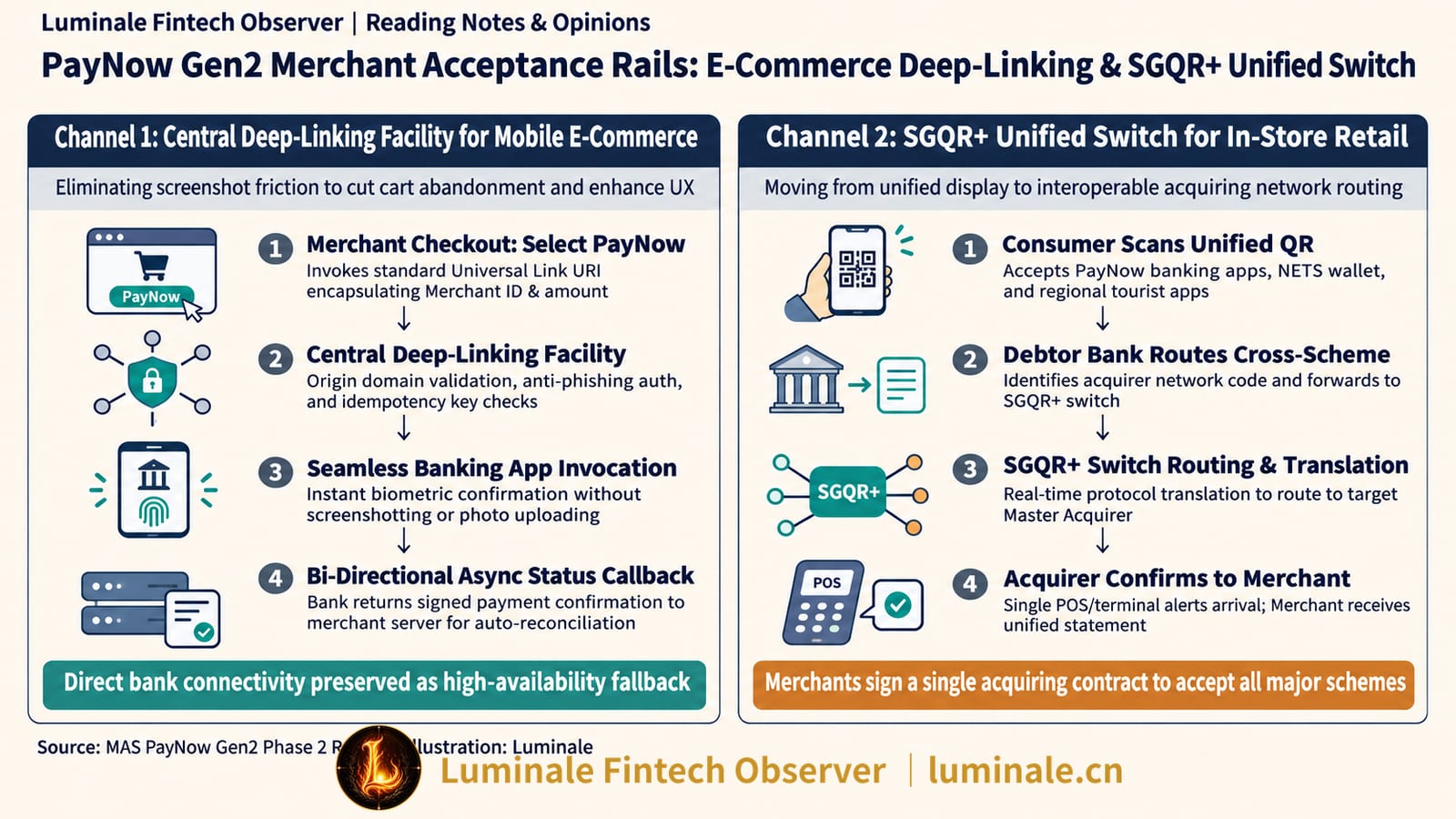
The evolution across dispersed QR codes, SGQR, and SGQR+ is contrasted below:
| Feature Dimension | Dispersed Proprietary QR Codes | SGQR (2018 Baseline) | SGQR+ Switch (Gen2 Target) |
|---|---|---|---|
| Physical Countertop Interface | Multiple standalone QR acrylic stands cluttering checkout counters | Single consolidated physical sticker containing distinct payload blocks | Unified aggregated QR code embedding interoperable network payload |
| Merchant Acquiring Contracts | Merchants must contract separately with each individual payment scheme | Merchants still contract with individual schemes to activate payloads | Single Contract: Merchant contracts with one Master Acquirer to accept all schemes |
| Underlying Network Interaction | Standalone networks with zero cross-scheme connectivity | Each scheme routes independently across proprietary infrastructure | Cross-Scheme Routing: Central SGQR+ Switch dynamically translates and routes instructions |
| Terminal & Hardware Maintenance | Merchants maintain multiple dedicated POS terminals and barcode scanners | Multiple POS devices still required to support differing scheme rails | Single standardized POS terminal or single static QR label |
| Settlement & Reconciliation | Fragmented settlement sheets across schemes; labor-intensive matching | Reconciliation remains split across individual scheme acquirers | Unified Accounting: Consolidated payout statement and stream delivered by Master Acquirer |
3. Financial Inclusion and Inbound Tourist Acquiring
Beyond resident payments, the Phase 2 Report incorporates Inclusive QR Apps into its roadmap. Historically, Singapore's cashless ecosystem primarily served resident account holders holding an NRIC/FIN. Short-term inbound tourists without local deposit accounts were largely excluded from PayNow and local QR payments; similarly, selected dependents lacking independent bank accounts faced digital barriers.
In 2026, stored-value applications such as Wise and modernized NETS prepaid apps began bridging this divide. Inbound tourists can fund digital wallets via international payment cards and scan SGQR or NETS QR codes across local merchant hawker centers and retail stores.
Inclusive QR apps operate on mechanisms distinct from bilateral retail fast payment linkages. Singapore previously deployed bilateral linkages connecting PayNow with Thailand's PromptPay, Malaysia's DuitNow, and India's UPI, while actively participating in the multilateral Project Nexus blueprint coordinated by the Bank for International Settlements (BIS).[7] For a comprehensive analysis of how fast payment infrastructures interconnect via cross-border gateways, see "From PayNow–PromptPay to Payment Connect: How Fast Payment Systems Turn into Cross-Border Networks".
The functional distinction lies in cross-border flows: bilateral linkages like PayNow–PromptPay focus primarily on account-to-account remittances between retail individuals using mobile proxies. In contrast, SGQR+ and inclusive QR applications solve retail merchant acquiring, enabling tourists to scan merchant codes using domestic wallets or travel cards, with FX conversion and acquiring settlement executed seamlessly in the back-end.
III. Once Merchants Receive Funds, How Are Transactions Reconciled and Disputes Handled?
While deep-linking and QR routing facilitate front-end transaction initiation, post-transaction data reconciliation and dispute resolution dictate whether merchants and commercial banks willingly embrace instant payment schemes at scale. In retail P2P transfers, transaction completion concludes the business cycle. In commercial operations, fund arrival represents merely the opening step of enterprise accounting workflows.
1. Structured Payment Data and Automated Financial Reconciliation
Enterprises often receive thousands of instant payments daily from diverse counterparties. The core operational challenge facing corporate treasury departments is matching incoming bank ledger entries against internal sales invoices, purchase orders, and accounts receivable records.
While PayNow adopted the global ISO 20022 messaging standard at the messaging layer, commercial remittance data was historically compressed into unstructured free-text lines within generic tags (such as RemittanceInformation). When a buyer inputs "Invoice INV-2026-001," this text often merges with payment reference numbers or becomes truncated as instructions traverse intermediate banking systems, corporate portals, and CSV exports.
Lacking structured syntax, corporate accounting software cannot reliably parse these unstructured strings. Many enterprises retain dedicated reconciliation teams to manually verify timestamps and amounts against internal ERP records. When multiple orders share identical transaction amounts within the same minute, misallocation and ledger errors occur frequently.
To resolve this bottleneck, the Phase 2 Report mandates the formal introduction of Richer Structured Data Fields within ISO 20022 clearing messages starting in late 2027. For a systematic breakdown of how ISO 20022 ensures end-to-end data integrity across institutional boundaries via semantic decoupling, see "What Is ISO 20022? Understanding the Common Language of Next-Generation Payment Infrastructure".
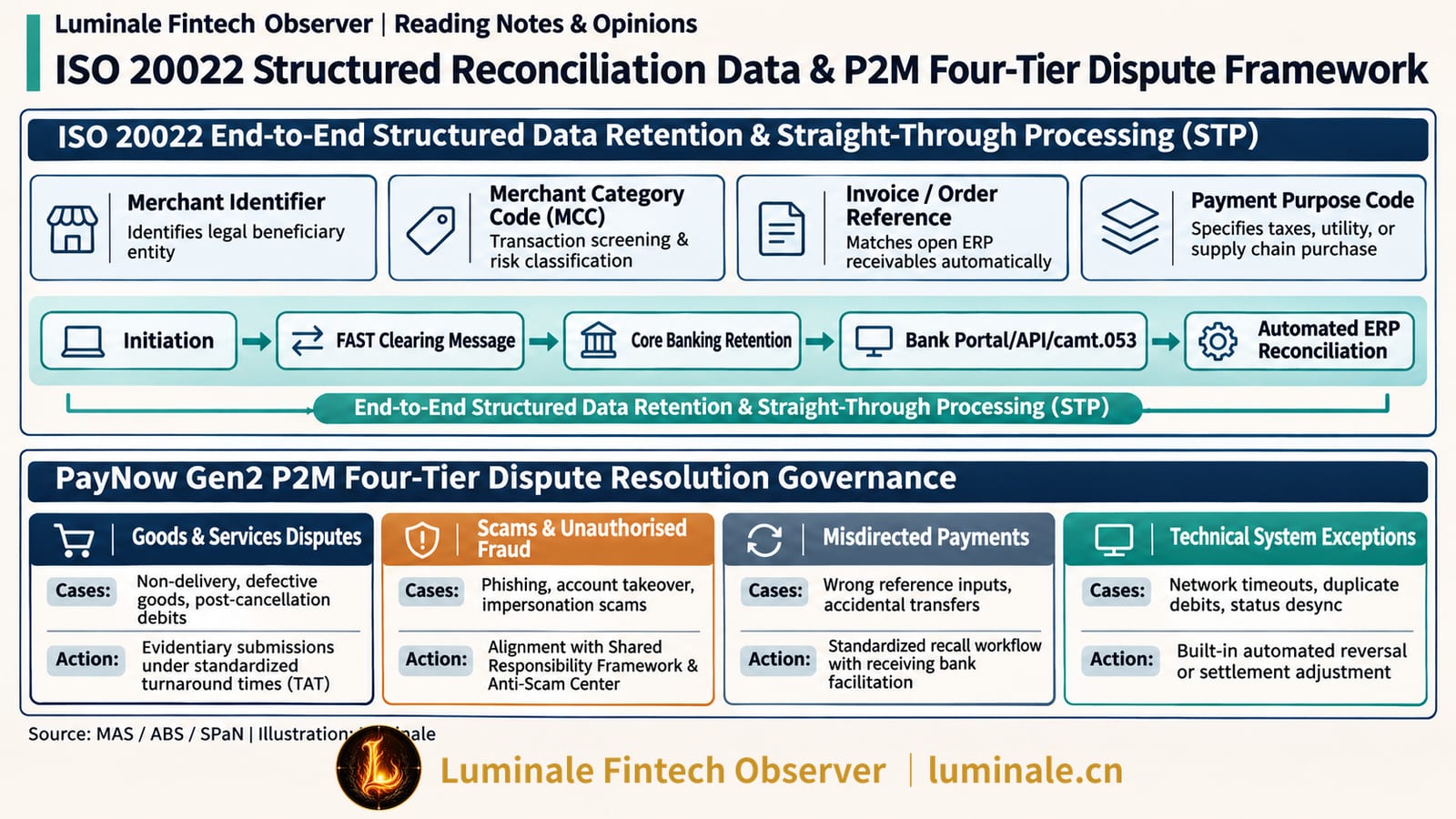
Under the Gen2 structured messaging framework, clearing messages will incorporate dedicated tags for key commercial identifiers:
- Merchant Identifier: Unambiguously identifying the legal payee entity;
- Merchant Category Code (MCC): Facilitating risk management, transaction classification, and regulatory reporting;
- Invoice / Order Reference: Serving as the primary key for automated ERP reconciliation;
- Payment Purpose Code: Distinguishing commercial utilities, rental obligations, supply chain trade, or retail consumption.
Crucially, MAS is guiding the banking sector to maintain end-to-end data integrity across downstream channels. These structured tags must not only transit FAST clearing messages, but also persist intact across corporate banking portals, Host-to-Host (H2H) channels, open APIs, and electronic bank reporting (such as ISO 20022 camt.053 statements and camt.054 credit notifications). Preserving data lineage eliminates intermediary truncation, empowering enterprise ERP systems to achieve Straight-Through Processing (STP) reconciliation.
2. P2M Merchant Payment Dispute Rules and Tiered Governance
As instant transfers permeate commercial transactions, dispute handling and fund recovery mechanisms become critical.
As examined in "Why Can One Card Work Across 200 Countries? Understanding Bank Card Clearing Networks", the traditional four-party payment card model incorporates comprehensive chargeback rules, evidence standards, and arbitration frameworks. If a merchant fails to deliver purchased goods, or an unauthorized charge occurs, cardholders can initiate chargeback proceedings with the issuer, temporarily freezing disputed funds.
Conversely, account-to-account (A2A) instant credit transfers debit and credit accounts irrevocably within seconds. PayNow historically lacked standardized scheme-level dispute rules for P2M commerce. When disputes arose, resolution depended on ad-hoc interbank correspondence or formal police reports. This process was opaque, protracted, and governed by inconsistent standards across institutions.
The Phase 2 Report outlines the phased rollout of unified PayNow P2M Scheme Rules in 2028. This reform categorizes commercial disputes across four distinct operational scenarios:
- Goods and Services Disputes: Scenarios where a merchant delays shipment, delivers defective goods, or bills a consumer post-cancellation. These represent contractual trade disputes. While the payment scheme does not act as a civil court, scheme rules establish standardized evidence submission criteria (e.g., invoices, shipping receipts) and enforceable Turnaround Times (TAT).
- Fraud and Scams: Incidents involving unauthorized account takeovers, social engineering scams, or bogus investment portals. Because these involve criminal conduct, scheme rules align directly with Singapore's Shared Responsibility Framework (SRF) and the Anti-Scam Command, establishing expedited freeze protocols, intelligence sharing, and asset recovery procedures.
- Misdirected Payments: Occurrences where a payer mistypes proxy credentials, crediting an unintended recipient. Rules define standardized Recall request protocols and legitimate defense standards, mandating that the receiving institution contact the recipient and coordinate fund return within specified timelines.
- Technical System Exceptions: Systemic anomalies such as network timeouts, latency drops, or lock contention, leading to debit deductions without merchant credit or accidental duplicate debits. These technical errors are rectified automatically via native system reversals or back-end reconciliation adjustments, rather than burdening consumers with manual coordination.
3. National Payment Governance Reform: Institutional Division of Labor Between SPaN and BCS
Alongside formal scheme rules, Singapore's national payment governance structure is undergoing an institutional realignment. Historically, PayNow scheme governance was maintained by the Association of Banks in Singapore (ABS) through industry self-regulation, while core clearing infrastructure was operated by BCS, under the macroprudential supervision of MAS.
As payment infrastructures deeply integrate across the economy, self-regulatory models face coordination friction when resolving cross-industry merchant disputes, fee governance, and cross-border connectivity. In response, MAS announced the establishment of the Singapore Payments Network (SPaN) and appointed its executive leadership team[6] to centralize national scheme governance.
Scheduled to commence operations in early 2027, SPaN will operate as an independent national payment scheme governance authority, consolidating ownership of PayNow, FAST, and Interbank GIRO. The Phase 2 Report outlines a three-tier governance matrix for Singapore's national payments ecosystem:
- Regulatory Authority (MAS): Overseeing payment institution licensing, designated financial market infrastructures (FMIs), national payment policies, and macro infrastructure blueprints;
- Scheme Governance Body (SPaN): Serving as the independent Scheme Owner, responsible for establishing P2M dispute rules, merchant onboarding standards, interchange fee principles, and cross-institutional arbitration;
- Infrastructure Operator (BCS): Continuing as the neutral technical utility operator, maintaining central clearing switches, FAST clearing engines, SGQR+ routing hubs, and deep-linking facilities with high availability.
This institutional evolution transitions Singapore's payment governance from industry association coordination toward an institutional framework separating policy regulation, unified scheme governance, and independent technical operations.
IV. What Must Change for High-Value Government Payments and Machine Micropayments?
While commercial checkouts focus on user experience and reconciliation efficiency for moderate transaction values, extreme payment requirements—such as high-value tax collections, mass social welfare disbursements, or sub-cent automated micropayments—encounter stark physical and institutional constraints.
Systemic modifications are shaped by specific operational conditions, including transaction size, concurrency spikes, and finality horizons.
1. High-Value Government Payments: Liquidity Commitments and Intraday Net Debit Caps
At present, Singapore's PayNow scheme enforces a uniform retail threshold of S$200,000 per transaction. While sufficient for retail commerce and peer transfers, this limit creates bottlenecks in public sector payments. For instance, Buyer's Stamp Duty (BSD), Additional Buyer's Stamp Duty (ABSD), Land Betterment Charges (LBC), and corporate income taxes often involve hundreds of thousands or millions of dollars.
Taxpayers cannot settle these obligations via PayNow, resorting instead to physical cashier's orders, paper checks, or commercial bank counter RTGS remittances via MEPS+. This increases administrative overhead, processing delays, and paper-based clearing costs.
However, relaxing the S$200,000 threshold universally across all retail accounts is unfeasible. Large-value real-time transfers must satisfy stringent risk mitigation and interbank liquidity constraints:
- Nonlinear Amplification of Fraud and Account Takeover Risks: Permitting unconstrained million-dollar transfers across retail accounts exposes consumers to catastrophic losses from advanced social engineering scams or account compromise, with instant finality hindering recovery.
- Interbank Liquidity and Net Debit Cap Constraints: Under FAST's deferred net settlement and prefunded arrangements, participating institutions must prefund high-quality liquid assets (central bank reserves) or operate within Net Debit Caps calculated from capital adequacy, credit ratings, and posted collateral. Single million-dollar transfers rapidly deplete a paying bank's intraday clearing headrooms.
- Liquidity Friction from Non-Operating Money Market Hours: During standard business hours, commercial bank treasury departments manage reserve balances via the interbank money market or central bank intraday liquidity facilities, adjusting priority queuing dynamically. However, FAST operates 24/7. Outside standard banking hours and on public holidays, wholesale funding markets are closed. If unrestricted large-value transfers were permitted continuously, sudden off-hour outflows could cause liquidity shortfalls, triggering transaction rejections.
Balancing convenience with financial stability, the Phase 2 Report adopts a targeted approach: large-value instant payments will not be deployed universally, but will operate via verified recipient whitelists and strict purpose binding.
MAS plans to pilot raised transaction caps with a single designated public agency (such as the Inland Revenue Authority of Singapore, IRAS) before the end of 2027. Key risk controls include:
- Approved Payee Whitelists: Large-value transfers are restricted to approved government treasury accounts, preventing transfers into personal deposit accounts;
- Tamper-Proof Notice Binding: Payers must bind transfers to cryptographically signed tax payment notices, validating underlying public collection obligations;
- Treasury Liquidity Monitoring: Closely monitoring bank clearing balances during pilot phases, particularly during non-business hours, to prevent localized reserve drains. Following risk and liquidity validation, whitelisted collections may expand to broader public agencies starting in 2028.
2. Government Bulk Disbursements: Concurrency Capacity and Throughput Window Management
Conversely, government disbursements present challenges rooted in sheer concurrency. Annual budgetary payouts—such as Community Development Council (CDC) vouchers or Workfare Income Supplement disbursements—require crediting millions of eligible citizens on designated dates.
Under existing architectures, injecting millions of instructions into FAST simultaneously at 9:00 AM causes acute concurrency bottlenecks. Although individual values are modest, sudden message bursts overwhelm clearing queues, inducing processing timeouts for routine consumer transfers. Furthermore, core banking throughput varies widely across institutions: while major banks process thousands of transactions per second, mid-tier and smaller institutions risk database lock contention and system degradation under sudden message surges.
The Phase 2 Report notes that resolving bulk disbursement friction requires reframing the core operational requirement: public welfare payouts require "guaranteed aggregate delivery within a designated processing window (e.g., by 6:00 PM on payout day)," rather than second-by-second real-time execution for each individual instruction.
Accordingly, the roadmap establishes targeted optimization strategies:
- Infrastructure Capacity Audits: Stress-testing throughput limits across central switches and participating core banking ledgers to identify processing chokepoints;
- Staggered Dispatch and Dedicated Processing Lanes: Replacing single-point burst submissions with staggered batch scheduling, alongside evaluating a dedicated Bulk Traffic Lane isolated from retail instant clearing queues. This ensures social welfare transfers complete reliably without degrading consumer payment performance.
3. Micropayment Rails: Economic Infeasibility of Traditional Gross Settlement for Sub-Cent Values
While large-value payments are constrained by liquidity risks and mass disbursements by concurrency limits, high-frequency micropayments are constrained by transaction unit economics.
Emerging digital business models—spurred by generative AI, agentic workflows, and the Internet of Things (IoT)—require granular micro-billing models:
- Agentic Commerce: Autonomous AI agents settling sub-cent computational expenses based on token consumption, API calls, or server runtime;
- Metered Digital Content: Readers paying S$0.05 per article section rather than subscribing to full periodicals;
- Connected Vehicle Utility Billing: Electric vehicles settling micro-charges continuously per minute of charging or specific toll road usage.
Traditional FAST rails cannot economically support these micro-transactions. Instant payment infrastructures incur fixed operating costs per instruction: clearing S$0.01 consumes roughly the same computing cycles, network bandwidth, compliance checks, and ISO 20022 message parsing as clearing S$10,000.
If processing a single instruction costs S$0.05 across infrastructure, compliance, and interbank messaging, using traditional instant gross rails to transfer S$0.01 results in processing fees exceeding transaction value by multiples, rendering the transaction commercially unviable.
To overcome this cost barrier, the Phase 2 Report prioritizes micropayment rail exploration. In 2027, MAS will deploy a Payment Simulator to evaluate two distinct architectural paths:[1]
- Track A: Traditional Ledger-Based Cost-Optimized Rail (FAST-LITE)
- Mechanism: Operating a streamlined rail parallel to the primary clearing engine. It compresses message syntax, adopts lightweight transmission protocols, and replaces real-time gross settlement with front-end instant confirmation backed by aggregated periodic Deferred Net Settlement (DNS) on an hourly or daily basis.
- Trade-Offs: Maximizes reuse of established bank ledgers and compliance infrastructure; however, it remains bound to centralized session architectures, introducing modest interbank daylight credit exposures during deferral windows.
- Track B: Programmable Settlement Layer via Tokenised Bank Deposits
- Mechanism: Leveraging technical research from MAS's Project Orchid and Purpose Bound Money (PBM), converting commercial bank deposits into tokenised deposit liabilities on distributed ledgers or programmable networks.
- Mechanism: Enabling AI agents and autonomous devices to execute conditional atomic payments via smart contracts without human multi-factor authentication loops.
- Trade-Offs: Natively aligns with machine commerce and autonomous logic, reducing marginal messaging overhead toward zero; however, it requires new interoperability frameworks, wholesale central bank money settlement bridges, and governance structures.
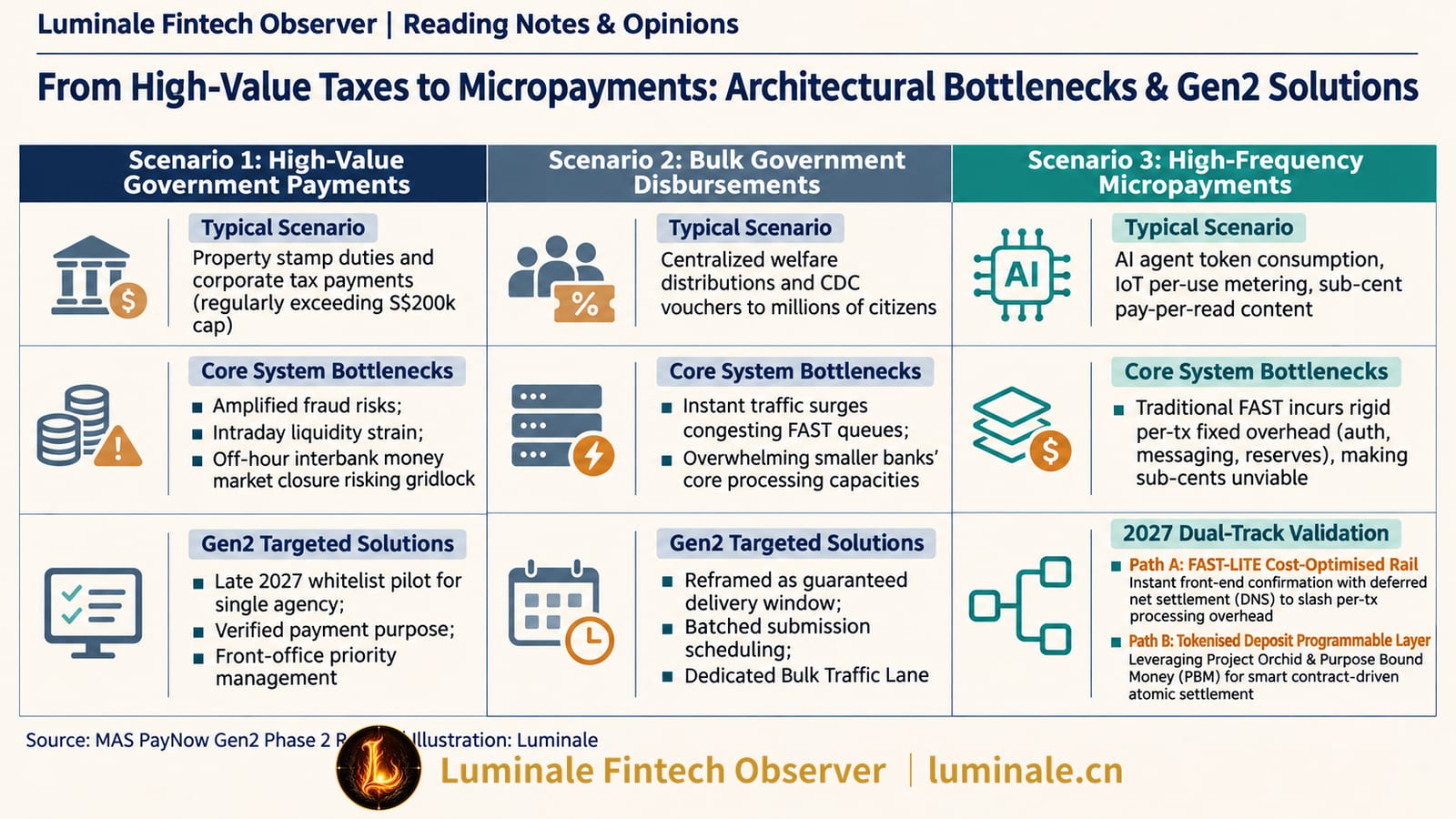
The structural differences between traditional FAST, candidate FAST-LITE rails, and tokenised deposit layers are summarized below:
| Architectural Dimension | Existing Instant Rail (FAST) | Candidate Cost-Optimized Rail (FAST-LITE) | Tokenised Bank Deposit Layer (Orchid Evolution) |
|---|---|---|---|
| Customer Authorization | Per-transaction biometric authentication; immediate debit | Pre-authorized or lightweight credentials; instant confirmation | Smart contract conditional triggers; fully autonomous machine execution |
| Core Accounting Asset | Centralized core banking ledger book deposits | Core banking deposits linked to specialized micropayment sub-ledgers | Tokenised deposit liabilities deployed on distributed/programmable ledgers |
| Interbank Discharge Model | Real-time gross clearing; instant reserve allocation | Multilateral Netting & Deferred Net Settlement (DNS) | Atomic Settlement; instant smart contract finality |
| Prefunded Liquidity Needs | Full reserve commitments required in real time | Dedicated liquidity buffer pool; significantly reduced intraday lockup | Backed by segregated fiat assets or wholesale tokenised reserves |
| Per-Transaction Overhead | Higher (fixed cost per unit; unsuited for micro-flows) | Significantly Reduced (diluted via aggregation and concise syntax) | Near Zero (marginal network execution costs approach zero) |
| Exception Handling | Comprehensive P2M dispute investigation and evidence review | Established caps on single/cumulative loss; automated batch adjustments | Automated smart contract arbitration; minimal manual intervention |
| Maturity & Roadmap Status | Mature production infrastructure handling 24/7 flows | Simulator Testing in 2027; production review in 2028 | Exploratory Prototype Stage; non-production testing |
The Phase 2 Report does not prematurely commit to a single architectural track. MAS will analyze 2027 simulator data across throughput, API stability, settlement finality, and liquidity efficiency before determining whether to commission a dedicated micropayment rail in 2028.
V. What Questions Must the Multi-Rail Blueprint Answer?
The initiatives outlined in the Phase 2 Report reflect a broader conceptual evolution in national payment infrastructure design. Over the past decade, financial technology discussions frequently pursued an all-in-one solution—either seeking to funnel all economic transactions through a single real-time gross network, or attempting to replace existing infrastructures entirely with distributed ledgers.
Singapore's experience demonstrates that payment flows embody fundamentally divergent economic characteristics: retail commerce requires seamless app-switching and structured invoice reconciliation, but modest liquidity; government tax collections demand strict identity whitelisting, where unrestricted instant transfers are undesirable; social welfare payouts prioritize reliable batch completion over sub-second latency; and machine micropayments demand negligible marginal processing costs, diverging from gross reserve accounting.
No single technical protocol or clearing rulebook can optimally satisfy these conflicting demands simultaneously. This realization underpins MAS's plan to formulate the Future Payment Rails Blueprint starting in 2027, transitioning national payments toward a multi-rail architecture.
1. Analytical Coordinates: Multi-Rail, Multi-Functional, and Multi-Service
Under Luminale's payment infrastructure analytical framework, the core logic of a multi-rail architecture lies not in duplicating clearing systems, but in decoupling common public capabilities (addressing directories, acquiring switches, invocation protocols, data syntaxes, dispute frameworks) from underlying financial settlement rails. This decoupling enables specialized applications to invoke optimal settlement mechanisms dynamically over shared public digital rails.
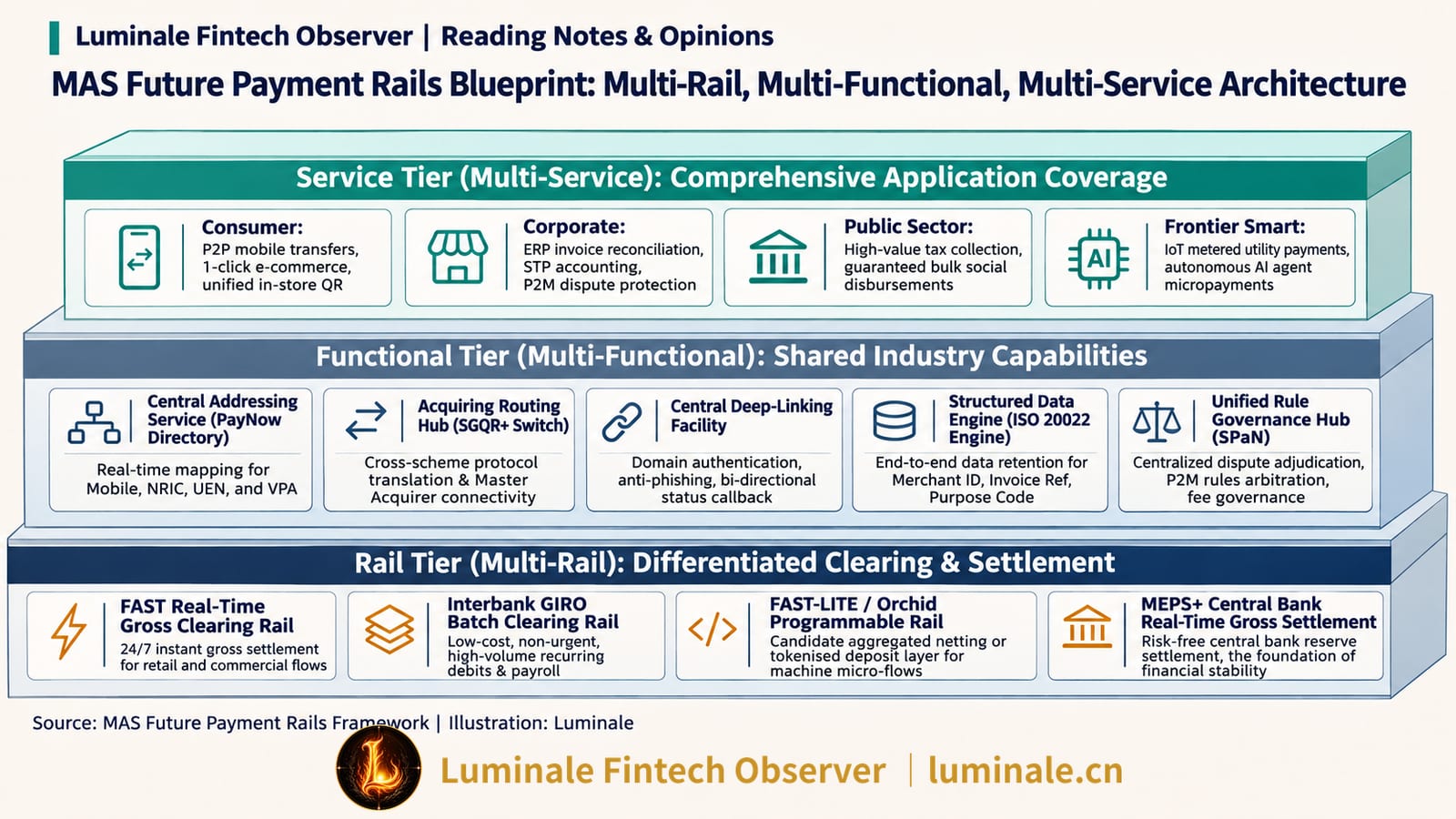
This framework is conceptualized across a three-dimensional matrix:
| Analytical Dimension | Component Infrastructure Elements | Core Problem Solved & Operational Function |
|---|---|---|
| Multi-Rail Where Value Settles | 1. FAST: 24/7 retail real-time gross clearing rail 2. Interbank GIRO: Scheduled, low-cost batch clearing rail 3. FAST-LITE / Orchid Layer: Candidate low-cost micropayment rails 4. MEPS+: Central bank RTGS ultimate settlement layer | Providing differentiated clearing speed, settlement frequency, liquidity overhead, and credit certainty, routing flows to optimal settlement channels. |
| Multi-Functional Shared Industry Capabilities | 1. Central Addressing Service: PayNow proxy directory and legal name verification 2. Acquiring Switch: SGQR+ routing hub and protocol normalization 3. App Redirection: Central Deep-Linking Facility and anti-phishing gateway 4. Data Standards: ISO 20022 structured commercial metadata engine 5. Centralized Governance: SPaN dispute adjudication and scheme rulebook | Providing shared public digital goods, removing bilateral integration friction between banks and merchants, and lowering aggregate industry connectivity costs. |
| Multi-Service End-User Applications | 1. Consumer Services: P2P transfers, one-click e-commerce, universal QR payments 2. Corporate Services: Automated ERP reconciliation, STP accounting, P2M dispute resolution 3. Public Sector Services: High-value tax collection, guaranteed bulk welfare disbursements 4. Autonomous Machine Services: IoT utility billing, AI agent micropayments | Delivering specialized payment experiences to micro-economic entities, balancing financial inclusion with system security. |
2. Economic Trade-Offs and Systemic Risks in Multi-Rail Evolution
Deploying a multi-rail architecture involves practical economic trade-offs and structural complexities:
First is central component dependency and system resilience. When the SGQR+ Switch and Central Deep-Linking Facility become shared hubs for the entire financial sector, they concentrate systemic operational risks. A network outage or cyber incident at the central switch could disrupt offline QR acquiring or online e-commerce nationwide. MAS's insistence on retaining direct bank connectivity as a fallback mechanism directly addresses this structural vulnerability.
Second is increased architectural complexity and integration overhead for commercial institutions. For participating commercial banks and payment firms, a multi-rail architecture compounds IT integration overhead. Institutions must upgrade interfaces to support ISO 20022 structured tags while simultaneously integrating traditional FAST, the SGQR+ Switch, deep-linking gateways, and SPaN dispute platforms—with prospective connections to FAST-LITE simulators and tokenised deposit platforms. If transaction volumes across new rails fall short of projections, recurring maintenance, stress-testing, and compliance costs could strain institutional budgets.
Finally, economic sustainability and actual transaction demand for micropayment rails must be verified. Developing a dedicated FAST-LITE or tokenised deposit rail represents a capital-intensive infrastructure investment. Achieving positive economic returns depends on whether agentic AI commerce and IoT billing scale into meaningful transaction volumes. If machine commerce remains confined to small-scale pilot experiments, fixed infrastructure amortization costs will prove difficult to recover.
3. Four Benchmark Indicators for Tracking Singapore's Payment Evolution
The PayNow Gen2 Phase 2 Report articulates a pragmatic transition from immediate market friction toward an integrated multi-rail blueprint. For industry practitioners, fintech enterprises, and regulatory observers, tracking the efficacy of this national modernization program over the 2027–2028 horizon centers on four key indicators:
- Merchant Penetration and Interchange Fee Structures in the SGQR+ Switch: Monitoring whether major acquirers (particularly NETS and commercial banks) establish viable commercial interchange fee agreements under SPaN governance, and whether SMEs achieve true single-contract universal acceptance.
- Deep-Linking Callback Consistency and Checkout Abandonment Rates: Measuring average latency, drop-off rates, and asynchronous status callback reliability across banking applications following standard deployment, assessing conversion gains in e-commerce checkout.
- Operational Efficacy and Loss Distribution Under SPaN P2M Dispute Rules: Evaluating whether the 2028 dispute framework establishes clear operational boundaries between contractual disputes and financial scams, and whether loss-sharing formulas achieve market acceptance among banks, payment firms, and merchants.
- End-to-End Unit Cost Disclosures from 2027 Micropayment Simulator Trials: Tracking the empirical throughput and liquidity performance of FAST-LITE and tokenised deposit layers under simulated load, verifying whether end-to-end clearing costs fall within commercially viable ranges for sub-cent values.
Tracing an ordinary merchant payment reveals how funds transfer across balance sheets, how instructions route across scheme boundaries, how structured metadata supports automated accounting, and how scheme rules allocate losses when anomalies occur. Through this systematic sequence of technical and institutional reforms, Singapore is establishing a resilient, interoperable foundation for its national payment infrastructure in the digital economy.
References
[1]: MAS, ABS, PayNow Gen2 Phase 2 Report, November 18, 2026. Official PDF ↩
[2]: MAS, ABS, Joint Media Release on PayNow Generation 2 Implementation Roadmap, November 18, 2026. Official Release ↩
[3]: MAS, ABS, PayNow Gen2 Phase 1 Report, June 25, 2026. Phase 1 Report PDF ↩
[4]: MAS, PayNow Operational Guidelines and Technical Specifications, 2026. Official Portal ↩
[5]: MAS, SGQR and SGQR+ Interoperable Network Specifications, 2026. Official Portal ↩
[6]: MAS, Singapore Payments Network (SPaN) Leadership Appointments and Governance Framework, October 28, 2026. Official Announcement ↩
[7]: BIS, Project Nexus: A Blueprint for Instant Cross-Border Payments, 2025. Official Report ↩
Originally published by Luminale Fintech Observer: https://luminale.cn/articles/paynow-gen2-roadmap-multi-rail-payment-infrastructure-en